Dementia friendly banking, for a UK bank, means serving a customer whose ability to make financial decisions is changing, and serving the person who acts for them as well as the bank would serve the customer. The hard part is the handover of authority. While the customer has capacity, a third-party mandate or an ordinary power of attorney can work; once they lack it, the bank needs a registered lasting power of attorney for property and financial affairs, a registered enduring power of attorney, or a deputy appointed by the Court of Protection, and a DWP appointee can deal only with benefits. Since July 2023 the Consumer Duty has required a firm to give a person authorised to help a retail customer, such as an attorney, "the same level of support" it would give the customer (FCA, PRIN 2A.6.5R, as quoted in its 2025 retail banks review). Botminds' Vulnerable Customer Support records who acts for the customer and how to help, in plain words that every channel reads, and routes power of attorney work to a specialist team with a service-level clock and a second person's check on every account change.
This guide covers England and Wales, following the government's guidance for people managing someone else's bank account, the Mental Capacity Act 2005 and the FCA's rules; Scotland and Northern Ireland have their own systems. The bank-side examples come from the solution's fictional sample bank, Corvane Bank UK.
Which authority lets someone act for a customer with dementia?
The one that matches the customer's capacity at the time, and the bank has to recognise six. The government's guidance sets them out; it notes it is "not a legal document or code of practice," and each bank lists the documents it accepts.
Six routes to acting on a customer's account, and what the bank checks
| Route | When it fits | What the bank checks | Limits |
|---|---|---|---|
| Third-party mandate | The customer has capacity and wants help | The bank's own mandate form, signed by the customer | "Not appropriate if the account holder is losing the ability to make relevant decisions" |
| Ordinary power of attorney | The customer has capacity | The signed power | "Stops being legal authority if the donor loses mental capacity" |
| Lasting power of attorney (property and financial affairs) | Made while the donor had capacity; usable before or after capacity is lost, as the donor chose | The registered LPA: original, or a copy stamped on every page by the OPG or signed on every page as a true copy; attorney ID and address | Unusable until registered; the donor's restrictions apply |
| Enduring power of attorney | Made before 1 October 2007 | The EPA; registered with the OPG if the donor has lost or is losing capacity | Can only be operated once registered if capacity is being lost |
| Deputy appointed by the Court of Protection | No valid power, and the person lacks capacity | The court order | Only the decisions the order allows |
| DWP appointee | The person receives state benefits and cannot manage them | Form BF57 confirming the appointment | Benefit payments only |
Two points from the guidance trip up branch staff. Registration of an LPA "does not mean that the donor has lost their mental capacity," so a registered attorney and a customer who still decides for themselves can both be on the account. And a joint account is its own case: "If one joint account holder loses mental capacity, banks and building societies can decide whether or not to temporarily restrict the use of the account to essential transactions only" until a deputy is appointed or a power registered. That is a discretion, not a duty, and a procedure should say when the bank uses it.
Start from capacity, not from the diagnosis
A dementia diagnosis does not settle what the customer can decide. The Mental Capacity Act's principles are that "a person must be assumed to have capacity unless it is established that he lacks capacity," and that a person "is not to be treated as unable to make a decision merely because he makes an unwise decision" (Mental Capacity Act 2005, section 1). Capacity is judged decision by decision: a customer who can no longer manage an investment switch may still be able to choose who helps with bills.
For the bank this has two practical consequences. Staff should not stop dealing with a customer, or refuse a mandate, because a relative mentions dementia; the customer is presumed able until shown otherwise. And when a customer with an LPA still wants to decide, the attorney's authority does not override them, which is why the Financial Ombudsman names a donor who is starting to lose capacity, does not accept it and still wants to decide among its hardest cases and expects the business to act in the donor's interests while weighing their rights against the attorney's concerns.
Verifying an LPA: originals, copies, access codes and the register
The bank needs proof of the attorney's identity and address, proof of the authority, and the customer's identity if it does not hold it. For a lasting power of attorney the document must be "the original document or a copy which the OPG has stamped every page of," or "signed on every page by the donor, a solicitor or a notary to confirm that it is a true copy." Two government services make verification faster than paper.
Five ways a bank can verify an attorney's or deputy's authority
- A certified or OPG-stamped copy
Accept it; insisting on the original is a complaint the Financial Ombudsman lists by name.
- The OPG's online view service
"Companies and organisations can use this online service to check who the attorneys are on a valid lasting power of attorney," using an access code the attorney or donor generates.
- The access code format
Thirteen characters starting with V, one code per LPA; attorneys of LPAs registered before 1 January 2016 cannot generate one.
- A register search
Form OPG100 asks the Office of the Public Guardian whether someone has a registered attorney or deputy.
- The court order
For a deputy, the order itself, read for the decisions it allows.
A procedure that defaults to the online view service where an access code exists, and to certified copies otherwise, removes the two most common delays: waiting for an original to arrive by post and waiting for it to be returned. The Ombudsman expects firms to have "returned original documents promptly" when they do take them.
The weeks before an attorney can act, and the urgent cases inside them
An LPA cannot be used until the Office of the Public Guardian registers it. GOV.UK says "it takes 8 to 10 weeks to register an LPA if there are no mistakes in the application," and that registration "can take up to 16 weeks." Applying costs £92, or £184 for both a property and financial affairs LPA and a health and welfare LPA.
The wait before a bank can deal with an attorney under an LPA
8–10weeks
to register an LPA with no mistakes in the application
16weeks
the longest registration time GOV.UK warns attorneys to expect
£92
to apply to register one LPA; £184 for both types
The bank's own processing comes after that wait, and the FCA found it is where emergencies go wrong. Its 2025 review saw "staff being unclear about what actions they should take and what support to provide in the event of an emergency, such as when the customer's capacity suddenly changed or when funds were urgently needed," and some customers and representatives "experiencing extended periods where they were unable to access funds to pay essential bills" (FCA, retail banks multi-firm review, 2025). A dementia friendly procedure names the urgent route in advance: who can approve essential payments such as care home fees while authority is being registered, on what evidence, and with what second check.
What does the Consumer Duty require for attorneys?
The same level of support the bank would give the customer. The FCA's review restates the rule: where a person is authorised by a retail customer or by law to help conduct their affairs, "such as a power of attorney (PoA), the firm must provide the same level of support to that person that they would have provided to the retail customer." The Financial Ombudsman applies the same test: where the Duty applies to a complaint, it considers "whether your business provided the same level of support to the attorney as you would to a customer" (Financial Ombudsman Service, power of attorney).
"Most firms had a limited range of channels available for attorneys to access the account of the relevant customer. In particular, app-based banking or online banking were often not available for the attorney to use."
FCA, Retail banks' treatment of customers in vulnerable circumstances, multi-firm review, 2025
The FCA attributed that limit, in many cases, to "the firm's investment decisions, suggesting access could be expanded if resource was committed to it." For a bank, that turns attorney channel access from a policy question into a funding one: an attorney who can only use a branch is not getting the same level of support as a customer with an app, and the Duty asks the firm to justify the difference.
Where the FCA found banks falling short, and what the Duty asks instead
What the FCA found: Customers repeating information to different staff; cases "lost" in fragmented systems.
What a dementia friendly bank does: Register the authority once, on every account and product, visible to every colleague.
What the FCA found: Online and app banking often unavailable to attorneys.
What a dementia friendly bank does: The channels the customer had, or a documented reason why not.
What the FCA found: Staff unsure what to do; periods without access to funds for essential bills.
What a dementia friendly bank does: A named urgent-payment route while authority is registered.
What the FCA found: Originals demanded; branch visits that were not feasible.
What a dementia friendly bank does: Certified copies, the OPG view service, remote identification.
What the FCA found: Inconsistent handling between teams.
What a dementia friendly bank does: An expected timeframe for registration, as the FCA saw in good-practice firms.
Protection against abuse without blocking access
A customer with dementia is also a customer at higher risk of financial abuse, sometimes by the person holding the authority. The FCA says it supports "firms' efforts to safeguard customers from fraud or financial abuse," but expects them weighed against customers' need to keep up basic banking. The balance is easier to hold when the controls are specific: the attorney's authority is recorded with the donor's restrictions, account changes need a second person, and concerns go to a specialist rather than becoming a blanket freeze.
The attorney's own duties help the bank here. GOV.UK tells attorneys they must follow the donor's restrictions and conditions, act in the donor's best interests and "help them make their own decisions where possible," and keep the donor's money and property separate from their own "unless you already share a bank account" (GOV.UK, use a lasting power of attorney). A bank that asks attorneys to confirm they understand those duties at registration, and records it, has a clearer basis for questioning a transaction later.
What a dementia friendly banking procedure should contain
The routes and the rules are fixed; the procedure is where banks differ. The checklist below is what a vulnerability lead can review against.
Eight parts of a dementia friendly procedure for attorneys and deputies
- One team owns registration
A specialist power of attorney and third parties team, with an expected timeframe.
- All accounts at once
The authority registered on every account and product the customer holds, in one step.
- Verification without originals
Certified copies and the OPG view service accepted; any original returned promptly.
- An urgent route
Essential payments approved by a named role while registration is pending.
- Channel parity
Attorneys get online and app access, or the reason is documented.
- The customer still decides
Presumption of capacity applied; the customer's own needs (large print, a hearing loop) kept alongside the attorney's role.
- Joint accounts
When the bank restricts a joint account to essential transactions, and who decides.
- Death
A power of attorney "is no longer valid after the donor or granter has passed away," so the bereavement process takes over.
How Vulnerable Customer Support records the attorney and the need
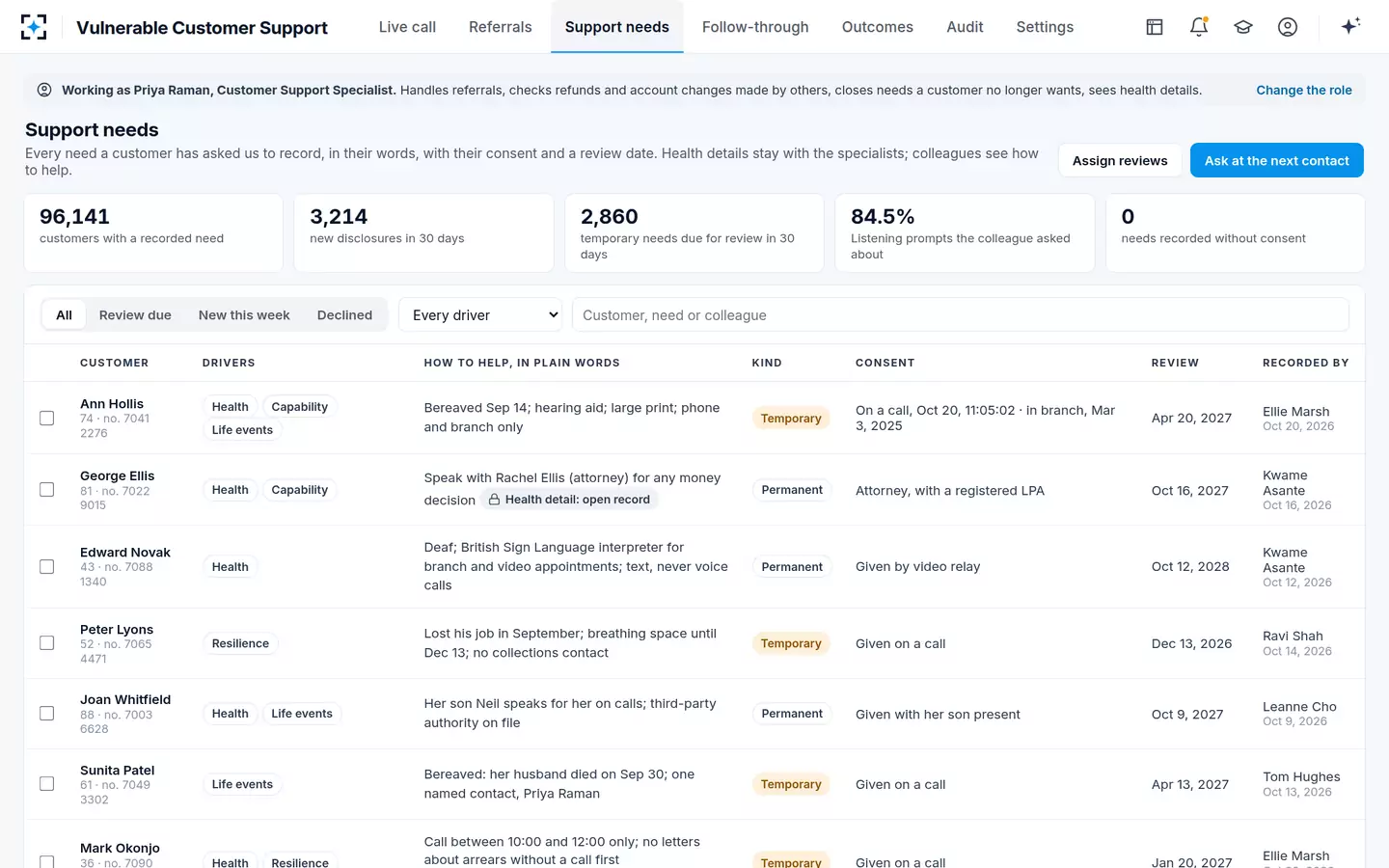
The solution keeps one register of support needs that every system reads. An attorney appears on the customer's line in plain words, such as "speak with the attorney for any money decision," with the basis (a registered LPA), a review date and who recorded it; the health detail behind it stays with specialists. Colleagues in every channel see who to speak to and how to help without seeing the diagnosis.
The attorney on the customer's line in plain words, with the health detail kept back
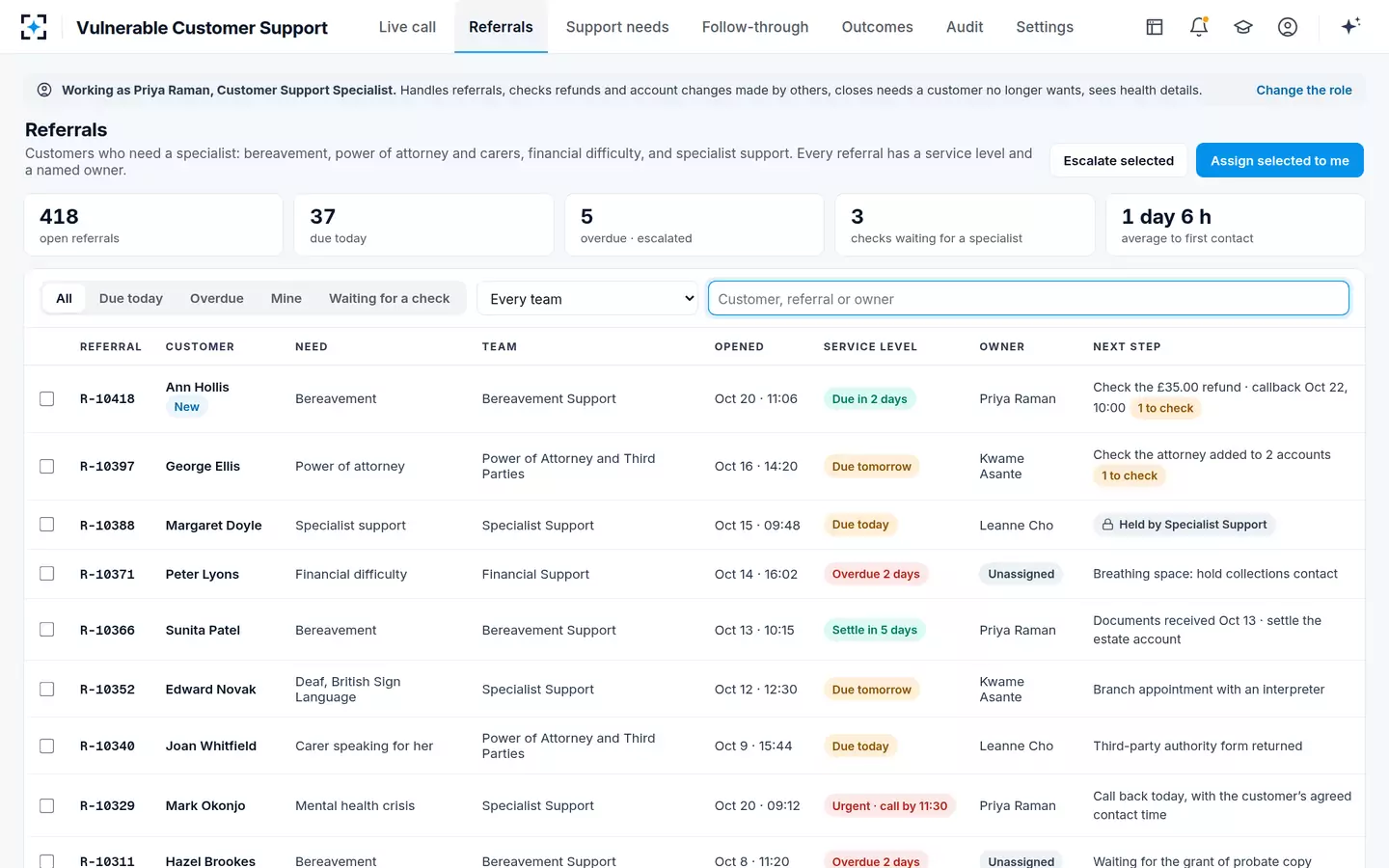
Power of attorney work runs as a referral. In the sample, an attorney's case was opened with the Power of Attorney and Third Parties team with a service-level clock and a next step to check the attorney had been added to both of the customer's accounts, and any account change needed a second person's check. A referral that misses its first-contact time escalates to the team manager and then the Consumer Duty manager.
Power of attorney work in a specialist queue, each case with an owner and a clock
Nothing is recorded without consent: the agents prompt, a colleague asks and the customer decides, and the consent passage is stored with the need. Each refund or account change goes to a second person, and the outcomes report the board sees compares customers with recorded needs against everyone else. Dealing with vulnerable customers sets out what changes at each desk, and the FCA's 2025 review covers its findings in full. The whole solution is on the Vulnerable Customer Support page.
Questions people ask
Can a bank refuse a third-party mandate for a customer with dementia?
A mandate depends on the customer having capacity to give it. The government's guidance says a mandate "is not appropriate if the account holder is losing the ability to make relevant decisions," so the bank should assess the decision in front of it, starting from the presumption of capacity.
Does a registered LPA mean the customer has lost capacity?
No. The guidance states that registration "does not mean that the donor has lost their mental capacity." The donor may still decide, and the bank may deal with both.
Must a bank accept a certified copy of an LPA?
The government's guidance accepts an OPG-stamped copy or one signed on every page as a true copy, and the Financial Ombudsman lists insisting on the original among the complaints it upholds. Banks can also check attorneys through the OPG's online view service.
Can a bank freeze a joint account when one holder loses capacity?
It can choose to restrict the account to essential transactions, such as living expenses and care bills, until a deputy is appointed or a power registered. The guidance frames this as the bank's decision, so the procedure should set when it applies.
What does a DWP appointee's authority cover?
State benefit payments only, confirmed by form BF57. Managing other money needs a deputy appointed by the Court of Protection or a registered power of attorney.
Do attorneys have to be offered online banking?
No rule names a channel, but the Consumer Duty requires the same level of support the customer would get. The FCA found online and app access often unavailable to attorneys and linked the gap to firms' investment decisions.