There is no single FCA deadline for the Consumer Duty board report. PRIN 2A.8.4R requires a firm's governing body to review and approve its report on customer outcomes at least annually, so the deadline is the board meeting your firm has fixed for it, and the next one falls no more than a year after the last approval. The only date the FCA ever set was the first: for open products, the first report was due by 31 July 2024. Everything else, from the data cut to the board pack, is a calendar each firm builds backwards from its own meeting. Botminds' Consumer Duty Outcomes Monitoring is built for that run-in: agents assemble the outcome MI from the bank's systems, draft each finding as a sentence with its numbers cited, and question the draft before the board does, so the weeks before the pack closes go on judgement rather than on chasing spreadsheets.
The sample examples on this page come from a fictional bank as it runs through the solution: Corvane Bank UK, with 1,214,600 customers and 46 retail products, whose 2026 report covers 1 October 2025 to 30 September 2026 and goes to the board on 26 November. The rules and supervisory findings are the FCA's own, linked where they appear.
“This assessment needs to be done at least once a year, so for firms with new and existing products and services the first report was due by 31 July 2024.”
FCA, Consumer Duty information for firms
When is the Consumer Duty board report due?
The Consumer Duty board report is due whenever your governing body last approved it, plus at most a year. The rule is PRIN 2A.8.4R, whose stem reads “At least annually, the governing body of a firm must:” and then lists three things: review and approve the outcomes report, say whether it is satisfied the firm meets the Duty, and judge whether its future strategy fits the Duty (the three duties are quoted in Consumer Duty board reporting requirements) (FCA Handbook, PRIN 2A.8). The interval is in the rule. The month is not.
That makes the first approval the anchor for every later one. A firm that approved its first report on 18 July 2024 and its second on 15 July 2025 has a July board as its natural deadline in 2026. A firm whose financial year and committee calendar point to November can move its cycle there, as long as no gap between approvals runs past a year; the safe reading of “at least annually” is that a cycle can be brought forward, never pushed back.
The rule changed form, not substance, in 2026. The current text of PRIN 2A.8.4R carries the version date 26 June 2026, when the FCA's Targeted Clarifications of Handbook Materials Instrument came into force; where the 2022 text spoke of obligations “under Principle 12 and PRIN 2A”, it now says “under the Consumer Duty” (FCA Handbook Notice 142; compare the rule text in PS22/9). The annual cycle is untouched.
Is there an FCA deadline, or only the board's?
There is only the board's. The FCA does not collect the report: firms keep it, and the regulator can ask for it, with the MI behind it, at any time. That has two consequences for planning. A late report is not a late filing; it is a governing body that has gone more than a year without approving the assessment the rules require, which is a breach of PRIN 2A.8.4R in its own right. And because the FCA may request the report at any point, the version that matters is the one the board approved, with the minutes that show how it was challenged.
The FCA has said how it uses the reports. It reviewed the first annual reports of 180 firms across retail banking, wholesale, insurance, payments, consumer investments and consumer finance, and published its findings on 11 December 2024; the page was last updated on 9 March 2026 (FCA board reports review). In April 2026 its head of consumer policy looked back on the second year: “With the third cycle of Consumer Duty Board reports on the horizon, now is a good moment to pause and reflect on what we’ve learned from year 2” (FCA blog, 16 April 2026). Supervisors read these reports. The deadline is internal; the audience is not.
Why July is the date people remember
July is the only date the FCA ever fixed, and it fixed it twice. The Duty came into force for open products on 31 July 2023 and for closed products on 31 July 2024. In its 2022 policy statement the FCA said that “we expect the first report to be considered by the board or equivalent management body within 12 months of the rules coming into force” (PS22/9), which set the first deadline at 31 July 2024.
A transitional provision in the same policy statement let that first report speak only to new and existing products; closed products came into scope on the very day it was due. From the second report onwards there is no such carve-out: the monitoring the report summarises has to cover the closed book too, which is where closed products under the Consumer Duty tend to change a bank's findings most.
Nothing in the rules keeps a firm in July. A report period that ends on 30 June and a board that meets in July leave four weeks for everything in the run-in; a period aligned to the firm's own committee calendar may leave eight. The question worth asking is which board date gives the freshest data, the most time for challenge, and the least collision with year-end.
Working back from the board date: a twelve-month calendar
A workable calendar starts from the board meeting and counts backwards: board papers go out about two weeks before the meeting, the pack closes then, the draft has to be challenged and answered before that, and the MI has to be cut and assembled before the draft can be written. The rest of the year is monitoring, with the board kept informed as issues arise rather than once.
A twelve-month Consumer Duty calendar for a late-November board
| Month | What happens | Who leads it |
|---|---|---|
| October | Period opens. Agree the measures and thresholds for the year, each with a written reason; confirm which closed products are in the book. | Conduct risk lead, product owners |
| November | Last year’s report goes to the board. Minutes record the questions asked; agreed actions go onto the tracker with owners and dates. | Company secretary, board |
| December to February | Quarterly outcome MI to the risk or conduct committee; first fair value reviews of the year, starting with the products furthest from their benchmarks. | MI team, pricing |
| March | Mid-cycle update to the board on open actions and any new poor outcome, not saved for November. | Conduct risk lead |
| April to June | Second quarter of MI; communications tested; vulnerability outcomes split by driver; outsourced and distributor data requested. | Product owners, vulnerability lead |
| July to August | Threshold review against last year’s results; second-line review of the monitoring framework; internal audit scoping. | Compliance, internal audit |
| September | Period closes on the 30th. Data cut fixed; late feeds named. | MI team |
| October (run-in) | MI assembled, draft written, challenged and answered; actions costed and assigned. | Conduct risk lead, product owners |
| November (run-in) | Pack closes ten business days before the board; directors read; the board approves, confirms and agrees actions. | Board |
Two rows in that calendar carry most of the risk. October is short: the period closes on 30 September and the sample bank's draft must be ready to challenge three weeks later. And the threshold review in July and August is easy to drop, yet the FCA's 2024 review asked firms to give their boards the rationale for each MI threshold, which cannot be written in a week. A threshold reviewed in the summer arrives at the board with its reason already written; one reviewed in October arrives without one.
Where the weeks go before the board pack closes
Eight weeks separate the end of the sample bank's period from its board meeting, and only three of them are for writing. The rest belong to the people who must read and answer what has been written. The solution's own settings fix two of the intervals: a challenge has five business days to be answered, and the board pack closes ten business days before the board.
Eight weeks from data cut to board, and the weeks after it
- MI cut, draft v3, challenged and signed off30 Sep to 22 Oct · 22 d
- Annex A signed, pack closesto 12 Nov · 21 d
- Directors read the packto 26 Nov · 14 d
- Rate rise in force 1 Dec; action A-07 due26 Nov to 31 Jan 2027 · 66 d
The last day of the first phase is the interesting one. On 22 October the sample bank's Challenge agent raised the question the FCA would ask of a closed savings issue, a trace of four years of letters and calls answered it, the conduct risk lead turned the answer into an owned action, the savings product owner committed a rate rise and the pricing committee chair approved it. That fits in a morning only because the MI was already assembled and every number in the draft was already traceable to its source. Built by hand, the same question asked in the boardroom tends to become an action to “look into it” for next year.
The second lane is the reason the board date is not the end of the cycle. The board agrees actions under PRIN 2A.8.5R, and those actions have their own deadlines. The FCA's 2024 review found that “Some action plans and improvements were not accompanied by further details such as timescales, action owners, and clarity on the data that would be used to evidence good outcomes”. A calendar that stops at the board meeting has nowhere to put the follow-up.
Who has to be in the room, and when
A board report written by one team in a fortnight is the pattern the FCA criticised most directly. Its review noted that “In some cases, reports appeared to be produced almost solely by Compliance teams or a dedicated Consumer Duty function”, which risked the report missing the scrutiny of people with subject expertise and “business ownership of any identified issues”. The good reports had the opposite shape: “It was clear some reports had been produced over a sufficient time period to allow for relevant business areas, forums, and committees to be involved in the production of the report” (FCA board reports review).
Who the board report calendar belongs to, before and after agents take the assembly
Today
Spends September and October requesting MI, reconciling it and typing findings, leaving days, not weeks, for challenge.
With agents
Starts October with the MI assembled and cited, and spends the run-in answering challenges and agreeing actions.
Still theirs: The wording of every finding, and every answer to a challenge
Today
Send product MI on request and see the findings for the first time in the pack.
With agents
See their products’ findings as they are drafted, with options costed, and commit actions before the pack closes.
Still theirs: Signing each fair value assessment and committing each action
Today
Review a finished draft in the last week, if they review it at all.
With agents
Read any number’s source and every challenge’s answer while the draft is still open.
Still theirs: Independent assurance on the framework and the report
Today
Receive a long report and approve it, with little in the minutes to show the questions they asked.
With agents
Receive a report whose weak points have already been questioned, and spend the meeting on the actions.
Still theirs: Approval, the compliance confirmation and the agreed actions
The calendar should therefore book the second and third lines before the draft exists. The FCA's good-practice reports showed “the full involvement of 2nd line of defence (2LOD) and 3rd line of defence (3LOD), including independent assessments from both lines”. Those assessments take weeks, which is the best argument for a summer threshold review and an October run-in that starts with numbers rather than requests for them.
Reporting through the year instead of once
The annual report is a floor, not a schedule. In its July 2026 review of outcomes monitoring the FCA described firms that went further: “Some firms reported customer outcomes to their board throughout the year rather than as a standalone annual exercise”, using structured MI, outcome indicators and tolerance levels to challenge processes where performance slipped (FCA outcomes monitoring review, 27 July 2026). A board that sees a closed savings issue's rate gap in March can agree an action in March.
Reporting through the year also changes what the annual report is for. Instead of announcing problems, it can show the year's actions and whether they worked, which is the evidence the FCA keeps asking for. The same review found firms that agreed actions but did not test whether they had fixed anything; a quarterly line on each open action gives the November report its proof. What FCA Consumer Duty outcomes monitoring requires sets out the monitoring the annual report rests on.
What CP26/23 would change about the annual cycle
The FCA's June 2026 consultation on the Duty's scope and proportionality would loosen the form of the report but keep the interval. CP26/23 proposes rule changes to clarify that the extent of a firm's reporting should match its role in the distribution chain, “and that they do not need to produce a stand-alone Consumer Duty board report”; Duty reporting could be folded into other board reporting (FCA CP26/23, chapter 4).
The annual floor stays in the proposal. In the FCA's words, “Proportionate Duty related board reporting should continue to take place at least annually to support board assurance about ongoing compliance with the Duty where it applies, combined with clear channels for timely escalation of material issues outside usual reporting cycles.” Comments closed on 18 September 2026, and the FCA said it expects to publish the policy statement and make any new rules in the first quarter of 2027. Until then the current PRIN 2A.8 applies unchanged, and a retail bank whose business is almost wholly in scope will find little in the proposal that shortens its own report.
How Consumer Duty Outcomes Monitoring shortens the run-in
The solution moves the assembly out of October. Its MI agent reads the outcome measures from the bank's own systems with the query and as-at time for each value; the Drafting agent writes each finding as one plain sentence whose numbers stay bound to those queries, and marks a finding it cannot support “No evidence yet” rather than guessing. On the sample bank's draft v3, that meant 14 findings carrying 32 live numbers, with two findings marked “No evidence yet” and one marked “Data late” because the contact centre transcripts had last loaded on 19 October.
Consumer Duty Outcomes Monitoring: the board report as the working screen
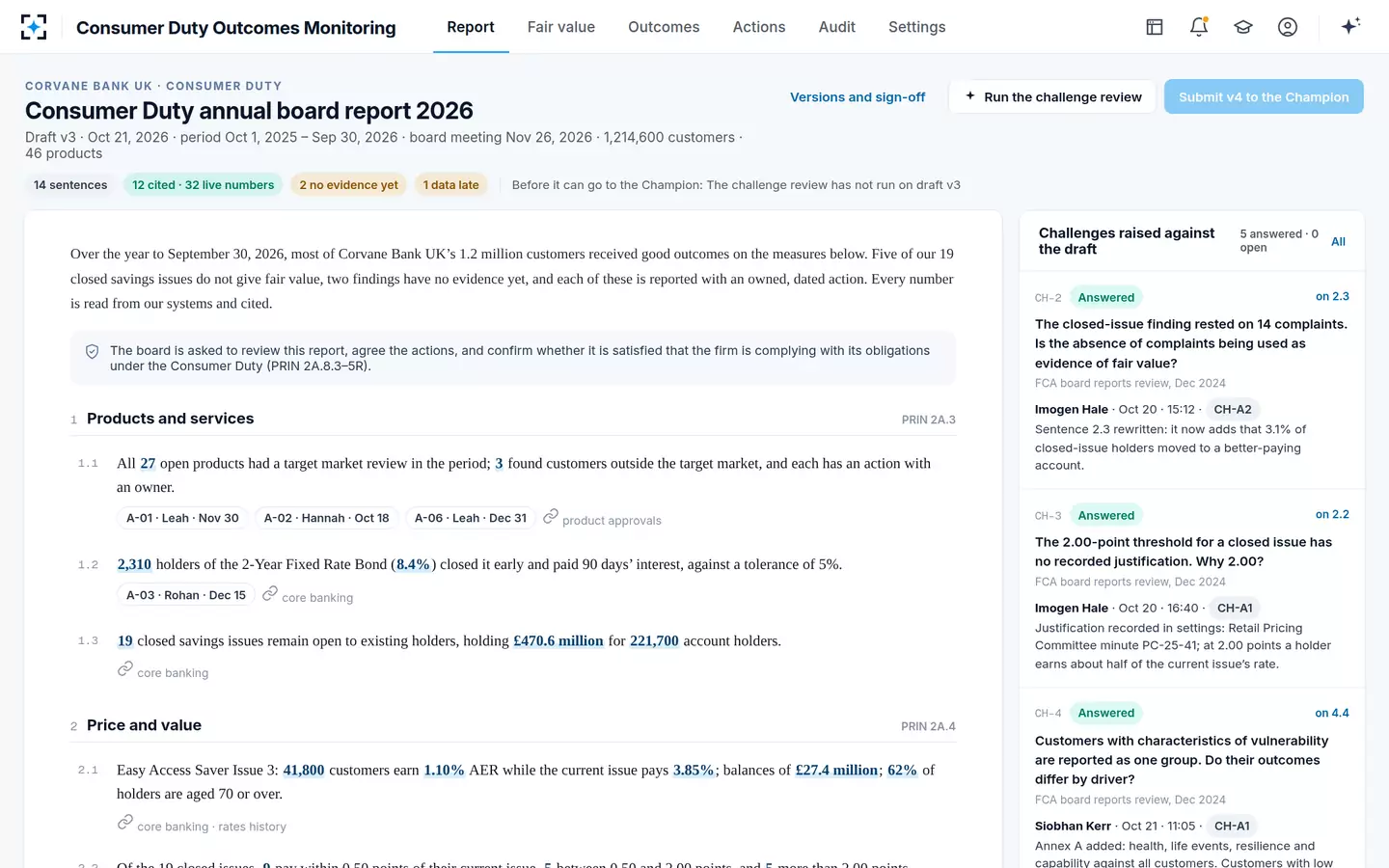
The calendar effect is that the challenge happens before the pack, not in the meeting. The Challenge agent reads the draft against the FCA's published findings on board reports and on cash savings and raises one question per weak point; the draft cannot be released until each has one of four recorded answers: evidence, a rewrite, an owned action, or a gap reported to the board. The solution's target is a full draft with cohort MI in two days, which turns a three-week October into one with time for second-line review.
Every step of the run-in, dated and attributed
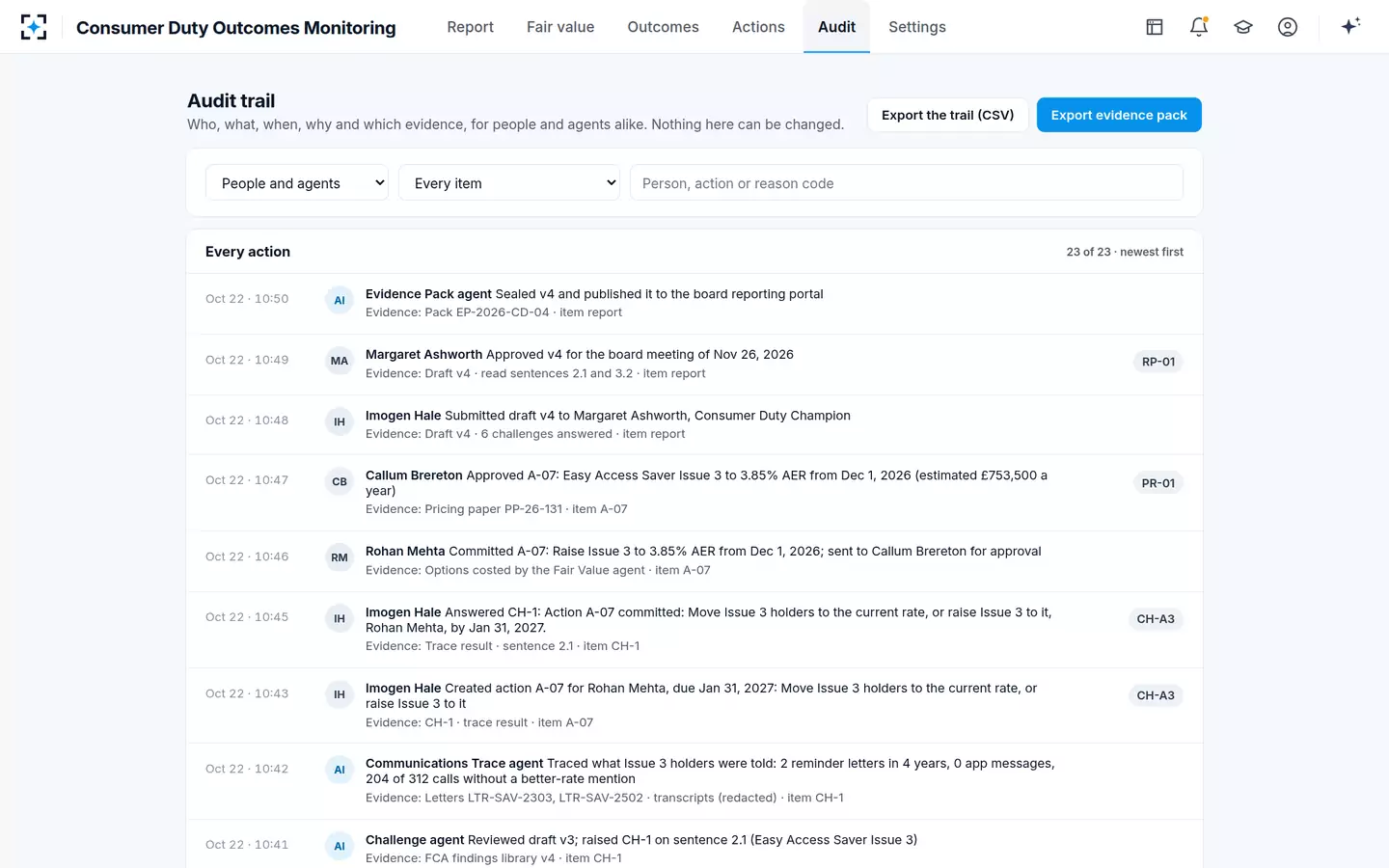
What the solution does not do is set the date or approve anything. The board date, the thresholds and the actions belong to people, and the governing body's approval under PRIN 2A.8.4R happens in the boardroom. For the full list of what the report must contain and who must sign which part, see Consumer Duty board reporting requirements; to see the run-in on the sample bank, start from Consumer Duty Outcomes Monitoring.
Questions people ask
Is there a Consumer Duty board report deadline in 2026?
Not a market-wide one. Each firm's next report is due at least a year after its last board approval, so a firm that approved in July 2025 needs its 2026 approval by July 2026. The FCA's only fixed date was the first report, due by 31 July 2024 for open products.
Do I have to send the Consumer Duty board report to the FCA?
No. The FCA's information for firms says firms do not need to send it but must be able to provide it if asked, and its finalised guidance FG22/5 says it expects the report and the MI behind it on request. The FCA has requested samples for its thematic reviews, including the 180 firms in its 2024 review.
Can we change the month of our board report?
Yes, as long as no more than a year passes between approvals. Moving earlier is always safe; moving later would stretch one cycle past the annual interval in PRIN 2A.8.4R, so the way to a later month is one shorter cycle first.
How long does a Consumer Duty board report take to prepare?
The FCA does not set a period, but it praised reports produced over enough time for business areas, forums and committees to take part. In the fictional sample bank's calendar the run-in from data cut to board is 57 days, of which three weeks are drafting and the rest are challenge, sign-off and directors' reading time.
Does the board report have to cover closed products?
Yes, from the second report on. Closed products came under the Duty on 31 July 2024, and a transitional provision let only the first report, due the same day, speak to new and existing products alone.
What happens if the board misses the annual review?
The firm is in breach of PRIN 2A.8.4R, which requires the governing body to review and approve the report at least annually. There is no late-filing penalty as such, because nothing is filed; the issue is a governance failure the FCA can find when it asks for the report.