A closed product under the Consumer Duty is a product or service that existing customers took out before 31 July 2023 and that has not been marketed or distributed, including by renewal, on or after that date. A product closed to new customers on or after 31 July 2023 is not a closed product for the Duty; it is an existing product and has been in scope since that day. Closed products themselves came under the Duty a year later, on 31 July 2024, so every closed book now needs a forward-looking fair value assessment, outcomes monitoring and, where value falls short, action. They need watching because nobody sells them any more: no sales team, no marketing budget and often no product owner looks at them, while the FCA's savings work found longstanding customers on old products earning less than new ones. Botminds' Consumer Duty Outcomes Monitoring keeps every closed issue on the list, compares it with the product on sale, and puts the gap in front of the people who can close it.
The examples on this page are the closed savings issues of a fictional sample bank, Corvane Bank UK, as they run through the solution: 19 issues closed to new customers, holding £470.6 million for 221,700 holders. The rules and market findings are the FCA's, linked where they appear.
What is a closed product under the Consumer Duty?
The FCA defines a closed product by two tests, both of which must be met. In its words, “a closed product or service must meet both of the following criteria”: there are existing customers who took out a contract before 31 July 2023, and the product “hasn’t been marketed or distributed (including by renewal) on or after 31 July 2023.” It then closes the obvious loophole: “Importantly, a product that was closed to new customers on or after 31 July 2023 is not a closed product for the purposes of the Duty. These products became subject to the Duty on 31 July 2023” (FCA, Consumer Duty information for firms).
That gives three kinds of product in a bank's back book. Products closed before 31 July 2023 and never renewed are closed products, in scope since 31 July 2024. Products closed to new customers after 31 July 2023 are existing products, in scope since 31 July 2023. Products still on sale are open products. The sample bank's 19 issues closed to new customers include Easy Access Saver Issue 6, closed in June 2026, which is an existing product under the FCA's definition. For fair value and monitoring the difference rarely changes the work; for a board report that claims something about “closed products”, it changes what the claim covers.
When did closed products come into scope of the Consumer Duty?
Closed products and services came into scope on 31 July 2024, a year after open ones. The FCA's policy statement explained the phasing: “Firms will need to apply the Duty to new and existing products and services that are open to sale (or renewal) from 31 July 2023. We have given firms longer, until 31 July 2024, to apply the Duty to products and services held in closed books” (PS22/9).
The extra year was for the work, which is heavier than it looks. Closed books can sit on older systems, with terms written before the Duty and customers the firm may not have contacted in years. In its 2023 cash savings plan the FCA told firms to accelerate their fair value assessments of off-sale accounts ahead of the July 2024 deadline, and its September 2024 statement said that it now expected firms to take action on closed book products. The first annual board report, due by 31 July 2024, could cover new and existing products only; every report since has had to cover the closed book too.
What is a back book, and why does the FCA watch it?
A back book is the set of customers on products a firm no longer sells, and the FCA watches it because those customers tend to be the least likely to move and the easiest to underpay. Its 2023 cash savings review drew on years of research.
“Our research showed that, longstanding customers on off-sale products typically received lower interest rates on their balances than those opening new savings accounts (on-sale products). This is sometimes referred to as a ‘loyalty penalty’.”
FCA, Cash Savings Market Review 2023
The same review gave the scale. “Five major retail banks held approximately £260bn in easy access savings accounts offering 1% or less”, and two firms were paying 0.30% or less on their off-sale products (FCA, Cash Savings Market Review 2023). It found that many firms now paid the same rates on on-sale and off-sale versions of like-for-like products, but not all: bonus-rate accounts often reverted to a lower rate, under a different name, when the bonus ended. The pattern is not peculiar to savings. The FCA's 2023 review of fair value frameworks praised firms that segmented customers to look at the value received by back-book customers, among others.
Do closed savings accounts need fair value assessments?
Yes. PRIN 2A.4.21R says: “The obligation on manufacturers in PRIN 2A.4.2R to ensure that a product provides fair value applies to closed products as well as new and existing products.” Because a closed product has no new buyers, the rule redefines its target market: “In the case of a closed product, the reference to a target market in PRIN 2A.4.2R should be read as referring to the retail customers who are customers of the closed product” (PRIN 2A.4.21R).
Two pieces of guidance limit the look-back. PRIN 2A.4.22G: “The assessment of whether a closed product or an existing product provides fair value should be on a forward-looking basis only.” Firms need not judge whether a closed product gave fair value before the rules came in, unless another rule requires it. And PRIN 2A.4.23G lets a manufacturer take into account the benefits provided, the charges paid and the costs incurred before the rules took effect. When an assessment finds poor value, PRIN 2A.4.25R requires action, but PRIN 2A.4.29R provides that, unless the firm has found a breach of pre-Duty rules, the action need not waive vested contractual rights such as charges already due. A fair value assessment template works through every element on one of the sample bank's closed issues.
Can customers be left on closed products?
Customers can stay on closed products; what the Duty does not allow is leaving them on poor value. Nothing in PRIN 2A requires a firm to close or migrate a product. It requires the product to give fair value to the customers who hold it, the firm to monitor whether it does, and action where it does not. The FCA's 2024 savings update was explicit about the comparison that matters: “From July 2024, the Duty applied to both open and closed products, and we expect any differential pricing between open and closed products to be justified by a clear rationale in the relevant FVAs” (FCA, September 2024 update).
It also named the structure that creates closed books by design: “Creating multiple tranches of a savings product which offer the same terms and conditions – distinguished only by the use of distinct issue numbers – to pay higher interest rates to new customers and not to existing customers of the same product.” The FCA said the practice can help firms balance funding and prompt switching, but puts them at greater risk of failing customers left in older issues, especially without effective communication. The sample bank's book has exactly this shape: issue after issue of the same easy-access account, from Issue 1 to Issue 7, with only the latest on sale.
The sample bank's five lowest-paying closed issues, against the issues on sale
Who holds the closed book, and what the money hides
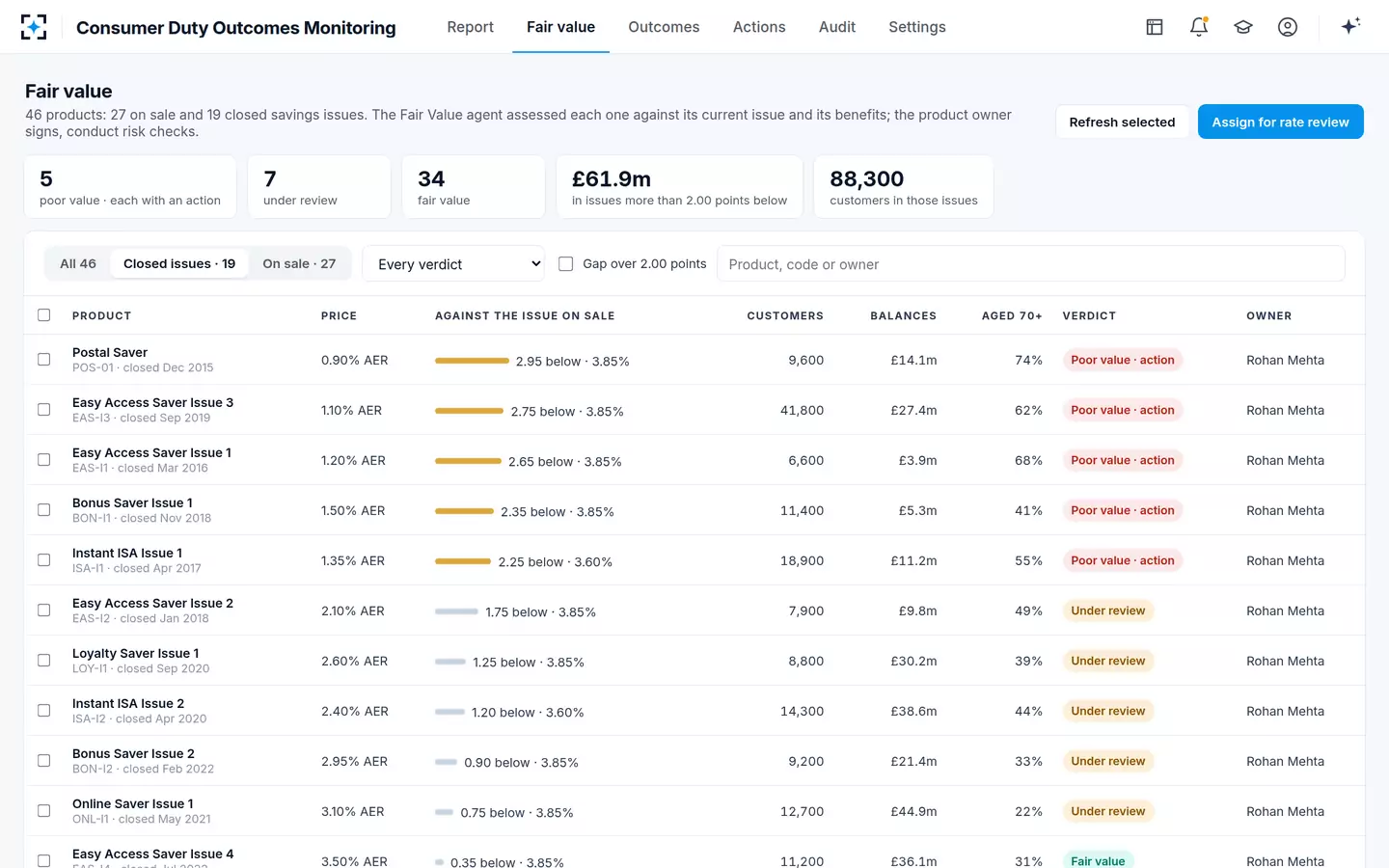
The money in a closed book understates the people in it. At the sample bank, the five issues paying more than 2.00 points below their current issue hold only 13% of the closed book's balances, £61.9 million of £470.6 million, but 40% of its holders, 88,300 of 221,700. Small balances, many people, and in the worst issues, mostly older people: 74% of Postal Saver holders and 62% of Easy Access Saver Issue 3 holders are aged 70 or over.
The worst-paying closed issues hold few pounds but many people
Holders of the 19 closed issues · 221,700
- In the five issues more than 2 points below · 88,300 · 39.8%
- In the other 14 issues · 133,400 · 60.2%
Balances in the 19 closed issues · £470.6m
- Five issues · £61.9m · 13.2%
- Other 14 issues · £408.7m · 86.8%
That shape explains why closed books slip through balance-weighted reporting. A board pack that ranks products by balance puts the lowest-paying issues near the bottom of every table. A fair value assessment that averages across the closed book sees a modest gap. Only a view by issue and by holder finds the 9,600 Postal Saver holders on 0.90%, three quarters of them over 70. The FCA's first review of board reports found the related gap in analysis: “Some reports also made no mention of characteristics of vulnerability factoring into their assessments of closed products” (FCA board reports review).
Consumer Duty Outcomes Monitoring: the closed issues sorted by their gap to the issue on sale
How do you monitor a closed book?
A closed book is monitored like any product, with three extra steps at the start: find every closed product, establish whether it is a closed or an existing product for the Duty, and find out who holds it now. The checklist below is the routine the sample bank runs each quarter, and one any firm can run with or without software.
Monitoring a closed book under the Consumer Duty, step by step
- List every product no longer on sale
Including those on legacy platforms and acquired books. A closed product nobody lists is a closed product nobody assesses.
- Classify each against the FCA definition
Closed before 31 July 2023 and never marketed or renewed since: closed product. Closed later: existing product. Both are in scope.
- Compare each with what is on sale
Rate, charges and benefits against the current version of the same product, with the gap stated in points and in pounds.
- Profile the holders, not just the balances
Numbers, age, digital activity and characteristics of vulnerability, issue by issue.
- Find out what holders were told
Letters, app messages and calls over several years: did anyone tell them a better option existed, in a way they could act on?
- Decide and cost the action
Raise the rate, move holders, or justify the difference with a clear rationale; a letter alone is not an answer to poor value.
- Report it and re-measure
The closed book belongs in the annual board report, and the same measures show next period whether the action worked.
Who watches the closed book?
The manufacturer watches it, which in a bank means named people, because a closed product has no sales team to notice it. At the sample bank the savings product owner owns all nine savings products on sale and all 19 closed issues, signs each fair value assessment and commits each action; the conduct risk lead checks the assessments and answers challenges in the board report; the head of customer vulnerability signs the annex that splits outcomes by driver; and the chair of the Retail Pricing Committee approves any rate change, which the proposer cannot approve himself.
The FCA has shown what it expects of the board above them. Its first review of board reports cited, as good practice on closed products, a firm that “sought approval from its board for additional funding to remediate harm following an Internal Audit report”, with a plan clear on purpose, actions and timescales. Closed products also remain part of the FCA's everyday supervision: its focus areas page lists “looking at any issues around closed products and services” as an example of the supervisory work it carries on alongside its published projects (FCA, Our Consumer Duty focus areas).
How do you contact closed-product customers?
Contact matters for closed products, but it is a means, not the remedy. Data protection is not the obstacle it is sometimes thought to be: the FCA's information for firms says data protection laws and PECR “don't stop firms from telling customers about better deals or providing information that they need to know as part of their relationship with that firm” (FCA, Consumer Duty information for firms). What the FCA's savings work found was that generic, high-volume letters moved few people, and targeted, personal messages worked better.
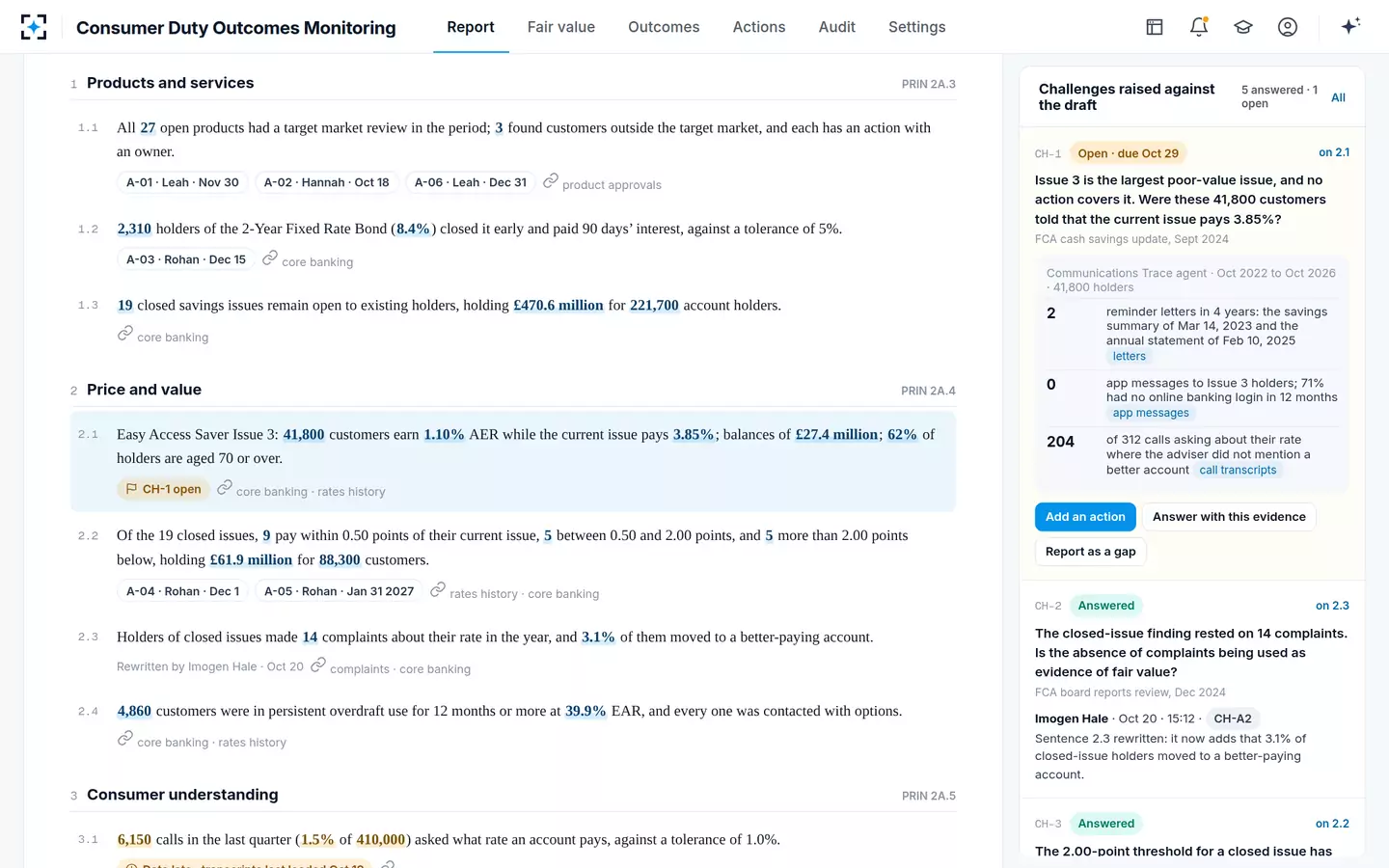
The sample bank's Issue 3 shows the limit of contact. Its Communications Trace agent searched four years of letters, app messages and call transcripts for the 41,800 holders and found two mentions of a better rate, no app message, and 204 of 312 calls about their rate in which the adviser did not mention a better account. With 71% of holders not logged in to online banking in a year, even a good letter would reach few who would act. The bank chose to raise the issue's rate from 1 December 2026, so holders benefit without doing anything, and sent a plain notice by post to all of them. The FCA cash savings market review sets out what the regulator found about letters across the market.
Were they told? Four years of letters, messages and calls for one closed issue
To see the closed book of the sample bank, issue by issue, start from Consumer Duty Outcomes Monitoring.
Questions people ask
Is a product closed to new customers in 2024 a closed product?
No. The FCA says a product closed to new customers on or after 31 July 2023 is not a closed product for the Duty; it is an existing product and has been subject to the Duty since 31 July 2023. Only products not marketed or distributed, including by renewal, since that date and held by customers who took them out before it are closed products.
Does the Consumer Duty apply retrospectively to closed products?
No. The FCA says the Duty does not apply retrospectively, and PRIN 2A.4.22G makes the fair value assessment of closed and existing products forward-looking only. Firms need not judge whether a closed product gave fair value before the rules came into force, unless another rule requires it.
Do we have to move closed-product customers to new products?
No rule requires migration. The firm must ensure the closed product gives fair value to its holders and act where it does not, which can mean changing the closed product's price or terms, offering a move, or setting out a clear rationale for any difference from the open product in its fair value assessment.
Should closed products appear in the Consumer Duty board report?
Yes, in every report after the first. Under a transitional provision in PS22/9, the first report, due by 31 July 2024, needed to cover only new and existing products; from then on the monitoring the report summarises covers closed products too, and the FCA's review of first reports praised firms that gave their boards an overview of closed-product reviews and actions.
Can a firm keep charges already due on a closed product?
Generally yes. PRIN 2A.4.29R provides that, for closed products and existing products held before 31 July 2023, appropriate action does not require a firm to waive vested contractual rights, such as payments already due or early termination charges, unless it has identified a breach of rules in force before that date.