A fair value assessment template is the structure a product manufacturer uses to show, product by product, that what retail customers pay, including any non-financial costs, is reasonable relative to the benefits they can reasonably expect, as the Consumer Duty's price and value outcome requires. The FCA does not publish one. PRIN 2A.4.8R lists four things every assessment must consider: the product's nature, benefits and quality; its limitations; the expected total price; and the characteristics of vulnerability in the target market. The FCA's reviews of 14 firms' fair value frameworks in 2023 and the nine largest savings providers' assessments in 2024 show what is missing when assessments fail: margins never mentioned, groups averaged away, benchmarks chosen to flatter, and conclusions that defend the existing price. The template below follows the rule and those findings, element by element. Botminds' Consumer Duty Outcomes Monitoring drafts each section from the bank's data, with options costed, and leaves the verdict to the product owner.
The worked example uses a closed savings issue of a fictional sample bank, Corvane Bank UK, as it runs through the solution. The rule text is from the FCA Handbook; the findings are the FCA's, linked where they appear.
What should a fair value assessment include?
A fair value assessment must include at least the four considerations in PRIN 2A.4.8R, and in practice should add the context the FCA's guidance and reviews expect: costs and margins, benchmarks, how each group of customers fares, and the action taken where value falls short. The rule's own wording is that the assessment “must include (but is not limited to) consideration of the following” (PRIN 2A.4.8R), so the four items are a floor.
The elements of a Consumer Duty fair value assessment, from PRIN 2A.4 and the FCA's reviews
- The product, its benefits and its quality
PRIN 2A.4.8R(1): what the product does and what customers can reasonably expect from it, including non-financial benefits such as service. Name the target market and how it uses the product.
- Its limitations
PRIN 2A.4.8R(2): access restrictions, conditions, bonus terms, anything that narrows the benefit.
- The expected total price, financial and non-financial
PRIN 2A.4.8R(3): the entry price, regular charges, contingent fees and charges, and non-financial costs such as personal data or the effort to switch or cancel.
- Characteristics of vulnerability in the target market
PRIN 2A.4.8R(4): which characteristics customers display, and how they change the chance of not getting fair value.
- Each group of customers, not the average
PRIN 2A.4.11G: whether the product gives fair value to every group in the target market, including where prices differ by group.
- Costs, margins and benchmarks
PRIN 2A.4.9G: costs, market rates for comparable products, accrued costs and benefits on existing and closed products, cheaper products with similar benefits.
- The conclusion, the evidence and its limits
A verdict the evidence supports, with the gaps in the data stated so decision-makers can challenge it.
- The action, its owner and its date
PRIN 2A.4.25R: where value falls short, action to mitigate and, where appropriate, remediate harm to existing customers and prevent harm to new ones.
Is there an FCA fair value assessment template?
No, and the FCA has warned against leaning too hard on any single one. Its 2023 review of 14 firms' frameworks found that “A few firms who were active across several markets had a single generalised template for assessing fair value. But it was not always clear how the template would apply to products with very different characteristics and which may serve different target markets” (FCA, findings from our review of fair value frameworks). A template is a checklist of questions; the answers have to be specific to the product.
The FCA also leaves the additional factors to firms. The same review notes that firms “have discretion to decide the additional factors they use in their value assessments”, which is why it used “good practice” only to present examples. What it does not leave open is the four mandatory considerations, and the duty to act when an assessment finds poor value.
Element 1: the product, its benefits and its limits
Start with what the product is for and who it is for, because value can only be judged against intended use. For savings, the FCA suggested firms consider “whether the product is intended for short-term use or as a long-term savings vehicle” and target savers accordingly, whether those starting to save, building a balance or maximising returns. A firm that offers branches and high service should say so in the target market, because those are benefits customers may value (FCA, September 2024 update).
Limitations belong next to benefits, not in an appendix. An easy-access account that pays a higher rate only to those who renew a bonus each year has a limitation most customers will meet; the FCA noted accounts where most customers failed to renew the bonus and the firm had not treated that as a concern. Grouping is allowed but must not blur: firms may assess similar products together if the customer base, complexity and risk of harm are similar enough, but the FCA found assessments that lumped instant-access, restricted-access and fixed-term accounts together when they should have been assessed separately.
Element 2: the total price, including non-financial costs
The expected total price is wider than the headline price. PRIN 2A.4.8R(3) lists the price paid on entering the contract, regular charges over the product's life, contingent fees and charges such as arrears charges, and “any non-financial costs the retail customer is asked or required to provide to the firm”. Guidance at PRIN 2A.4.10G gives the provision of personal data, and permission to use it, as examples of non-financial costs.
The FCA's frameworks review found the non-financial side often missing. “Some firms did not consider the types of non-financial costs and benefits that retail consumers may reasonably expect to pay or receive.” It pointed to FG22/5: “Non-financial costs might include factors such as the time and effort to make a decision about a product, such as amending or cancelling it.” For a savings product, the effort it takes to move to a better rate is part of the price the customer pays for staying on a poor one, which is why a postal-only or branch-only switching route belongs in this section.
Element 3: groups of customers and characteristics of vulnerability
A product can give fair value on average and poor value to a group, and the rules require the assessment to look. PRIN 2A.4.8R(4) makes characteristics of vulnerability a mandatory consideration, and PRIN 2A.4.11G asks whether the product gives fair value “for each of the different groups of retail customer in the target market”, including where different prices are charged to different groups (PRIN 2A.4.11G).
The frameworks review was specific about how averages mislead: “Even where firms are undertaking analysis of consumers using segmented groups, group averages could disguise outliers or pockets of poor value.” In the 2024 savings review, the better assessments identified groups such as customers starting to save, low-balance high-transaction customers and customers maintaining high balances, considered the value each received, and set out actions for those doing worst; less developed ones did not consider that one easy-access account may serve very different customers. In the FCA's first review of board reports, some firms also omitted the analysis that would let the board conclude every group, including customers with characteristics of vulnerability, received fair value (FCA board reports review).
Element 4: costs, margins and benchmarks
Costs and margins are optional under the rule but hard to leave out in practice. PRIN 2A.4.9G says a manufacturer “may consider” its costs, market rates for comparable products, accrued costs and benefits on existing and closed products, and whether cheaper products give similar or better benefits. The frameworks review found the gap: “Some firms’ assessments did not make any reference to the firm’s profit margins on different products and services.” It added that while costs can be hard to allocate, “the profit margins of a product or service are likely to be a relevant factor in assessing its fair value.”
The 2024 savings review drew the line on justifications. There is no requirement to include costs, but if a firm justifies a lower rate than peers mainly by its costs, the FCA expects a clear rationale, and it criticised assessments that cited cost to serve without explaining its basis. On benchmarks it was blunt: “If a firm chooses to benchmark its accounts against only low paying accounts, or a subset of competitors, this is unlikely to represent effective benchmarking” (FCA, September 2024 update). The frameworks review added a caution about relative comparisons in general: “Relative comparisons can hide fair value issues that are prevalent within a wider market.”
Element 5: the conclusion, the action and the evidence
The conclusion is where a weak assessment shows itself, because it is written to confirm a decision already taken. The FCA's review of the largest savings providers found that “many FVAs were not sufficiently testing and tended to seek to validate previous pricing decisions.” An assessment that starts from the current price and looks for reasons to keep it will usually find some.
“In determining whether a product provides fair value, or distribution arrangements are consistent with fair value being provided, a firm must not rely on individual retail customers to consider whether they believe the product provides fair value in place of the firm’s own assessment.”
FCA Handbook, PRIN 2A.4.20R
When the assessment finds poor value, PRIN 2A.4.25R requires appropriate action to mitigate and, where appropriate, remediate harm to existing customers and to prevent harm to new ones. The FCA's 2024 savings review named the weakest response: assessments whose only remedy was a letter telling customers their rate was low, leaving the harm itself untouched (Consumer Duty champion removed? quotes the finding). Its frameworks review praised the strongest: “clear rectification processes, complete with named owners”, sometimes with triggers such as movements in a data indicator that require a new assessment. Many frameworks used points-based or red-amber-green scoring; the FCA's caution was that decision-makers need the reasoning behind the thresholds between ratings, and the limits of the evidence, to challenge the result.
A weak and a strong fair value assessment of the same savings account
Weak: written to defend the price: Compared with a peer group of other low-paying accounts
Strong: written to test it: Compared with the market, market leaders included, and with the firm’s own issue on sale
Weak: written to defend the price: One average across all holders
Strong: written to test it: Groups by balance, age, channel and vulnerability, each judged separately
Weak: written to defend the price: The interest rate only
Strong: written to test it: The rate, conditions, and the effort it takes to move to a better one
Weak: written to defend the price: Not mentioned
Strong: written to test it: Stated, with how costs were allocated
Weak: written to defend the price: Complaints are low
Strong: written to test it: Few complaints and few movers, read together as inertia
Weak: written to defend the price: Write to customers about their rate
Strong: written to test it: Raise the rate or move holders, costed, owned and dated
How often should fair value be assessed?
Fair value must be assessed before a product is marketed or distributed, again before any significant adaptation, and then reviewed “on a regular basis appropriate to the nature and duration of the product” (PRIN 2A.4.2R and 2A.4.3R). There is no fixed annual rule; the frameworks the FCA reviewed mostly set timelines linked to how long customers keep a product or how it renews, and the better ones added triggers that force a fresh assessment between scheduled reviews.
The assessment also has to look forward. PRIN 2A.4.5R requires the manufacturer to be satisfied the product will give fair value “for a reasonably foreseeable period, including, where the product is one that renews, following renewal.” For savings, that makes a Bank Rate change a natural trigger, and the FCA said in 2024 that it would expect a clear explanation from any firm that cut rates significantly faster and further than it had raised them.
Who signs a fair value assessment?
The rules do not name a signatory; they put the duty on the manufacturer, and for distributors on their distribution arrangements. Firms decide the governance, and the FCA's findings point to a clear pattern: a named owner for the assessment and its actions, a separate person who challenges it, and the board seeing the conclusions in the annual report. At the sample bank the savings product owner signs each assessment, the conduct risk lead checks it after him, and any rate change needs approval from the chair of the Retail Pricing Committee, who is never the person proposing it.
Consumer Duty Outcomes Monitoring: a fair value verdict for every product, closed issues included
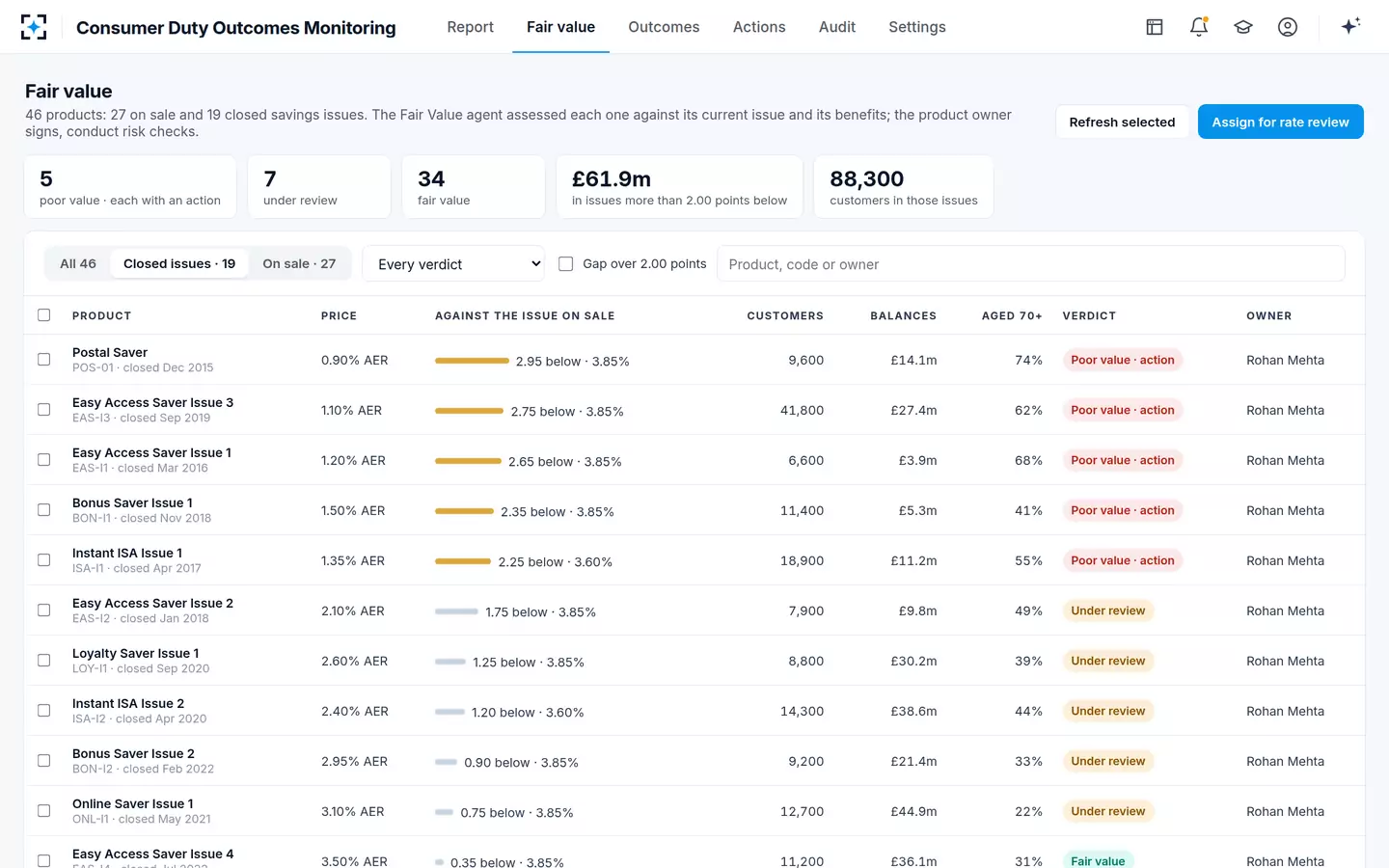
A worked template on a closed savings issue
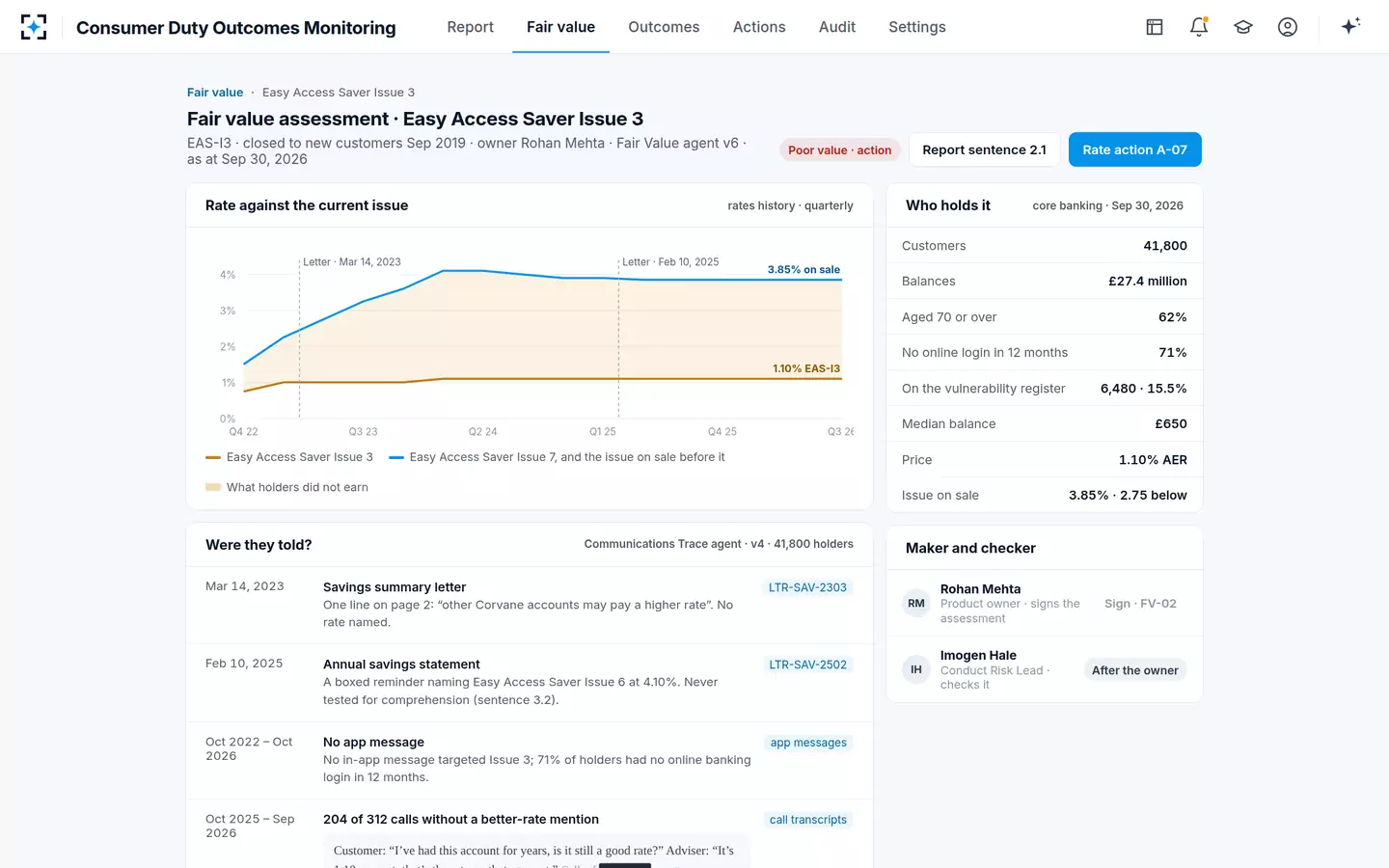
Here is the template filled in for the sample bank's Easy Access Saver Issue 3, closed to new customers in September 2019 and assessed as at 30 September 2026. The Fair Value agent drafted each section from the core banking system, the rates history, the letters archive and the call transcripts; the conclusion and the action are the product owner's.
The fair value assessment for Issue 3, section by section
| Section | What the assessment says | Evidence |
|---|---|---|
| Product and target market | Easy-access savings for holders who opened before September 2019; no longer sold. Its target market is now its existing customers. | Product approval records; PRIN 2A.4.21R |
| Benefits and limits | Easy access. The notice to holders confirms their account number, card and way of paying in stay the same when the rate changes. | Product terms; customer notice |
| Price | 1.10% AER, unchanged since 1 March 2024, against 3.85% on the issue on sale: 2.75 points below. | Rates history |
| Non-financial costs | Moving requires action by the holder; 71% have not logged in to online banking in 12 months. | Core banking |
| Who holds it | 41,800 holders, £27.4m, median balance £650; 62% aged 70 or over; 6,480 on the vulnerability register. | Core banking; vulnerability register |
| Were they told | Two mentions of a better rate in four years; no app message; 204 of 312 rate calls with no better-rate mention. | Letters, app messages, redacted transcripts |
| Cost to close the gap | An estimated £753,500 a year, whether by raising the rate or moving holders to the issue on sale. | Fair Value agent’s costing |
| Conclusion | Poor value, with action: a 2.75-point gap on a product most holders are unlikely to leave on their own. | Signed by the product owner |
| Action | Raise Issue 3 to 3.85% from 1 December 2026; notice at reading age 9 by post and in the app. Owner the savings product owner, due 31 January 2027. | Approved by the pricing committee chair |
Three things in the filled template are worth copying whatever tool a firm uses. The price section dates the rate, so a reader can see how long the gap has run. The non-financial cost section turns “holders could switch” into evidence that most will not. And the conclusion rests on the comparison with the firm's own issue on sale, which is the comparison behind the FCA's 2024 expectation that a firm can explain, in the assessment itself, any gap between the price of an open product and a closed one. Closed products bring their own rules, set out in what a closed product is under the Consumer Duty; the market story behind this assessment is in the FCA cash savings market review.
The assessment as the product owner signs it, with the checker named
To see a fair value assessment drafted for every product on the sample bank, start from Consumer Duty Outcomes Monitoring.
Questions people ask
Do fair value assessments need profit margins?
The rules do not require costs or margins, but the FCA's 2023 frameworks review said a product's profit margins are likely to be relevant, and criticised assessments that never mentioned them. If a firm justifies a worse price than peers by its costs, the FCA's 2024 savings review expects a clear rationale in the assessment.
Do closed products need a fair value assessment?
Yes. PRIN 2A.4.21R applies the fair value obligation to closed products, reading the target market as the closed product's existing customers, and the obligation took effect on 31 July 2024. The assessment looks forward only; firms need not judge whether a closed product gave fair value before the rules came into force.
Can one fair value assessment cover several products?
Yes, if the customer base, complexity and risk of harm are similar enough, but the assessment must still deal with each product. In 2024 the FCA found savings assessments that grouped instant-access, restricted-access and fixed-term accounts together when they should have been assessed separately.
Is telling customers about a better deal part of fair value?
It helps the consumer understanding outcome but does not make a poor-value product fair value. PRIN 2A.4.20R forbids relying on customers to judge value in place of the firm's own assessment, and the FCA's 2024 savings update said alerting customers to low rates would not satisfy the Duty on its own.
What happens if a fair value assessment finds poor value?
The manufacturer must take appropriate action under PRIN 2A.4.25R to mitigate and, where appropriate, remediate harm to existing customers and prevent harm to new ones, and tell distributors of the issue and its changes. For closed and pre-Duty products, PRIN 2A.4.29R says the action need not waive vested contractual rights unless an earlier rule was breached.