Yes, the Consumer Duty champion has been removed as an expectation, though not abolished: on 27 February 2025 the FCA said it no longer expects firms to have a Consumer Duty board champion, and that firms may keep the role if they wish. The champion was always guidance in FG22/5, never a rule, and it never carried the board report's approval, which PRIN 2A.8.4R gives to the governing body. The change is one of several corrections to common beliefs about the Duty that the FCA has made in its reviews, updates and consultations since the rules came into force. This guide takes five of them in turn, quoting the FCA's own text, and shows how Botminds' Consumer Duty Outcomes Monitoring keeps each decision with the person or body the rules name.
Product examples on this page come from a fictional sample bank, Corvane Bank UK, as it runs through the solution. Every FCA statement is quoted from the regulator's pages as published on 27 October 2026.
Four dates behind the corrections
31 Jul 2024
Duty in force for closed products and services
27 Feb 2025
FCA stops expecting a board champion
18 Sep 2026
CP26/23 on scope and proportionality closed
Q1 2027
FCA’s expected date for the CP26/23 policy statement
Has the Consumer Duty champion been removed?
The expectation has been removed; the role has not been banned. The FCA added a note to its PS22/9 page on 27 February 2025 that remains there today.
“We no longer expect firms to have a Consumer Duty Board champion, although they can retain the role should they wish to do so.”
FCA, PS22/9: A new Consumer Duty, update of 27 February 2025
The original expectation was specific. FG22/5 paragraph 10.10 asked for “a champion at board (or equivalent governing body) level” who, with the chair and chief executive, would make sure the Duty was discussed regularly, and added: “The champion should be an Independent Non-Executive Director (NED), where possible” (FG22/5). The FCA's information for firms explains the change: with the Duty in force for open products since July 2023 and closed products since July 2024, it “should therefore be well-embedded”, so the FCA wanted to give firms more flexibility on their ongoing governance (FCA, Consumer Duty information for firms).
One loose end matters to anyone reading the guidance cold. The February 2025 note said: “We will take steps to amend references to Board champions in FG22/5 in due course.” As of 27 October 2026, the FG22/5 document on the FCA's site still carries paragraph 10.10, so a policy that quotes it should note the 2025 change beside it.
Do firms still need a Consumer Duty board champion?
No, but many have kept one. The FCA's review of second-year board reports said: “Many firms have also chosen to retain their Consumer Duty Board Champion, after we gave them flexibility to decide for themselves. This reflects a recognition that senior accountability is central to cultural change and embedding the Duty across businesses” (FCA, 16 April 2026). Its July 2026 outcomes monitoring review still described firms whose actions went to senior forums “with oversight provided through the Consumer Duty Champion, senior management and board-level reporting” as good practice (FCA outcomes monitoring review).
The question for a firm is what the role adds now. A champion who keeps the Duty on the agenda between annual reports, chases overdue actions and reads drafts before they reach the board is doing useful work. A champion whose signature has quietly replaced the board's is a governance problem, which is the first of the five beliefs.
Five beliefs about the Consumer Duty, and what the FCA's own text says
The belief: The Consumer Duty champion approves the board report.
The FCA’s text: PRIN 2A.8.4R: at least annually the governing body reviews and approves the report and confirms whether it is satisfied the firm complies. Since February 2025 a champion is optional.
The belief: The board report has to be sent to the FCA every year.
The FCA’s text: “You don’t need to send us your Board report, but we do expect you to be able to provide it if asked.”
The belief: Writing to customers about a low rate meets the Duty.
The FCA’s text: The FCA criticised assessments that planned “to simply inform them that they were receiving a low rate, rather than to address the harm more proactively and substantively.”
The belief: Products closed to new customers are outside the Duty.
The FCA’s text: “for closed products or services, the rules come into force on 31 July 2024”
The belief: The FCA is scaling the Duty back in 2026.
The FCA’s text: CP26/23 clarifies scope and proportionality “rather than narrowing its scope in a way that would undermine its core purpose.”
Belief 1: the champion approves the board report
The champion never approved the board report. PRIN 2A.8.4R puts review and approval on the governing body, together with the confirmation of whether it is satisfied the firm complies with the Duty and the assessment of strategy, and PRIN 2A.8.5R adds the actions the governing body must agree (PRIN 2A.8). FG22/5 gave the champion a supporting role: to ensure, with the chair and chief executive, that the Duty is “discussed regularly and raised in all relevant discussions”.
The distinction matters most in firms where a pre-board step has grown into the real decision. The sample bank in Consumer Duty Outcomes Monitoring keeps the optional champion role: an independent non-executive director reads what changed since the last version and every answer to every challenge, then releases the version to the board pack. That is a review. The approval, the compliance confirmation and the agreed actions still happen at the board meeting, and Consumer Duty board reporting requirements sets out each of them line by line.
Belief 2: the board report must be sent to the FCA
It does not. The FCA's information for firms says: “You don’t need to send us your Board report, but we do expect you to be able to provide it if asked” (FCA, Consumer Duty information for firms). There is no annual submission, no filing deadline and no FCA template.
“If asked” is not a remote possibility. The FCA requested the first reports of 180 firms for its 2024 review, along with the supplementary information given to their boards and the minutes, and its guidance says it expects the report and the MI behind it on request. A firm should keep the version its board approved together with the evidence behind each statement, because that is what a request will test. The Consumer Duty board report deadline explains how the absence of a filing date shapes the year.
Belief 3: a letter about a low rate meets the Duty
A letter helps customers understand; it does not make a poor-value product fair value. In its September 2024 review of the largest savings providers' fair value assessments, the FCA described the weaker ones: “These FVAs often set out the firm’s intention to write to customers to simply inform them that they were receiving a low rate, rather than to address the harm more proactively and substantively” (FCA, September 2024 update). PRIN 2A.4.20R forbids relying on customers to judge value in place of the firm's own assessment.
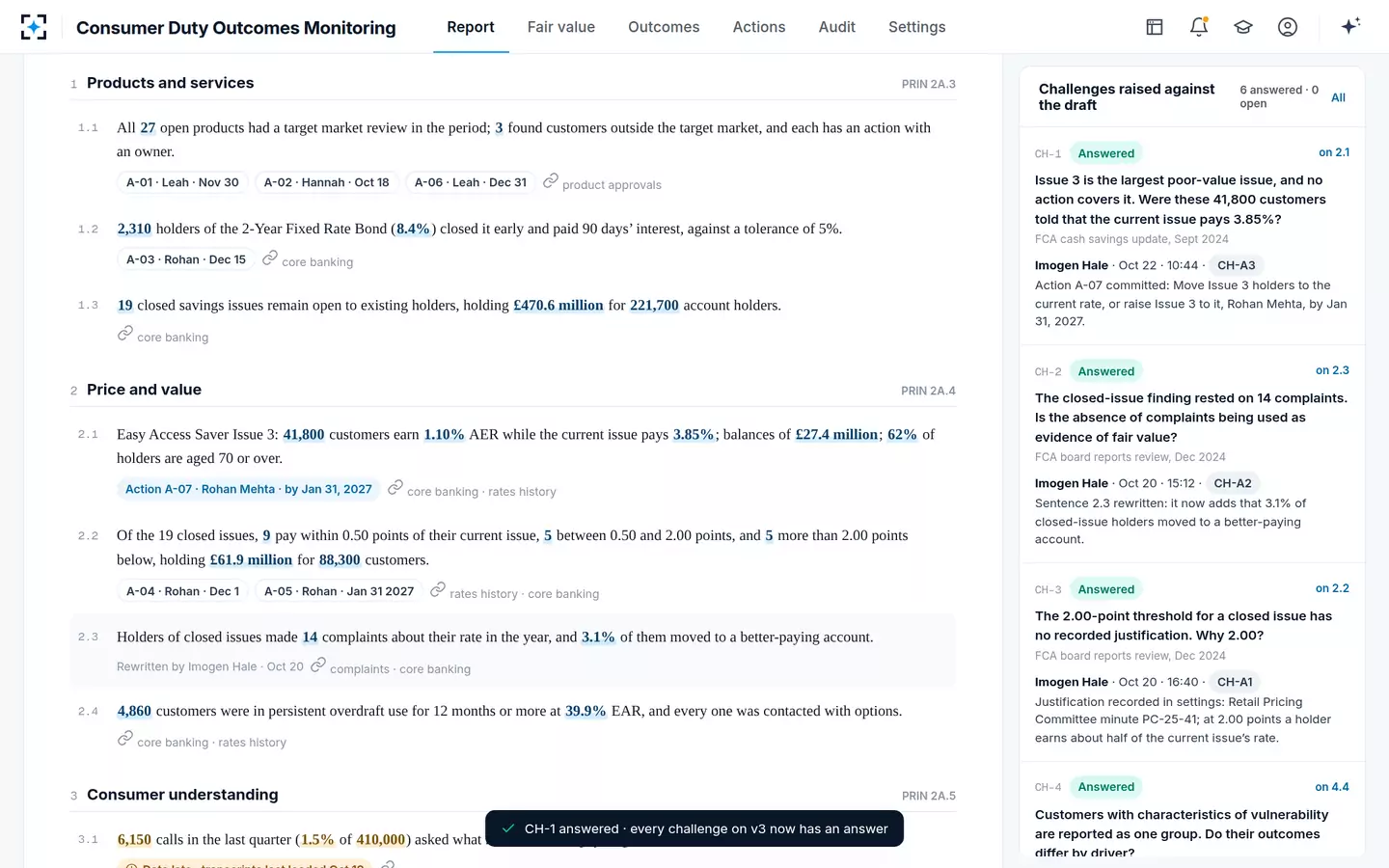
The sample bank's numbers show why the FCA took that line. Of the 41,800 holders of its closed Easy Access Saver Issue 3, paying 1.10% against 3.85% on the issue on sale, 62% are aged 70 or over and 71% had not logged in to online banking in a year; the estimate for a letters-only approach was that about 3% would move. The action the bank adopted raises the closed issue's rate instead, so no holder has to act. The market background is in the FCA cash savings market review.
The challenge answered with an owned, dated action, not a letter
Belief 4: closed books are outside the Duty
Closed products and services came into the Duty a year after open ones. The FCA's PS22/9 page sets out the phasing: “for new and existing products or services that are open to sale or renewal the rules come into force on 31 July 2023” and “for closed products or services, the rules come into force on 31 July 2024” (FCA, PS22/9). The year's delay was for preparation, not exemption.
The belief survives partly because “closed” has two meanings. In a bank's systems it usually means closed to new customers; for the Duty it means a product with customers who took it out before 31 July 2023 and no marketing or distribution, renewals included, since. A product closed to new customers after that date is an existing product and has been in scope since July 2023. Either way it is in scope. What a closed product is under the Consumer Duty works through the definition and the fair value rules that follow.
Belief 5: the FCA is scaling the Duty back in 2026
The FCA is narrowing where the Duty applies at the edges, mainly wholesale and cross-border business, and loosening how it is evidenced for firms far from retail customers; it is not lowering the standard for retail banks. CP26/23, published in June 2026, explains why: “we have seen evidence that in some areas the Duty is being applied more widely, and more intensively, than intended – particularly in wholesale markets and complex distribution chains” (FCA CP26/23). Its proposals would remove business with non-UK customers from scope, clarify which wholesale activities are outside it, and let firms fold Duty reporting into other board reporting rather than produce a stand-alone report.
The same paper states its limit plainly: the proposals focus on clarifying where the Duty applies “and ensuring it is applied proportionately, rather than narrowing its scope in a way that would undermine its core purpose.” Comments closed on 18 September 2026 and the FCA expects to publish final rules in the first quarter of 2027. In parallel, its 2025/26 focus areas page says: “We are relying on the Duty as much as possible rather than creating new prescriptive rules” (FCA, Our Consumer Duty focus areas). For a retail bank, that makes the Duty more central, not less: in June 2026 the FCA also began removing older treating-customers-fairly guidance that overlapped with it (FCA Handbook Notice 142), leaning on the Duty to carry the weight.
Who is accountable for the Consumer Duty now?
The governing body, the firm and its senior managers are accountable, with or without a champion. PRIN 2A.8.1R requires firms to reflect the Duty in their strategies, governance, leadership and people policies, including incentives at all levels, and to make customer outcomes central to risk control and internal audit. FG22/5 adds individual accountability: “we will hold senior managers accountable through the Senior Managers & Certification Regime (SM&CR)” (FG22/5, paragraph 10.8).
Where Consumer Duty accountability sits, with or without a champion
Governing body
Reviews and approves the outcomes report, confirms whether it is satisfied the firm complies, assesses strategy and agrees actions
PRIN 2A.8.4R, 2A.8.5R
The firm
Reflects the Duty in strategy, governance, leadership and people policies, incentives included; puts customer outcomes at the centre of risk control and internal audit
PRIN 2A.8.1R
Senior managers
Accountable for good customer outcomes within their own responsibilities
SM&CR, FG22/5 10.8
A champion, if kept
Raises the Duty in board discussions and challenges management; a reviewer, never the approver
Optional since 27 February 2025
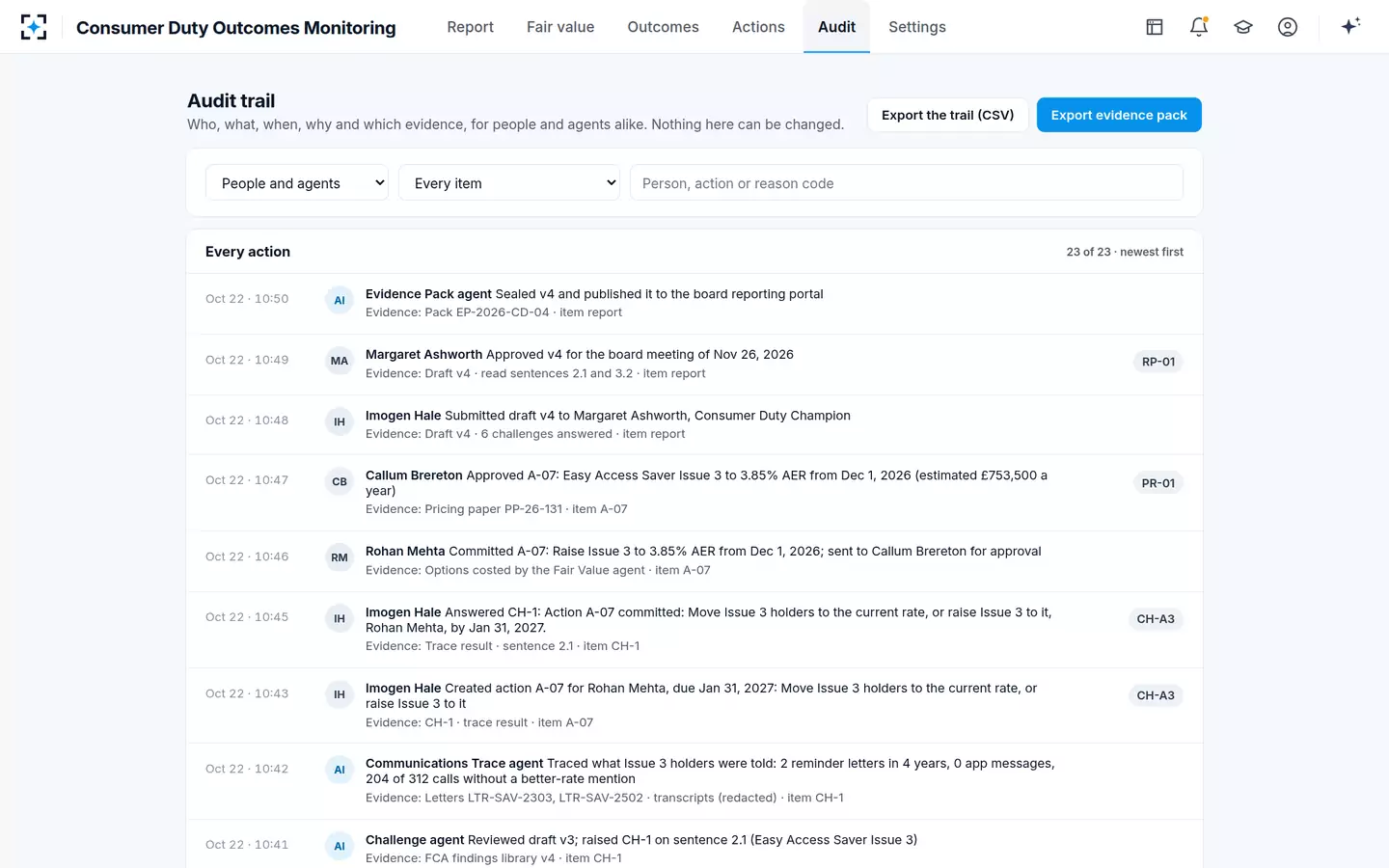
In Consumer Duty Outcomes Monitoring the same chain is enforced in the software rather than in a policy. Each decision has a named role and a different checker: the conduct risk lead drafts and answers challenges, product owners sign fair value and commit actions, the pricing committee chair approves rate changes, the vulnerability lead signs the vulnerability annex, and the approval of the report stays with the board. No one approves their own work, and every step lands on an audit trail.
Consumer Duty Outcomes Monitoring: who did what, when, why and on which evidence
To see the roles and the trail on the sample bank, start from Consumer Duty Outcomes Monitoring.
Questions people ask
When was the Consumer Duty champion requirement removed?
On 27 February 2025, when the FCA updated its PS22/9 page and its information for firms. It was an expectation in guidance (FG22/5 paragraph 10.10), never a rule, and firms may keep the role if they wish.
Should we keep our Consumer Duty champion?
It is a firm's choice. The FCA reported in April 2026 that many firms had kept the role, seeing senior accountability as central to embedding the Duty. A kept champion should be documented as a reviewer and challenger, so the board's own approval and confirmation under PRIN 2A.8.4R stay visible.
Is the Consumer Duty changing in 2026?
Proposals are out and rules are expected in the first quarter of 2027. CP26/23 would remove business with non-UK customers from scope, clarify wholesale activities that are out of scope, and allow Duty reporting to be folded into other board reporting, while keeping at least annual board reporting. Separately, the FCA made technical clarifications to PRIN 2A that took effect on 26 June 2026.
Does the Consumer Duty apply to wholesale firms?
Only where their activities affect retail customers. CP26/23 says the vast majority of wholesale market activity has no material impact on retail outcomes and is rightly outside the Duty's scope, and proposes clearer rules and worked examples for firms early in distribution chains.
Do we still need to follow FG22/5?
Yes. FG22/5 remains the FCA's finalised non-Handbook guidance on the Duty. Read it with the FCA's later updates, such as the February 2025 change on champions, which the FCA said it would reflect in FG22/5 in due course.