The Consumer Duty board reporting requirements are three rules in the FCA Handbook. PRIN 2A.8.3R requires a firm to prepare a report for its governing body setting out the results of its outcomes monitoring and the actions that monitoring calls for. PRIN 2A.8.4R requires the governing body, at least annually, to review and approve that report, confirm whether it is satisfied the firm complies with the Consumer Duty, and assess whether its future business strategy is consistent with the Duty. PRIN 2A.8.5R requires it, when approving, to agree the actions needed on risks, on poor outcomes already suffered and on strategy. The format is left to firms. The authority is not: every approval, confirmation and action in those rules is the governing body's. Botminds' Consumer Duty Outcomes Monitoring is designed around that line, with agents that assemble the MI, draft the findings and challenge the draft, and people who answer, commit and approve.
Examples on this page come from a fictional sample bank, Corvane Bank UK, as it runs through the solution with its 2026 report. The rule text is quoted from the FCA Handbook as in force on 27 October 2026.
What must a Consumer Duty board report include?
A Consumer Duty board report must include the results of the firm's outcomes monitoring, any evidence of poor outcomes, the actions taken and needed, and how the firm's future strategy fits the Duty. The rule itself is short; the FCA's finalised guidance FG22/5 fills in the contents. In paragraph 10.12 it lists the results of monitoring “to assess whether products and services are delivering expected outcomes in line with the Duty”, including whether any group of customers fares worse than another, with “an evaluation of the impact and the root cause”; an overview of actions taken; and how the future strategy is consistent with delivering good outcomes (FG22/5, chapter 10).
The FCA has declined, so far, to say how that should look on the page. In its 2022 policy statement it wrote: “We do not think that it is necessary to prescribe the format of the report to the board or equivalent management body” (PS22/9). That leaves the structure to the firm, and the FCA's later reviews to show which structures worked. The best reports in its review of 180 first reports had dedicated sections for each of the four outcomes, good quality MI behind each conclusion, and analysis of different customer groups.
What each Consumer Duty board reporting rule requires, and who does it
| Rule | What it requires | Who | What the FCA expects to see |
|---|---|---|---|
| PRIN 2A.8.3R | A report for the governing body: the results of monitoring under PRIN 2A.9, and the actions the monitoring calls for. | The firm: in practice the conduct, product and data teams | Findings tied to MI; group comparisons; impact and root cause |
| PRIN 2A.8.4R(1) | Review and approve the outcomes report, at least annually. | The governing body | Minutes showing the review, not only the approval |
| PRIN 2A.8.4R(2) | Confirm whether it is satisfied the firm is complying with the Duty. | The governing body | An explicit confirmation, or an explicit statement of where it is not satisfied |
| PRIN 2A.8.4R(3) | Assess whether future business strategy is consistent with the Duty. | The governing body | A real review of strategy, not a line saying it is aligned |
| PRIN 2A.8.5R(1)–(2) | Agree actions on identified risks of poor outcomes and on poor outcomes already found. | The governing body | Actions with owners, timescales and the data that will show they worked |
| PRIN 2A.8.5R(3) | Agree any amendments to strategy needed to stay consistent with the Duty. | The governing body | Strategy changes recorded as decisions |
PRIN 2A.8.3 to 2A.8.5, line by line
PRIN 2A.8.3R is the drafting duty, and it says less than people assume: “A firm must prepare a report for its governing body setting out the results of its monitoring under PRIN 2A.9 and any actions required as a result of the monitoring.” It does not say who writes it, how long it is or what template it uses. It does tie the report to PRIN 2A.9, which means the report can only be as good as the outcomes monitoring underneath it; FCA Consumer Duty outcomes monitoring sets out what that monitoring must find.
PRIN 2A.8.4R adds three duties, each for the governing body alone. The first is to review and approve the report. The second is to “confirm whether it is satisfied that the firm is complying with its obligations under the Consumer Duty”. The third is to “assess whether the firm’s future business strategy is consistent with its obligations under the Consumer Duty” (PRIN 2A.8.4R). The second is the easiest to blur: it is a confirmation of compliance, which a board can only give honestly if the report tells it where the firm is not yet compliant.
PRIN 2A.8.5R turns approval into commitment. When approving the report, the governing body “must also agree” three kinds of action: “any action required to address any identified risk that retail customers may not receive good outcomes”; “any action required to address any identified instance where retail customers have not received good outcomes”; and “any amendments to the firm’s business strategy to ensure that it remains consistent with meeting the firm’s obligations under the Consumer Duty”. A report that lists problems without proposing actions leaves the board unable to meet this rule in the meeting.
Who must approve it, and what must the board confirm?
The governing body must approve the report, and nobody can do it for it. Not the Consumer Duty champion, a role the FCA stopped expecting in February 2025; not compliance; not a committee acting on the board's behalf. In smaller firms without a board, the rules apply to the equivalent governing body, and the FCA has suggested a knowledgeable “critical friend” to bring the independence a board would otherwise supply (FCA board reports review).
“The board should not be seen simply as a ‘rubber stamp’ for the report.”
FCA, Consumer Duty board reports: good practice and areas for improvement
The confirmation under PRIN 2A.8.4R(2) is a statement the board makes about the firm, and the FCA reads it alongside the evidence. In its review of first reports it found some firms whose conclusions did not match their MI, including one that described its support for customers with characteristics of vulnerability in detail while its MI showed fewer than half were getting good outcomes. A board that confirms compliance on top of that report has confirmed something its own papers contradict. Consumer Duty MI measures follows one number from its source to the board to show where that gap opens.
The actions the board must agree
The board must agree actions on three things: risks that customers may not get good outcomes, cases where they have not, and any change of strategy the Duty requires. The FCA's first-year review found the weak point: “Some actions lacked owners and timescales, risking inaction over issues that could result in poor outcomes for customers.” By the second year it saw progress: “Most reports now identify accountable owners for improvements and track delivery status, so Boards can monitor progress more systematically” (FCA, Year 2 Consumer Duty Board Reports).
An action the board can agree is one that is already costed and owned when the pack goes out. On the sample bank's draft, the finding about Easy Access Saver Issue 3, a closed savings issue paying 1.10% to 41,800 holders while the issue on sale pays 3.85%, reached the board with action A-07 attached: owner the savings product owner, due 31 January 2027, a rate rise from 1 December 2026 costed at an estimated £753,500 a year, already approved by the chair of the Retail Pricing Committee. The board agrees it; it does not have to invent it.
Can AI draft a Consumer Duty board report?
Yes, AI can draft a Consumer Duty board report, because PRIN 2A.8.3R says nothing about who or what writes it; what it cannot do is any of the things PRIN 2A.8.4R and 2A.8.5R reserve for the governing body. The FCA's October 2026 publication on AI in financial services describes the approach it saw working: “Firms used AI systems to support rather than replace people’s judgement”, with staff accountable and in control at the points where decisions affected consumers (FCA, AI in financial services: good practice).
The real risk in an AI draft is a fluent sentence with a wrong number. A preregistered study published in the Journal of Empirical Legal Studies in 2025 found that commercial AI legal research tools, built to retrieve from trusted sources, still hallucinated between 17% and 33% of the time (Magesh et al., 2025). A board report that says “customers on closed savings accounts receive fair value” cannot afford that rate. The control is not to forbid drafting; it is to make every number traceable to the system it came from, and to have the draft say plainly when there is no evidence.
That is how the solution's agents are limited. The Drafting agent “never writes a number it cannot cite”; a finding it cannot support is marked “No evidence yet” and goes to the board as a gap with an owned action. Each number carries its system, query, as-at time and a confidence score, and below a confidence of 0.85 a person confirms the number before the sentence can be used.
The authority line: what agents may do, and what only people decide
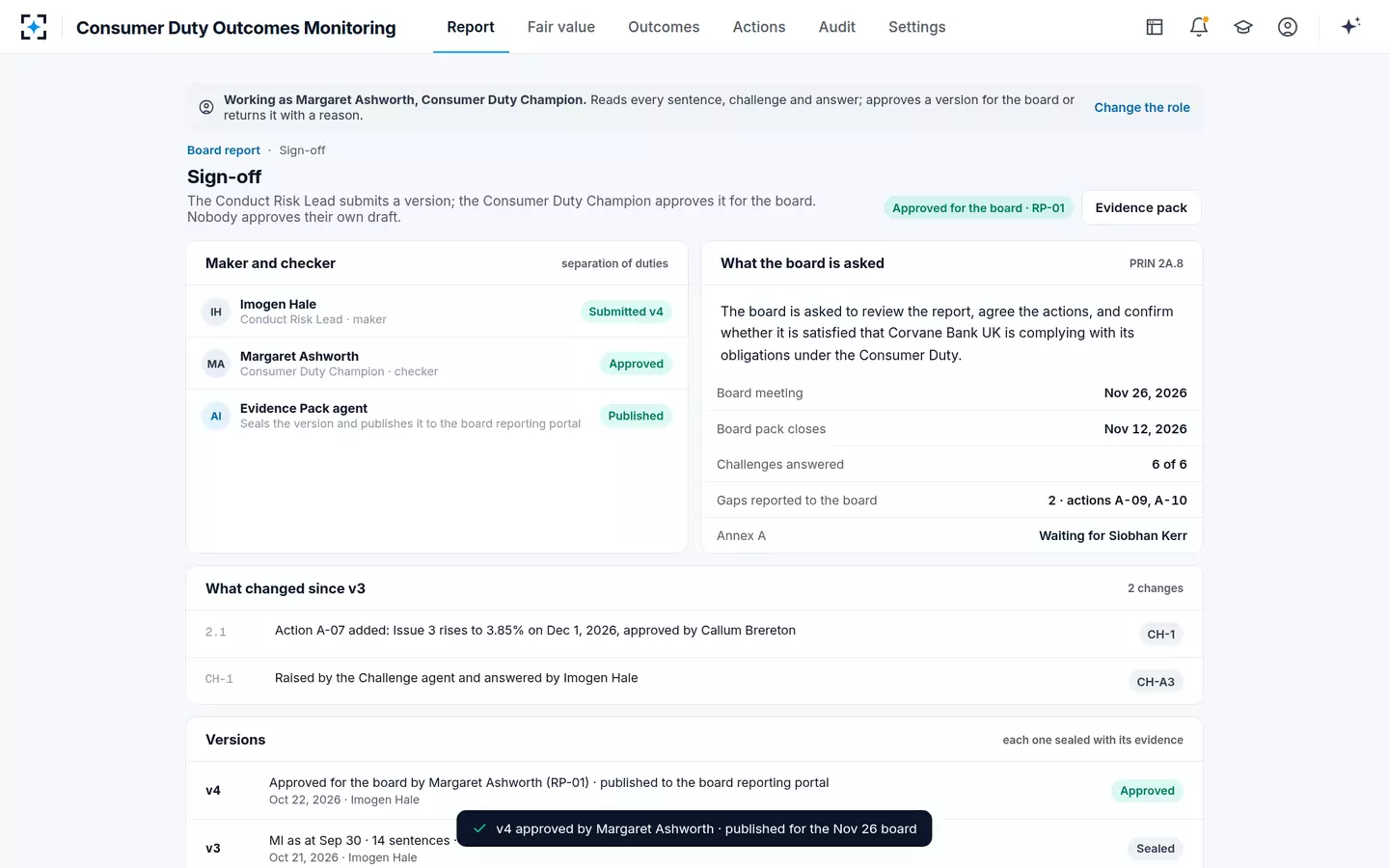
The line runs between assembling and deciding. Agents can read systems, compute measures, draft sentences, compare cohorts, trace what customers were told and question the draft. People answer the questions, commit actions, approve prices, sign assessments and approve the report. In Consumer Duty Outcomes Monitoring the line is enforced by the software, not by a policy document: a button a role cannot use says why, and nobody approves their own work.
Consumer Duty Outcomes Monitoring: who drafts, who challenges, who decides
Agent
MI and Drafting agentsAssemble each outcome measure from the bank’s systems with its query and as-at time; write each finding as one sentence with its numbers bound to their source, or mark it “No evidence yet”.
Never: estimate a missing number, or write one they cannot cite
Agent
Challenge agentReads the draft against the FCA’s published findings and raises one question per weak point; holds the draft until each is answered.
Never: answers its own challenge, or approves
A person decides
Conduct risk leadAnswers each challenge with evidence, a rewrite, an owned action or a gap reported to the board; submits the version.
Never: approves her own draft
A person decides
Product owner and pricing approverThe owner signs fair value and commits actions; the pricing committee chair approves any rate change.
Never: approves a rate change he proposed
A person decides
Governing bodyReviews and approves the report, confirms whether it is satisfied on compliance, assesses strategy and agrees actions.
Never: delegates the confirmation to an agent
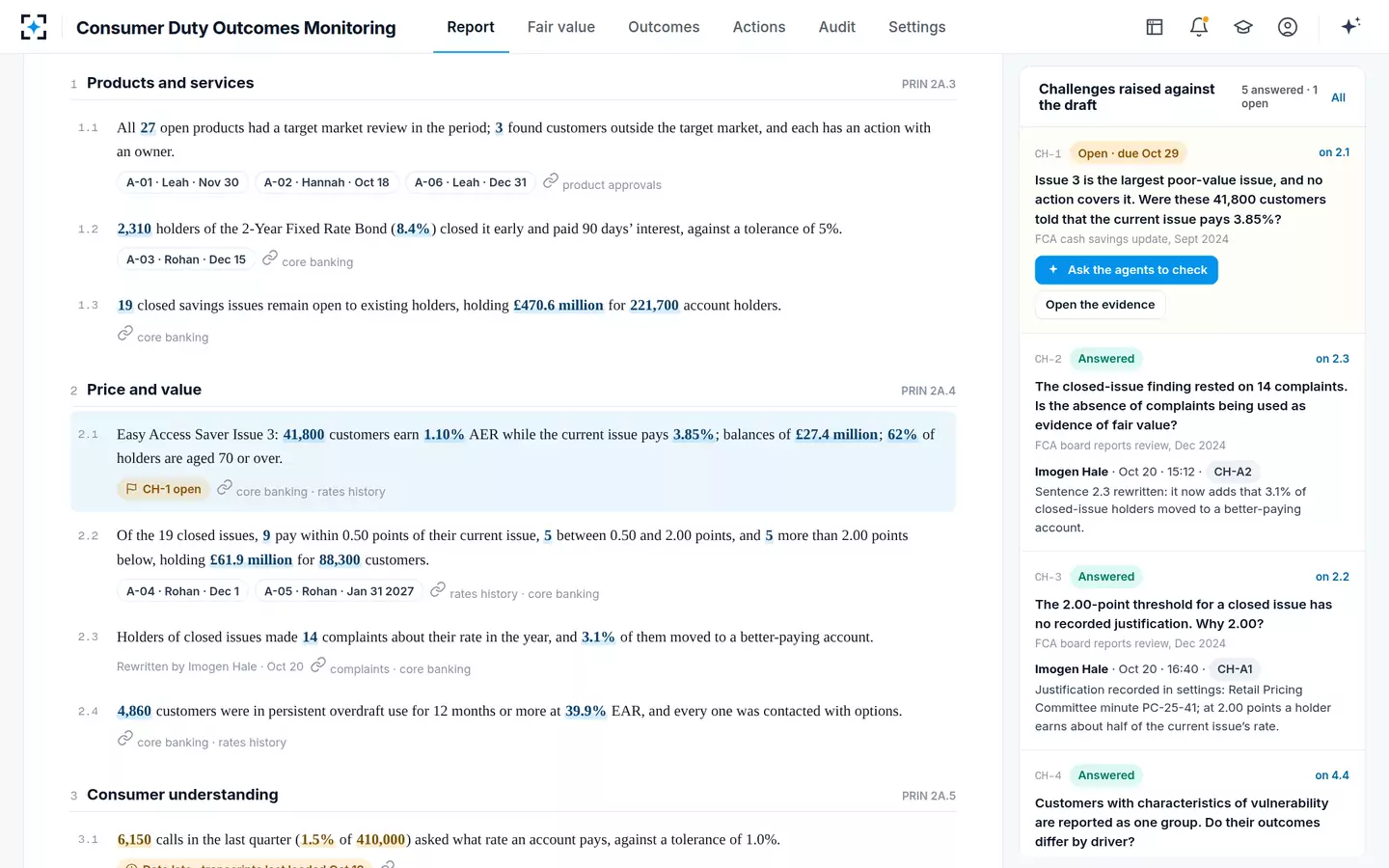
The Challenge agent asks the question the FCA would ask, before the board does
How should board challenge be documented?
Board challenge should be documented in the minutes and papers, question by question, with the follow-up each question produced. That is the FCA's own instruction after the second year of reports: “While most Boards reviewed and approved the reports, many did not adequately document the challenge they had provided.” It went on: “Boards should ensure their minutes and papers clearly set out the discussions they had, the questions they asked and any follow up actions they requested” (FCA, 16 April 2026).
The first-year review described what good looked like. Some reports showed board requests for more information on target markets and on user research testing; one board member challenged a plan for customers with characteristics of vulnerability, and the resulting action was allocated to a senior member of the management team. One firm kept a tracker of every request the board had made during the year, with the rationale for its data thresholds and the progress of the actions. A tracker of that kind is exactly what a board secretary needs to write minutes that survive a supervisory request.
Challenge raised before the meeting counts too, if it is visible. In the solution, each challenge, its answer, the person who answered and the reason code stay with the version the board receives, and the board can open any of them. The governance cannot stop at the agents' questions, though: the FCA wants to see the board's own.
Sign-off before the board pack, with every answer visible
What the FCA can ask to see
The FCA can ask for the report and the MI behind it, and it has said so in its guidance: “We expect to be provided on request with the report and the management information (MI) that sits behind it” (FG22/5, paragraph 10.14). In the same paragraph it says the assessment “will be part of the evidence we use to assess a firm’s compliance with the Duty.” For its first thematic review it requested the reports, any supplementary information given to the board, and the minutes.
That request is the practical test of every requirement above. A board that approved a sentence must be able to show the number behind it; a confirmation of compliance must sit beside the gaps the board was told about; an agreed action must have an owner and a date. In the solution, the version the board received is sealed with its evidence and can be exported for the FCA or internal audit, so the request is answered from what the board actually read, not reconstructed later. Where the report sits in the year is covered in the Consumer Duty board report deadline; to see the drafting and challenge on the sample bank, start from Consumer Duty Outcomes Monitoring.
Questions people ask
What is PRIN 2A.8?
PRIN 2A.8 is the governance and culture section of the FCA's Consumer Duty rules. It requires the Duty to be reflected in strategy, governance, leadership and incentives (PRIN 2A.8.1R) and sets the board reporting duties in PRIN 2A.8.3R to 2A.8.5R. Its provisions were last updated on 26 June 2026.
Is there an FCA template for the Consumer Duty board report?
No. The FCA said in PS22/9 that it did not think it necessary to prescribe the format, and its information for firms says the rules do not set a template. Its reviews of first- and second-year reports describe what worked, which is the closest thing to a model.
Does the board have to confirm compliance with the Consumer Duty?
It has to confirm whether it is satisfied the firm is complying, under PRIN 2A.8.4R(2). That allows a board to say where it is not yet satisfied, which is more credible than a blanket confirmation sitting above evidence of poor outcomes.
Can a committee approve the Consumer Duty board report instead of the board?
The rule names the governing body. Committees can prepare, scrutinise and recommend, and the FCA praised reports that passed through relevant forums and committees first, but the review, approval, confirmation and agreed actions under PRIN 2A.8.4R and 2A.8.5R belong to the governing body.
Does the Consumer Duty champion approve the report?
No. The governing body approves it under PRIN 2A.8.4R. Since 27 February 2025 the FCA no longer expects a champion at all, though firms may keep the role, and a champion who reads the report before the board is a reviewer, not the approver.