The FCA's cash savings market review, published on 31 July 2023, the day the Consumer Duty came into force, found that nine of the largest savings providers had passed on, on average, only 28% of the rise in Bank Rate to their easy-access savers between January 2022 and May 2023. It set a 14-point action plan that made the firms paying the lowest rates justify them as fair value under the new Duty. A year later the average easy-access rate had risen from 1.66% to 2.11%, which the FCA estimated would give savers about £4bn a year more in interest, but its review of the banks' fair value assessments found many that defended old pricing rather than tested it, and firms planning to write to customers about a low rate instead of fixing it. For a bank, the lesson is that fair value on savings is a sum in pounds per customer that the firm must do itself. Botminds' Consumer Duty Outcomes Monitoring does that sum for every closed issue and puts it in front of the people who decide the rate.
Worked examples on this page use the closed savings issues of a fictional sample bank, Corvane Bank UK, as they run through the solution. The market figures are the FCA's, linked where they appear.
What the FCA's cash savings work found, and what it delivered
28%
of Bank Rate rises passed to easy-access savers by nine large firms, Jan 2022 to May 2023
1.66%
average easy-access rate in July 2023, when the review was published
2.11%
average easy-access rate in June 2024
£4bn
a year more interest for savers, by the FCA’s estimate
What did the FCA cash savings market review find?
The review found that easy-access savers were being left behind as rates rose. Between January 2022 and May 2023 Bank Rate rose by 4.25 percentage points; nine of the biggest providers passed on an average of 28% of that rise to easy-access deposits and 51% to notice and fixed-term deposits (FCA press release, 31 July 2023). Smaller firms paid more: a median easy-access rate of 3.7% against 2% at the largest firms (FCA, Cash Savings Market Review 2023).
Easy-access savers got little more than a quarter of the rate rise
The reason it mattered for the Duty was where the money sat. The review found that 75% of consumers with a savings account held it with their main current account provider, which, the FCA said, lets the largest banks carry the advantage of their current account market share into savings. And it found that longstanding customers on products no longer on sale typically earned less than new customers, a pattern the FCA's earlier work had called a loyalty penalty. Both point at the same customers: loyal, inert, and easy to underpay.
The 14-point plan, and the deadline it set
The plan gave the FCA eight actions and firms six, and its first item had a date. “Firms offering the lowest savings rates will be required to justify by the end of August how those rates offer fair value, according to the Consumer Duty which enters into force today. If they are unable to do so, the FCA will take action” (FCA, 31 July 2023). The FCA would take robust action by the end of 2023 against those who could not.
The rest of the plan set the agenda for a year. The FCA would review the timing of firms' rate changes at each Bank Rate change, analyse the gap between on-sale and off-sale products, review cash ISA switching and the contribution of savings to firms' profits, and review how effectively firms engaged their customers by the end of March 2024. Firms were to use their fair value assessments of on-sale savings products from that day, accelerate their assessments of off-sale accounts ahead of the July 2024 deadline for closed products, prompt customers in low-paying accounts to consider alternatives, and monitor whether their communications worked, with the larger firms reporting to the FCA by the end of 2023.
One promised action did not survive. The FCA had committed to publish, every six months, an analysis of firms' easy-access rates from best to worst; in September 2024 it concluded that this was “not an effective use of resources given widely, freely available comparison websites and best buy tables” and stopped (FCA, September 2024 update).
Which banks were in the FCA savings review?
The nine firms the FCA worked with on easy-access fair value were Lloyds Banking Group, HSBC, NatWest Group, Santander UK, Barclays, Nationwide Building Society, TSB Bank, Virgin Money UK and The Co-operative Bank, as listed in the FCA's September 2024 update. For its 2023 analysis of on-sale and off-sale rates it also asked six of the largest building societies for data: Skipton, Coventry, Progressive, Leeds, Melton and Newcastle.
The findings were written for everyone else too. The FCA said the update “should be helpful for all firms which offer cash savings products”, and that firms other than savings providers might find its fair value insights useful. A smaller bank or building society that was never asked for its assessment is held to the same standard; it simply has not yet been asked to show it.
From 1.66% to 2.11%: what savers gained
Savers gained roughly half a percentage point on the average easy-access account in eleven months, while Bank Rate barely moved. The FCA's quarter-end series shows the climb, which continued even after Bank Rate stopped rising in August 2023.
The average easy-access rate rose for a year after the review
The money moved as well as the rates. Between July 2023 and June 2024 fixed-term and notice balances grew by £29bn to £274bn, while easy-access deposits stayed broadly stable at £909bn. By August 2024, 174 instant-access or no-notice accounts paid more than 4%. Yet the FCA's conclusion was not that the market was fixed: its review of fair value assessments found that “the largest firms generally continue to pay below the market average for standard easy access products”, and its December 2023 data update had shown three firms making limited progress in aligning rates on old and current versions of the same product (FCA, December 2023 update).
Why telling customers about a low rate is not enough
Telling customers they are on a low rate is not enough because the Duty makes fair value the firm's job, not the customer's. PRIN 2A.4.20R forbids a firm from relying on individual customers to judge whether a product gives fair value in place of its own assessment, and the FCA applied that directly to savings.
“Simply alerting customers that they are on low rates may contribute towards meeting the consumer understanding outcome, but it would not satisfy the Duty’s requirements not to offer poor value products in the first instance.”
FCA, update on cash savings, September 2024
The FCA's evidence on letters explains why. Firms issued over 100 million communications to savings customers in 2023, and the FCA concluded: “Generally, we found that the effectiveness of repeated large volume, generic communications was limited”; targeted messages to narrow groups worked better. Many communications did not explain the rate the customer was getting or the benefit of moving, used passive messaging with vague calls to action, or buried the point in information about every tariff.
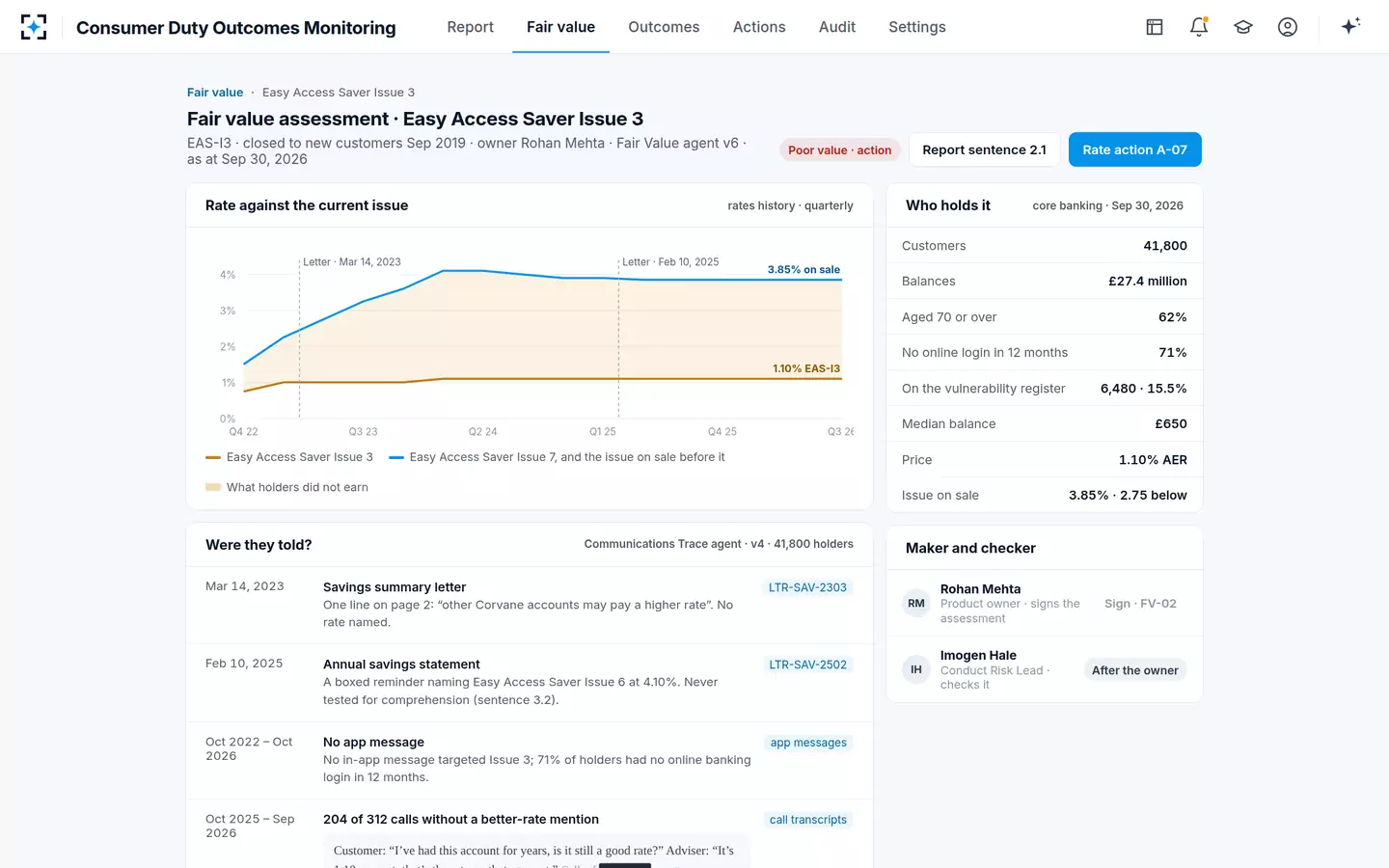
The sample bank shows the arithmetic of a letters-only answer. Its Easy Access Saver Issue 3, closed to new customers in September 2019, pays 1.10% to 41,800 holders while the issue on sale pays 3.85%. Four years of letters, app messages and call transcripts show two mentions of a better rate: one line on page two of a 2023 savings summary, and a boxed reminder in a 2025 annual statement. Of the holders, 62% are aged 70 or over and 71% had not logged in to online banking in a year. The Fair Value agent's estimate for writing to holders alone is that about 3% would move. The other 97% would stay where the harm is.
What fair value is worth in pounds per customer
Fair value on a savings product can be priced as the rate gap times the balance: what the holders forgo each year, and therefore what it would cost the bank to close the gap. The sum is simple, and it changes the conversation in two ways. It shows the board a cost it can weigh against the harm. And it shows why customers rarely act on their own: the amount at stake for a typical holder is small enough to ignore, even when the total is large.
Fair value in pounds: the sample bank's five lowest-paying closed issues
| Closed issue | Rate gap to the issue on sale | Balances | A year to close the gap | Per holder, on the average balance |
|---|---|---|---|---|
| Postal Saver · 9,600 holders | 0.90% vs 3.85% · 2.95 pts | £14.1m | £415,950 | £43 |
| Easy Access Saver Issue 3 · 41,800 | 1.10% vs 3.85% · 2.75 pts | £27.4m | £753,500 | £18 |
| Easy Access Saver Issue 1 · 6,600 | 1.20% vs 3.85% · 2.65 pts | £3.9m | £103,350 | £16 |
| Bonus Saver Issue 1 · 11,400 | 1.50% vs 3.85% · 2.35 pts | £5.3m | £124,550 | £11 |
| Instant ISA Issue 1 · 18,900 | 1.35% vs 3.60% · 2.25 pts | £11.2m | £252,000 | £13 |
| All five · 88,300 holders | 2.25 to 2.95 pts | £61.9m | £1,649,350 | £19 |
Read across, the table says something a percentage cannot. The largest annual cost sits with Issue 3, because it holds the most money. The largest harm per person sits with the Postal Saver, whose 9,600 holders forgo about £43 a year each, and 74% of whom are aged 70 or over. A fair value assessment that ranks issues only by rate gap would put them close together; one that ranks by pounds per holder and by who holds them sees two different problems with two different fixes.
The FCA's aggregate number is the same sum done across the market. Its £4bn a year is what higher rates were worth to savers. At a single bank, the equivalent figure is the one a pricing committee has to approve, which is why the solution puts the costed options in front of the product owner and the pricing approver rather than only in the board report.
What the FCA found in the fair value assessments
The FCA reviewed the nine firms' fair value assessments for their lowest-paying, on-sale easy-access accounts and found many that “lacked appropriate data and analysis to support the conclusions”. Some grouped instant-access, restricted-access and fixed-term accounts in one assessment when they should have been assessed separately. Some benchmarked only against low-paying peers. Some did not consider that one easy-access account can serve very different customers, from new savers to people leaving large balances for years, and so set out no action for the groups doing worst.
The update also named pricing structures that carry more risk under the Duty: separate issues of the same product paying new customers more than existing ones, annual bonuses most customers fail to renew, and regressive tiering, where larger balances earn lower rates. None is banned, but each needs monitoring of who ends up on the lower rate and whether they are being reached. The FCA's profitability analysis added context: easy-access accounts earned higher net interest margins than term accounts. A fair value assessment template builds these findings into the assessment itself, and closed products under the Consumer Duty covers the off-sale book the FCA expected firms to tackle from July 2024.
Since July 2024 there has been no gap in coverage to hide behind. The FCA's statement with the update said: “Since July 2024, the Consumer Duty applies to both open and closed products, and we now expect firms to take action in relation to closed book products” (FCA statement, 18 September 2024).
Pricing a closed issue with Consumer Duty Outcomes Monitoring
The solution's Fair Value agent assesses every product against its benefits and, for each closed issue, against the issue on sale, then costs the options for the product owner. It never decides fair value and never proposes a rate the pricing committee has not seen. On the sample bank's Issue 3 the assessment draws the closed issue's rate flat near 1.10% against the issue on sale, marks the two mentions on the line, and shows who holds it: £27.4 million, a median balance of £650, 6,480 holders on the vulnerability register.
A closed savings issue's rate drawn against the issue on sale, with what holders were told
The decision then sits with people, in order. The savings product owner chose to raise Issue 3 to 3.85% from 1 December 2026, the option the agent recommended because 62% of holders are 70 or over and most are offline; the chair of the Retail Pricing Committee approved it with a reason code; the customer notice was drafted in plain words at a reading age of 9 and sent by post to every holder, and in the app to the 29% who use it. The proposer cannot approve his own rate change.
Three options costed, one committed, approved by someone else
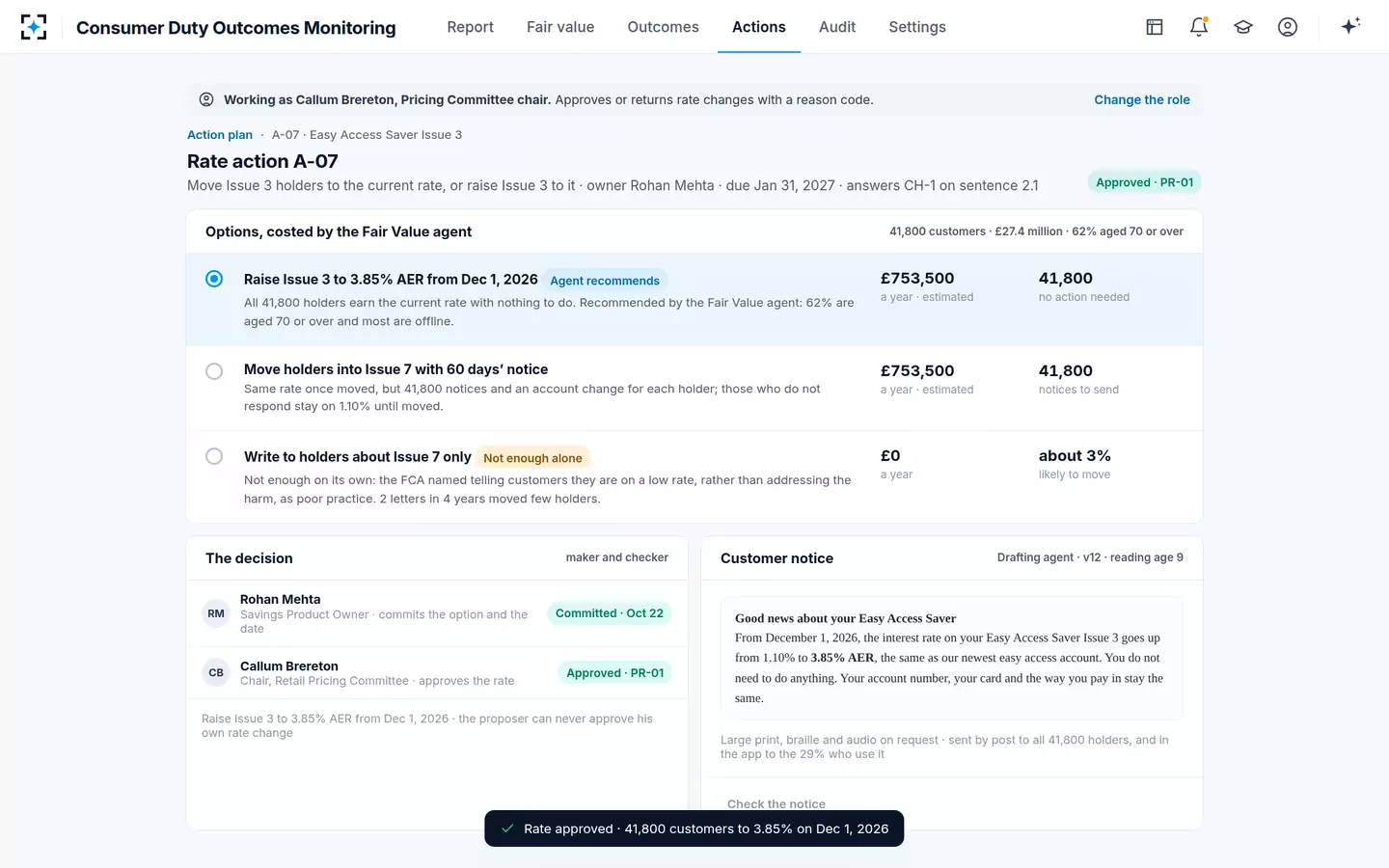
The board then sees the finding, the action, its owner and its date in one sentence of the report. To see the assessment and the rate action on the sample bank, start from Consumer Duty Outcomes Monitoring.
Questions people ask
Is the FCA still publishing cash savings updates?
Not routinely. In September 2024 the FCA said it did not anticipate further savings updates unless it identified market-wide concerns not addressed in that publication, and that it would continue to monitor firms' rate changes, including whether they cut rates faster than they had raised them.
What is regressive tiering on a savings account?
Regressive tiering pays a lower rate on larger balances, the reverse of the usual structure. The FCA's September 2024 update said it is not banned but puts firms at greater risk on fair value and target-market fit, and that such accounts need monitoring of whether most balances earn the lower rate and whether larger savers have considered alternatives.
Did the FCA cash savings review lead to fines?
The FCA's published savings updates do not report fines. Its September 2024 update said it would continue to work with firms on their assessments and would consider what action was required where firms did not respond to its concerns.
How fast must banks complete cash ISA transfers?
A voluntary industry agreement sets a minimum of 85% of cash ISA to cash ISA transfers within 7 working days, and the largest nine firms committed to 90%. In the second quarter of 2024 they completed 89%, the FCA reported from UK Finance data.
Does the FCA expect banks to pay the market-leading rate?
No. The FCA said the Duty does not require prices to be low or margins narrow; it requires a reasonable relationship between what customers pay, including any non-financial costs, and the benefits they can reasonably expect. An outlier rate needs evidence of other benefits customers use and value, and the further it lags, the more rigorous the assessment must be.