When are K-1s due to recipients? A partnership must furnish each partner's Schedule K-1 by the date its own Form 1065 is due, counting any extension: March 15 for a calendar-year partnership that files on time, and September 15 for one that takes the automatic six-month extension. For the 2025 tax year those dates were Monday, March 16, 2026, because the 15th fell on a Sunday, and Tuesday, September 15, 2026. The difficulty for the people who receive K-1s is that their own deadlines do not move with the partnership's, and for some recipients, a fund of funds above all, the two dates coincide. Investor tax teams therefore spend March asking for estimates and September racing finals. Botminds' K-1 Aggregation is built for that receiving side: it lists every K-1 each investor entity expects and counts back from that entity's own deadline, not the partnership's.
The examples on this page come from a fictional investor, Quillfield Capital, whose tax team receives 2,512 K-1s a season across 41 investor entities as it runs through the solution. Deadlines are the statutory ones for calendar-year filers, with sources linked.
The K-1 due date against the returns that depend on it, in days after December 31
When are K-1s due to recipients? On the partnership's due date, extensions included
The rule has two parts. The statute requires the partnership to furnish each partner its information on or before the day its return for the year was required to be filed (26 U.S.C. 6031(b)), and the return's own due date is set by section 6072: partnership returns made on a calendar year "shall be filed on or before the 15th day of March following the close of the calendar year" (26 U.S.C. 6072(b)). A fiscal-year partnership uses the 15th day of the third month after its year ends.
The Treasury regulation that implements the K-1 rule counts extensions (26 CFR 1.6031(b)-1T(b)), so when the partnership extends its return, the K-1 date moves with it. That is the whole of the investor's problem in one sentence: the date that governs the K-1 belongs to the partnership, and the partnership alone decides whether it moves.
Is the K-1 deadline March 15? Only for a partnership that does not extend
March 15 is the K-1 deadline only for a calendar-year partnership that files its Form 1065 on time. When the 15th falls on a weekend or legal holiday, a return filed on the next business day is timely, which is why the 2025 returns were due March 16, 2026. Many operating partnerships and simple funds meet it.
Private funds often do not, and not out of neglect. A fund that holds other partnerships cannot finish until it has their K-1s, and a fund with foreign investments needs its underlying funds' K-3 detail; the tier-by-tier cascade explains why the top of a chain extends almost by necessity. For an investor, March 15 is best treated as the date to receive estimates, not finals.
What is the K-1 extension deadline? September 15, with no second extension
The K-1 extension deadline for a calendar-year partnership is September 15: the regulation grants an automatic six-month extension, requested on Form 7004, and rules out a second one (26 CFR 1.6081-2(a)). The six months run from the original due date, so the 2026 extended date is Tuesday, September 15.
After that date a K-1 is late, and the partnership, not the partner, faces the penalty. The same regulation is explicit that the partnership's extension does nothing for the partner's own return or tax payment. The cost of that asymmetry for the investor, mostly in estimated payments and interest, is priced in the estimated tax guide.
When are K-1s due to investors with deadlines of their own?
Every recipient's room for a late K-1 is the gap between September 15 and its own extended deadline, and that gap ranges from zero to about two months. The table sets out the main recipients of fund K-1s, their returns and the dates that bind them.
Who receives K-1s, and how many days a September 15 K-1 leaves them
| Recipient | Return | Due | Extended to | Room after Sep 15 |
|---|---|---|---|---|
| Fund of funds, feeder or family partnership | Form 1065 | Mar 16, 2026 | Sep 15, 2026 | 0 days: its own K-1s are due the same day |
| Trust or estate | Form 1041 | Apr 15 | Sep 30 (five and a half months) | 15 days, and its own K-1s to beneficiaries are due with its return |
| Individual | Form 1040 | Apr 15 | Oct 15 (Form 4868) | 30 days |
| C corporation | Form 1120 | Apr 15 | Oct 15 (Form 7004) | 30 days |
| IRA or pension trust with UBTI | Form 990-T | Apr 15 (4th month) | Oct 15 (Form 8868) | 30 days, but the tax is due in April |
| Endowment, foundation or other exempt organisation with UBTI | Form 990-T | May 15 (5th month) | Nov 16 (Form 8868) | About two months |
The 990-T rows deserve a second look. The IRS requires "an IRA (including SEPs and SIMPLEs), a Roth IRA, a Coverdell ESA, or an Archer MSA" and an employees' trust under section 401(a) to file Form 990-T "by the 15th day of the 4th month after the end of its tax year," while "All other organizations must file Form 990-T by the 15th day of the 5th month" (Instructions for Form 990-T, 2025). Form 8868 gives either an automatic six-month extension (Instructions for Form 8868), but the unrelated business income tax itself is due on the original date. A pension fund in a real estate fund that extends will usually pay its UBTI tax on an estimate.
When are K-1s due to trust beneficiaries? The fifteen-day squeeze
A trust's own K-1s, the Schedule K-1 of Form 1041, are due to its beneficiaries on or before the date the trust's return is required to be filed (26 U.S.C. 6034A(a)). On extension, an estate or trust gets "an automatic 51/2-month extension of time to file" (Instructions for Form 7004), which for a calendar-year trust ends on September 30.
So a family trust that holds private fund interests receives partnership K-1s as late as September 15 and must issue its own K-1s fifteen days later. If a single fund in its portfolio slips past its deadline, the trust either files on an estimate or misses its own date. Family-office controllers who run several trusts feel this more sharply than almost any other recipient, and they are the ones who most need to know in July which funds have not yet given a date.
The season inside an LP tax team, March to September
Because the K-1 calendar is fixed by the partnerships, an investor tax team's year has a shape that repeats. Estimates arrive around the original date and drive the April extensions and payments. Finals trickle in through the summer. Then the extended deadline pulls the slowest funds into a September peak that coincides with the team's own filing dates.
An investor tax team's season: estimates in spring, finals in a September rush
- Close, ask for estimatesJan to mid-Mar
- Estimatesto Apr 15
- Finals trickle inMay to Aug
- PeakSep
- Own returnsto Oct 15
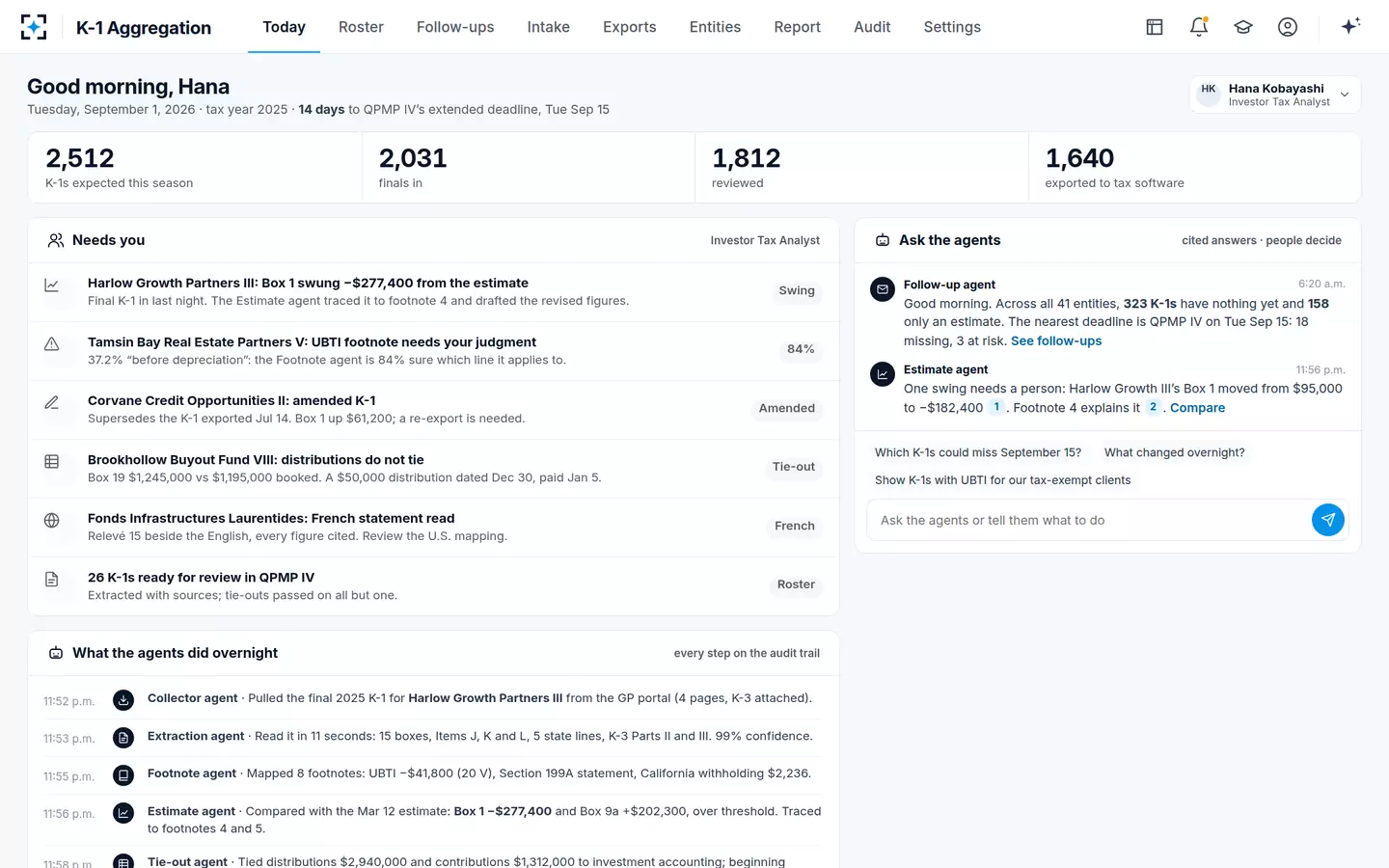
The sample investor's tax team shows the peak in numbers. On Tuesday, September 1, 2026, across its 41 entities, it expected 2,512 K-1s; 2,031 finals had arrived, 1,812 had been reviewed and 1,640 exported to the tax software. Across all entities, 323 finals had nothing yet and 158 had only an estimate. For one entity, a fund of funds due on September 15, eighteen K-1s were missing with fourteen days to go.
One analyst's home on September 1: what is in, what needs her, what the agents did overnight
Four people, one season
The season is shared across seats, and each one feels the K-1 calendar differently. The analyst feels it as a queue, the manager as a sign-off, operations as a list of GPs to call, and internal audit as a reconstruction after the fact.
Who works the K-1 season, and what changes when agents take the mechanical part
Today
Logs in portal by portal, re-keys every K-1 and hunts for UBTI and state withholding in the footnotes.
With agents
Opens each K-1 already read, cited and tied out, and spends her time on swings and footnotes the agents put to her.
Still theirs: Every judgment on a footnote, every acceptance of a final over an estimate.
Today
Signs off exports built in spreadsheets, with no quick view of what moved from the estimate and why.
With agents
Sees what changes in the tax software, the footnote behind it and the export checks, then approves.
Still theirs: Approval of every export; the preparer never approves their own.
Today
Works out which GP to call from a spreadsheet of missing K-1s and old emails.
With agents
Gets escalations drafted back from each deadline, with each GP’s promised date.
Still theirs: Approval of every message that goes to a GP.
Today
Reconstructs who changed which value, and why, from email threads after the season.
With agents
Reads every action by people and agents with its reason and evidence on one trail.
Still theirs: The question of whether the controls worked.
When should I receive my K-1? Ask for a date, then hold the GP to it
Legally, by the partnership's due date: March 15 or, on extension, September 15 for a calendar-year fund. Practically, an investor should expect an estimate around the original date and a final whenever the fund's own lower-tier K-1s allow, and should ask each GP for both in writing. A promised date is the only one an investor can plan against.
The IRS puts the reading duty on the partner once the K-1 arrives: the partnership reports the partner's share, and "It’s the partner’s responsibility to consider and apply any applicable limitations" (Partner's Instructions for Schedule K-1, 2025). Every day between arrival and the investor's own deadline is time for that work, which is why a promised date of September 14 is not good news for a fund of funds due on the 15th. The footnotes on each K-1 show how much there is to do with each one.
Counting back from each investor entity's own deadline
A tracker that counts toward the partnership's September 15 treats every investor the same. One that counts back from the investor's own date treats a fund of funds due September 15, a trust due September 30 and an individual due October 15 as the three different problems they are. In K-1 Aggregation the Follow-up agent does the second: reminders at 45, 30 and 21 days before each entity's extended deadline, an escalation to the GP's head of investor relations at 14, a placeholder plan at 7.
Where K-1s arrive, and which GP portals need attention
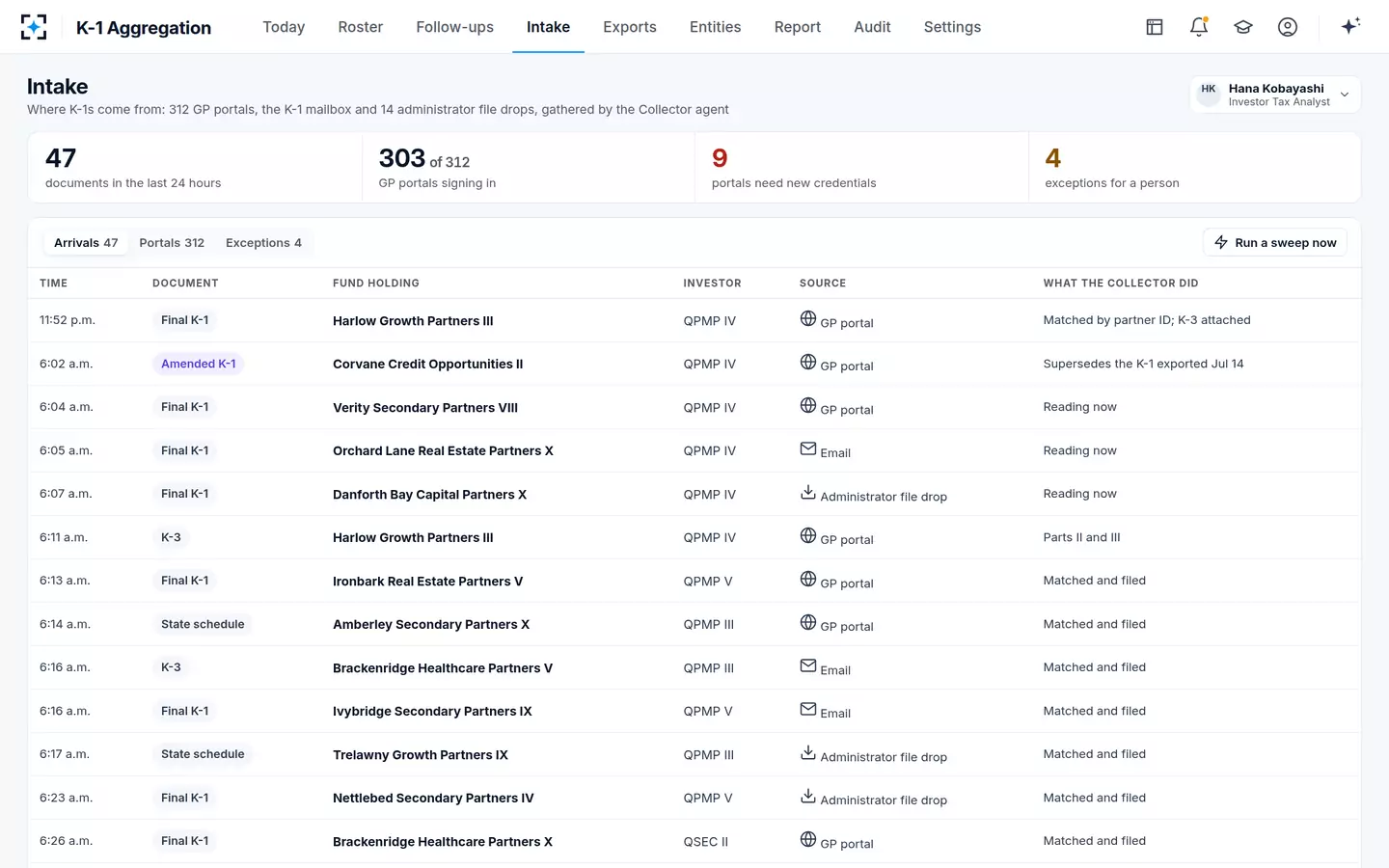
The cadence and the placeholder rule are settings the tax manager approves, and every promised date a GP gives is read from its reply and set against the investor's date. The point is that the September peak is predictable from March onward; see how the roster, follow-ups and exports fit together on the K-1 Aggregation page.
Questions people ask
When are K-1s due to partners?
On or before the day the partnership's return is due, counting extensions. For a calendar-year partnership that is March 15, or September 15 if it files Form 7004 for the automatic six-month extension. In 2026 the original date rolled to March 16 because the 15th was a Sunday.
When do K-1s come out?
Simple partnerships often send K-1s by the original March date. Private funds that hold other partnerships or invest abroad commonly extend and send estimates in spring and finals between spring and mid-September. A fund of funds tends to send last, because it must wait for every fund it holds.
When are K-1s due to trust beneficiaries?
A trust or estate must furnish its beneficiaries' K-1s on or before the date its Form 1041 is due, which is April 15 for a calendar-year trust or September 30 on the five-and-a-half-month extension. A trust holding partnership interests can receive fund K-1s on September 15 and owe its own fifteen days later.
Do K-1s have to be mailed by the due date, or received?
The statute requires the partnership to furnish the K-1 on or before its return's due date; partnerships commonly meet that by posting to an investor portal or sending by mail. For planning, an investor should treat a K-1 as arrived only when it is in hand and readable, and track portal access as carefully as mail.
Does the partnership's extension give me more time to file?
No. The regulation that grants the partnership its six-month extension states that it does not extend the time for filing a partner's return or paying the partner's tax. Individuals extend separately on Form 4868, to October 15, 2026 for most calendar-year taxpayers.