What is a K-1 estimate? It is a general partner's forecast of the amounts an investor's final Schedule K-1 will show, sent in spring, usually around the partnership's original March due date, when the partnership has extended its return. It lets the investor extend its own return, make tax payments and, if the final is still missing at its deadline, file on estimated amounts. It is not a K-1: no IRS form or instruction defines an estimate, the partnership does not file it, and the final can differ from it in amount and in character. For an investor holding hundreds of fund interests, much of K-1 aggregation, the work of collecting and extracting every K-1 owed, is managing that gap: knowing which K-1s are still estimates, and catching the swing when each final lands. Botminds' K-1 Aggregation compares every final with its estimate box by box, traces each swing to the footnote behind it, and asks a person to decide.
The worked swing on this page is from fictional sample data in the solution: a final K-1 from Harlow Growth Partners III to a fictional fund of funds, Quillfield Private Markets Partners IV.
One final against its March estimate: two boxes moved, three new lines appeared
What is a K-1 estimate? A forecast with no form of its own
A K-1 estimate is the partnership's best view of each box before its own inputs are final: lower-tier K-1s, the audit, valuations and allocations still in progress. Funds send them because investors need numbers to plan with in April, when their own returns and first estimated payments fall due and the K-1 may be five months away.
What an estimate is not matters as much. The K-1 the law requires is the one the partnership furnishes by its return's due date (26 U.S.C. 6031(b)), and the partnership files a copy with the IRS. An estimate is neither filed nor bound by any rule about its format or its completeness. It may cover Boxes 1 to 10 and nothing else, leave UBTI, state and K-3 detail for the final, or be a range rather than a number. The first question to ask of an estimate is what it leaves out.
Is a pro forma K-1 an estimate?
In practice, yes: GPs use "estimate", "pro forma", "draft" and "preliminary" for the same thing, a set of figures sent before the final K-1. None of these terms appears in the IRS's K-1 rules, so none changes the legal position. Until the final arrives, the investor holds information, not a K-1, and the partner's duty to report consistently with the partnership's return attaches to what the partnership actually files.
The naming does matter in one way: some GPs send a "draft K-1" on the K-1 form itself, with every box filled. It looks final and is not. An investor's process should mark every document by what it is, estimate or final, from the moment it arrives, so a draft is never exported as a final by mistake.
Can I file with an estimated K-1?
Yes, and the IRS's own instructions describe how. When a partner reports an item the partnership has not yet reported to it, Form 8082 is the notice, and the instructions anticipate exactly this case.
"If you didn’t receive a Schedule K-1, Schedule K-3, Schedule Q, and/or foreign trust statement but are still reporting estimated amounts on your original filing, enter a complete description of the item and where you’re reporting the estimated amount on your original return."
IRS, Instructions for Form 8082 (Rev. October 2025), Part II, column (a)
Filing on an estimate is a choice made under deadline, not a default. An individual investor can usually extend to October 15 and wait; a fund of funds has the same September 15 as the funds it holds and often cannot. The partnership's own extension does not move the partner's deadline (26 CFR 1.6081-2(e)), which is why some investors have no option but to file with estimates for a handful of holdings and correct later.
K-1 estimate vs final K-1: what changes, in amount and in character
A final K-1 can differ from its estimate in two ways, and the second is the one that hurts. A change in amount moves tax up or down. A change in character moves income from one line of the return to another, ordinary to capital, taxable to exempt, domestic to foreign, and can create filings the investor did not plan for.
The IRS draws the same line between amount and character in its own forms. Form 8082 has separate boxes for disputing the amount of an item and its treatment, and the instructions give as an example of a treatment issue "a long-term capital loss that a partner thinks should be an ordinary loss" (Instructions for Form 8082). A swing review should keep the same two columns: how much moved, and whether anything moved to a different line.
A K-1 estimate and a final K-1 are different documents
K-1 estimate: Information from the GP; not filed with the IRS.
Final K-1: The statement the partnership must furnish; a copy is filed with its return.
K-1 estimate: Usually spring, around the original due date.
Final K-1: By the return’s due date, September 15 on extension for a calendar year.
K-1 estimate: Often the main income boxes only; may omit codes and statements.
Final K-1: Every box and code, Items J, K and L, statements, and the K-3 when required.
K-1 estimate: May assume last year’s mix of ordinary and capital income.
Final K-1: Reflects the year’s actual events, such as a recapitalization loss or a sale.
K-1 estimate: UBTI may be missing or marked as to come.
Final K-1: Box 20 code V and its statement for partners that told the fund they are exempt.
K-1 estimate: None attaches to the estimate itself.
Final K-1: The partner reports consistently with it, or explains the difference on Form 8082.
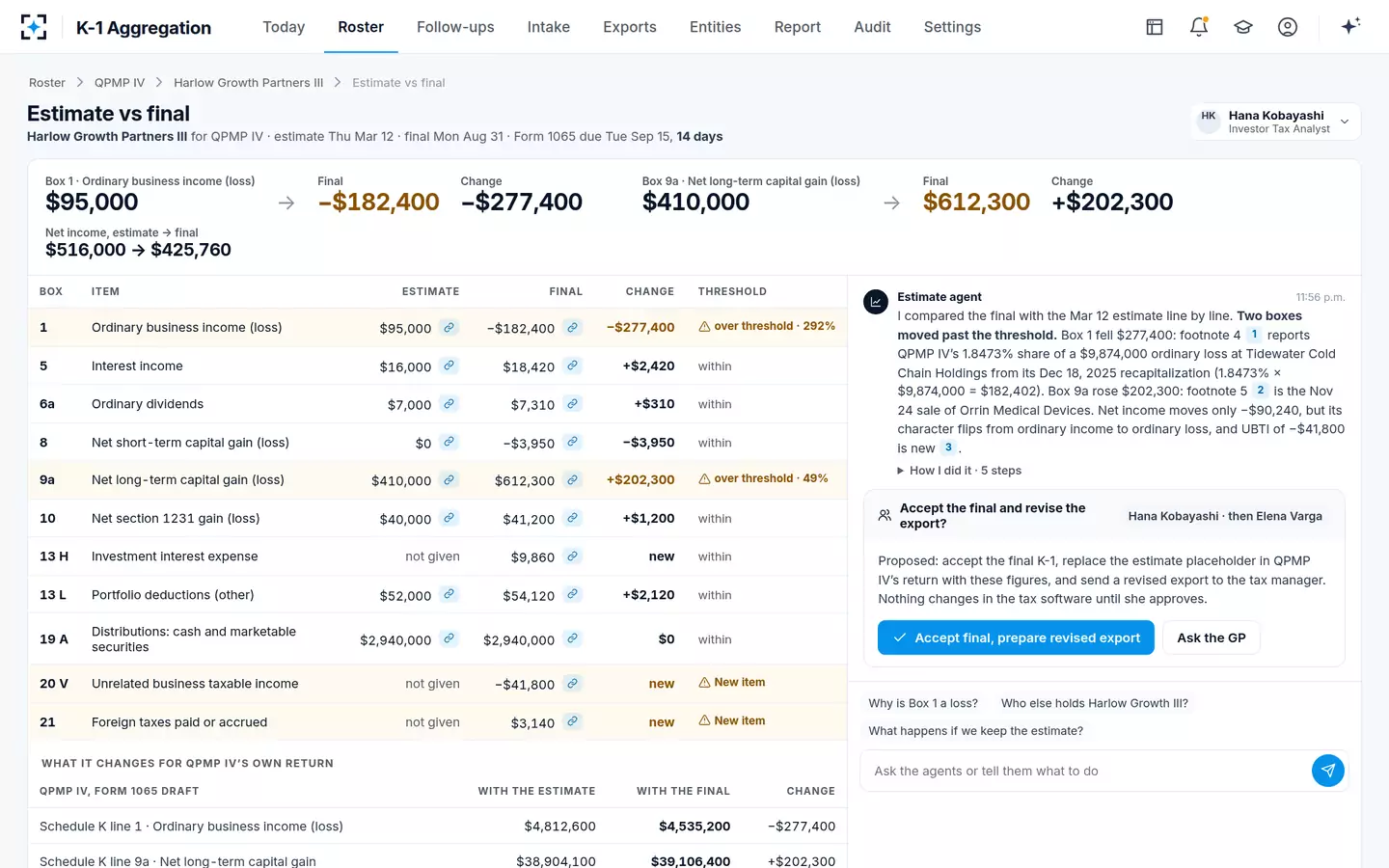
The sample swing shows both kinds. Box 1 fell from $95,000 of ordinary income on the March 12 estimate to an ordinary loss of $182,400 on the August 31 final, a change of $277,400. Footnote 4 explains it: the fund of funds' 1.8473% share of a $9,874,000 ordinary loss at a portfolio company, Tidewater Cold Chain Holdings, from its December 18, 2025 recapitalization. Box 9a rose $202,300 on footnote 5, the November 24 sale of another holding. Net income moved far less than either box, from $516,000 to $425,760, but its character flipped, and a UBTI line of −$41,800 appeared that the estimate never mentioned.
Estimate against final, box by box, with what it changes in the investor's own return
How accurate are K-1 estimates? Measure your own funds
No regulator or independent study publishes how far final K-1s move from their estimates, and the answer varies by fund strategy and by year. A buyout fund in a year of recapitalizations and exits will swing more than a credit fund collecting interest. The useful figure is your own, by GP, and it can be built from last season's documents.
The method is simple: for every holding that sent an estimate, list each box on the estimate and the final, compute the change in dollars and as a share of the estimate, and mark changes in character and items that appear only on the final. Rank GPs by how often their estimates crossed your threshold, and keep the result by strategy as well as by GP, because a fund's estimate quality usually tracks the kind of year its portfolio had. The ranking tells you where a placeholder is a reasonable bet and where it is a guess, and it gives operations a fact to take to a GP whose estimates are routinely wrong.
Two refinements make the measure honest. Count items that appear only on the final, such as a first UBTI line or a K-3 part, as swings of their full amount, since the estimate gave nothing to plan with. And measure at the level of the investor's return as well as the box: a fund whose Box 1 and Box 9a move in opposite directions may leave total income almost unchanged while moving tens of thousands of dollars between tax rates, as the sample did.
Which swings matter: thresholds by amount, by share and by character
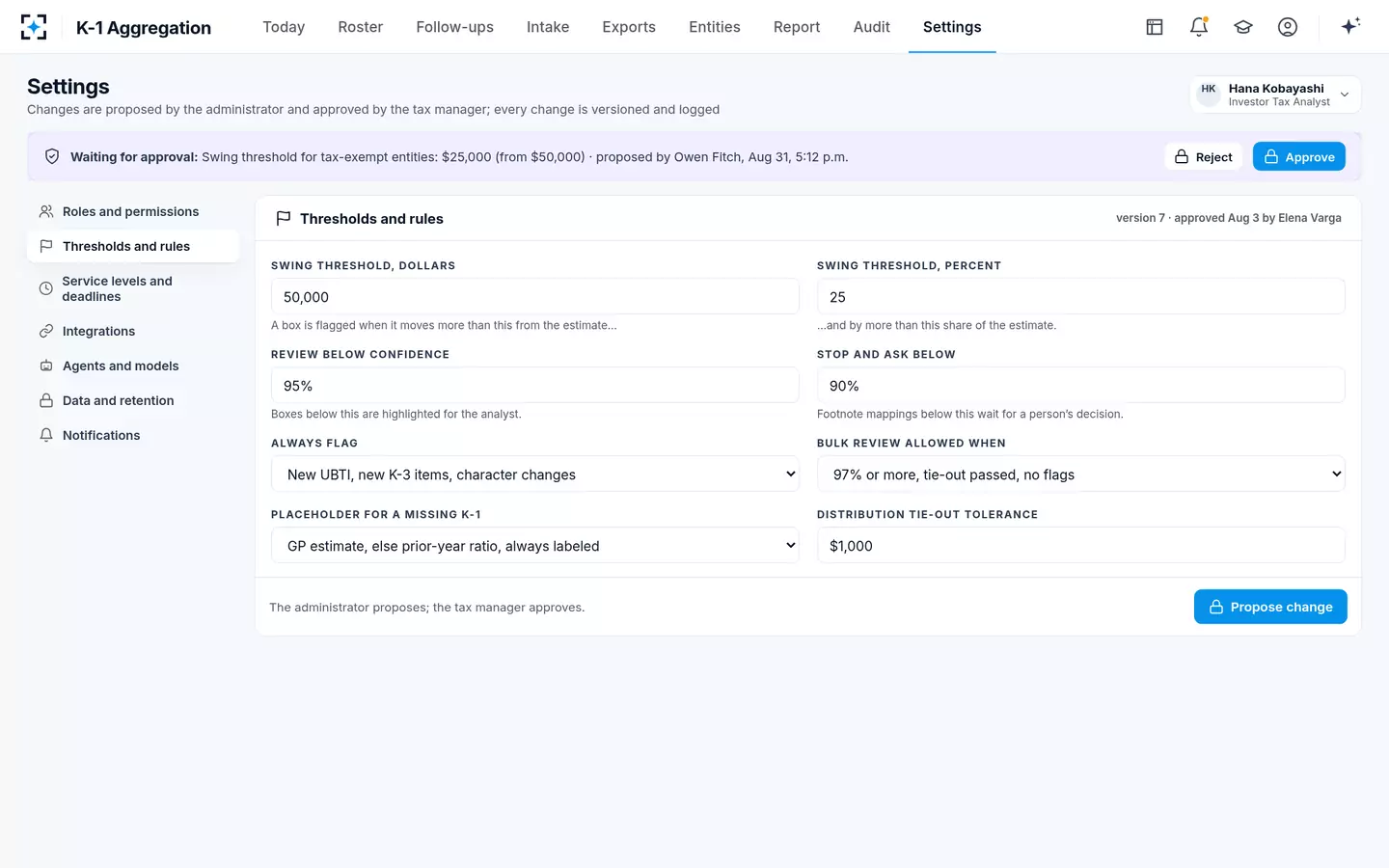
A swing matters when it changes the investor's return enough to act on, and a single dollar rule misses the cases that matter most. A threshold should combine an amount, a share of the estimate and a list of changes that are flagged whatever their size. The table is one way to write that policy; the first three rows are the solution's default settings.
A swing policy an investor tax team can write down
| Rule | Default in the sample settings | Why it is there |
|---|---|---|
| Amount and share together | $50,000 and 25% of the estimate on a box | Either alone floods the queue: small boxes swing by large shares, large boxes by large amounts. |
| Always flagged | New UBTI, new K-3 items, any change in character | These change filings and other investors’ returns whatever the amount. |
| Who decides | The analyst accepts the final with a reason; the tax manager approves the revised export | A swing is a judgment, and the person who prepared it does not approve it. |
| Lower thresholds for exempt investors | A proposed change to $25,000 for tax-exempt entities, awaiting approval | UBTI can create a Form 990-T obligation from a small amount. |
| Placeholders | GP estimate, else prior-year ratio, always labeled | A missing final should never be indistinguishable from a received one. |
The thresholds are settings, versioned and approved
What if my final K-1 differs from the estimate?
Then the route depends on whether you have already filed. If you have not, use the final: report it, and the estimate is history. If you filed on the estimate, compare the final with what you reported, and if the difference matters, file an amended return. If you reported the estimated amounts with a Form 8082, the final is the document your amended return now has to match.
For a fund of funds, the question has a second half: its own partners. If it already issued K-1s on an estimate and the final changes them, it is in the partnership's position, correcting a filed return. Under the centralized audit regime a partnership generally cannot simply issue amended K-1s after filing and instead files an administrative adjustment request; the AAR-versus-amended-return guide covers that side. From the receiving side, what an investor does when an amended K-1 or a Form 8986 arrives follows each branch.
The sample shows why the decision is worth a minute of explanation. Had the fund of funds filed with Harlow's estimate, its return would have overstated ordinary income by $277,400 and understated long-term gain by $202,300, its 214 tax-exempt partners would have missed the UBTI, and amended K-1s for all 1,912 partners would have followed. With fourteen days left, the analyst accepted the final with a reason code, and the tax manager approved the revised export.
A placeholder must say it is one
Some K-1s will not arrive in time, so some returns will carry placeholders. The danger is not the placeholder; it is forgetting it. A placeholder exported into the tax software as an ordinary value looks, a year later, exactly like a reviewed K-1. In the sample season, 26 estimates were exported as labeled placeholders in a single export of 64 K-1s, each listed for amendment when its final arrives.
The rule worth adopting whatever tools are in use: every value in the return should be traceable to a final K-1, or visibly marked as an estimate with the date and the source. K-1 Aggregation enforces that rule in its export checks, and its Estimate agent proposes but never accepts a final. See how the comparison, the reason codes and the approval fit together on the K-1 Aggregation page.
Questions people ask
What is a K-1 swing?
The difference between an amount on a K-1 estimate and the same amount on the final K-1. A useful swing policy flags by amount and by share of the estimate together, $50,000 and 25% in the sample settings, and flags new UBTI, new K-3 items and changes of character whatever their size.
Do I need to amend my return if the K-1 changes?
If you filed using estimated amounts and the final K-1 differs in a way that changes your tax or the treatment of an item, yes, you would normally amend so your return matches what the partnership reported. Partners must report consistently with the partnership's return or explain the difference on Form 8082.
Why did my K-1 estimate leave out UBTI?
Estimates often cover only the main income boxes, because unrelated business taxable income depends on lower-tier detail that arrives late. In the sample, a UBTI line of −$41,800 appeared only on the final. Ask each GP whether its estimate includes UBTI, state and K-3 items.
Is a K-1 estimate binding on the partnership?
No. An estimate is information, not the statement the partnership must furnish and file. The partnership's obligation is to the final K-1 it furnishes by its return's due date, and the investor's reporting duty attaches to that.
Should I pay estimated tax on a K-1 estimate?
Paying on the estimate is how most investors avoid an underpayment while the final is outstanding, because the partnership's extension does not extend the time to pay. If the estimate later proves low, the shortfall carries interest; the trade-off is priced in the guide to K-1 estimated tax payments.