K-1 footnotes are the supplemental statements a partnership attaches to each partner's Schedule K-1 for information that cannot sit in a box as a single dollar amount. On a private fund's K-1 they carry most of what an institutional investor's tax team needs beyond the year's income: the unrelated business taxable income a tax-exempt partner must report, the Section 199A figures an individual partner's deduction depends on, state-by-state sourcing and withholding, the foreign items now on Schedule K-3, and the explanations for a swing from the estimate or a distribution that does not tie. The IRS treats them as part of the K-1: a partner must report the K-1 "and any attached statements" the way the partnership did. They are hard because every fund writes them differently, often as a percentage of another line, across hundreds of K-1s that arrive in the same few weeks. Botminds' K-1 Aggregation reads each footnote, maps it to a tax code with its page cited, and stops for a person when the wording is ambiguous.
The examples are sample data on a fictional fund of funds and its fictional underlying funds, as they run through the solution.
One season's footnotes at a sample fund of funds
214
K-1s expected from underlying funds, each with its own statements
8
footnotes mapped on one growth fund's final K-1, in seconds
−$41,800
UBTI that appeared only in a footnote, new since the estimate
1,912
partners who would have received amended K-1s had the estimate stood
Why do fund K-1s put so much in footnotes?
Because the form's boxes take one dollar amount each, and much of what a fund must tell its partners is not one amount. The IRS instructions describe the mechanism: the partnership enters an asterisk after a code "for each item for which it has attached a statement providing additional information", and "for those informational items that can't be reported as a single dollar amount, the partnership will enter an asterisk (*) in the left column and enter 'STMT' in the dollar amount entry space" (IRS, Partner's Instructions for Schedule K-1 (Form 1065), 2025).
The statements are not optional reading. The same instructions say a partner in a partnership under the centralised audit regime "must report the items shown on your Schedule K-1 (and any attached statements) the same way that the partnership treated the items on its return", or file Form 8082 to flag the inconsistency. For an investor tax team, a footnote left unread is a position taken by default, and for a fund of funds it is a position passed on to every one of its own partners.
Private funds use statements heavily because their partners differ. A tax-exempt endowment needs UBTI, an individual needs Section 199A, a foreign partner needs effectively connected income, a resident of one state needs sourcing for another. The fund cannot fit all of that in twenty boxes, so the box often says "STMT" and the substance is on page 3 of a 14-page package.
The footnotes an LP tax team must capture, and who uses each
An institutional LP's tax team captures six kinds of footnote, each feeding a different return or a different partner. The table sorts them by where the information ends up, which is also the order in which a missed one hurts.
Six kinds of K-1 footnote, what each carries and where it lands
| Footnote | What it carries | Who needs it | Where it lands |
|---|---|---|---|
| UBTI (Box 20, code V) | Income and deductions from unrelated business and debt-financed property, often as a percentage of another line | Tax-exempt partners; a fund of funds passing through to them | Form 990-T, or the partner's own K-1s |
| Section 199A (Box 20, code Z) | Qualified business income, W-2 wages, property basis, REIT dividends and PTP income | Individuals, trusts, and pass-throughs with such partners | Form 8995 or 8995-A |
| State sourcing and withholding | Income by state, nonresident withholding, composite filing elections | Partners filing or credited in each state | State returns and credits |
| Foreign items (Schedule K-3) | Income by source and basket, foreign taxes, foreign partnership reporting | Partners claiming credits; foreign partners | Form 1116, Forms 8865 and 1042-S |
| Explanations of movement | Why a box changed from the estimate, or a gain's character | The tax team deciding whether to accept a final | Review notes and the investor's own return |
| Capital and distribution detail | Timing of distributions and contributions, basis-related items | Investment accounting and tie-out | Reconciliation to the books |
The fund-of-funds column matters most. A fund of funds is both an LP receiving K-1s and a partnership issuing them, so each underlying fund's footnote becomes an input to its own Schedule K-1s. In the sample, the fund of funds has 214 tax-exempt partners; a UBTI line missed at one underlying fund is a UBTI line missing from 214 K-1s.
UBTI footnotes: a percentage of a line, and a base to choose
UBTI footnotes are the hardest to capture because funds often state them as a percentage of another figure rather than as a dollar amount. The IRS instructions say only that the partnership "will report any information you need to figure unrelated business taxable income under section 512(a)(1)" for a tax-exempt partner, and add a tip that matters for the LP: "A partner is required to notify the partnership of its tax-exempt status." Where to find the number on the form is covered in where UBTI is reported on a K-1; the harder question is what the footnote means.
Debt-financed income shows why. Section 514 includes in UBTI the same percentage of a property's gross income as "the average acquisition indebtedness … for the taxable year with respect to the property is of … the average amount … of the adjusted basis of such property", and applies a matching percentage to its deductions (26 U.S.C. 514(a)). A fund that states the percentage but describes the base loosely leaves the LP to decide which line it multiplies.
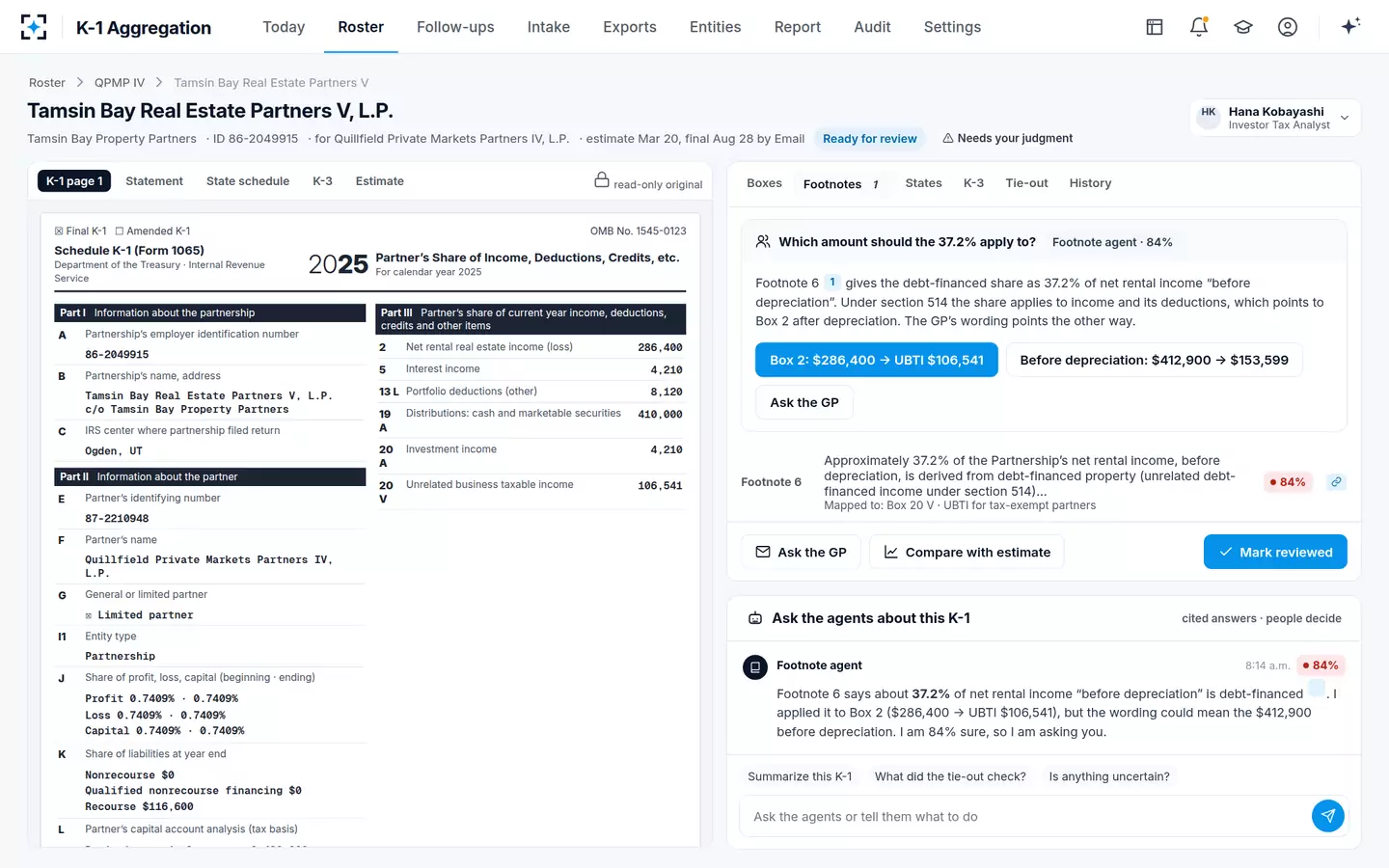
One real estate fund's UBTI footnote, two readings
Box 2, after depreciation: Debt-financed share 37.2% of net rental income "before depreciation"
Rental income before depreciation: The same words
Box 2, after depreciation: Section 514 applies the share to income and its deductions, which points to Box 2
Rental income before depreciation: The fund's wording points to the figure before depreciation
Box 2, after depreciation: $286,400
Rental income before depreciation: $412,900
Box 2, after depreciation: $106,541
Rental income before depreciation: $153,599
Box 2, after depreciation: Put both readings to the analyst at 84% confidence, below its 90% line
Rental income before depreciation: Offered a third choice: ask the fund before deciding
A team capturing UBTI at volume needs a rule for this case, written down: who decides, whether the fund is asked, and how the decision is documented for the next year, when the same fund will probably write the same footnote.
Section 199A statements: who on the cap table needs them
Section 199A statements matter to the partners who can take the qualified business income deduction: individuals, trusts and estates, and pass-throughs whose own partners are. The IRS instructions put it in one line: "Generally, you may be allowed a deduction of up to 20% of your net qualified business income (QBI) plus 20% of your qualified REIT dividends … and qualified PTP income from your partnership. The partnership will provide the information you need to figure your deduction."
For a tax-exempt endowment the code Z statement is largely irrelevant. For a fund of funds with individual partners, it is information to pass through, trade or business by trade or business, with W-2 wages and property basis where the fund gives them. The capture problem is format: funds present the statement as a table per activity, often across pages, and the activity numbers have to survive into the tax software import so the partner-level figures can be rebuilt.
State sourcing and withholding: the footnote that changes cash
State footnotes allocate income by state and report tax withheld on the partner's behalf, and they are the footnotes most likely to involve money already paid. A nonresident withholding amount is a credit the partner can claim only if it is captured; a composite filing election changes whether the partner files at all in that state.
In the sample, one growth fund's final K-1 carried California withholding of $2,236 in a footnote, beside five state lines. Each state's rules differ, so the capture step should do no state analysis of its own; it should get every state line, every withholding amount and every election into the tax software with the page it came from, and leave the state positions to the people who file.
Foreign items moved to Schedule K-3
International tax items no longer live in K-1 footnotes alone; they sit in Schedule K-3, which can run to thirteen parts. The IRS instructions describe Part II as the part "used to determine your distributive share of partnership income and loss by source and separate category", and later parts serve foreign partners, including the information they need for Form 1042-S (IRS, Partner's Instructions for Schedule K-3, 2025). Only some parts apply to a given partner, which is why a capture process should record which parts were provided as well as their values.
Foreign partnerships add a language and a currency. In the sample, a Québec infrastructure limited partnership reported on a Relevé 15 in French. The solution read the original beside an English workpaper and converted at the Bank of Canada annual average of CAD 1 = USD 0.7300: net business income of CAD 412,880 became $301,402, and CAD 41,290 withheld on distributions mapped to a foreign tax credit of $30,142. The workpaper noted that the fund of funds reports that partnership on Form 8865.
Footnotes that explain why a number moved
Some footnotes carry no new tax item at all; they explain a box, and they decide whether a tax team accepts a final K-1 that differs from the estimate. In the sample, a growth fund's Box 1 fell from $95,000 on the March estimate to −$182,400 on the final. Footnote 4 explained it: the fund of funds' 1.8473% share of a $9,874,000 ordinary loss at a portfolio company, from its December recapitalisation.
What one footnote-explained swing would have cost if the estimate had stood
A distribution footnote does the same for the books. In the sample, a buyout fund reported $1,245,000 of distributions in Box 19, code A, while investment accounting had booked $1,195,000. Footnote 8 said $50,000 was declared at the end of December and paid in early January, so the custodian booked it in the new year. The break was explained before anyone posted an adjustment. How a final can move from its estimate, and how far, is the subject of what a K-1 estimate is, and the swing.
How does an LP tax team capture K-1 footnotes at volume?
By separating reading from judgement and keeping every value cited to its page. A tax team that re-keys footnotes from PDFs into spreadsheets spends its season typing; one that has the reading done for it spends the season on the dozen footnotes that need a decision. The solution's own estimate for one K-1 in season at a large LP puts re-keying the boxes, the items and the K-3 at about a business day by hand.
How K-1 Aggregation turns a fund's footnotes into tax-ready data
Agent
Collector agentPulls each K-1, K-3, estimate and amended K-1 from GP portals, the mailbox and administrators' file drops, and matches it to the holding.
Never: Never accepts new portal terms or changes MFA
Agent
Extraction agentReads every box, code, item and K-3 part, in any language, and cites the page for each value.
Never: Never fills a blank
Agent
Footnote agentMaps supplemental statements to tax codes: UBTI and debt-financed ratios, Section 199A, state sourcing and withholding.
Never: Never guesses a percentage; below 90% it stops
A person decides
Investor tax analystDecides the ambiguous footnotes and the swings over threshold, with a reason code.
Agent
Export agentBuilds the tax software import with activity numbers and runs its 12 checks.
A person decides
Tax managerSees exactly what changes in the tax software and approves; the preparer never approves their own export.
K-1 Aggregation stops on an ambiguous UBTI footnote and asks
Controls a tax manager can test on footnotes
Footnote capture fails in recognisable ways: a statement never opened, a percentage applied to the wrong base, a state withholding amount dropped, a K-3 part assumed not to apply. Each can be tested before the export reaches the tax software, and again in review.
Eight checks on a season's K-1 footnotes
- Was every STMT and asterisk followed to its statement?
A box that says STMT with no captured statement is an open item, not a zero.
- Does each UBTI percentage name its base?
Where it does not, the reading chosen and the reason are written down, or the fund is asked.
- Were Section 199A figures kept by activity?
So partner-level figures can be rebuilt for individuals and pass-throughs.
- Was every state line and withholding amount captured?
Withholding is a credit only if someone claims it.
- Was the list of K-3 parts provided recorded?
Parts not provided are a question for the fund, not an assumption.
- Was every swing over threshold traced to a footnote?
Accepting a final is a decision with a reason code.
- Do distributions tie to the books, with timing footnotes applied?
Break explained before anything is posted.
- Did a second person approve the export?
The preparer is not the approver.
The last check is the one regulators of the investor's own return will never see but auditors of the process will. In the sample, nothing reaches the tax software without two people: the analyst prepares, and the tax manager approves the revised export, 14 days before the fund of funds' own deadline.
What K-1 Aggregation reads in a footnote, and what it leaves to the tax team
The solution reads and maps; the tax team decides. The Footnote agent turns supplemental statements into tax codes with each value cited to its page, but it does not take tax positions: it does not choose a UBTI base when the fund's words allow two, it does not decide state filing positions, and it does not accept a final K-1. The Estimate agent proposes; a person decides every swing over threshold.
A team evaluating any tool for this work can test it on last season's hardest packages: the real estate fund with a percentage-based UBTI footnote, the foreign partnership in another language, the fund whose final moved in character. If the tool produces a confident number for each without asking, it has hidden the decisions rather than made them easier. How to run that test is set out in a K-1 software pilot on last season.
Questions people ask
What are K-1 footnotes?
They are the supplemental statements a partnership attaches to Schedule K-1 for information that cannot be reported as a single dollar amount. The IRS instructions say the partnership marks such items with an asterisk and, where needed, "STMT" in the amount space.
Do K-1 footnotes have to be reported consistently?
Yes. For partnerships under the centralised audit regime, the IRS instructions say partners must report the K-1 "and any attached statements" the same way the partnership treated the items, or file Form 8082 to identify the inconsistency.
Where is Section 199A information on a fund K-1?
In Box 20 under code Z, usually with an attached statement giving qualified business income and related figures by activity. The deduction can be up to 20% of net qualified business income for eligible partners; a tax-exempt partner generally does not need it.
Why does a UBTI footnote give a percentage instead of a number?
Because debt-financed income under section 514 is a percentage of a property's income and deductions, set by its average acquisition indebtedness against its average adjusted basis. Funds often state the percentage and leave the partner to apply it, so the base it applies to must be clear.
How should a fund of funds handle footnotes from underlying funds?
As inputs to its own K-1s: each UBTI, 199A, state and foreign item flows through to its partners. In the sample, one missed UBTI line would have reached 214 tax-exempt partners, and keeping an estimate that a footnote had overtaken would have meant amended K-1s for 1,912.
Are foreign items still reported in K-1 footnotes?
Mostly on Schedule K-3, which has up to thirteen parts covering income by source and category, foreign taxes and information for foreign partners. A capture process should record which parts the fund provided as well as their values.