K-1 software, for an investor, is software that collects the Schedule K-1s and K-3s it receives, tracks which are missing, extracts their values and prepares them for the tax software. The best way to choose it is not a feature list or a demonstration on clean samples but a replay: last season's K-1s, estimates and amended K-1s, run through the tool and compared, field by field, with what the investor's team filed after review. That comparison needs a few weeks and must finish before the K-1 calendar restarts, because estimates begin arriving around the partnerships' March due date and a tool changed in mid-season is changed under deadline. For investors receiving K-1s by the hundred, K-1 aggregation, collecting and extracting every K-1 owed, is the job the software must prove it can do. Botminds' K-1 Aggregation is built to be piloted that way, on a sample of the investor's own documents, with every value cited to its page so each can be checked.
Product examples on this page are fictional sample data in the solution; the pilot design is ours, built on the measurement principles of the US government's AI risk framework, linked below.
The pass-or-fail sheet for a K-1 software pilot
1
Box accuracy
What is replayedEvery box, code and Item J, K and L value on the replayed K-1s, compared with what was filed after review.
Passes whenError rate by field type no worse than your measured manual baseline; every value cited to its page.
2
Footnote mapping
What is replayedStatements for UBTI, Section 199A, state and K-3 items, including the ambiguous footnotes your team argued about last year.
Passes whenNo silent guesses on the known hard cases: each is mapped correctly or sent to a person with both readings.
3
Swing detection
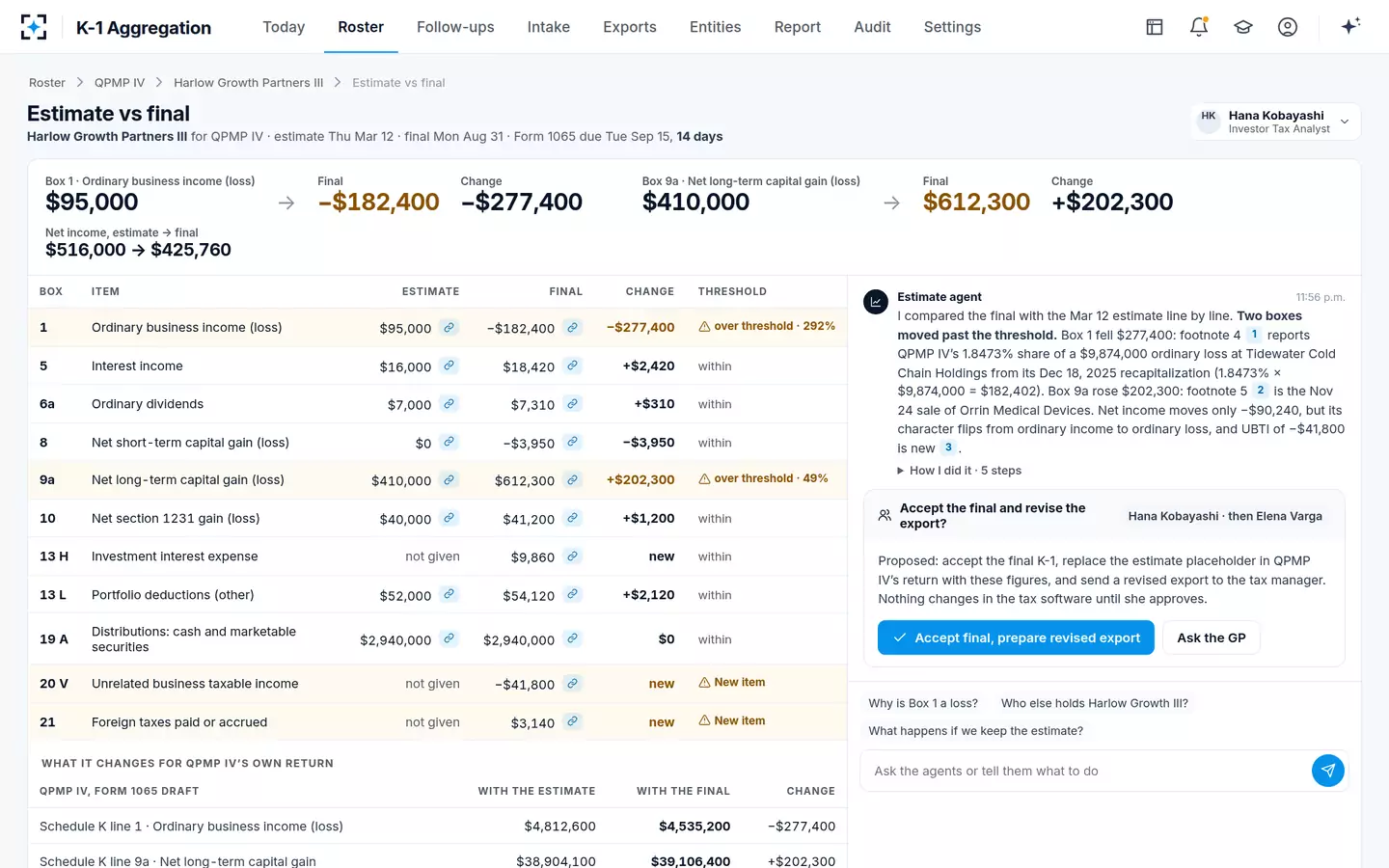
What is replayedLast season’s estimates replayed against their finals, under your own thresholds.
Passes whenEvery swing your team flagged by hand is flagged, with the footnote behind it; character changes and new UBTI always.
4
Corrections
What is replayedAmended K-1s and any Forms 8986 replayed after the originals they replace.
Passes whenEach matched to the document it supersedes, with the difference shown against what was exported.
5
Tie-out and export
What is replayedDistributions, contributions and beginning capital against investment accounting; the export against what was imported.
Passes whenThe breaks your team found are found and explained; federal totals tie box by box; nothing exports without a second person.
What does K-1 software do for an investor?
Three different kinds of software are sold as K-1 software, and a buyer should know which one it is evaluating. Partnership tax software prepares a fund's own return and its partners' K-1s from the fund's books; the fund-side buying guide covers it. Individual and corporate tax software accepts K-1 data and puts it on the right lines of the investor's return. And K-1 aggregation software, sometimes called K-1 scanning software, sits between them: it receives the K-1s, reads them and hands the data to the tax software.
This page is about the third. Its inputs are documents the investor does not control, from GP portals, email and administrators' file drops; its output is data the investor will report as consistent with the partnership's return. That combination, uncontrolled input and a strict consistency duty, is why a pilot on real documents matters more here than for most software.
What is the best K-1 software? The one that passes your own season
No regulator or independent body tests K-1 software, and no vendor publishes an error rate measured on another investor's documents that would mean much for yours. The answer that matters is how a tool performs on your K-1s: your GPs' layouts, your funds' footnotes, your investor entities and your thresholds.
The US government's AI risk framework, written for any AI system, says the same in general terms. NIST's AI Risk Management Framework asks that a system's performance be shown, in numbers or in words, under conditions like the ones it will be used in, with the measures written down (NIST AI 100-1, MEASURE 2.3). It adds that an accuracy figure means little without a realistic test set that looks like real use and a description of how the test was run. Last season is the closest thing to deployment conditions an investor has before deployment: real documents, real layouts and answers already settled.
How do you test K-1 software? Replay last season
Gather last season's documents and outcomes, run the documents through the tool in the order they arrived, and compare what it produces with what your team settled on. The answers are known: the filed returns, the exports and the corrections made since. That makes last season the cheapest realistic test set an investor has, and it is free of the bias of a vendor's chosen samples.
Three design choices keep the replay honest. Use the documents as they arrived, including estimates before finals and amended K-1s after originals, so the tool meets the same sequence your team did. Include the hard cases on purpose, the footnotes argued over, the K-1 that arrived in French, the fund whose distributions never tied, because averages hide them. And fix the pass criteria in writing before the replay starts, so the result cannot be argued into a pass afterwards. How many K-1s are enough depends on the error rate you need to detect; measuring the hand-keyed baseline works through the sample size.
How to score the replay so the result holds up
Score each test as a count against a baseline, with its uncertainty, rather than as an impression. For box accuracy that means the number of wrong fields per thousand, for the tool and for the manual baseline, on the same documents. Suppose the baseline is 0.3% on boxes and the replay covers 11,600 fields: the team's own process would be expected to produce about 35 errors, and the measurement is good to roughly plus or minus 12 at 95% confidence (our arithmetic). A tool with 20 errors on the same fields has beaten the baseline by more than the baseline's own noise; one with 30 has not shown anything yet.
Score the footnote and swing tests differently, because they are about catching specific cases rather than averages. Seed the replay with the hard cases from last season and count how many the tool either got right or sent to a person; a silent wrong answer on any of them is a fail whatever the overall rate. And note, for every value the tool sent to a person, how long the person took to resolve it, because a tool that asks well saves time and one that asks badly only moves it.
The five tests, and why each one is there
Each test on the sheet corresponds to a way K-1 work goes wrong. Box accuracy is the obvious one. Footnote mapping is where interpretation happens and where a tool's confidence matters most. Swing detection protects the return from a final that moved in character. Corrections test whether the tool knows which document supersedes which. Tie-out and export test whether the data reaching the tax software is complete, checked and approved.
How the five tests map to the failure each one catches
| Test | The failure it catches | Why it matters on the return |
|---|---|---|
| Box accuracy | A misread amount, a sign lost, a code on the wrong line | Partners must report consistently with the partnership’s return; an inconsistency can be assessed like a math error. |
| Footnote mapping | A UBTI percentage on the wrong base; a 199A statement missed | UBTI drives Form 990-T for exempt investors; 199A drives an individual’s deduction. |
| Swing detection | A final accepted without noticing a change in character | Income moves between ordinary and capital lines; new items appear that need other filings. |
| Corrections | An amended K-1 treated as new, or ignored | The exported value and the partnership’s amended figures diverge. |
| Tie-out and export | A distribution timing break plugged; totals that do not tie | Errors reach the tax software with no second person having seen them. |
What swing detection looks like when it passes
When should we implement K-1 software? Before the estimates start
Decide by February and go live before mid-March. The K-1 calendar is set by statute: calendar-year partnership returns, and with them the K-1s, are due on the 15th day of March (26 U.S.C. 6072(b)), which is when extending funds send estimates, and from then until September 15 every week brings documents that need to be tracked. A tool brought in during that run inherits a half-finished roster and a team with no time to check it.
A pilot calendar that finishes before the next season starts
- Gather last seasonOct to mid-Nov
- Manual baselineto mid-Dec
- Replay and scoreto end-Jan
- Decide and connectFeb
- Liveby Mar 16
The autumn start has a second advantage: last season is fresh. Corrections and amended K-1s for the prior year have mostly arrived by October, the people who made the hard calls are still there to explain them, and the replay can include the whole season rather than the part that was easy to collect.
Can K-1 software import into tax software?
Yes; that is its purpose. The questions are what it sends, how the tax software knows where each value belongs, and who approves the send. In K-1 Aggregation the Export agent builds the import with activity numbers mapped for every holding, runs twelve checks, from every line coming from a reviewed K-1 to the preparer not being the approver, and labels placeholders so they are amended when finals arrive. Nothing is sent until the tax manager approves.
The export a pilot should check: what changes, which checks passed, who approved
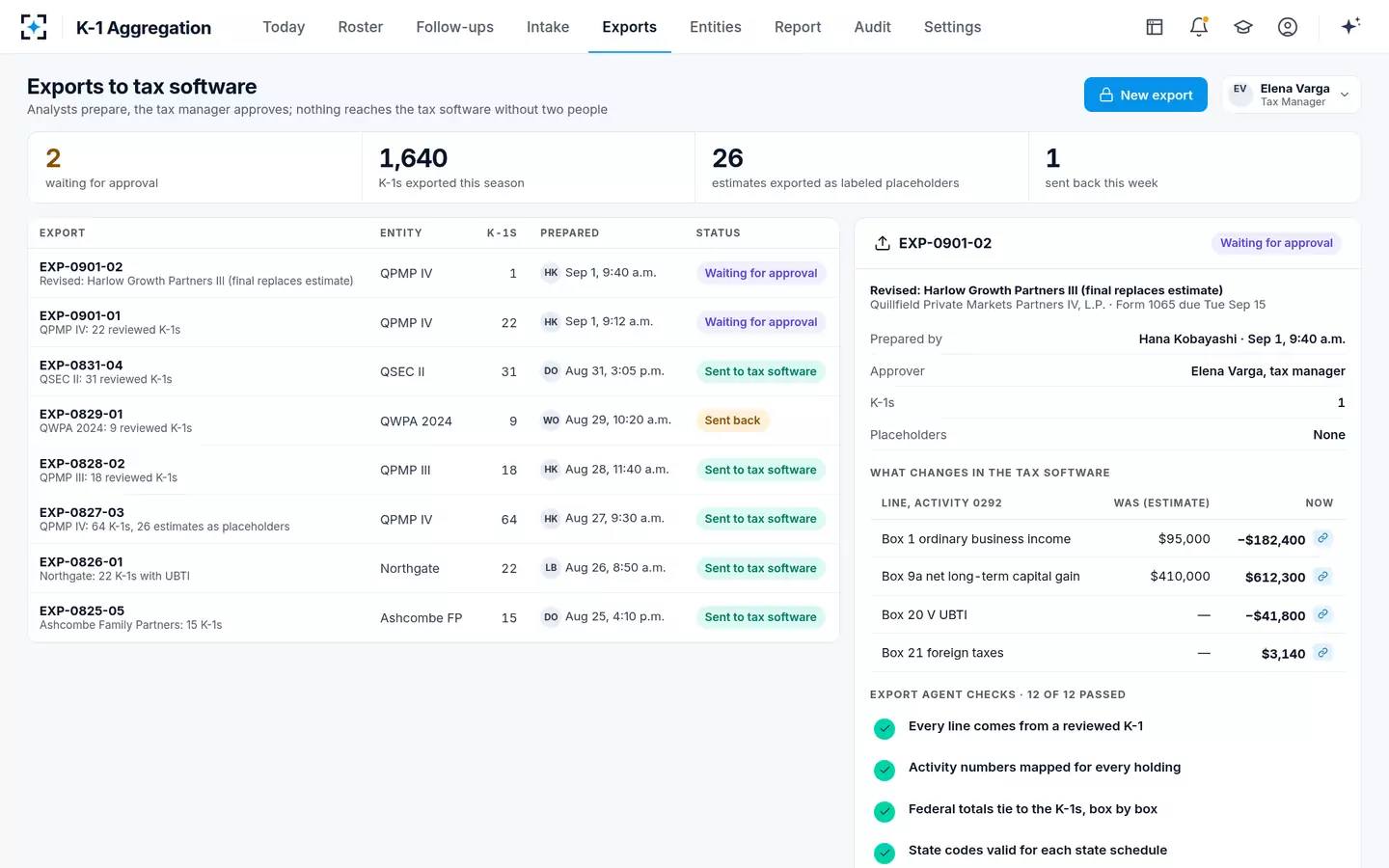
Two details deserve a test of their own. State information is not on the federal K-1 at all, so a tool that reads only the form will miss it; ask to see the state schedules mapped. And the IRS expects the investor, not the software, to apply limitations: the Partner's Instructions warn that the loss and deduction an investor may claim can be less than the K-1 reports, and leave the limits to the partner (Partner's Instructions for Schedule K-1, 2025). Software that hands over K-1 amounts as if they were final deductions is doing less than it appears to.
What does K-1 scanning software do, and what does it not do?
Scanning software reads K-1 documents into data. Good scanning reads boxes, codes, Items J, K and L, statements, K-3 parts and state schedules, in whatever layout and language the GP used, and cites each value to its page. It does not decide what a footnote means when the footnote is ambiguous, it does not know facts about the investor that the partnership does not, and it does not make a K-1 arrive sooner.
The last point is worth stating in a pilot plan, because the costs of late K-1s are often the reason the project starts. Software can make lateness visible early and follow up on a cadence; it cannot change a GP's calendar. If the business case assumes it will, the pilot will be judged against the wrong measure.
What data do you need for a K-1 software pilot?
What to bring to a pilot on last season
- Last season’s documents as received
Estimates, finals, amended K-1s, K-3s and state schedules, with the date each arrived.
- What was filed
The exports or imports into the tax software, and the corrections made since.
- Holdings by investor entity
From investment accounting, so the tool can build the roster of expected K-1s.
- Distributions and contributions
Cash booked by holding, for the tie-out test.
- Your thresholds and rules
Swing thresholds, confidence levels, placeholder policy and who approves what.
- A list of last season’s hard cases
The footnotes argued over, the breaks that took weeks, the K-1 that arrived late and amended.
- Your manual baseline
An error rate by field type on a blind re-extraction of a sample, measured before the replay.
K-1 Aggregation is built for this kind of test. Every value carries the agent version that produced it, and a new version runs on a golden set of 1,200 K-1s with known answers before it can be proposed, so the investor's replay becomes part of the same discipline. To run it on a sample of your own K-1s, estimates and statements, start from the K-1 Aggregation page, and see what to ask a K-1 aggregator before the pilot begins.
Questions people ask
How long does a K-1 software pilot take?
Long enough to replay a meaningful sample and short enough to finish before mid-March. The plan above allows about three months from gathering documents to a decision; the replay itself takes weeks, and the sample size follows from the error rate you need to detect.
Can we pilot K-1 software during tax season?
It is possible but risky. From mid-March, when extending funds send estimates, to mid-September, when extended K-1s are due, the team's time goes to live deadlines, and a tool compared against work still in progress has no settled answers to be measured against.
Do we need a vendor's sample K-1s?
No; they are the least informative documents in a pilot, because they were chosen to work. Your own K-1s, in your GPs' layouts and with your funds' footnotes, are the only test set that predicts how the tool will perform for you.
What if the software is better on boxes and worse on footnotes?
Then use it where it passes and keep people where it does not, which is how a tool that stops and asks is meant to work. Measure separately the error rate on values it filled itself and the share it sent to a person; a tool that asks about footnotes it is unsure of can pass on both.
Does K-1 software handle amended K-1s and Forms 8986?
Ask to see it. Amended K-1s should be matched to the K-1 they supersede and compared with what was exported; a Form 8986 from a partnership in the centralized audit regime is reported in the year received, so it should not overwrite last year's data. Include both in the replay.