An amended K-1 is a partnership's corrected statement of a partner's share for a year it has already reported, marked by the "Amended K-1" box at the top of the Schedule K-1. What the investor does next depends on what actually arrived and when. A corrected K-1 before the investor files simply replaces the original. An amended K-1 after the investor files may mean amending the investor's own return to stay consistent with the partnership. And since 2018 many funds cannot issue an amended K-1 at all once their return is filed: under the centralized audit regime they file an administrative adjustment request, and investors receive a Form 8986 that is reported in the year it arrives. For an investor receiving hundreds of K-1s, K-1 aggregation, the work of collecting and extracting every K-1 owed, includes noticing which documents replace ones already used. Botminds' K-1 Aggregation flags every amended K-1 against what was exported and routes the re-export to the tax manager.
The example of an amended K-1 on this page is fictional sample data in the solution. The rules are the IRS's and the Code's, linked where they appear; the partnership's side of the same decision is in the fund-accounting guides on administrative adjustment requests.
Four documents an investor can receive, and the route each one takes
A corrected K-1 before the investor’s return is filed
What it meansThe partnership fixed an error, usually before its own due date.
What the investor doesUse the corrected K-1 and discard the earlier one. Keep both, with the date each arrived.
The rulePartner’s Instructions, "Errors"
An amended K-1 after the investor has filed
What it meansMost often a partnership that elected out of the centralized audit regime, filing an amended Form 1065.
What the investor doesCompare it with what was reported. If the tax or an item’s treatment changes, amend the return to match.
The rule26 U.S.C. 6222; Form 1040-X time limits
A Form 8986 from an administrative adjustment request
What it meansA BBA partnership corrected a filed year and pushed the adjustments to its partners.
What the investor doesReport the effect in the year that includes the date it was received, not by amending the old year.
The rule26 U.S.C. 6226(b) as applied by 6227; Form 8978
Nothing yet, and the final may change
What it meansThe investor’s deadline arrives before a final or corrected K-1.
What the investor doesFile on the best figures available, describe them on Form 8082, and amend when the final arrives.
The ruleInstructions for Form 8082
What is an amended K-1? A corrected statement for a year already reported
An amended K-1 replaces a partner's K-1 for a tax year after the partnership has filed that year's return. For a partnership allowed to amend, the IRS's instructions describe the mechanics: if the information on a partner's K-1 is incorrect, the partnership must "file an amended Schedule K-1 or K-3 for that partner with the amended Form 1065. Also give a copy of the amended Schedule K-1 or K-3 to that partner" (Instructions for Form 1065, 2025), and mark it with the "Amended K-1" box.
The statute limits when that can happen. Information a partnership has furnished generally may not be amended after the due date of its return, except in the cases the statute lists (26 U.S.C. 6031(b)). Corrections before the due date, which partners often call corrected K-1s, are a different matter: the partnership is still within its time to furnish, and the newer K-1 is simply the one to use.
Final K-1 or amended K-1: read the boxes at the top
The 2025 Schedule K-1 carries two checkboxes above Part I, "Final K-1" and "Amended K-1" (Schedule K-1 (Form 1065), 2025). They answer different questions. "Final K-1" marks the last K-1 the partner will receive from the partnership, typically because the partner's interest ended or the partnership wound up. "Amended K-1" marks a replacement for a K-1 already issued for the same year.
Investors confuse the two because the word "final" is also used for a final as opposed to an estimate. A last K-1 from a fund in liquidation may arrive with the "Final K-1" box checked and, later, an amended version of that same final K-1. The way to keep them apart is to file each document by year, holding and type, never by the word in its file name.
Why amended K-1s are rarer since 2018
The Bipartisan Budget Act of 2015 replaced the old partnership audit rules with a centralized regime for partnership tax years beginning after 2017, which applies unless a partnership is eligible and elects out. The Form 8082 instructions summarise eligibility: "certain partnerships with 100 or fewer eligible partners for the tax year can elect out of the centralized partnership audit regime." Most private funds, with hundreds of partners or with partnerships among their partners, cannot.
A fund in the regime that finds an error after filing generally does not file an amended return or amended K-1s; it files an administrative adjustment request, and either pays any resulting tax at the partnership level or pushes the adjustments out to the partners who held interests in the year being corrected. The partnership's choice between those routes is set out in the AAR-versus-amended-return guide. For the investor, the practical consequence is that a fund correction may arrive as a different form, in a later year, addressed to a partner who may have sold its interest since.
Does the investor have to amend its return for an amended K-1?
If the amended K-1 changes the investor's tax or the treatment of an item it reported, the investor should normally amend, because the Code requires a partner to treat partnership items consistently with the partnership's return (26 U.S.C. 6222(a)), and the amended K-1 now reflects that return. If the change has no effect on the investor's tax, for example a correction to a capital percentage, the tax team may still need to note it, but there is no tax to correct.
Time limits apply to the investor's side. For an individual claiming a refund, the IRS says that "Generally, for a credit or refund, you must file Form 1040-X within 3 years (including extensions) after the date you filed your original return or within 2 years after the date you paid the tax, whichever is later" (Instructions for Form 1040-X, Rev. December 2025). An amended K-1 that lowers income, arriving late in that window, is worth pursuing promptly.
What is Form 8986, and what is an AAR statement?
Form 8986 is the statement that carries a BBA partnership's adjustments to its partners. In the IRS's words, "Form 8986 is used by BBA partnerships to furnish and transmit each partner’s share of adjustments to partnership-related items" (Instructions for Form 8986). When it results from an administrative adjustment request rather than an IRS audit, investors often call it an AAR statement.
The key difference from an amended K-1 is the year. A partner does not reopen the year being corrected; it adjusts its tax for the year in which it receives the statement. The statute puts it this way for push-outs: each partner's tax "for the taxable year which includes the date the statement was furnished ... shall be adjusted by the aggregate of the correction amounts" (26 U.S.C. 6226(b)(1)), and the AAR rules apply the same approach. The Form 8082 instructions call that year the reporting year.
"Partners (other than pass-through partners such as partnerships or S corporations) use Form 8978 and Schedule A (Form 8978) to report adjustments shown on Forms 8986 received from partnerships that have elected to push out adjustments to partnership-related items to their partners."
IRS, Instructions for Form 8978 (Rev. December 2024)
Form 8978 works out the change in tax for the first affected year and any years in between, and adds the total to the current year's tax. A taxable investor that receives a Form 8986 in 2026 for a 2023 error therefore reports it on its 2026 return, together with any interest the rules add. The old year stays as filed.
What is Form 8082 used for?
Form 8082 is the partner's notice to the IRS that it is reporting an item differently from the way the partnership reported it, or that it did not receive a K-1 by its own due date. It is how an investor files on an estimate, or disputes an item it believes is wrong, without breaching the consistency rule. The investor attaches it to the original or amended return on which the difference appears.
It has limits. An investor may file inconsistently with a Form 8986 that came from an AAR, attaching Form 8082 to its reporting-year return, but not with one that came from an audit: "A partner is bound to finally determined adjustments on Form 8986 resulting from a BBA partnership audit and may not use Form 8082 to report the items differently" (Instructions for Form 8082, Rev. October 2025). The source of a Form 8986 is therefore the first thing to establish when one arrives.
The fund of funds in the middle: a correction below means statements above
A fund of funds that receives a Form 8986 is a pass-through partner, and the statement does not stop with it. It must pass the adjustments to its own partners, using its own Forms 8985 and 8986, or pay the tax itself. The deadline is the extended due date of the lower partnership's return for its adjustment year, printed on the Form 8986 it received, and the IRS is blunt about missing it: "Failure to submit these forms by the due date results in the pass-through partner being liable for an IU," an imputed underpayment (Instructions for Form 8986).
The investor-side lesson matches the K-1 calendar: a single correction at the bottom of a chain creates work at every tier above it, and each tier's partners are the ones who held interests in the corrected year, not necessarily today's. A fund of funds needs to know, for every holding, which year a correction relates to and who its partners were then. That is a question of keeping each year's K-1s, statements and partner lists retrievable, not a question of memory.
How an amended K-1 moves through the solution
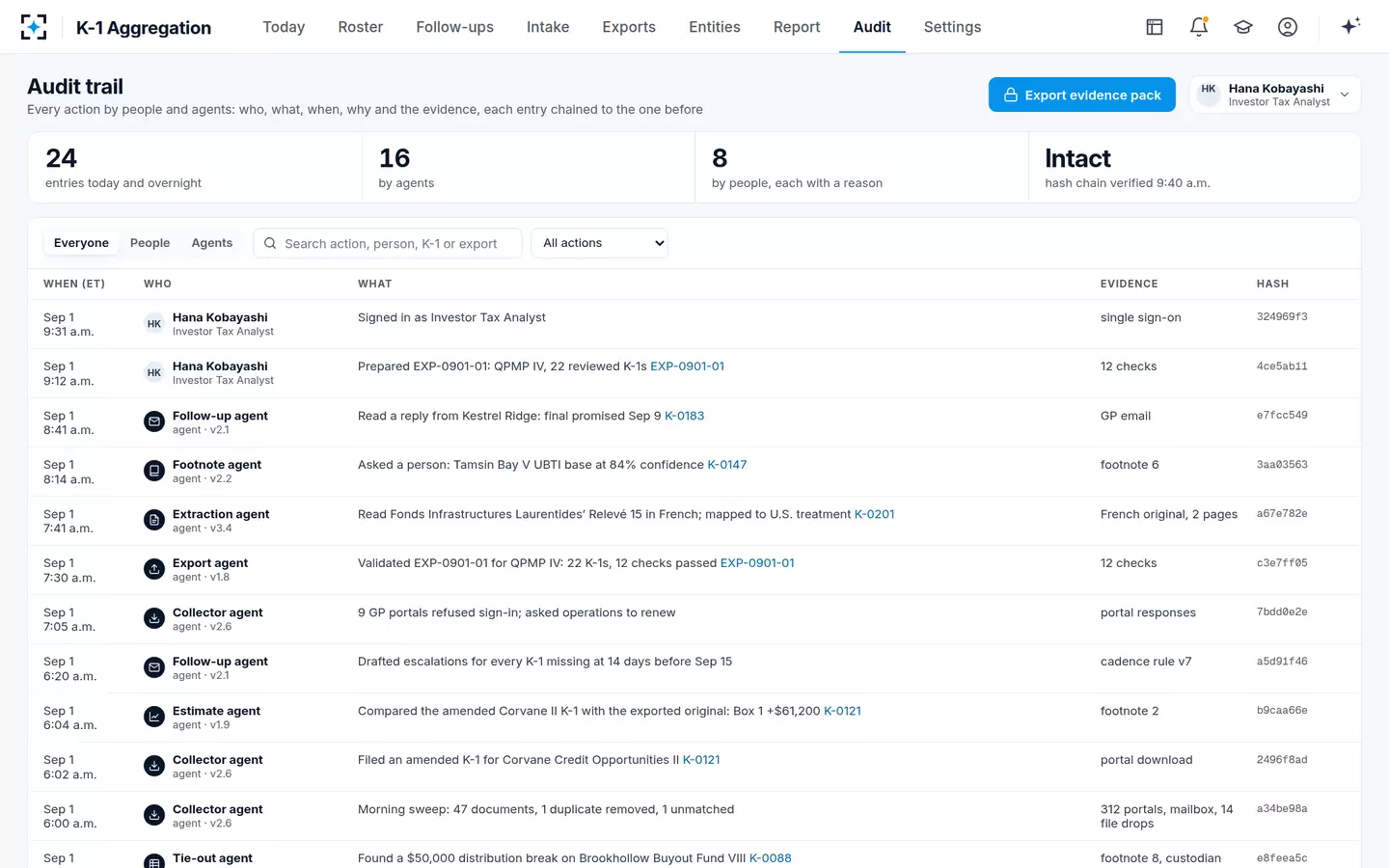
Take the sample investor on September 1, 2026. At 6:02 a.m. the Collector agent filed an amended K-1 from Corvane Credit Opportunities II, a fictional credit fund, downloaded from its GP portal. The K-1 it supersedes had already been exported to the tax software on July 14. Two minutes later the Estimate agent compared the amended K-1 with the exported original and found Box 1 up $61,200, then put a re-export in front of the analyst.
An amended K-1, from arrival to a re-export two people approve
Agent
Collector agentDownloads the amended K-1, matches it to the holding and marks it as superseding the K-1 exported on July 14.
Never: overwrites the original; both stay, read-only.
Agent
Extraction and Estimate agentsRead every box and compare it with the exported original: Box 1 up $61,200, traced to the GP’s footnote.
Never: accept the change; they propose.
A person decides
Investor tax analystDecides whether the amended K-1 replaces the original for this return, with a reason code.
Agent
Export agentBuilds the revised import showing exactly what changes in the tax software, and runs its checks.
Never: sends without approval.
A person decides
Tax managerApproves the revised export; the preparer cannot approve their own.
Every action on the amended K-1, on one trail
When a correction arrives: five questions before anyone changes a number
- What is it?
Corrected K-1, amended K-1 or Form 8986, and if a Form 8986, from an AAR or an audit.
- Which year does it correct?
An amended K-1 corrects its own year; a Form 8986 is reported in the year it is received.
- Was the original already used?
Exported to the tax software, reported on a filed return, or passed on in the investor’s own K-1s.
- Does it change tax or treatment?
Compare box by box with what was used, by amount and by character.
- Who above the investor is affected?
For a fund of funds, the partners of the corrected year may need statements of their own.
Corrections are where a season's shortcuts come back. An estimate exported without a label, a K-1 read without its statement or a decision made without a reason is invisible until a correction makes someone ask what was used. Estimates and the swing to the final covers the most common source of corrections, and the K-1 Aggregation page shows the full workflow.
Questions people ask
Does an investor file an amended K-1?
A partner does not file a K-1; the partnership issues it and files its own copy. If an investor receives an amended K-1 that changes its tax, it amends its own return, for an individual on Form 1040-X, so its figures match the partnership's. If the partnership is in the centralized audit regime, its correction may come as a Form 8986 instead.
Why does an investor get a Form 8986 instead of an amended K-1?
Because the partnership is subject to the centralized audit regime that applies to tax years beginning after 2017 and corrected a filed year through an administrative adjustment request or an audit, then pushed the adjustments to partners. The investor reports the effect in the year that includes the date it received the Form 8986, using Form 8978 if it is not a pass-through partner.
Can an investor disagree with a Form 8986?
If it came from an administrative adjustment request, the investor may report differently and explain on Form 8082 attached to its reporting-year return. If it came from a BBA audit, the Form 8082 instructions say the partner is bound to the finally determined adjustments and may not use Form 8082 to report them differently.
Is an amended K-1 the same as a corrected K-1?
Investors use the words loosely. The IRS's partner instructions tell a partner to ask the partnership for a corrected K-1 if it believes the partnership has made an error. A K-1 marked with the "Amended K-1" box replaces one issued for the same year, and for partnerships in the centralized audit regime, corrections after filing generally go through an administrative adjustment request instead.
What happens to a fund of funds when an underlying fund amends?
If the correction arrives as a Form 8986, the fund of funds is a pass-through partner and must pass the adjustments to its own partners for the corrected year or pay the tax itself. If it arrives as an amended K-1 from a fund that elected out of the regime, the fund of funds may have to correct its own return and its partners' K-1s.