For an investor's tax team, do K-1s require estimated tax payments? Usually yes: partnership income reaches investors with no withholding, so an investor who expects to owe tax on it pays through quarterly estimated tax payments and, for the year just ended, a payment with its extension. The difficulty is timing. A fund's K-1 for 2025 can legally arrive on September 15, 2026, but the investor's 2025 balance was due on April 15, and its 2026 installments fall on April 15, June 15 and September 15, so every one of those payments is sized on estimates. The partnership's extension extends none of them. What waiting costs the investor is interest, sometimes a penalty, and the work of truing up later; none of the partnership's own late-filing penalty ever reaches the investor. For an investor managing hundreds of K-1s, K-1 aggregation, the work of tracking and extracting every K-1 owed, is also the work of knowing which payments rest on guesses. Botminds' K-1 Aggregation shows that on one roster and chases the missing K-1s back from each investor's own dates.
The rules and rates on this page are the IRS's, linked where they appear; the priced examples are illustrations with stated assumptions, not data. Product examples are fictional sample data.
The numbers that set the cost of a late K-1 for an individual investor
7%
IRS underpayment rate for individuals, fourth quarter of 2026, compounded daily
90%
of the year’s tax paid by April 15 avoids the late payment penalty on an extension
110%
of last year’s tax: the safe harbor for estimated tax when last year’s AGI exceeded $150,000
½%
late payment penalty a month on unpaid tax, up to 25%, when the 90% test fails
Does an investor need to make estimated tax payments for K-1 income?
If it expects to owe enough, yes. The IRS's general rule for individuals is that estimated tax for 2026 is owed by those who "expect to owe at least $1,000 in tax for 2026, after subtracting your withholding and refundable credits," and your withholding and credits will be less than the smaller of 90% of the 2026 tax or 100% of the tax on a full-year 2025 return (Form 1040-ES, 2026). Partnership income carries no withholding, so an investor with meaningful K-1 income almost always meets the first test.
The 2026 installments are due April 15, June 15 and September 15, 2026, and January 15, 2027. The third is due on the same day as the extended 2025 fund K-1s. An investor whose largest fund sends its final K-1 on September 15 learns its 2025 income on the day its third 2026 payment is due, and has already made its April payment for 2025 on an estimate.
What is the estimated tax safe harbor? 90%, 100% or 110%
The safe harbor is the smaller of 90% of the current year's tax or 100% of the prior year's, paid in four equal installments. The Code raises the second figure for higher-income taxpayers: if the prior year's adjusted gross income exceeded $150,000, the prior-year test is applied "by substituting '110 percent' for '100 percent'" (26 U.S.C. 6654(d)(1)(C)).
The prior-year route looks like a way to ignore K-1 timing, and for many individuals it is. But it depends on knowing last year's tax, and an investor who extended because its K-1s were late does not know its 2025 tax precisely in April 2026, when the first 2026 installment is due. The safe harbor rests on an estimate of the year the late K-1s describe. For investors whose fund income is lumpy, the IRS also allows the annualized income installment method, which matches payments to income as it accumulates; its worksheet asks for income for each period "including your share of partnership or S corporation income or loss" (Publication 505, 2026), which for a fund investor is exactly what is not known in time.
Does a partnership extension extend the investor's payment deadline?
No. The regulation that grants partnerships their automatic six-month extension says so in terms: it "does not extend the time for filing a partner's income tax return or the time for the payment of any tax due on a partner's income tax return" (26 CFR 1.6081-2(e)). The partner's own extension does not help with payment either. Form 4868 warns that it "doesn’t extend the time to pay taxes," and on interest it is blunt (Form 4868, 2025): "Even if you had a good reason for not paying on time, you will still owe interest."
2026 for a calendar-year investor: every payment falls before the last K-1s are due
- 2025 balance, 1st installmentApr 15
- 2nd installmentJun 15
- 3rd installmentSep 15
- ReturnOct 15
- Original dateMar 16
- Extended K-1s arriveto Sep 15
What does a late K-1 cost an investor? A method, priced
A late K-1 costs an investor through five channels, and only the first is certain. Each can be priced from the investor's own numbers: the shortfall or excess the estimate produced, the number of days it lasted, and the rate or penalty that applies.
The cost of a late K-1, layer by layer
1
Interest on tax paid late
Any tax for the year not paid by the original due date carries interest at the IRS underpayment rate until paid, even on extension and even with a good reason.
Always, on the shortfall
2
The late payment penalty
Half of one percent of the unpaid tax for each month or part of a month, up to 25%, unless at least 90% of the year’s tax was paid by the due date and the rest comes with the return.
When the late K-1 pushes the shortfall past 10%
3
The estimated tax penalty
For next year’s installments, an addition figured at the same underpayment rate, quarter by quarter, when payments fall short of the required amount.
When installments were sized on a low estimate
4
Cash held against the unknown
Overpaying to be safe has a cost too: the excess sits with the IRS until the return is filed and it is refunded or applied to next year.
When the estimate was high
5
Amended returns and staff time
Filing on an estimate and amending later doubles the work on that holding, and a fund of funds passes the amendment to its own partners.
When the final arrives after filing
The table puts numbers on the first two layers for one investor. Assume total 2025 tax was estimated at $500,000 in April from GP estimates and paid in full with Form 4868, a marginal rate of 37% on any extra ordinary income, and the IRS's 7% rate throughout. In the first case the final K-1s in September add $100,000 of ordinary income; in the second, $250,000. Both are paid with the return on October 15, 183 days late.
Two late swings, priced: interest only, or interest and a penalty
| Swing of $100,000 | Swing of $250,000 | |
|---|---|---|
| Extra tax at 37% | $37,000 | $92,500 |
| Total 2025 tax | $537,000 | $592,500 |
| Share paid by April 15 | 93.1%: meets the 90% test | 84.4%: fails the 90% test |
| Interest, 7% for 183 days | about $1,300 | about $3,250 |
| Late payment penalty, ½% a month for 6 months | none | about $2,775 |
| Cost of the late K-1 | about $1,300 | about $6,000 |
The difference between the two columns is the 90% test, not the size of the swing. A K-1 that moves the investor's tax by more than a tenth of the year's total turns interest into interest plus a penalty. That threshold is worth computing in April, holding by holding: which outstanding K-1s could, between them, move the year's tax by 10%?
How is the underpayment penalty calculated?
For estimated tax, the Code computes an addition to tax on each installment's shortfall from its due date until paid, "determined by applying" the underpayment rate established under section 6621 (26 U.S.C. 6654(a)). For individuals that rate is the federal short-term rate plus three percentage points, set quarterly; the IRS announced that for the fourth quarter of 2026, "the rate for overpayments and underpayments will be 7% per year, compounded daily" (IRS, IR-2026-98).
Each installment is a separate calculation. A shortfall on the April 15 installment runs until it is made up, by a later installment or the return; one on June 15 runs from June. An investor who learns in September that its K-1 income will be far higher can stop the clock on later installments by paying more on September 15, but not on the earlier ones, which is why the annualized method, which sizes each installment on income to date, is often worth the extra worksheet for investors with a few very large K-1s.
Corporations and tax-exempt investors pay on stricter terms
Corporate investors have less room. A corporation's required annual payment is the lesser of 100% of the current year's tax or 100% of the prior year's (26 U.S.C. 6655(d)), and for a large corporation, one with taxable income of $1,000,000 or more in any of the three preceding years, the prior-year route is generally unavailable beyond the first installment. A corporation that holds fund interests through a taxable blocker therefore pays on its estimate of the current year, with K-1s outstanding.
Tax-exempt investors with unrelated business taxable income face the same rule on a smaller scale: an organization filing Form 990-T "must make installment payments of estimated tax if its estimated tax (tax minus allowable credits) is expected to be $500 or more" (Instructions for Form 990-T, 2025). For an IRA in a real estate fund, the UBTI that drives those payments often appears only on the final K-1; where UBTI sits on a K-1 explains why estimates often omit it.
Who pays the late K-1 penalty?
The partnership does. A partnership that files late or furnishes K-1s late faces penalties per K-1 and per month, worked through in the failure-to-furnish penalty guide. Those penalties are paid to the IRS, and nothing in them compensates the investor. A K-1 furnished on September 15 under a valid extension carries no penalty at all, even though it arrives after every one of the investor's spring payment dates.
That asymmetry is the whole economic case for managing late K-1s on the investor's side. The GP's on-time K-1 can still cost the investor interest, a penalty and a second round of work, and the investor's only levers are earlier information, better estimates and firmer follow-up.
What if a K-1 arrives after the investor files?
Then the investor filed on estimated amounts, ideally with Form 8082 describing them, and the final K-1 decides whether it amends. If the final changes its tax, the tax team amends so the return matches the partnership's, and pay any additional tax with interest from the original due date. What to do when the final swings from the estimate covers the decision box by box.
Keeping the estimate has a price, stated before anyone decides
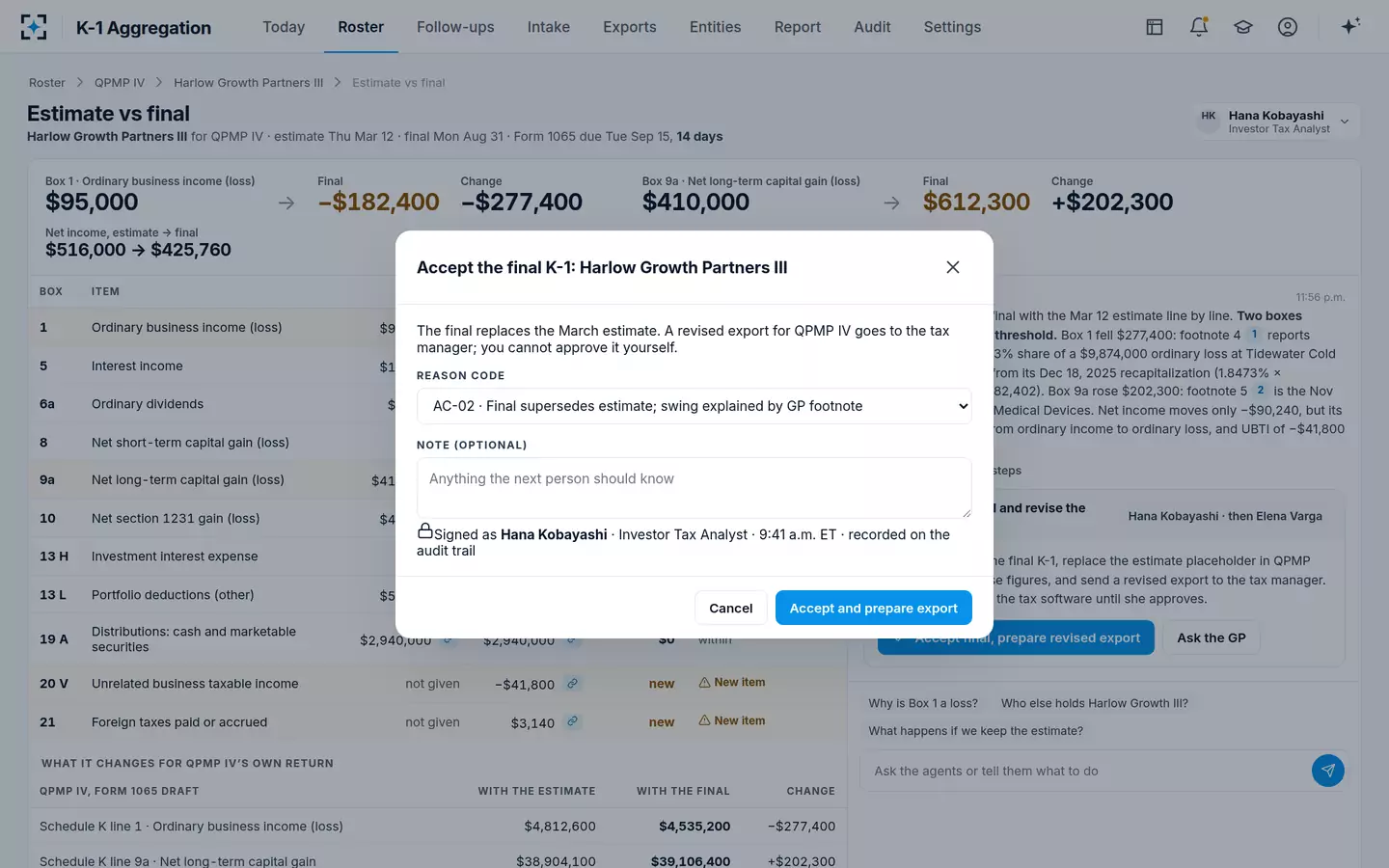
Where K-1 Aggregation changes the cost
The cost of a late K-1 is driven by how long the investor pays on a guess and how wrong the guess is. A tool cannot shorten the GP's calendar; it can shorten the time between a K-1's arrival and its use, and it can put the size of each open estimate in front of the person sizing the next payment. In K-1 Aggregation the roster shows, for each investor entity, which holdings are final, estimate only or missing, and the Follow-up agent plans reminders back from the entity's own deadline, with escalations approved by operations.
Every missing K-1, with the GP's promised date against the investor's
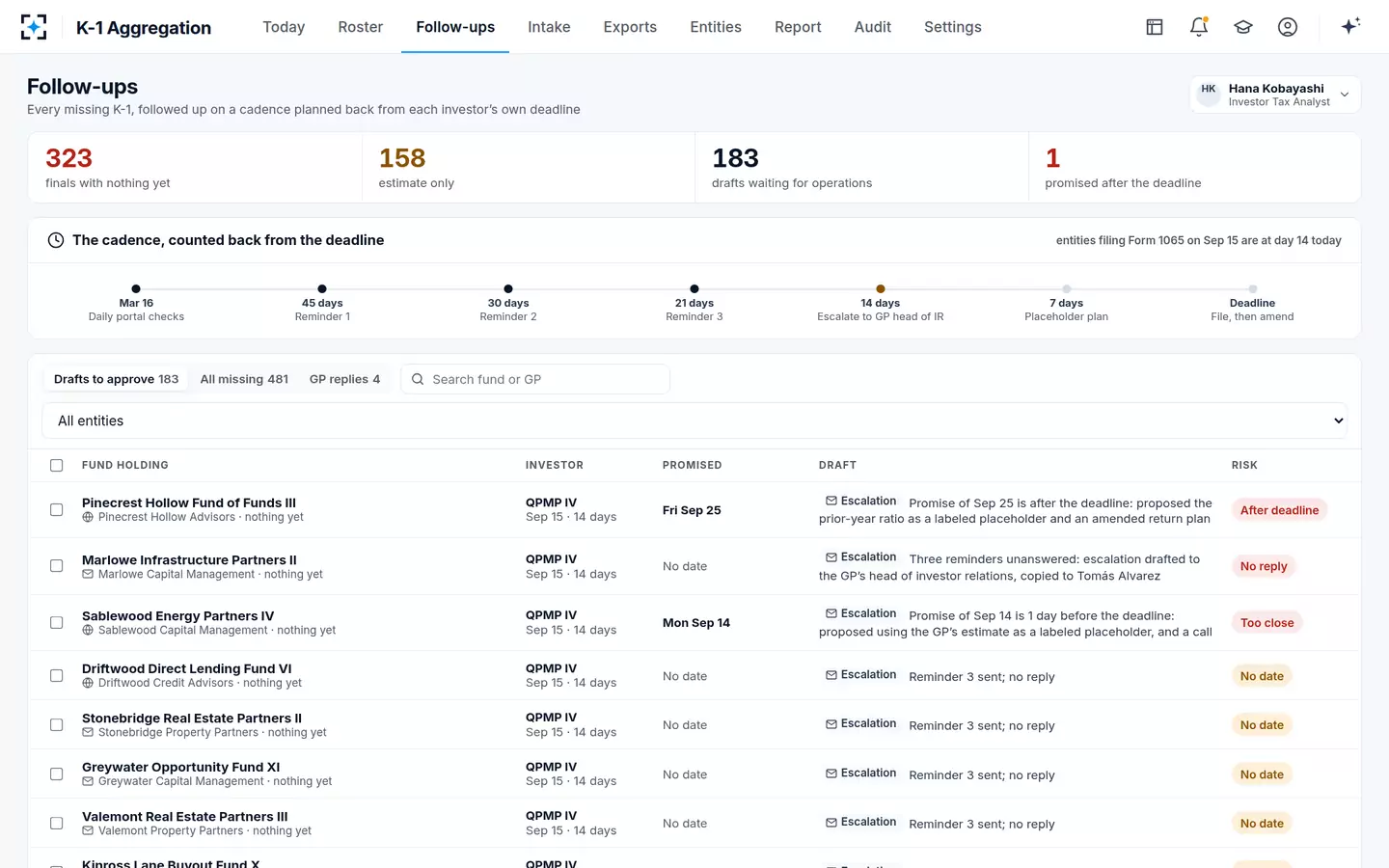
Every value in an export is either from a reviewed final K-1 or labeled as an estimate, so the tax manager can see, when sizing a payment, how much of the year still rests on estimates. See the roster, the follow-ups and the exports together on the K-1 Aggregation page.
Questions people ask
When are estimated tax payments due for 2026?
For calendar-year individuals, April 15, June 15 and September 15, 2026, and January 15, 2027. The IRS notes the January payment is not needed if the 2026 return is filed by February 1, 2027 with the balance paid, which few fund investors can do because their K-1s arrive later.
Does filing an extension stop interest on tax owed?
No. Form 4868 extends the time to file, not to pay, and interest runs on any tax unpaid after the original due date until it is paid. If at least 90% of the year's tax was paid by the due date and the rest comes with the return, the late payment penalty is avoided, but the interest is not.
Can an investor use last year's tax to avoid estimated tax penalties on K-1 income?
Individuals can pay 100% of the prior year's tax, or 110% if the prior year's adjusted gross income exceeded $150,000, in four equal installments. The catch for fund investors is that last year's tax may itself rest on estimates when the first installment is due, because the K-1s for that year are still outstanding.
Do trusts make estimated tax payments on K-1 income?
Yes. The estimated tax rules for individuals apply to estates and trusts, with an exception for a decedent's estate, and certain trusts, for tax years ending within two years of the death. A trust holding fund interests faces the same timing problem, with a shorter extension to September 30.
What rate does the IRS charge on underpaid estimated tax?
The underpayment rate under section 6621, set quarterly as the federal short-term rate plus three percentage points for individuals. The IRS set it at 7% a year, compounded daily, for the fourth quarter of 2026.