Where is UBTI reported on a K-1? On a partnership Schedule K-1 (Form 1065), unrelated business taxable income is reported in Box 20 under code V, for partners that are tax-exempt organizations, usually with an attached statement. The amount in the box is often only a starting point: many funds give UBTI in a footnote as a percentage of another line, such as net rental income, and leave the investor to apply it to the right base. Getting the base wrong changes the tax on a Form 990-T, and for an IRA, a pension trust or an endowment with dozens of private fund interests it changes it many times over. For those investors, UBTI is the part of K-1 aggregation, the work of collecting and extracting every K-1 owed, where a misread footnote costs the most. Botminds' K-1 Aggregation maps each UBTI footnote to Box 20 code V with its source cited, and when a footnote can be read two ways, it stops and asks a person rather than guess.
The footnote worked through on this page is fictional sample data in the solution, from a fictional real estate fund to a fictional fund of funds. The law is quoted from the Code, the regulations and the IRS's instructions, linked where it appears.
One footnote, two readings: the base decides how much of the income is UBTI
Reading 1: 37.2% of Box 2, after depreciation · UBTI $106,541
- UBTI · 25.8%
- Depreciation · 30.6%
- Not UBTI · 43.6%
Reading 2: 37.2% of income before depreciation · UBTI $153,599
- UBTI · 37.2%
- Not UBTI · 62.8%
Where is UBTI reported on a K-1? Box 20, code V, and the statement behind it
The IRS's instructions to partners describe the code: "Code V. Unrelated business taxable income. The partnership will report any information you need to figure unrelated business taxable income under section 512(a) (1) (but excluding any modifications required by section 512(b), paragraphs (8) through (15)) for a partner that’s a tax-exempt organization" (Partner's Instructions for Schedule K-1, 2025). The duty behind it is in the statute: a partnership carrying on a trade or business must give partners the information they need to compute their share of its income from that business under section 512(a)(1) (26 U.S.C. 6031(d)).
Three details are worth knowing before the first K-1 arrives. The code is reported only to partners the partnership knows are tax-exempt, and the partner must tell it. The words "any information you need" mean the entry can be an amount, a statement or both. And where the partner is an IRA, the partnership adds code AR with the IRA's own identifying number: for tax years after 2025, the IRS says, partnerships with IRA partners "are required to include the IRA partner’s EIN on Schedule K-1 (Form 1065) if the IRA partner is receiving an allocation of UBTI" (Instructions for Form 1065, 2025).
What is UBTI? Income from a business unrelated to the exempt purpose
Section 512 defines unrelated business taxable income as "the gross income derived by any organization from any unrelated trade or business (as defined in section 513) regularly carried on by it, less the deductions allowed by this chapter which are directly connected with the carrying on of such trade or business," both computed with the modifications in section 512(b) (26 U.S.C. 512(a)(1)). Those modifications exclude most passive investment income, dividends, interest, royalties, most rents and most capital gains, which is why a tax-exempt investor can hold a buyout fund and report little or no UBTI.
Partnerships are looked through. When a partnership regularly carries on a trade or business that is unrelated to the exempt partner's purpose, the partner includes "its share (whether or not distributed) of the gross income of the partnership from such unrelated trade or business and its share of the partnership deductions directly connected with such gross income" (26 U.S.C. 512(c)(1)). An exempt investor in an operating partnership, or in a fund that holds one directly, has UBTI whether or not any cash was distributed.
How is UBTI calculated from a K-1? Apply the share to the right base
When Box 20 code V shows a finished amount, the calculation is the partnership's and the investor's job is to check it against the statement. When the statement gives a percentage, the investor does the calculation, and the work is in identifying the base: which line, before or after which deductions, and for which property. Four steps cover most fund footnotes.
Calculating UBTI from a fund K-1, step by step
| Step | What to do | On the sample footnote |
|---|---|---|
| 1. Find every UBTI reference | Box 20 code V, its statement, and any footnote that mentions unrelated business, debt-financed property or section 514. | Footnote 6: about 37.2% of net rental income "before depreciation" is from debt-financed property. |
| 2. Identify the base | Which box or statement line the percentage applies to, and whether deductions are before or after depreciation and interest. | Box 2 net rental real estate income $286,400 after depreciation, or $412,900 before it. |
| 3. Apply the share, then the deductions | For debt-financed property, the percentage applies to the income and, separately, to the directly connected deductions. | 37.2% of $286,400 = $106,541; 37.2% of $412,900 = $153,599. |
| 4. Check the result against the box | If Box 20 code V shows an amount, reconcile it with your calculation and ask the GP about any gap. | The sample K-1 prints 106,541 in 20 V, matching reading 1, while the footnote wording points to reading 2. |
What is debt-financed income, and why the K-1 cannot finish the sum alone
Debt-financed income is income from property held to produce income that is subject to acquisition indebtedness, and section 514 brings a share of it into UBTI even when it would otherwise be excluded rent, interest or gain. The share is a ratio: an amount of gross income "which is the same percentage (but not in excess of 100 percent) of the total gross income derived during the taxable year from or on account of such property" as the average acquisition indebtedness is of the property's average adjusted basis (26 U.S.C. 514(a)(1)). The same percentage is then applied to the deductions directly connected with the property.
One rule in the same subsection bears directly on the sample footnote: where debt-financed property is depreciable, the depreciation deduction "shall be computed only by use of the straight-line method" (26 U.S.C. 514(a)(3)). A K-1's Box 2 reflects whatever depreciation the partnership claimed. So neither "Box 2 after depreciation" nor "income before depreciation" is necessarily the right base until the GP says which depreciation it used. That is a question for the GP, not a choice for the reader.
The investor's own borrowing adds a second layer the K-1 cannot see. The IRS's Publication 598 gives the example of an exempt organization that invests $1 million of its own funds and $2 million of borrowed funds in a partnership whose building is financed with a $15 million mortgage: "X has acquisition indebtedness of $7 million. This amount is the $2 million debt X incurred in acquiring the partnership interest, plus the $5 million that is X's allocable part of the partnership's debt" (IRS Publication 598, Rev. March 2021). The partnership knows its own mortgage; only the investor knows whether it borrowed to buy in.
One sample footnote, two readings, and a question to the GP
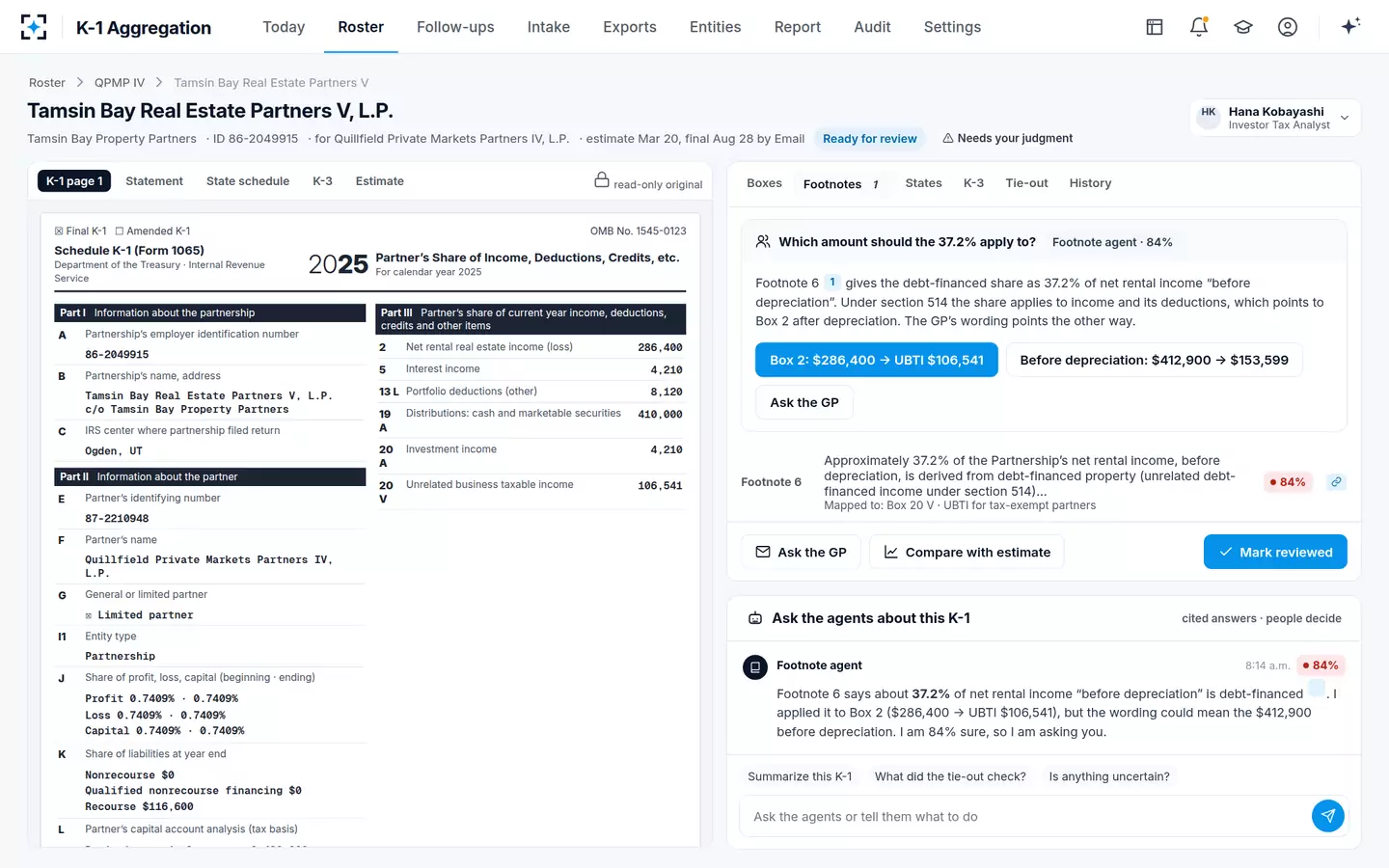
Take the sample K-1 from Tamsin Bay Real Estate Partners V, a fictional fund, to the sample fund of funds. Box 2 shows net rental real estate income of $286,400. Footnote 6 says approximately 37.2% of the partnership's net rental income, "before depreciation", is derived from debt-financed property. Applied to Box 2, that is UBTI of $106,541; applied to income before depreciation, $412,900, it is $153,599.
The fund's printed Box 20 code V shows 106,541, which matches the first reading, but the footnote's own words point to the second. Section 514's straight-line rule suggests that the right answer may be neither until the depreciation method is known. In the solution, the Footnote agent scored its mapping at 84% confidence, below the sample investor's 90% line, and put both readings and a draft question to the GP in front of the analyst. For the fund of funds, the answer passes through to 214 tax-exempt partners of its own.
Unsure of a UBTI base, the agent puts both readings to a person
Can UBTI be negative? Losses stay inside their own business
A K-1 can report a UBTI loss, and the sample Harlow K-1 does: −$41,800 in Box 20 code V. Whether that loss reduces the investor's tax is another matter. Since 2018 an organization with more than one unrelated trade or business computes UBTI separately for each, and the result for any one "shall not be less than zero" (26 U.S.C. 512(a)(6)(C)). A loss from one fund's business cannot offset income from another's in the same year; it is carried within its own business as a net operating loss.
The total is then reduced by a specific deduction of $1,000 (26 U.S.C. 512(b)(12)), taken once against the sum, not once per business. For an investor with UBTI from many funds, which businesses are separate is therefore a question with money attached, and the regulations answer it partly from the K-1.
The 2% and 20% tests: when fund interests can be grouped
The regulation under section 512(a)(6) lets an exempt organization treat its "investment activities" as one separate business, and qualifying partnership interests count as investment activities. A directly held interest qualifies under a de minimis test if the organization holds "no more than 2 percent of the profits interest and no more than 2 percent of the capital interest," or under a participation test if it holds no more than 20 percent of the capital interest and does not significantly participate (26 CFR 1.512(a)-6(c)).
The numbers a tax-exempt K-1 recipient works to
2%
profits and capital: the de minimis test for grouping a fund interest with other investments
20%
capital, without significant participation: the participation test
$1,000
of gross income from an unrelated business before Form 990-T is required
$500
of expected tax before estimated payments are required on Form 990-T
The regulation ties the test to the K-1 itself. An organization may rely on the Schedule K-1 it receives "if the form lists the organization's percentage profits interest or its percentage capital interest, or both, at the beginning and end of the year," using the average of the two. Item J is therefore a UBTI input, not just information; the other disclosures a tax-exempt partner needs are set out in K-1 footnotes for LP tax teams.
Does UBTI apply to IRAs? Yes, and the deadline is earlier
Yes. The trustee or custodian of an IRA, including a Roth, SEP or SIMPLE IRA, must file Form 990-T when the account has $1,000 or more of unrelated business gross income, and the IRS adds that "Each account of a type listed above is treated as a separate trust for unrelated business income tax purposes (even if there is a single owner or beneficiary for multiple accounts)" and needs its own EIN to file (Instructions for Form 990-T, 2025). A self-directed IRA in a private real estate fund is the classic case.
The dates are unforgiving. An IRA or a pension trust files Form 990-T by the 15th day of the fourth month after its year ends, April 15 for a calendar year, five months before an extended fund K-1 is due. Form 8868 extends the time to file, but "The organization must pay any tax due in full by the due date of the return without extension." An IRA owner whose fund K-1 arrives in September has paid, or should have paid, on an estimate in April. The K-1 calendar by recipient sets out how far apart those dates are.
What a tax-exempt investor should ask the GP
Most UBTI errors start before the K-1 is written: a fund that was never told the investor is exempt, an estimate that omitted UBTI, a footnote whose base is ambiguous. A short set of questions, asked in spring, removes most of them.
Seven UBTI questions to put to every GP before the final K-1
- Do you have us on file as tax-exempt, and as what type of entity?
Code V is reported only to partners the partnership knows are exempt.
- Will the estimate include UBTI?
If not, ask for a range, so April payments are not made on zero.
- Is any income from debt-financed property?
If so, which property, what percentage, and applied to which line.
- Is the percentage before or after depreciation, and which method?
Section 514(a)(3) requires straight-line depreciation on debt-financed property.
- Is any UBTI from an operating business rather than debt financing?
Different sources may be different trades or businesses for the separate computation.
- For an IRA partner, is our EIN on file for code AR?
Required for UBTI allocated to IRA partners for tax years after 2025.
- Will Item J show both profit and capital percentages?
Reliance on the K-1 for the 2% and 20% tests needs them stated, beginning and end.
K-1 Aggregation treats any new UBTI as a change to be flagged whatever its size, and the Footnote agent maps UBTI and debt-financed ratios to Box 20 code V with each mapping cited to its footnote. Below the investor's confidence setting it waits for a person, as it did on the sample footnote. See how the footnote, the swing and the export fit together on the K-1 Aggregation page.
Questions people ask
What is Box 20 code V?
Box 20 code V on a partnership K-1 reports the information a tax-exempt partner needs to figure its unrelated business taxable income under section 512(a)(1). It may be an amount, a statement or both, and is reported to partners that have told the partnership they are tax-exempt.
When is Form 990-T required?
An exempt organization, or the trustee of an IRA or similar account, files Form 990-T when it has $1,000 or more of gross income from an unrelated trade or business. IRAs and pension trusts file by the 15th day of the fourth month after their year ends; other organizations by the 15th day of the fifth month.
Where do I report UBTI from a K-1?
A tax-exempt organization reports it on Form 990-T, computing UBTI separately for each unrelated trade or business, with qualifying partnership interests grouped as investment activities. An individual investing in a taxable account does not report UBTI; the code matters only to exempt partners and accounts such as IRAs.
Does UBTI from a fund of funds pass through to its partners?
Yes. A fund of funds is a partnership, so UBTI from its underlying funds passes through to its own tax-exempt partners on their K-1s. In the sample, −$41,800 of UBTI from one underlying fund passes to the fund of funds' 214 tax-exempt partners by capital share.
Do I owe estimated tax on UBTI?
An organization filing Form 990-T must generally make estimated tax payments if its expected tax, after credits, is $500 or more. Because fund K-1s often arrive after the April or May filing date, many exempt investors pay on a GP's estimate and true up when the final arrives.