Why are K-1s always late? Because a partnership cannot finish its Schedule K-1s until it holds the K-1s of every partnership it owns, and those partnerships are waiting on theirs. An operating company organised as a partnership closes its books first; the buyout fund that owns it waits for that K-1; a fund of funds waits for the buyout fund's; a feeder or family partnership waits for the fund of funds'. Each tier may take the same automatic six-month extension, so for calendar-year partnerships the whole chain can legally converge on September 15. For an investor with hundreds of fund interests, K-1 aggregation, the work of tracking, collecting and reading every K-1 it is owed, runs on a calendar it does not control. Botminds' K-1 Aggregation is built for that receiving side: it tracks every expected K-1, chases the missing ones on a cadence counted back from the investor's own deadline, and reads each one the night it lands.
The examples on this page come from a fictional fund of funds, Quillfield Private Markets Partners IV, and its fictional underlying funds as they run through the solution. The rules and research are linked where they appear.
Partnerships own partnerships, at scale
4.5M
partnership returns filed for tax year 2023
30.2M
partners on those returns, up 5.0% in a year
$635.5B
of income allocated to partners that are themselves partnerships, the largest share of any partner type
Why are K-1s always late? Each tier waits for the one below
The short answer is that a K-1 is not a document a fund can draft early. It reports the partner's share of the partnership's year, and when the partnership owns other partnerships, part of that year arrives only as their K-1s. The partnership's K-1 obligation is tied by statute to the day its own return is due (26 U.S.C. 6031(b)), and that day moves when the partnership extends.
The extension is generous and uniform. A partnership filing Form 1065 "will be allowed an automatic six-month extension of time to file the return," and "No additional extension will be allowed" beyond it (26 CFR 1.6081-2(a)). A calendar-year partnership's return is due on March 15, and six months later is September 15: our arithmetic, applied to every tier alike. For the 2025 tax year, March 15 fell on a Sunday, so the original date was Monday, March 16, 2026; the extended date is Tuesday, September 15, 2026.
That uniformity is the problem. The extension belongs to each partnership, not to the chain. If an operating partnership uses most of its six months, the buyout fund above it has the same September 15 and fewer days to use; the fund of funds above that has the same date and fewer days still. Nothing in the rules gives the top of a chain more time than the bottom. A K-1 from a fund of funds arrives late in the season because it is the last link of a chain that every link was entitled to stretch.
Four tiers, one extended deadline: each tier starts when the one below finishes
- Year-end close and audit60 d
- Its own K-1s45 d
- Waiting for lower-tier K-1s105 d
- Its own K-1s60 d
- Waiting for lower-tier K-1s165 d
- Its own K-1s60 d
- Waiting for lower-tier K-1s225 d
- Its own K-1s30 d
How tiers stack: what GAO found inside large partnerships
Multi-tier chains are not an edge case in private markets; they are the common structure. When the Government Accountability Office examined large partnerships, it found that "Some partnerships create tiers of partnerships with hundreds of thousands of partners," and that "Almost two-thirds of large partnerships had more than 1,000 direct and indirect partners, had six or more tiers and/or self reported being in the finance and insurance sector, with many being investment funds" (GAO-14-732, September 2014).
The population has kept growing. GAO's 2023 follow-up counted 20,052 large partnerships in tax year 2019, an increase of nearly 600 percent since 2002, and explained the complexity in one clause: income can pass "through multiple levels such that a partnership could be a partner in another partnership" (GAO-23-106020, July 2023). The IRS's own statistics show where the money goes: partners that are themselves partnerships received $635.5 billion of allocated income for 2023, more than any other kind of partner.
GAO's concern was the IRS's ability to audit these chains, but the mechanism it describes is the same one that delays K-1s. Every dollar that crosses a tier needs a K-1 at the lower level before it can appear on a K-1 at the upper level. Six tiers mean six sequential hand-offs, each one entitled to wait until September 15.
The SEC described the same cascade in fund-of-funds audits
Regulators have written down the waiting problem, in a neighbouring context. Under today's custody rule, a pooled fund that relies on the audit provision must deliver audited financial statements to its investors within 120 days of its fiscal year end (17 CFR 275.206(4)-2(b)(4)), one of the few dated duties left in US private equity reporting requirements. In its October 6, 2026 proposal to rewrite that rule, the SEC explained why funds of funds struggle with that date: their auditors often cannot finish until the underlying funds' audited statements are in hand, and those may themselves take 120 days or more after year end.
"To be able to prepare accurate audited financial statements for funds of funds and funds of funds of funds, auditors generally need more than 120 days after fiscal year end."
SEC, proposed custody rule amendments, 91 FR 63870 (October 6, 2026)
The proposal would give a fund of funds 180 days to deliver, and a fund that holds funds of funds 260. It is a proposal, with comments open to December 7, 2026, and it concerns audited financial statements, not tax forms. The point for an investor is that the regulator has put the same dependency into days: the proposed deadlines give a second tier 60 more days than the first, and a third tier 80 more again. The fund's tax K-1s are usually built after its books close and often after its audit, so the same chain sets their pace.
Why do private equity K-1s come so late? What sits under the boxes
A private equity K-1 is late partly because of tiers and partly because of what has to be computed before it can be released. The boxes on page one are the summary. Underneath sit the supplemental statements: the share of each portfolio partnership's income by character, state sourcing and withholding, unrelated business taxable income for tax-exempt investors, Section 199A information, and the international detail on Schedule K-3.
The K-3 alone shows how information has to travel up a chain. The IRS instructs that "If the partner receiving Schedule K-3 is itself a partnership, it’ll use information from Schedule K-3 to complete Schedules K-3 to report to its partners" (Partner's Instructions for Schedule K-3, 2025). A fund of funds cannot fill in its own foreign-tax detail until every underlying fund has filled in theirs. The partnership-side work, from closed books to a released K-1, is set out seat by seat in how a fund prepares a K-1; from the receiving side, what matters is that every statement is another reason to wait for the slowest document below.
Can a partnership issue K-1s late?
A partnership can issue K-1s on extension without being late at all: up to September 15 for a calendar-year partnership, the K-1 is on time. After that date it is late, and the consequence falls on the partnership, which owes a penalty per K-1 and per month for failing to file and furnish on time. The amounts and the routes to abatement are worked through in the failure-to-furnish penalty guide.
None of that money reaches the investor. The penalty is paid to the IRS; the investor's costs, an extension, estimated payments made on a guess, perhaps an amended return, are its own. The statute also makes a late but correct K-1 preferable to an early wrong one: information a partnership has furnished generally cannot be amended after the return's due date except in the cases the statute lists (26 U.S.C. 6031(b)). A general partner who expects a lower-tier K-1 to change has a reason to extend rather than release.
What a late K-1 looks like from the investor's chair
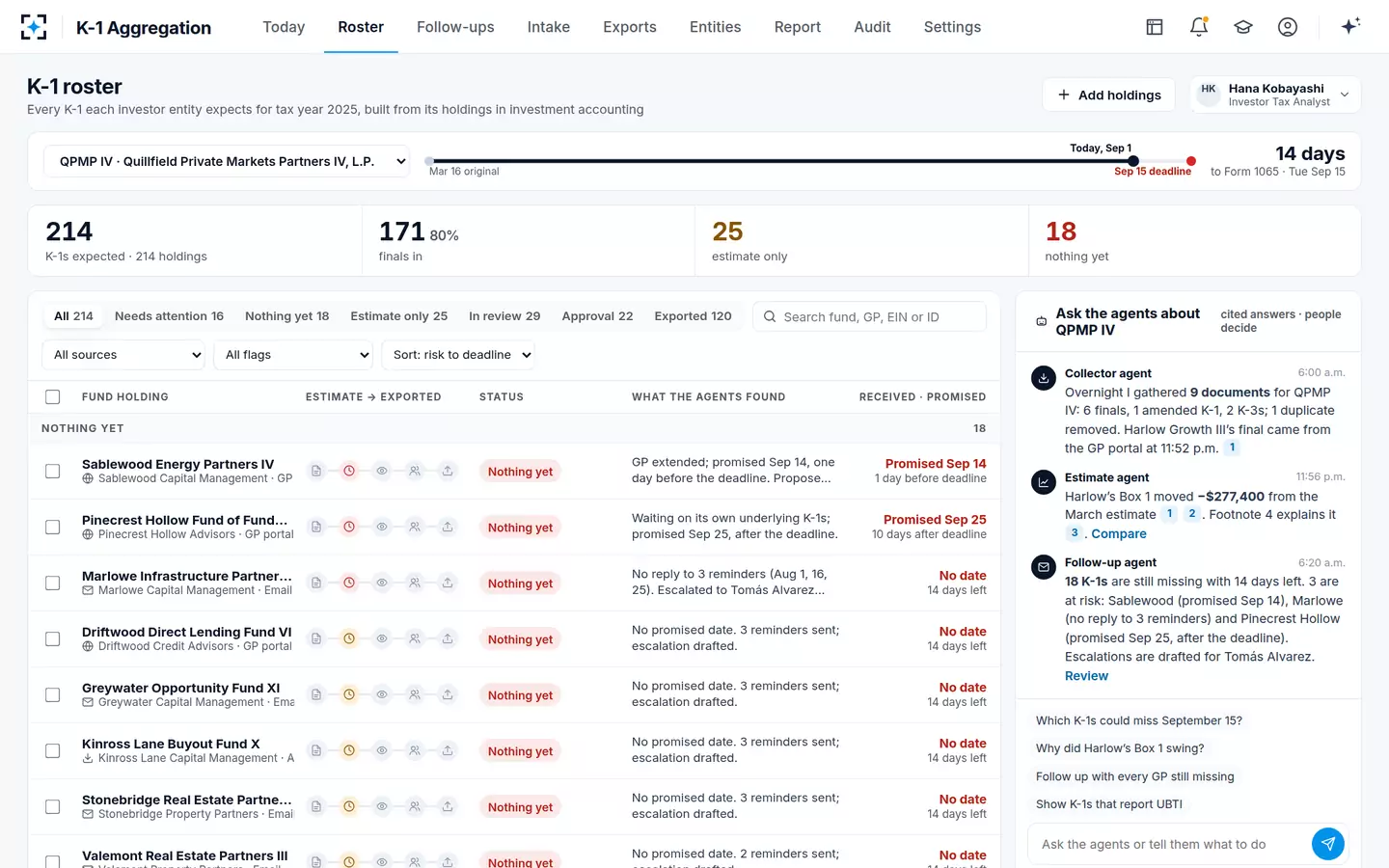
Take the sample fund of funds on Tuesday, September 1, 2026, fourteen days before its own extended Form 1065 is due. It expects 214 K-1s, one for every fund it holds. 171 finals are in. Twenty-five funds have sent only an estimate, and eighteen have sent nothing.
Two weeks before its own deadline, one fund of funds is still missing 43 final K-1s
The row at the top of its roster is the cascade in miniature. Pinecrest Hollow Fund of Funds III, itself a fund of funds, is "waiting on its own underlying K-1s" and has promised September 25, ten days after the sample investor's own deadline. Nothing the investor does can make Pinecrest's underlying funds faster. What it can control is how early it knows, how firmly it asks, and what it files with if the promise is missed.
The roster of every expected K-1, missing ones first
Why did I get my K-1 in September?
Most likely because the partnership, or one below it, used its extension. A K-1 in early September is on time under the rules above; it is late only for the investor's planning. Whether it is late for the investor's own return depends on who the investor is.
An individual who files Form 4868 gets an extension of 6 months, to October 15, 2026 for most calendar-year taxpayers (IRS Form 4868), so a September K-1 still fits, with weeks to spare. A fund of funds filing its own Form 1065 has the same September 15 as its underlying funds and no slack at all. A trust filing Form 1041 has a shorter automatic extension, five and a half months (Instructions for Form 7004), which ends on September 30 by our count. The full calendar of who is due when explains why the season's peak is structural rather than bad luck.
What should I do if my K-1 is late?
Ask early for two things, an estimate and a promised date, and plan to file without the final if you must. The IRS expects that some investors will: it tells partners to use Form 8082 "if you didn’t receive Schedule K-1, Schedule Q, and/or a foreign trust statement from the foreign trust by the due date for filing your return (including extensions)" (Instructions for Form 8082, Rev. October 2025).
When a K-1 is late: six steps an investor controls
- Ask for an estimate and a promised date in writing
A date the GP has committed to can be planned against; "soon" cannot. Ask what the estimate excludes, especially UBTI and K-3 items.
- Count back from your own deadline, not the partnership’s
A trust at September 30 and a fund of funds at September 15 need the K-1 before an individual at October 15 does.
- Extend your own return, and pay as if the K-1 were in
An extension to file is not an extension to pay. The cost of paying on a guess is set out in the estimated tax guide.
- Escalate on a fixed cadence
Reminders at set intervals, then the GP’s head of investor relations, are cheaper than a September scramble.
- If the deadline arrives first, file with the estimate and Form 8082
Describe the item and where the estimated amount sits on your return, as the Form 8082 instructions ask.
- When the final arrives, compare it box by box
Decide by amount and by character whether to amend. A new UBTI line or a change in character matters more than a small change in total.
Steps three and five carry real money. Paying on an estimate that later moves leaves either an underpayment with interest or cash parked with the IRS, and what waiting for a late K-1 costs prices both. Step six is where most of the judgment sits; what to do when the final swings from the estimate works through it on a sample K-1.
Where K-1 Aggregation helps with late K-1s, and where it cannot
No investor-side tool can make a general partner file sooner; the cascade is in the law and the fund structures. What the solution changes is the investor's position inside it. The roster is built from holdings in investment accounting, so a K-1 that has not arrived is a visible gap on day one rather than a discovery in August. The Follow-up agent plans reminders back from each investor entity's own deadline, at 45, 30 and 21 days, an escalation at 14 and a placeholder plan at 7, and reads GP replies into promised dates.
Late K-1s chased on a cadence counted back from the deadline
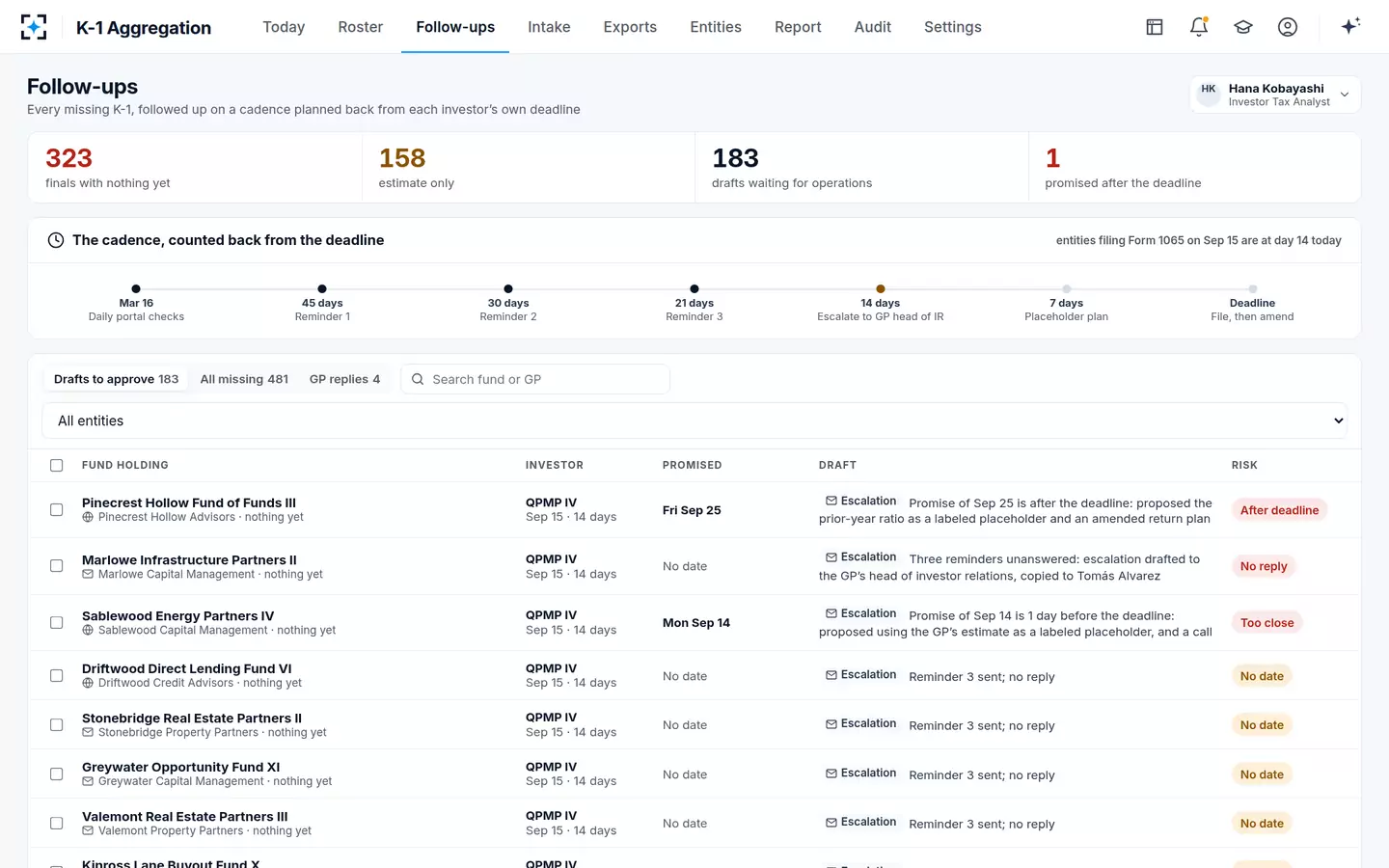
When a promise lands after the deadline, as Pinecrest's does, the agents propose the GP's estimate or, failing that, the prior-year ratio as a placeholder, labeled in the export so it is amended when the final arrives. People approve every message to a GP and every export. The aim is modest and measurable: no K-1 that the investor learns about for the first time in the last week. See the whole workflow on the K-1 Aggregation page.
Questions people ask
Why do K-1s take so long?
A K-1 needs the partnership's closed books, and when the partnership owns other partnerships, their K-1s too. Each partnership may extend its return by six months, to September 15 for a calendar year, so a chain of tiers can stretch the whole way. GAO found almost two-thirds of large partnerships had more than 1,000 direct and indirect partners, six or more tiers, and/or were in finance and insurance, many of them investment funds.
What if I don't receive a K-1 at all?
Ask the partnership for it, and for an estimate, in writing. If your own filing deadline arrives first, the IRS instructions for Form 8082 tell you to use that form to notify the IRS that you did not receive the K-1 by your due date, including extensions, and to describe any estimated amounts you report.
Can I file my taxes without my K-1?
You can file using estimated amounts, attaching Form 8082 to explain them, and amend once the final K-1 arrives if it differs. Many investors first extend: an individual's Form 4868 extension runs to October 15, 2026 for most calendar-year filers, though it does not extend the time to pay.
Is a K-1 that arrives after September 15 late?
For a calendar-year partnership that extended, yes: September 15 is March 15 plus the automatic six-month extension, and the regulation allows no further one. A partnership that did not extend was due on March 15 (March 16 in 2026). Either way the penalty for lateness is the partnership's, not the investor's.
Why are fund-of-funds K-1s usually the last to arrive?
A fund of funds needs the K-1s, and often the K-3s, of every fund it holds before it can finish its own, and those funds may wait on operating partnerships below them. The SEC's 2026 custody proposal describes the same dependency for audits, proposing 180 days for funds of funds and 260 for funds of funds of funds against 120 for other funds.
Does a late K-1 change my own deadline?
No. The regulation that grants the partnership its extension says it does not extend the time for filing a partner's return or paying the partner's tax. A late K-1 changes how much of your return rests on estimates, not when the return is due.