The AI use cases for investor relations that survive a compliance review are the mechanical ones, and AI agents are software that does that work on its own initiative: gathering the administrator's results, drafting a letter in the portfolio manager's voice from a memo, tying every figure to its source, checking the draft against what partners were told last quarter, preparing each audience's version and building the recipient lists. What they cannot do is decide. The view is the PM's, the figures are certified by the CFO, the approval is the chief compliance officer's, and the release needs two people. Regulators draw the same line from the other side: FINRA says its communications rules apply to text a tool generated just as to text a person wrote, and the SEC's examiners say firms' obligations do not change with the technology. Botminds' Quarterly Investor Letters is built on that division: seven agents draft and check, and every decision is a person's, recorded with the evidence they saw.
The examples come from fictional sample data: a fictional firm, Quillfield Alternatives, and its third-quarter 2026 letters, as they run through the solution.
Who decides: what the agents do, what a person decides, and the line between
First draft in the PM's voice
The agentsWrites from the memo, notes and results; links each paragraph to the memo moment it came from
A personPM edits and approves content and voice
The lineNever invents a reason or a view the PM did not give
Every figure
The agentsTies each to source, page and rounding rule; re-ties at the final NAV
A personFund CFO certifies against the final
The lineNo figure without a source; never certifies
What partners were told before
The agentsReads every prior letter; flags silence and contradiction; asks the PM
A personPM answers in her own words
The lineAsks; never answers for the PM
Status for each audience and the prospect version
The agentsReads recipient flags; runs the firm's checks with the rule passage; builds the additions
A personCCO accepts or returns each addition, then approves with a reason
The lineNever approves; never removes a required disclosure
Translation
The agentsWrites the Japanese version with the same figures, re-tied
A personA native-speaker reviewer signs off the first letter of each fund
The lineNever changes a figure or a meaning
Release
The agentsBuilds lists by audience, class and language; holds back anyone it cannot qualify
A personOne person prepares, a different person confirms
The lineNever releases without both keys
AI use cases for investor relations: what the agents do
The use cases for AI in investor relations are the parts of the job that are reading, matching and assembling. In the quarterly letter, that is most of the hours and few of the decisions. The sample solution splits the work across seven agents. An intake agent gathers the estimate and final NAV by class, attribution and position P&L, exposures, the PM's memo and every prior letter, and marks each source final or estimate. A drafting agent writes in the PM's voice. A tie-out agent ties every figure. A continuity agent reads the earlier letters for what the PM promised. A marketing rule agent decides each audience's status and builds the prospect version. A translation agent writes the Japanese version, and a distribution agent builds the lists and holds back anyone it cannot qualify.
The point of splitting the work is that each agent has one job and one limit, which makes each limit enforceable. An agent that only ties figures can be forbidden to certify them; an agent that only reads prior letters can be required to ask rather than answer. A single assistant that "writes the letter" has no such seams, and its errors arrive mixed into fluent prose.
Do SEC rules apply to AI-generated communications?
Yes. No US securities rule exempts a communication because software wrote it, and the regulators have said so. FINRA's 2024 notice on generative AI reminded member firms that its communications rule applies to content produced with AI exactly as it applies to content a person writes, and that its supervision rule covers the firm's use of the tools (FINRA Regulatory Notice 24-09). The SEC's examiners, who call these tools by their own name, "super intelligence (SI)", say in their fiscal 2027 priorities that they will look at how the tools influence outcomes and whether firms still meet obligations that do not depend on the technology (SEC FY2027 examination priorities).
The same document describes how the Division uses the tools itself: to add capacity to examinations and risk assessment while the judgement stays with the examiner (SEC FY2027 examination priorities). That formula, tools that augment while judgement stays with a person, is the right one for a letter too. There is no SEC rule written for AI in adviser communications: the Commission's 2023 proposal on predictive data analytics by advisers and broker-dealers was withdrawn in a notice published on 17 June 2025, in which the Commission said it would not finalise it (90 FR 25531). The existing rules carry the weight: the anti-fraud rule for pooled funds, the books-and-records rule and, for prospects, the marketing rule.
Who is responsible for an AI-written investor letter?
The adviser, through the same people who would be responsible if a person had written every word. A registered adviser must adopt and implement written compliance policies and procedures that cover what is done "by you and your supervised persons" (17 CFR 275.206(4)-7(a)), and a tool the firm deploys works inside those procedures, not beside them. Using an agent to draft a letter changes what the procedures must cover, not who answers for the result.
The European supervisor put the principle most plainly in a statement addressed to investment firms under MiFID II, and its logic does not depend on the jurisdiction.
"It is the responsibility of the management body to establish robust governance structures that monitor the performance and impact of AI tools on the firm's services."
ESMA, public statement on AI and investment services, 30 May 2024
ESMA's statement also names letters among the documents AI could draft, "email/letters to clients", and asks firms to check the accuracy of what goes into and comes out of AI systems before anything reaches a client, then to keep monitoring the process afterwards. That is a description of a tie-out step: an agent may write the sentence, but the figure in it has to be checked against its source before anyone signs.
Decision rights, letter by letter
Responsibility is only real if the software enforces it. In the sample, the rights are set so that no one can sign for something they prepared or something outside their role: investor relations drafts, the PM approves content and voice, the Fund CFO certifies, the CCO approves. The CCO cannot edit the letter's text, a PM cannot certify figures, nobody approves their own edit, and a blocked action says why.
One letter's decisions, and who made each
Agent
Drafting agent writes version 1From an 11-minute memo, the notes and the estimate, in 41 seconds; each paragraph linked to its memo moment.
Never: invent a reason or a view.
A person decides
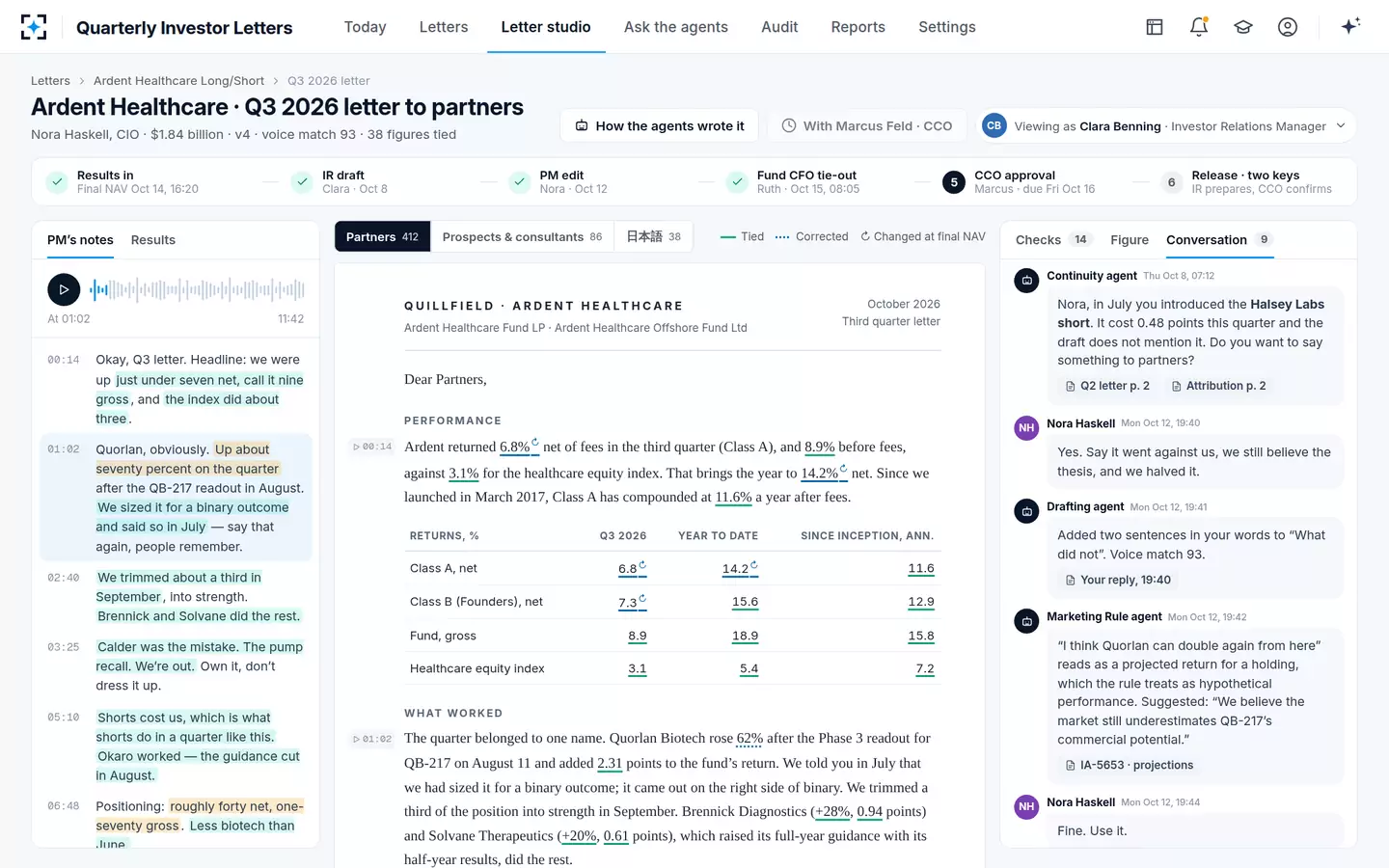
PM edits and answersEdits the draft; answers the continuity agent about a July short; accepts a rewording of a predicted return.
Agent
Tie-out agent re-ties at the final NAVAll 38 figures; five moved 0.1 point; only the affected sign-off reopens.
Never: certify.
A person decides
Fund CFO certifiesAll 38 figures against the final statement, with one signature.
A person decides
CCO approvesAccepts the prospect version's additions and approves with a reason code.
A person decides
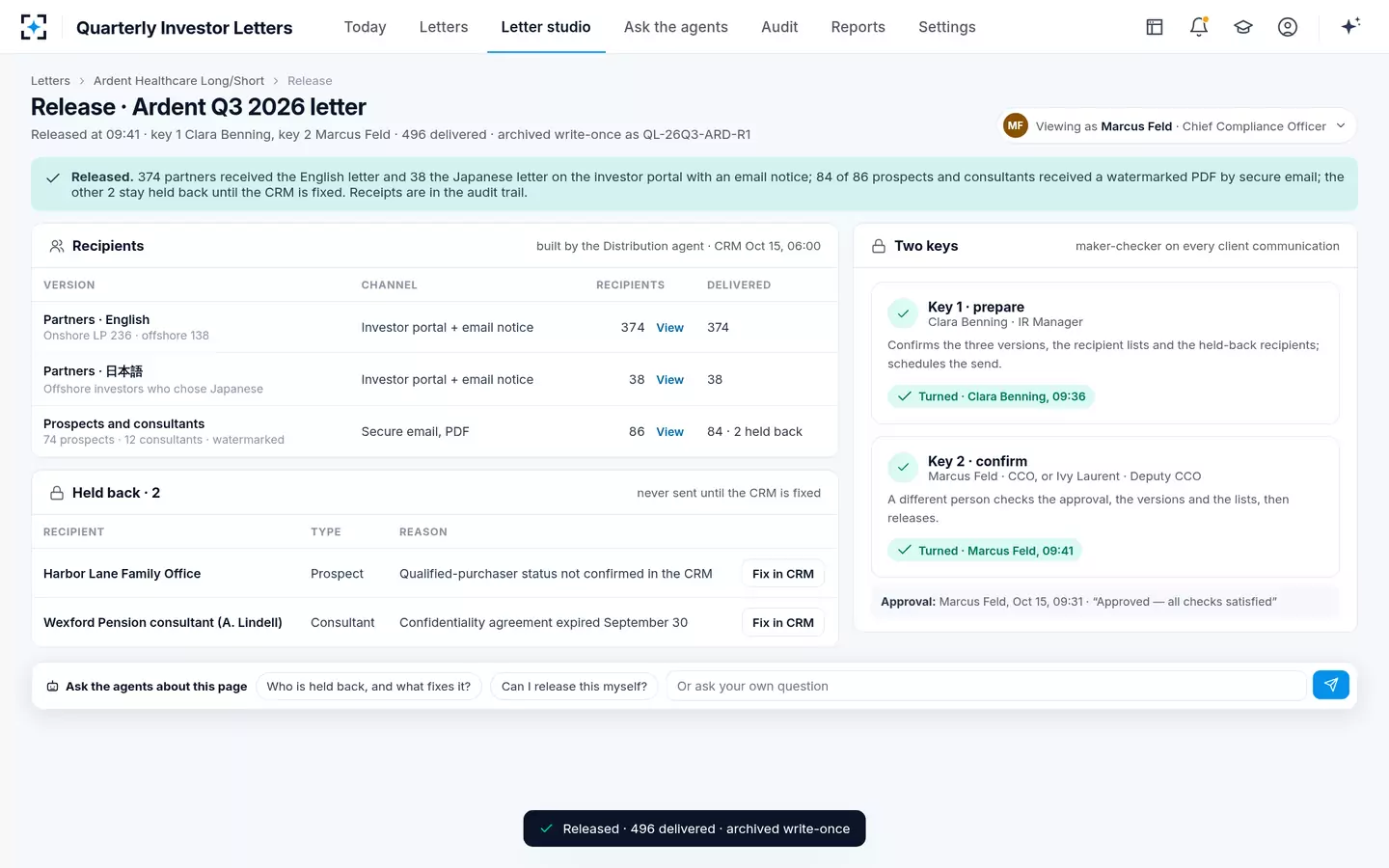
Two people releaseThe IR manager prepares; the CCO confirms. Two recipients held back.
Where the agents must stop
An agent should stop wherever a sentence would carry a judgement nobody gave it. The sample's agents stop at four kinds of line. They never supply a reason or view: the drafting agent works only from what the PM said or wrote. They never fill a silence: when the continuity agent found the draft silent about a short introduced in July, it asked the PM, and two sentences went in only after she answered. They never sign: the tie-out agent prepares the CFO's certification and the marketing rule agent prepares the CCO's approval, and neither can perform it. And they never release: the distribution agent will not send without two keys, and will not send a prospect version to a reader the CRM cannot qualify.
The fourth line is where an agent's caution matters most. In the sample, a family office whose qualified-purchaser status the CRM had not confirmed, and a consultant whose confidentiality agreement had expired, were held back from the prospect send. An agent that guesses a status would have sent both. One more setting governs the agents' own corrections: only format fixes are accepted automatically, and only at a confidence of 0.97 or above; every other change waits for a person.
The agents ask; the PM answers
Can AI write a hedge fund letter in the PM's voice?
It can draft one, if it learns the voice from the PM's own letters and edits and is held to her words. In the sample, the drafting agent's profile of the CIO came from 12 of her letters and 41 of her edits: short sentences averaging 14 words, a mistake owned in the first clause, points for contribution and percent for returns, and a list of words she never uses. She approved the profile; new traits learned from her edits wait for her approval before they are used.
Every draft is scored against the profile, and a draft below the firm's floor of 85 goes back to investor relations before the PM sees it; the sample's third-quarter draft scored 93, and across the cycle's 22 letters past PM review, the median PM review took 1 hour 52 minutes. A voice is not a view, though. The agent can make the CIO's sentences sound like hers; only she can decide that Calder Medtech was a mistake. Why candour, not polish, is what partners reward explains why the profile favours plain admissions over fluent ones.
What to look for when you evaluate AI tools for investor relations
Evaluate an AI tool for investor relations on what it refuses to do, not only on what it writes. A fluent draft is easy to produce; a draft whose every figure points to its source, whose every addition is attributable to a person, and whose release cannot happen without two people is not. Run any candidate on a letter you have already sent, so you know the right answers.
Eight questions for any AI tool that drafts investor letters
- Can every figure be clicked back to its source and page?
And does the tool know which source is final and which is an estimate?
- What happens when the final NAV changes a figure?
Every instance should re-tie, and only the sign-offs that covered it should reopen.
- Does it read your previous letters?
Silence about last quarter's bets is the error reviewers miss.
- Can it write a view the PM did not give?
The right answer is no, and the tool should show where each paragraph came from.
- Does it know who each reader is?
A prospect version is an advertisement; a partner letter generally is not.
- Who can approve, and can they approve their own work?
Look for enforced roles, not a shared login.
- What is recorded?
Every action, the evidence used, the prompt and model version, written once.
- Where does your data go?
Reads only what each fund's entitlement and information barrier allow.
Where AI agents do not fit in investor relations
Agents add least where there is little to tie or remember. A manager with one strategy and a short annual letter may find the setup outweighs the saving. A new fund with no prior letters has no voice to learn and no record to read for continuity; its first letters are better written by hand and used to build the profile. And agents cannot shorten the administrator's timetable: if the final NAV arrives on day 14, the letter is final on day 14.
Nor do agents replace the relationship side of investor relations: the call with a partner who has read a bad quarter, the meeting with a consultant, the judgement about what to say first. Answering a limited partner's question between letters is a different use case with its own controls; Botminds' Investor Relations AI handles that one, from the investor's capital account and the fund documents, for IR to approve. In the sample, the IR manager's job became reviewing and releasing rather than chasing and re-typing, and the time saved went to the people. The investor relations week follows that change day by day. To see the agents and their limits on a letter of your own, start from Quarterly Investor Letters.
Two people release; the agents hold back who they cannot qualify
Questions people ask
What is an AI agent for investor relations?
Software that carries out a defined part of investor relations work by itself, such as gathering results, drafting, tying figures or building recipient lists, and hands its output to a person for decision. It differs from a writing assistant in having a job, sources it must cite and limits it cannot cross.
Can AI write a hedge fund letter?
It can draft one from the PM's memo, notes and results, in a voice learned from her own letters, with every figure tied to the final NAV. The views, the certification of figures and the approval to send must stay with people, and the PM should be able to see where every paragraph came from.
Do FINRA's rules apply to AI-generated communications?
Yes. FINRA Regulatory Notice 24-09 reminds member firms that the content standards of Rule 2210 apply to AI-generated communications as they do to any other, and that FINRA means its rules to be neutral about technology. The SEC examiners' 2027 priorities take the same view of advisers' obligations.
What are the best AI tools for investor relations?
The ones that can show the source of every figure, refuse to write a view the PM did not give, read your earlier letters, know each reader's status and record every action with its evidence. Test each candidate on a letter you have already sent and count what it gets wrong.
Is investor data safe with AI agents?
It depends on what the agents can read. In the sample, each agent reads only what the fund's entitlement and information barrier allow, and every read is recorded. Ask any vendor where the data is processed, who can see it and what is logged.