The best hedge fund letters are the ones partners trust, and the evidence on fund letters says trust is earned by candour, not cheer. They name the losers as precisely as the winners, say what the manager got wrong in the first sentence that mentions it, return to the bets described last quarter, and give a view without promising a number. A peer-reviewed study of fund shareholder letters found that investors respond to tone, with a less negative tone bringing higher net flows, but that a letter inconsistent with the fund's actual performance reduces flows, and that tone does not consistently predict future returns. Botminds' Quarterly Investor Letters drafts each letter in the PM's own voice from her memo, and keeps that voice honest by tying every figure to the books and every silence to the letter before.
The examples come from fictional sample data: the third-quarter 2026 letter of Ardent Healthcare Long/Short, written by its CIO, Nora Haskell, at a fictional firm, as it runs through the solution.
Tone matched to results, and tone that is not: what the research found
Tone consistent with performance: A less negative tone is associated with higher net flows.
Tone inconsistent with performance: A "dishonest communication" not consistent with actual performance decreases flows.
Tone consistent with performance: Tone did not reliably foretell how the fund would do.
Tone inconsistent with performance: Tone did not reliably foretell how the fund would do.
Tone consistent with performance: A measured style.
Tone inconsistent with performance: A positive writing style predicts higher idiosyncratic risk and more style bets.
Tone consistent with performance: "Calder Medtech was our mistake. It fell 21% … and cost us 0.72 points. We are out."
Tone inconsistent with performance: A sentence about headwinds in medtech that names no position and gives no figure.
What makes the best hedge fund letters?
The best hedge fund letters share four habits: they lead with the result partners actually earned, they give the detractors the same precision as the contributors, they remember what they told partners last quarter, and they sound like the person who runs the money. None of the four is a matter of style alone. Each is how a letter keeps the reader's trust when the quarter was bad, which is the only quarter in which trust is tested.
Lists of "best letters" tend to reward wit and conviction, and both help. But a letter is read by partners who own the fund, against the statement they received from the administrator, and alongside the letter they read three months ago. A memorable letter that does not survive those three comparisons is not a good one for its own investors, however widely it is shared.
Do investors read hedge fund letters? What the research found
Investors read fund letters closely enough that the letters' words move money. No independent study has measured how hedge fund partners read their letters, which are private; the strongest evidence comes from mutual funds, whose shareholder letters are public and can be analysed at scale. Hillert, Niessen-Ruenzi and Ruenzi applied textual analysis to mutual fund shareholder letters and asked whether a letter's writing style influences flows and predicts performance (Management Science, 2025).
Their answer, in the paper's abstract, is that investors "react to the tone and content of shareholder letters", and that a letter whose tone is less negative is followed by higher net flows. The authors draw the commercial conclusion plainly: fund companies "can use shareholder letters as a tactical instrument to influence flows". A hedge fund's partners are fewer and more sophisticated than a mutual fund's shareholders, so the size of the effect need not carry over; that they read, and respond, is the safer inference.
Does the tone of a fund letter matter?
Yes, in both directions. The same study that found a less negative tone attracts money found that tone the results do not support repels it.
"However, at the same time, a dishonest communication that is not consistent with the fund's actual performance decreases flows."
Hillert, Niessen-Ruenzi and Ruenzi, Management Science (2025), abstract
That finding is the practical rule for a letter after a weak quarter. Softening the language helps only while the reader cannot see the gap between the words and the numbers, and in a fund letter the numbers are on the same page. A partner who reads "a challenging environment" above a table showing the fund behind its index has learned something about the result and something about the writer.
The regulatory version of the same point is older. The SEC's 2011 inquiry into suspicious hedge fund returns charged one manager whose communications "gave investors the false impression that the fund's returns were consistently positive" (SEC press release 2011-252; allegations at the time). Tone that the record does not support is a commercial risk in the study and a legal one in the enforcement case.
Does an optimistic letter predict returns?
No. In the study, a letter's tone did not reliably foretell the fund's future performance. What a positive writing style did predict was behaviour: "higher idiosyncratic risk as well as more style bets". An upbeat letter, on that evidence, tells the reader more about the risks the manager is about to take than about the returns that will follow.
For a PM, the implication is that optimism in a letter buys flows without buying performance, and costs credibility when the next quarter disagrees. For an allocator reading letters, it suggests a useful habit: weigh a letter's specifics, the positions, the figures and the stated reasons, and discount its adjectives. A manager who writes "we were wrong about Calder, and we are out" has given the reader something to check next quarter. One letter annotated by source shows which sentences can be checked and against what.
What the research cannot tell a hedge fund
The study is about mutual funds, and three differences matter. Mutual fund shareholders can buy or sell daily, so flows can respond quickly to a letter; hedge fund partners may face lock-ups, notice periods and redemption limits in the fund documents, so a letter's effect shows up later, in a redemption notice or a declined allocation. Mutual fund letters reach many small investors; a hedge fund letter reaches a few hundred partners, many of whom read it with their own statement and their consultant's notes beside it. And the study measures money, not trust, which is what a manager actually loses first.
No independent study has yet measured hedge fund letters this way, because the letters are private. A firm can measure its own: log partners' questions after each letter, the subscriptions and redemption notices that follow it, and which paragraphs those questions refer to. Over a few quarters, that log shows whether candour about a loser cost the firm anything, and the study suggests it is more likely to have been the silence that did.
How should a letter explain a bad quarter?
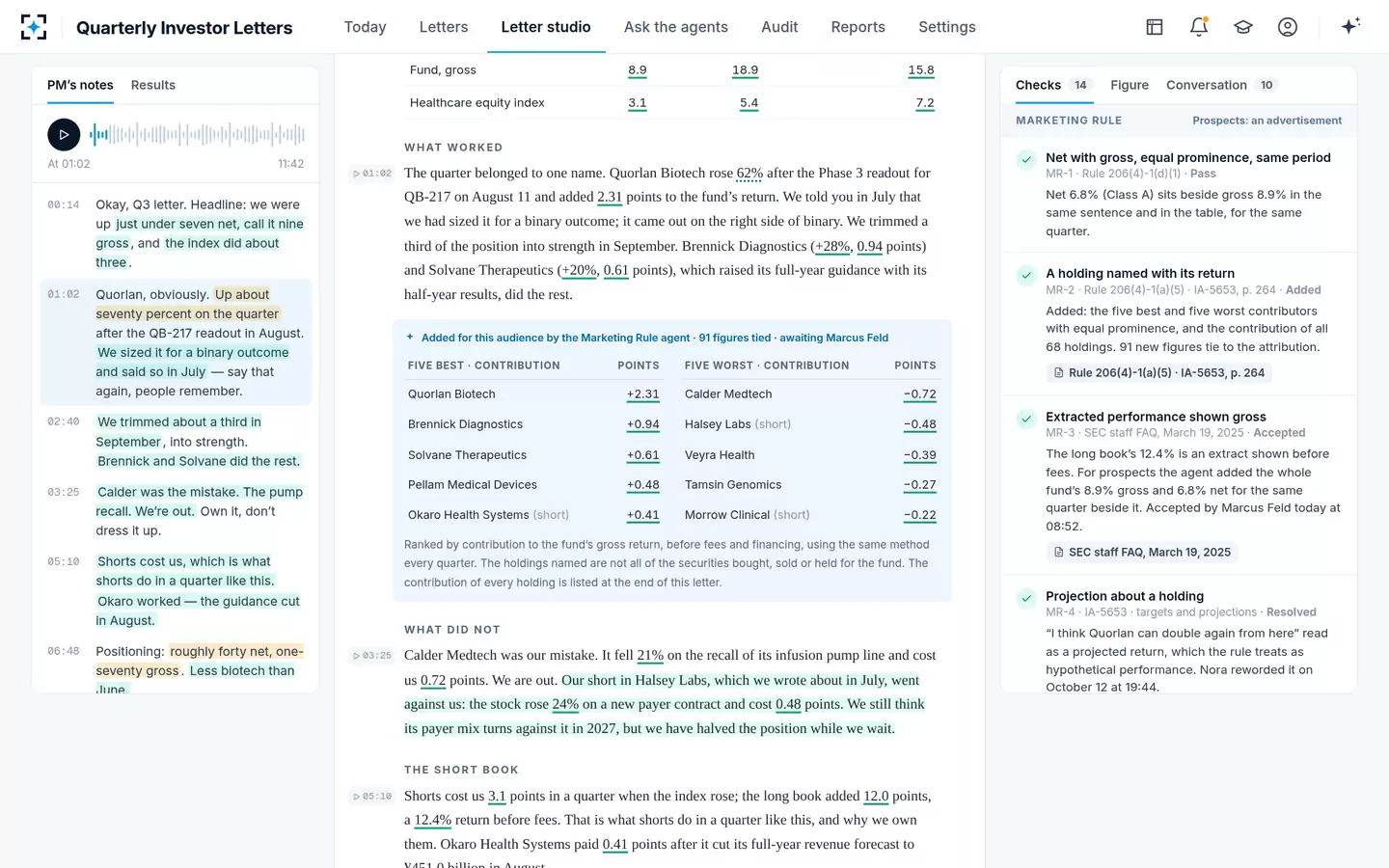
Lead with the result, name the largest detractor in the first sentence that mentions it, say what it cost in points, and say what was done. The sample letter follows that order. Its CIO's voice memo said of her worst position: "Calder was the mistake. The pump recall. We're out. Own it, don't dress it up." The letter says: "Calder Medtech was our mistake. It fell 21% on the recall of its infusion pump line and cost us 0.72 points. We are out."
The same order applies to a thesis that has not yet worked. The fund's short in Halsey Labs, which the CIO had described to partners in July, rose 24% and cost 0.48 points. The letter does not abandon the thesis or defend it at length; it says the position went against the fund, that the manager still holds the view, and that the position has been halved. A partner can disagree with the judgement, but cannot say it was hidden.
What did not work, in the PM's own words and the books' own figures
Candour has a memory: letters as a series
Partners do not read one letter; they read a series, and candour is judged across it. A short introduced with conviction in July and absent in October tells a careful reader that it went badly. The letter that says so first keeps the reader's trust; the one that waits for the reader to notice spends it.
The sample's draft was silent on the Halsey Labs short until the solution's Continuity agent, which reads every prior letter for the theses, sized bets and promised updates the PM gave partners, asked her about it. She answered in one line, and two sentences in her words were added. Remembering is not a writing skill; it is a reading task, and it is the part of a letter's honesty that is easiest to automate and hardest to do by hand on a deadline. The errors that slip through when nobody reads the last letter are set out in the seeded-error test.
Voice without varnish
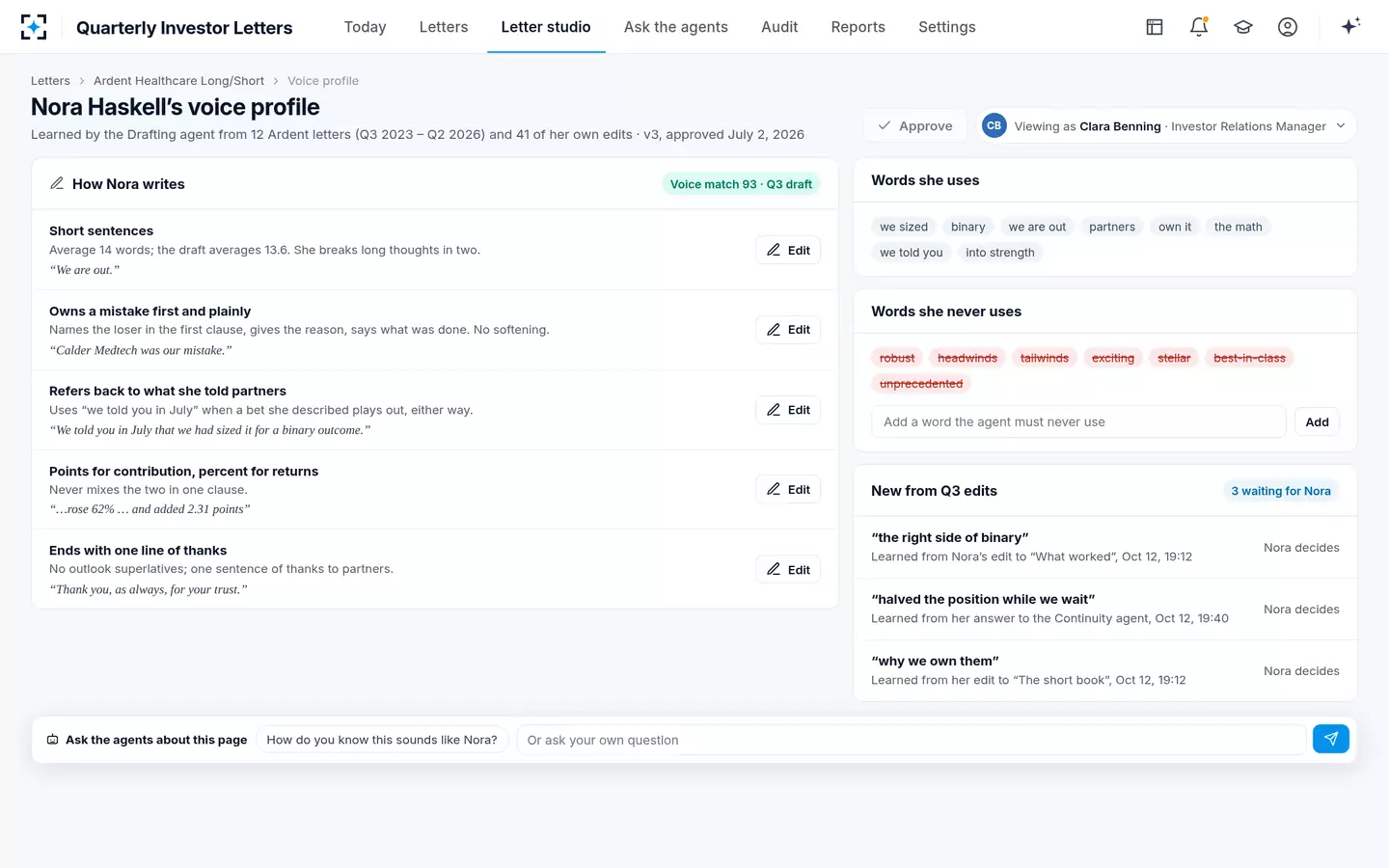
A letter in the PM's own voice is part of its candour: partners invest with a person, and a letter that reads like a brochure suggests someone else wrote it, or that the person is managing them. The sample CIO's voice was described from 12 of her letters and 41 of her own edits: short sentences, averaging 14 words; a mistake owned in the first clause; references back to what she told partners; points for contribution and percent for returns; one line of thanks and no superlatives.
One PM's voice, written down: words she uses, and words she never uses
| Trait | What it means in a letter | Her words | What she avoids |
|---|---|---|---|
| Owns a mistake first | The loser named in the first clause, with the reason and what was done | "Calder Medtech was our mistake." | "headwinds", "tailwinds" |
| Refers back | Every bet described before is followed up | "We told you in July that we had sized it for a binary outcome." | Silence |
| Units kept apart | Percent for a return, points for a contribution | "…rose 62% … and added 2.31 points" | Mixed units in one clause |
| Plain close | One sentence of thanks, no outlook superlatives | "Thank you, as always, for your trust." | "exciting", "stellar", "best-in-class", "unprecedented" |
How the PM writes, learned from her letters and her edits
Reading other managers' letters: what to look for
Other managers' letters are worth reading, and the searches for them, quarter by quarter, suggest that many people do. Read them as an allocator would, for the habits that make a letter checkable, rather than for the eloquence that makes it quotable.
Seven questions to ask of any hedge fund letter
- Which class and which net figure leads?
The class most partners hold, net of fees, against a stated benchmark for the same period.
- Are the losers as precise as the winners?
Named, with return and contribution in points.
- Does it follow up last quarter's bets?
Every thesis introduced earlier is either reported on or dropped with a reason.
- Are returns and contributions kept apart?
A 62% return that added 2.31 points is two facts, not one.
- Is the outlook a view or a number?
A target return for the fund or a holding is a promise; a reason the market misprices something is a view.
- Does the tone match the table?
If the words and the numbers disagree, the research says readers notice.
- Could it have been written by anyone else?
Generic adjectives are a sign that the letter is managing its readers rather than informing them.
For a letter sent to prospects rather than partners, several of these questions become conditions: the marketing rule requires that specific investment advice be presented in a manner that is "fair and balanced" (17 CFR 275.206(4)-1(a)(5)). To see a letter drafted in one PM's voice and held to her own record, start from Quarterly Investor Letters.
Questions people ask
What are the best hedge fund letters to read?
Read the ones that let you check them: net results by class against a stated benchmark, losers named with figures, and a follow-up on what the previous letter promised. Published letters are useful models of structure and voice; judge their candour by whether the specifics would let a partner hold the manager to them next quarter.
Where do people find Q2 2026 hedge fund letters?
Letters are private communications to partners, so those available to the public are the ones managers chose to publish, which readers collect and share each quarter, including on forums such as Reddit. Treat a published letter as written for a wide audience, prospects included, and read it with the questions above.
Does a positive tone in a fund letter predict better returns?
The evidence says no. A study of mutual fund shareholder letters published in Management Science in 2025 found that tone did not reliably foretell future performance, while a positive writing style predicted higher idiosyncratic risk and more style bets.
Should a hedge fund letter be written by the PM or by investor relations?
The views and the voice should be the PM's, because partners invest with that person and notice when a letter is not theirs. The assembly, the figures and the checks can sit with investor relations, the CFO and compliance, or with agents that draft from the PM's own memo and edits for her to approve.
How long should a hedge fund letter be?
Long enough to cover performance, contributors, detractors, positioning and a view with figures; no rule sets a length. The fictional sample firm fixes a range of 1,100 to 1,500 words, so that a good quarter does not produce a long letter and a bad one a short letter.