Investor reporting software covers the tools a fund manager uses to produce and deliver what investors receive: portals that distribute statements and documents, reporting tools that build statements and factsheets from fund data, and, more recently, AI agents that draft and check narrative documents such as the quarterly letter. The right one depends on which hours you are trying to remove, and for a hedge fund letter those hours are rarely measured. No regulator or independent study publishes how long a quarterly letter takes or what it costs, and vendors don't publish comparable prices. So price one letter yourself, by role: the PM's writing time, investor relations' assembly and re-typing, the CFO's checking, compliance review and the prospect version, translation and release. On our estimate, the PM's hours are the largest line once a PM costs more than about $54 an hour. Botminds' Quarterly Investor Letters is built to shrink that line without taking the letter out of the PM's hands.
The hours below are our estimate for one fund's letter, not a measured time study; the wages are the Bureau of Labor Statistics' medians for all industries. Product examples are fictional sample data at a fictional firm, Quillfield Alternatives.
Where one letter's hours go, by role: by hand, and with the agents
By hand · about 26 hours (our estimate)
- PM · 12 h · 46%
- Investor relations · 10 h · 39%
- Compliance · 4 h · 15%
With the agents · about 4.2 hours (our estimate)
- PM · 2 h · 48%
- IR · 1.2 h · 28%
- Compliance · 1 h · 24%
What does investor reporting software do?
Investor reporting software does three different jobs, and a product may do one of them or several. Distribution: an investor portal stores and delivers statements, letters and documents, controls who sees what, and records who opened it. Production of numbers: reporting tools turn fund accounting data into capital account statements, performance reports and factsheets on a schedule. Production of narrative: drafting tools write or assist with the letter, the commentary and the questionnaire answers.
The letter sits awkwardly across all three. Its figures come from fund accounting, its words from the PM, and its delivery through the portal or secure email; its legal status depends on who receives it. A portal can send a letter but not write one; a reporting tool can produce the returns table but not the paragraph about what went wrong. The cost of a letter is therefore spread across tools and people, and most of it sits where no tool reaches: in the PM's hours and in the hand-offs between roles.
What is investor reporting, and where does the letter fit?
Investor reporting is everything a fund sends its investors about their investment: capital account statements, performance updates, audited financial statements, tax documents, and the PM's letter. Most of it is driven by numbers and produced by administrators and operations teams. The letter is the exception: the one document investors read for judgement, which is why the PM writes it and why it is the hardest to automate well.
That also makes it the document where errors cost most. A statement is checked against the administrator's books by construction; a letter is written from a memo and a memory, and its figures, its omissions and its prospect version each answer to a rule. The errors reviews miss are the hidden part of a letter's cost, and they appear only when someone finds them.
Why no one publishes the cost of a letter
No regulator collects the hours advisers spend on investor letters, and no independent study has measured them. The letter is not a required filing, so it has no Paperwork Reduction Act burden estimate of the kind the SEC publishes for required forms. Industry surveys of operating costs exist, but they are commercial and do not publish their methods in full. And firms rarely log the hours themselves, because the PM's share arrives in a weekend rather than a timesheet.
That leaves two honest sources: your own time log, and an estimate whose assumptions are stated. The estimate on this page is ours, built from the steps one letter goes through: 26 hours by hand for one fund's letter, of which the PM's writing and editing, one to two days, is 12. Replace each line with your own.
Price one letter: the formula
The cost of one quarterly letter, line by line
PM time
hours writing and editing × PM's hourly cost
Include the weekend; include the second edit after compliance and the CFO
Your PM's own cost
Investor relations
hours gathering, re-typing, building versions and lists × IR hourly cost
Re-typing at the final NAV belongs here
BLS financial analysts as a floor
Figure checking
CFO or controller hours × hourly cost
Vouching the figures against the final NAV
BLS financial managers as a floor
Compliance
review hours, partner and prospect versions × hourly cost
Include rebuilding the prospect version
BLS compliance officers as a floor
The hourly costs should be loaded: salary plus bonus, benefits and overhead, divided by working hours. Government data gives a floor, not an answer, because its medians cover all industries. For an investment firm, the useful use of the BLS figures is as a check on the shape of the result rather than its size.
A worked example at government wage data
Take our estimate and price the roles that have a government wage series. The BLS reports median pay for May 2025 of $103,570 a year for financial analysts, $166,570 for financial managers, the family that includes controllers and fund treasurers, and $80,730 for compliance officers. Divided by 2,080 working hours, those are about $49.79, $80.08 and $38.81 an hour.
Hourly medians for three roles around the letter
$49.79
an hour, financial analysts, a floor for investor relations
$80.08
an hour, financial managers, a floor for the CFO or controller
$38.81
an hour, compliance officers
On those floors, the investor relations hours in our estimate, 10 hours, cost about $498 a letter, and the compliance hours, 4, about $155: some $653 a letter before any CFO time. The PM's 12 hours have no government series; the BLS notes only that experienced financial analysts may go on to become portfolio or fund managers (BLS, Financial Analysts). That is the line you have to price yourself, and it is where the arithmetic turns.
When the PM's time is the largest line
On our estimate, the PM's hours outweigh everyone else's combined unless the PM costs less than about $54 an hour. Twelve PM hours exceed the $653 of investor relations and compliance time at BLS medians once the PM's loaded cost passes $653 ÷ 12, or $54.43 an hour, roughly $113,000 a year at 2,080 hours. If your IR and compliance staff cost twice the BLS medians, the threshold doubles to about $109 an hour. Set your PM's loaded cost against those thresholds: above them, the PM's hours are the largest line in the letter, and the line where software can save the most.
That changes what to look for in software. A tool that saves investor relations a few hours of formatting saves the cheaper hours. A tool that cuts the PM's 12 hours to 2, by drafting in her voice from a memo she records between meetings, saves the expensive ones, provided it does not add review time back. In the sample, the median PM review across the cycle's 22 letters past PM review was 1 hour 52 minutes; that, not the drafting speed, is the figure to test in a trial. The investor relations week shows where the other hours go.
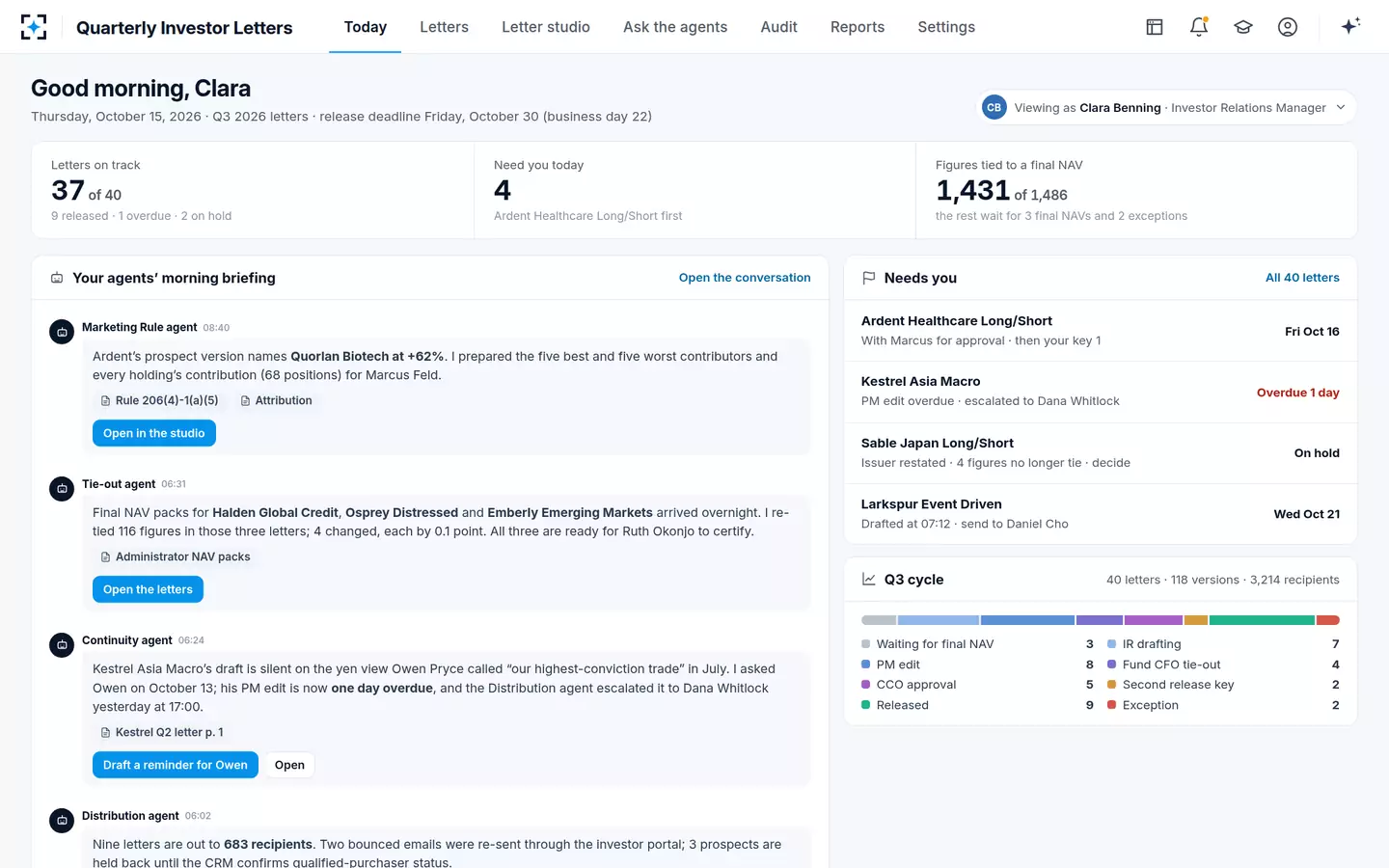
A cycle of 40 letters, where the hours become visible
From one letter to a year of letters
A single letter's cost looks small; a year of them does not. Scale our estimate to the fictional sample firm, which sends 40 letters a quarter from 22 in-house hedge fund teams and six boutiques. By hand, at about 26 hours each, that is some 1,040 hours a quarter, 480 of them PMs' hours. With the agents, at about 4.2 hours each, it is some 168 hours, 80 of them PMs'. Over four quarters the difference is roughly 3,500 hours; for each PM writing one letter a quarter, it is some 40 hours a year, about a working week of weekends, and that is the part people notice.
Forty letters a quarter: hours by hand and with the agents, on our estimate
The same arithmetic is the basis for comparing any tool. Multiply your own per-letter hours by your letters a year, price each role's hours, and the result is the most a tool could save. What it actually saves is the hours a trial shows it removes, which is why the trial should time the PM's edit rather than the draft.
Investor reporting software, portals and agents compared
The options differ in which hours they remove. The comparison below is by job, not by vendor; vendors don't publish comparable prices, so the cost column is what you should ask for, not a figure.
Four ways to produce a quarterly letter, and which hours each removes
| Approach | What it removes | What remains | What to ask for |
|---|---|---|---|
| By hand: word processor and email | Nothing; flexible | All 26 hours in our estimate; re-typing; version control by file name | Your own time log for one quarter |
| Investor portal | Distribution, access control, read receipts | Writing, figures, checks, the prospect version | Price per investor or per fund; how letters are versioned by audience |
| Reporting tool or document automation | The returns table and figures, filled from data | The PM's writing, the narrative's accuracy, continuity, compliance | Whether figures in the text, not only the table, are filled and re-tied |
| AI agents drafting and checking | Assembly, first draft, tie-out, continuity, prospect version, lists | The PM's edit, the CFO's certification, the CCO's approval, release | A run on a letter you already sent; the PM's edit time; the audit export |
What to ask in a demo of investor reporting software
Seven requests that turn a demo into a measurement
- Run it on last quarter's letter
Use the real memo or notes, estimate, final NAV and recipient list, so the right answers are known.
- Time the PM's edit
The most expensive hours; a fast draft that needs a long edit saves little.
- Change a figure at the final NAV
Every instance should move, in every version and translation, and only the affected sign-offs should reopen.
- Remove a position from last quarter's letter
See whether the tool notices the silence.
- Send to a prospect with an incomplete CRM record
The right answer is to hold the reader back, with a reason.
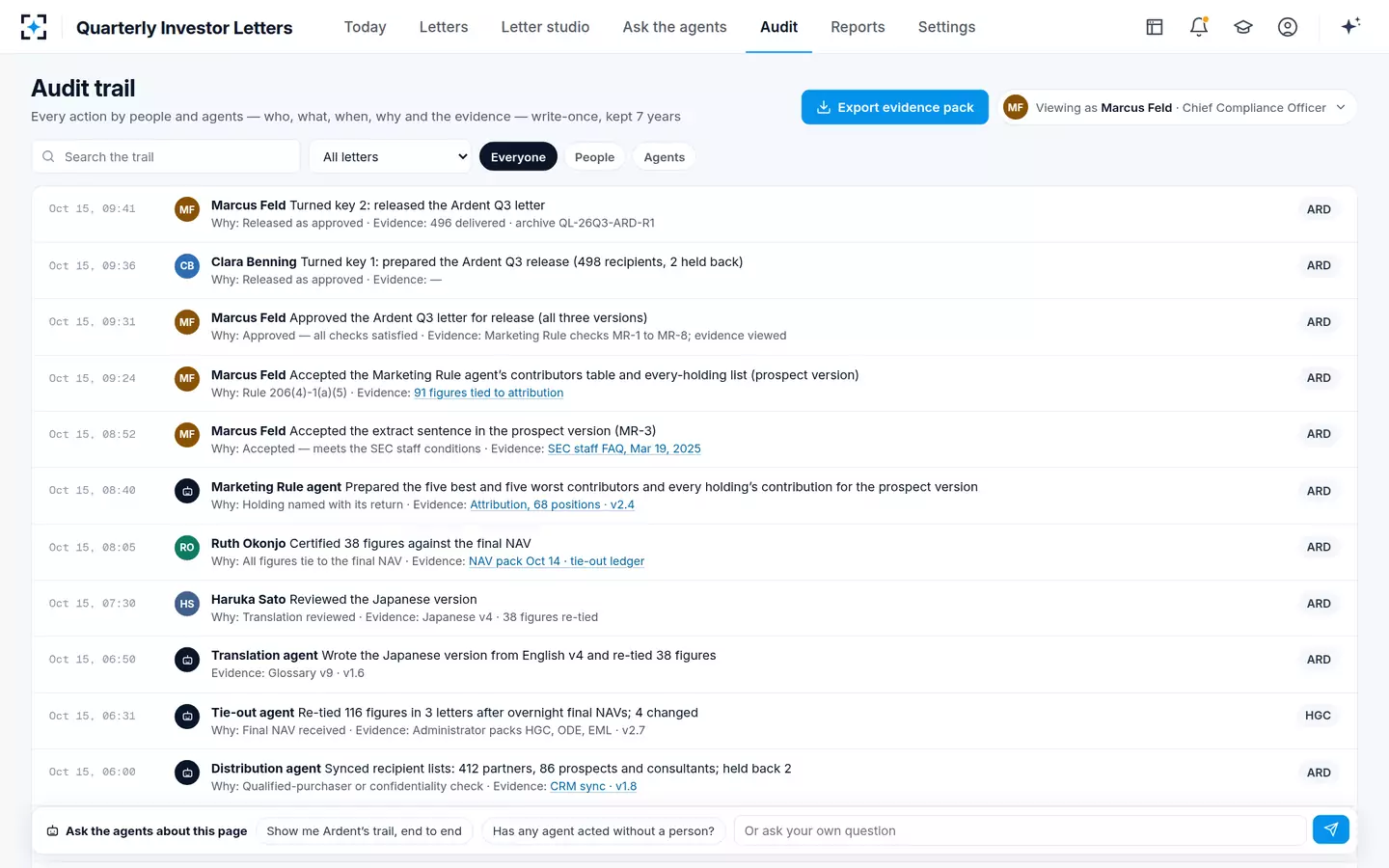
- Export the file for one letter
Every version, source, change, approval and recipient, with who did what.
- Ask for the price per letter
Then set it against your own priced letter, not against a vendor benchmark.
Where Quarterly Investor Letters fits, and where it does not
Quarterly Investor Letters fits firms that write narrative letters to partners each quarter, across several funds or several PMs, with a fund administrator, portfolio accounting and a CRM it can read. It removes the assembly, the first draft, the re-typing, the continuity check and the build of the prospect version, and records every step for the file. It leaves the PM's edit, the CFO's certification, the CCO's approval and the release with people, by design.
It does not replace an investor portal, a CRM or fund accounting; it reads from them and releases through them. It is the wrong purchase for a manager with one fund and a short annual letter, where the setup would outweigh the saving, or for a firm whose letters are numbers-only statements with no PM narrative. And its value depends on the PM: a firm whose PM will not record a memo or approve a voice profile will save investor relations hours but not the expensive ones. A one-quarter plan from template to first live letter sets out what a trial needs. To price it against your own letter, start from Quarterly Investor Letters.
One letter's file, exported for review
Questions people ask
How much time does a quarterly letter take?
No regulator or independent study has measured it. We put one fund's letter, done by hand, at roughly 26 hours across the PM, investor relations and compliance, of which the PM's writing and editing, one to two days, is the largest part. Log each role's hours for one quarter to replace the estimate with your own.
What is the difference between investor reporting software and investor relations software?
Investor reporting software produces and delivers what investors receive: statements, performance reports, letters. Investor relations software usually means the CRM and contact tools that manage the relationship: who the investors are, what they asked and when. A letter needs both, since the CRM decides which version each reader gets.
Are investor portal software reviews useful for choosing a letter tool?
For distribution, yes; for the letter itself, rarely, because a portal delivers documents but does not write or check them. Judge a letter tool on a run against a letter you already sent, timing the PM's edit and checking every figure against the final NAV.
How do I build a business case for investor reporting software?
Price one letter by role with the formula above, multiply by letters a year, and set the result against the tool's price and your own trial measurements, especially the PM's edit time. Count the cost of one correction letter as well, since avoiding it is part of the return.
Does automating investor letters reduce compliance risk?
It can, if the tool ties every figure to its source, reads earlier letters for omissions, decides each audience's status and records every step; it cannot if it only writes faster. The anti-fraud rule and the books-and-records rule apply to the letter whatever produced it.