An investor letter is a periodic letter, usually quarterly, from a fund's portfolio manager to the people already invested in the fund: how it performed, what drove the result, how it is positioned and what the manager thinks. Under the SEC's marketing rule, a letter to existing investors about the fund they hold is generally not an advertisement, because it does not offer the adviser's services to anyone new. The same letter sent to a prospect or a consultant does offer them, so for that reader it is an advertisement and must meet the rule's conditions. Whatever its status, the anti-fraud rule for pooled funds applies to every sentence, and the books-and-records rule names the "investment letter" outright. Botminds' Quarterly Investor Letters drafts the letter once and decides its legal status for each audience before compliance approves it.
The examples come from fictional sample data: Quillfield Alternatives, a firm whose 40 hedge fund and boutique strategies each write to their partners every quarter, as it runs through the solution.
How one investor letter's status is decided, reader by reader
Agent
Read who each reader isRecipient flags from the CRM: existing partner in this fund, prospect, consultant, qualification status, language.
Never: guess a status the CRM does not hold; the reader is held back instead.
Agent
Existing investor in the fund the letter discusses?If yes, the letter is account and market information for that reader, unless it also offers a new fund or service.
Agent
Offers new or additional services?A new fund, a co-investment, a separately managed account: the passage that offers it is an advertisement even for partners.
Agent
Prospect or consultant?The letter offers the adviser's services to a prospective investor: an advertisement, with the marketing rule's conditions in full.
A person decides
Chief compliance officer decidesReads each audience's status with the passage it rests on and approves, or returns the version.
What is an investor letter?
An investor letter is the manager's narrative of a period, sent to investors in a fund: a hedge fund's quarterly letter to partners, a boutique's letter to separately managed account clients, a mutual fund's shareholder letter. In private funds it is written in the PM's voice and carries the numbers investors care about: net return by class for the quarter, the year and since inception; the positions that drove it; exposures; and a view.
No US rule requires a private fund to send one. The SEC adopted a rule in 2023 that would have required registered advisers to send private fund investors a quarterly statement of adviser pay, fund fees and expenses, and performance; as the SEC's own summary now notes, "A Federal court vacated these new rules as of June 5, 2024" (SEC overview chart). The letter is therefore a practice that rules surround rather than one they create, a point hedge fund reporting requirements takes further.
Investment letter, side letter, investor statement: what is an investor letter in fund finance?
In fund finance the words "investor letter" name several different documents, and searchers often mean one of the others. The quarterly letter is a communication; a side letter is a contract; a verification letter is evidence for an offering exemption; a statement is an account record. Each has its own rule.
Five documents called a letter to or about investors, and the rule each sits under
| Document | What it is | Who sends it | The rule that names or governs it |
|---|---|---|---|
| Quarterly investor letter | The PM's account of the quarter: results, positions, view | The adviser, to the fund's investors | Anti-fraud rule 206(4)-8; books and records 204-2 ("investment letter"); the marketing rule for prospects |
| Investment letter | The books-and-records rule's own term for a letter or bulletin with investment content | The adviser | 17 CFR 275.204-2(a)(11) and (a)(16) |
| Investor side letter | An agreement giving one investor terms the fund documents do not, such as lower fees or extra reporting | The fund and the investor, both signing | The fund's documents and the anti-fraud rule; the SEC's 2023 preferential-treatment rule on side letters was vacated in 2024 |
| Accredited investor verification letter | A written confirmation that a buyer in a 506(c) offering is accredited | A registered broker-dealer, SEC-registered adviser, licensed attorney or CPA | 17 CFR 230.506(c)(2)(ii)(C) |
| Investor statement | The investor's capital account, return and fees for the period | The administrator or the adviser | The fund documents; the custody rule's audit and statement provisions |
The overlap that matters is between the first two rows. The books-and-records rule requires an adviser to keep a copy of each investment letter, bulletin or similar communication it sends "to ten or more persons (other than persons associated with such investment adviser)" (17 CFR 275.204-2(a)(11)(i)(B)). A quarterly letter to a fund's partners is squarely that. Whether or not it is an advertisement, it is a record.
Is an investor letter an advertisement? The adopting release's answer
Generally no, when it goes to existing investors about the fund they hold. The marketing rule defines an advertisement as a communication that "offers the investment adviser's investment advisory services with regard to securities to prospective clients or investors in a private fund" or "offers new investment advisory services with regard to securities to current clients or investors in a private fund" (17 CFR 275.206(4)-1(e)(1)(i)). A letter that reports on the fund a partner already owns offers neither.
The Commission said so in terms when it adopted the rule. "Our intent is not to chill ordinary course communications with current investors," the release reads, and the narrower definition "will allow advisers to continue to provide current investors with timely information regarding their accounts and the market without subjecting those communications to the marketing rule." It named private fund materials specifically.
"Private fund account statements, transaction reports, and other similar materials delivered to existing private fund investors, and presentations to existing clients concerning the performance of funds they have invested in (for example, at annual meetings of limited partners) also would not be considered advertisements under the final rule."
SEC adopting release for the marketing rule, 86 FR 13024 (5 March 2021)
A commenter had asked the precise question: would the definition reach the monthly or quarterly letters managers send existing investors about account performance and markets? The annotated quarterly letter quotes the comment. The release did not carve out letters by name; it answered with the general test, and its stated aim, timely information to current investors about their accounts and the market, describes a letter of that kind. Market commentary gets the same treatment: "Generally, generic brand content, educational material, and market commentary would not meet the revised definition of an advertisement."
When does an investor letter become an advertisement?
An investor letter becomes an advertisement in four situations: when it is sent to prospective investors; when it offers existing investors a new or additional service; when part of it is a pitch attached to commentary; and when it contains hypothetical performance, such as a target return, where even a letter to a single reader can count. Each is a fact about the reader or the content, not about the letter's name.
Sent to prospects or consultants. A prospect is not invested in the fund, so a letter describing its strategy and results offers the adviser's services to that reader. In the sample, the letter that goes to partners also goes to a pipeline of 74 prospects and to 12 consultants who advise allocators.
Offering something new. A partner letter that announces a successor fund, a co-investment vehicle or a separately managed account, with an invitation to take it up, offers a new service. The release explains the logic: the Commission views "an adviser seeking to offer new or additional investment advisory services with regard to securities to current investors as posing the same risks to investors as an adviser seeking to offer such services to new investors".
Commentary that ends in a pitch. The release gives the example of "an article or white paper that provides general market commentary and concludes with a description of how the adviser's securities-related services can help prospective investors invest in the market", and says that portion is an advertisement. A letter whose last page invites readers to invest has the same shape.
Hypothetical performance. The definition reaches a communication to "one or more persons if the communication includes hypothetical performance", with exclusions for a reply to an unsolicited request and for a one-on-one communication with a private fund investor. A target return for the fund belongs in that category; a view about the market does not, since "projections of general market performance or economic conditions in an advertisement are not targeted or projected performance returns" in the release's words.
One trap is mechanical. Sending a letter to 86 prospects as 86 separate emails does not make it one-on-one. The release asks advisers to have procedures to tell "whether a communication nominally directed to a single person is actually a communication to more than one person, or contains duplicated inserts as part of that communication".
The partner version and the prospect version, side by side
Once the status is settled, the two versions diverge in what they must contain, not in what they may say. Both rest on the same final figures and the same account of the quarter. The prospect version carries the conditions an advertisement must meet; the partner version carries only the duty not to mislead, which is narrower in form and just as strict in substance.
The partner letter and the prospect letter: same draft, different obligations
To existing partners: Generally not an advertisement: information about the fund they hold.
To prospects and consultants: An advertisement: it offers the adviser's services to prospective investors.
To existing partners: Applies to every statement and omission.
To prospects and consultants: Applies to every statement and omission.
To existing partners: Firm policy; a gross-only figure can still mislead.
To prospects and consultants: Net must accompany any gross figure, with at least equal prominence, same period and method.
To existing partners: Fair to the partner if the losers are discussed too.
To prospects and consultants: Must be fair and balanced under the general prohibitions; the sample firm's policy adds the five best and five worst contributors.
To existing partners: Explained in context.
To prospects and consultants: Total fund performance provided, or offered promptly.
To existing partners: A copy if sent to ten or more persons; the working papers behind every figure.
To prospects and consultants: A copy of the advertisement, however few received it; the working papers behind every figure.
Does the anti-fraud rule apply to investor letters?
Yes, to every version and every reader. The rule for advisers to pooled investment vehicles makes it fraudulent to "make any untrue statement of a material fact" to an investor or prospective investor, or to leave out a material fact that what was said needs in order not to mislead, and separately to "otherwise engage in any act, practice, or course of business that is fraudulent, deceptive, or manipulative" toward them (17 CFR 275.206(4)-8(a)).
The adopting release closes the gap explicitly: "regardless of whether a communication to an existing or prospective investor is an ‘advertisement’ under the marketing rule, the communication is subject to the anti-fraud provisions of section 206 of the Act". The practical consequence is that the partner letter is not a lighter-touch document. It escapes the marketing rule's conditions, such as the net-with-gross requirement, which SEC Marketing Rule Compliance applies across a firm's advertisements; it does not escape the duty not to mislead, including by omission. Five ways letters fail that duty in practice are planted and tested in the seeded-error test for hedge fund investor letters.
When a placement agent forwards the letter
When a broker-dealer acting as placement agent sends a fund's letter to its own contacts, FINRA's communications rule applies to the broker-dealer's use of it. FINRA Rule 2210 has long barred member communications from predicting or projecting performance or implying that past performance will recur (FINRA Rule 2210(d)(1)(F); how to write market commentary quotes the rule and its exceptions).
That rule is changing. On 15 October 2026 the SEC approved a FINRA change allowing a member "to project performance or provide a targeted return with respect to a security, a securities portfolio, or an asset allocation or other investment strategy in its communications with the public, subject to specified conditions" (91 FR 66371). At the end of October 2026 FINRA's rulebook listed the amendment with no effective date, so until FINRA announces one, a letter carrying a target return should not go out through a broker-dealer on the assumption that the new exception applies.
How a firm decides, audience by audience
The decision belongs to the chief compliance officer, but it can be prepared for each audience before the CCO reads the letter. In the sample, the letter for Ardent Healthcare Long/Short went to three audiences: 374 partners in English and 38 who prefer Japanese, for whom it is not an advertisement, and 86 prospects and consultants, for whom it is. The firm's written policy states the default plainly: letters to prospects and consultants are advertisements and the rule applies in full.
Two readers on the prospect list were held back at release: a family office whose qualified-purchaser status the CRM had not confirmed, and a consultant whose confidentiality agreement had expired on 30 September. Neither is a marketing rule question; both are questions about whether the firm should be sending the letter to that person at all, and they are easier to catch when the status of each reader is decided before release rather than inferred from a distribution list.
The same letter, three audiences, two legal statuses
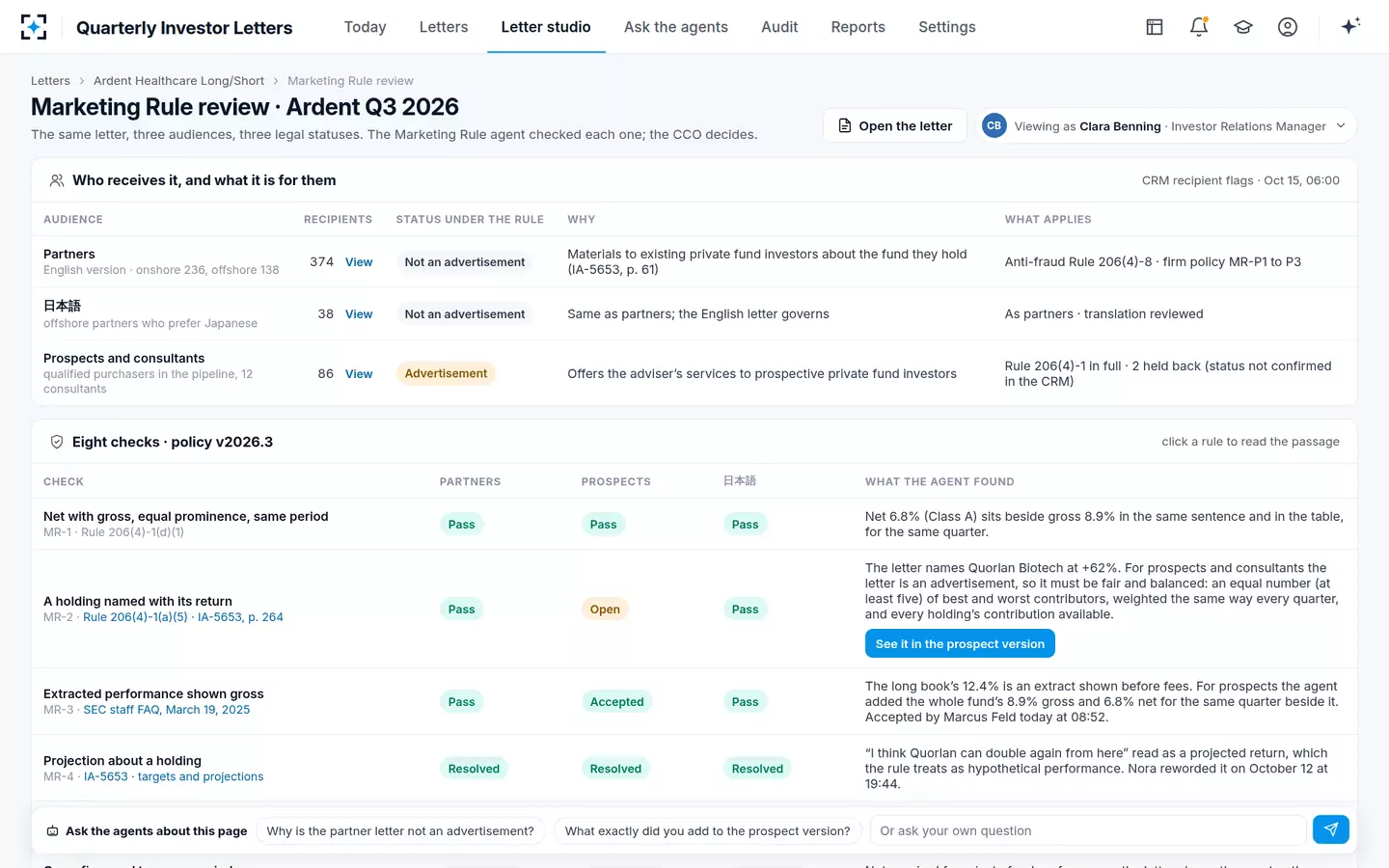
Release waits until each reader's status is settled
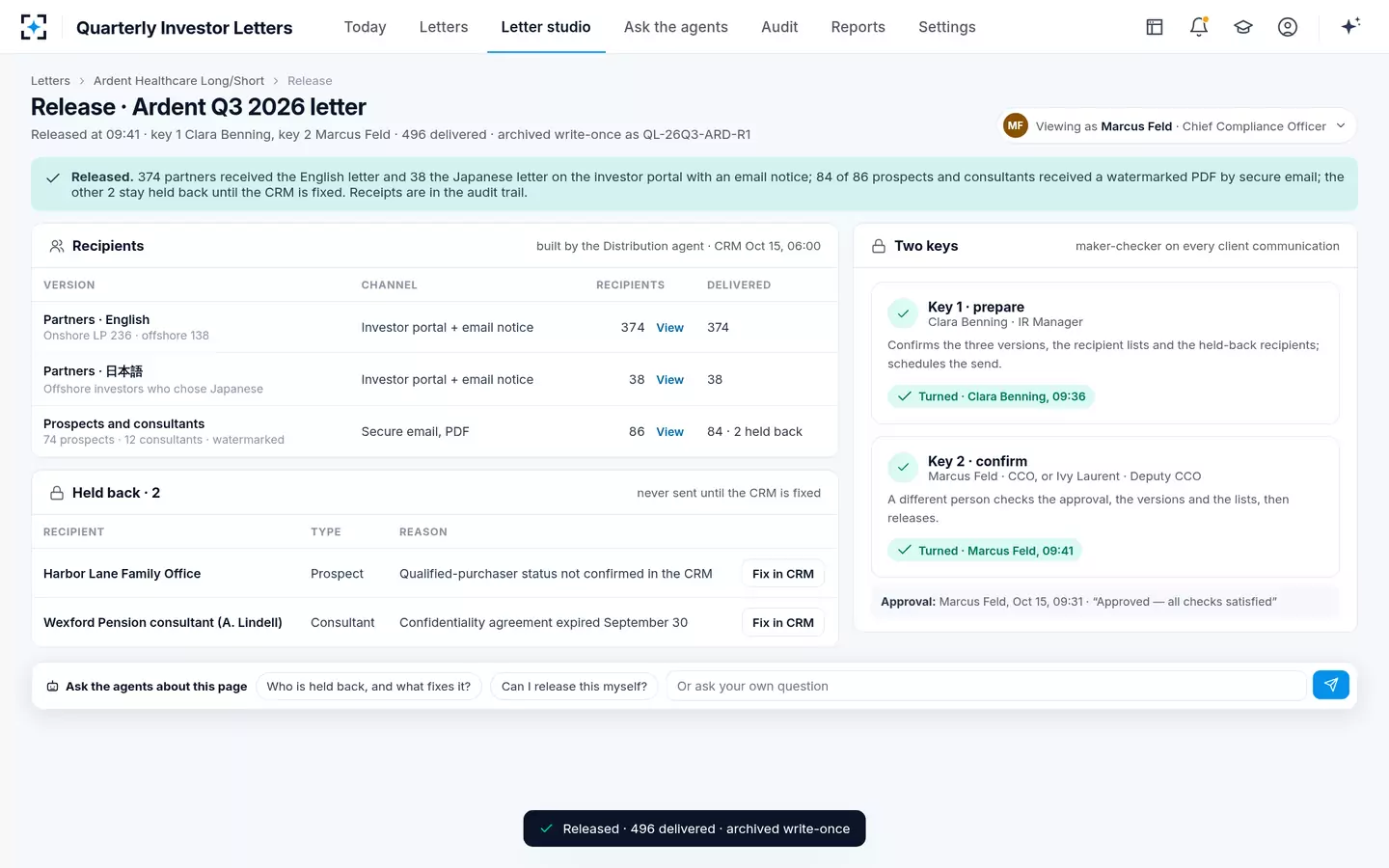
To see a letter's partner and prospect versions built from one draft, with each reader's status shown beside the passage it rests on, start from Quarterly Investor Letters.
Questions people ask
What is an investment letter?
"Investment letter" is the term the SEC's books-and-records rule uses, alongside notices, circulars and bulletins, for a communication with investment content that an adviser sends out. An adviser must keep a copy of each one sent to ten or more persons, and the records behind any performance figure it presents.
Do the marketing rule requirements apply to letters to existing investors?
Generally not. The rule covers communications to current investors only when they offer new or additional investment advisory services, and the adopting release says it does not intend "to chill ordinary course communications with current investors". The anti-fraud rule still applies in full.
Is an investor letter the same as a shareholder letter?
They are the same kind of document addressed to different investors: a registered fund's public shareholders, or a private fund's partners. A registered fund's shareholder communications sit under the rules for registered funds; a hedge fund's investor letter is a private communication that no rule requires. Both are subject to anti-fraud rules.
Is a letter sent to one prospect an advertisement?
Not by its reach alone, unless it contains hypothetical performance, since the definition counts communications to "more than one person". But a letter sent separately to many prospects is a communication to more than one person, and the release asks firms to watch for letters "nominally directed to a single person".
What is an investor side letter?
A side letter is an agreement between a fund and one investor that changes or adds to that investor's terms, such as fees, liquidity or reporting. It is a contract, not a communication like the quarterly letter. The SEC's 2023 rule restricting preferential terms granted in side letters was vacated by a federal court as of 5 June 2024.