Hedge fund quarterly letters are the portfolio manager's account to partners of how the fund did, what worked, what did not and how it is positioned, sent once the quarter's final figures are in. They look like essays, but they are built from four kinds of sentence, and each answers to a different source: performance figures to the administrator's final NAV, position stories to the portfolio accounting books, views to the PM, and the outlook to the anti-fraud rule that governs every word an adviser sends investors in a pooled fund. Errors enter where a sentence is written from the wrong source. Botminds' Quarterly Investor Letters drafts the letter in the PM's own voice and ties every sentence to its source before compliance reads it; this guide walks one letter through, sentence by sentence.
The letter annotated here is fictional sample data: the third-quarter 2026 letter of Ardent Healthcare Long/Short, a $1.84 billion fund at a fictional firm, Quillfield Alternatives, written by its CIO, Nora Haskell, as it runs through the solution.
One sample letter: 38 figures to tie, 498 readers, two legal statuses
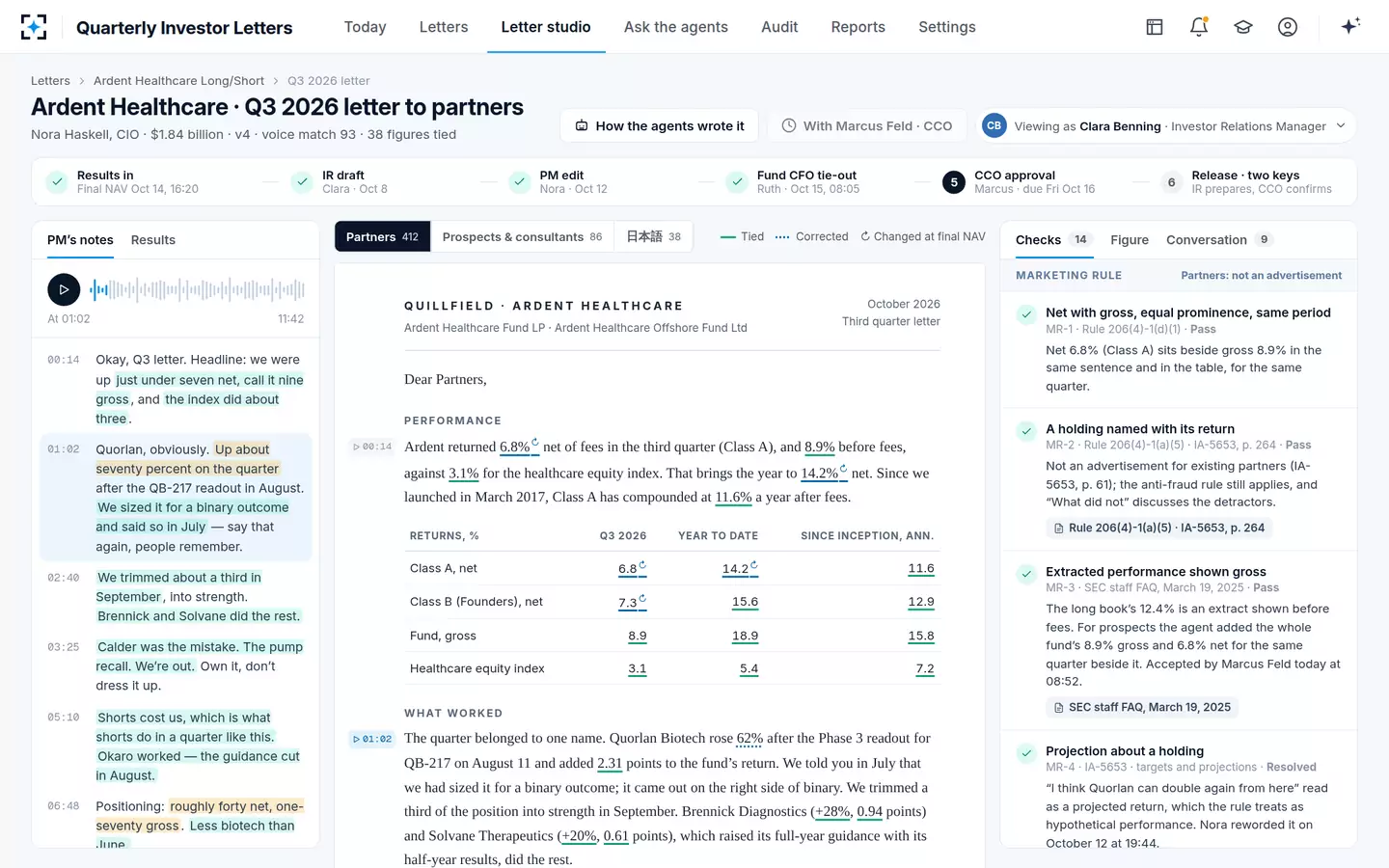
The 38 figures in the partner letter, when the administrator's final NAV replaced the estimate
- Unchanged · 33 · 87%
- Moved 0.1 point · 5 · 13%
The 498 people it was prepared for
- Partners, English · 374 · 75%
- Japanese · 38 · 8%
- Prospects, consultants · 86 · 17%
What goes in a hedge fund quarterly letter?
A hedge fund quarterly letter usually has six parts: performance for the quarter, the year and since inception; what worked; what did not; the short book or hedges; positioning; and a closing view. No rule prescribes that order. Letters to existing partners are a business practice, not a regulatory filing, and the SEC's 2023 rule that would have required quarterly statements to private fund investors was vacated in 2024; what an investor letter is, and when it becomes an advertisement sets out that history.
What a rule does govern is every sentence in it. The SEC's anti-fraud rule for advisers to pooled investment vehicles makes it fraud to tell an investor, or a prospective investor, an untrue material fact, or to leave out a material fact that the rest of the letter needs in order not to mislead (17 CFR 275.206(4)-8(a)(1)). That one clause covers the figure, the story, the view and the omission alike, which is why annotating a letter by source is more useful than proofreading it.
The sample letter, annotated: each kind of sentence and the source it must match
| Section | A sentence from the sample letter | Its source | Who signs it |
|---|---|---|---|
| Performance | "Ardent returned 6.8% net of fees in the third quarter (Class A), and 8.9% before fees, against 3.1% for the healthcare equity index." | The administrator's final NAV by class; the index provider's total return series | Fund CFO certifies the figures |
| What worked | "Quorlan Biotech rose 62% after the Phase 3 readout for QB-217 on August 11 and added 2.31 points to the fund's return." | Position P&L and contribution from portfolio accounting | PM for the story; Fund CFO for the figures |
| What did not | "Calder Medtech was our mistake. It fell 21% on the recall of its infusion pump line and cost us 0.72 points. We are out." | The same books, read for the bottom of the list | PM |
| Short book | "Shorts cost us 3.1 points in a quarter when the index rose; the long book added 12.0 points …" | Attribution split by long and short book | PM; Fund CFO for the figures |
| Positioning | Net and gross exposure, the memo's "roughly forty net, one-seventy" stated as 42% and 168% | Risk system and prime broker exposure report at quarter end | PM; Fund CFO for the figures |
| Outlook | "We believe the market still underestimates QB-217's commercial potential." | The PM's view, with a reasonable basis she can show | PM, then the CCO |
The performance paragraph: every figure from the final NAV
The performance paragraph is the only part of a hedge fund quarterly letter that a partner can check against another document, and a careful partner will. The returns by class, year to date and since inception must match the administrator's statement to whatever tolerance the firm sets, and they must come from the final NAV, not the estimate that arrives before it. In the sample, the estimate arrived on 7 October and the final on 14 October; between the two, the incentive allocation was trued up and five figures moved by 0.1 point: Class A's quarter from 6.9% to 6.8%, its year from 14.3% to 14.2%, and Class B's quarter from 7.4% to 7.3%.
The books-and-records rule makes the trail mandatory. An adviser must keep the accounts, internal working papers and other records that support or show how it calculated any performance figure it sends outside the firm, and the rule lists the investment letter among the communications it covers (17 CFR 275.204-2(a)(16)). A return in a letter with no administrator statement behind it is a records problem before it is anything else.
One convention deserves to be written down: which class leads. A letter that quotes the founders' class because it has the lowest fees overstates what most partners earned. The sample leads with Class A and shows Class B, the founders' class, and gross in a table beside it, with the index for the same periods. Whichever class leads, the letter should say why.
Every figure underlined: tied, corrected, or changed at the final NAV
What worked: position stories from the books, not from memory
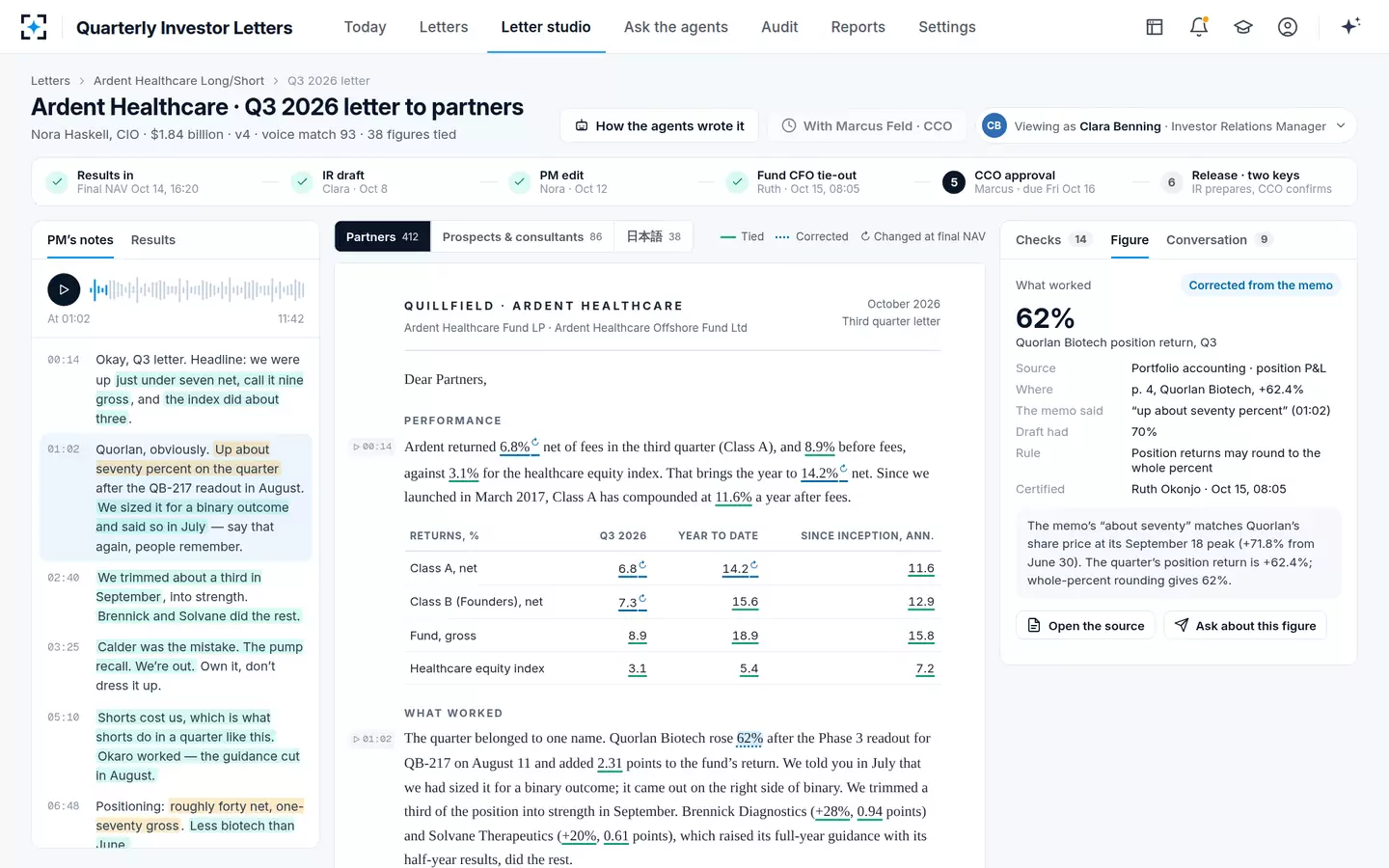
A position story has two halves that come from different places. The narrative, why the fund owned it and what happened, belongs to the PM. The numbers, the position's return and its contribution in points, belong to portfolio accounting. Letters go wrong when the PM supplies both. In the sample, the CIO's voice memo said Quorlan Biotech was "up about seventy percent on the quarter"; the books said the position returned 62.4%. The memo was not wrong about the stock: its share price had been up 71.8% at its 18 September peak. It was wrong about the position over the quarter, which is the figure the letter reports.
The distinction between a position's return and its contribution matters too. Quorlan rose 62% and added 2.31 points; a sentence that blends the two ("Quorlan added 62%") misstates the fund's result by a factor of about twenty-seven. The sample PM's own rule, learned from her past letters, is percent for returns and points for contribution, never mixed in one clause.
The memo said seventy. The books say 62.
What did not: the paragraph that decides whether partners believe the rest
The losers paragraph is where a letter earns its credibility. In the sample, it names the largest detractor first, says what it cost and what was done: Calder Medtech fell 21%, cost 0.72 points, and the fund is out. It then returns to a short the PM introduced to partners in July, Halsey Labs, which went against the fund and cost 0.48 points. Her first draft did not mention it.
Silence is the error a reviewer is least likely to catch, because nothing on the page is wrong. The omission clause of the pooled-vehicle anti-fraud rule reaches it: whether a letter misleads by what it leaves out is judged in the light of the circumstances in which it was written, and a July letter that described the short is one of them. The only reliable check is to read the new draft against what the earlier letters told partners. What the research says investors do with candour and cheer is a separate question, and the evidence there points the same way.
The same quarter, written two ways: the losers paragraph
What the PM said: Voice memo, 03:25: "Calder was the mistake. The pump recall. We're out. Own it, don't dress it up."
What the letter says: "Calder Medtech was our mistake. It fell 21% on the recall of its infusion pump line and cost us 0.72 points. We are out."
What the PM said: Not in the memo. The first draft was silent about it.
What the letter says: "Our short in Halsey Labs, which we wrote about in July, went against us: the stock rose 24% on a new payer contract and cost 0.48 points."
What the PM said: Her one-line answer when asked: "Yes. Say it went against us, we still believe the thesis, and we halved it."
What the letter says: "We still think its payer mix turns against it in 2027, but we have halved the position while we wait."
Positioning and outlook: views, not promises
The positioning section reports exposures, which are figures and come from the risk system: in the sample, 42% net and 168% gross at quarter end, corrected from the memo's "forty" and "one-seventy". The outlook is the PM's view, and it is the part of a letter that most often drifts from a view into a forecast.
The sample's first draft said: "I think Quorlan can double again from here." The firm's policy treats a predicted return for a named holding as a projection that compliance must see, and for prospects the marketing rule's conditions on "targeted or projected performance returns" apply to portfolios and advisory services (17 CFR 275.206(4)-1(e)(8)). The PM rewrote it as a view about the market rather than a number for the stock. That is a safer sentence for every audience, because a view can be explained and a doubling can only be met or missed.
Who writes the hedge fund quarterly letter, and who signs each part?
The PM or CIO writes the hedge fund quarterly letter, in the sense that the voice and the views are theirs. The work around the writing falls to three other roles: investor relations assembles the letter and its recipient lists, the CFO or controller vouches for the figures, and the chief compliance officer approves it before release. The sample separates those rights explicitly: investor relations drafts, the PM approves content and voice, the Fund CFO certifies the figures, the CCO approves, and two different people release it.
The order matters because each signature covers a different source. A CFO certifying figures against the final NAV says nothing about whether the losers paragraph is complete. A CCO approving the outlook says nothing about whether 6.8% is the final number. When one person signs for everything, as a PM does who writes the letter alone over a weekend, each kind of error has only one chance to be caught. The investor relations week behind one letter shows who waits on whom.
How many hedge funds write to partners
9,940
hedge funds reported to the SEC, third quarter of 2025
1,834
advisers advising those hedge funds
$5.86trn
hedge fund net asset value reported on Form PF
How long is a hedge fund quarterly letter?
No regulator or independent study measures letter length, and no rule sets one. The sample firm sets its own range, 1,100 to 1,500 words, as a written setting, which is the useful practice: a fixed range stops a strong quarter from producing a long letter and a weak one a short letter, which would tell partners something the words do not.
Length also sets the review load. Every additional position story adds a figure to tie and, for a prospect, a holding named with its return. The sample letter carries 38 figures in its partner version; the prospect version adds 91 more.
One letter, three audiences
The same text reaches readers for whom it has different legal status. For the 412 existing partners, 38 of whom read it in Japanese, it is a communication about the fund they hold. For the 86 prospects and consultants on the sample firm's list, it offers the adviser's services and is an advertisement under the marketing rule. That status brings conditions the partner letter does not need, among them that any gross figure come with the net figure beside it, at least as prominent and laid out so the two can be compared (17 CFR 275.206(4)-1(d)(1); the gross and net attribution guide quotes the rule and the staff's answers on it).
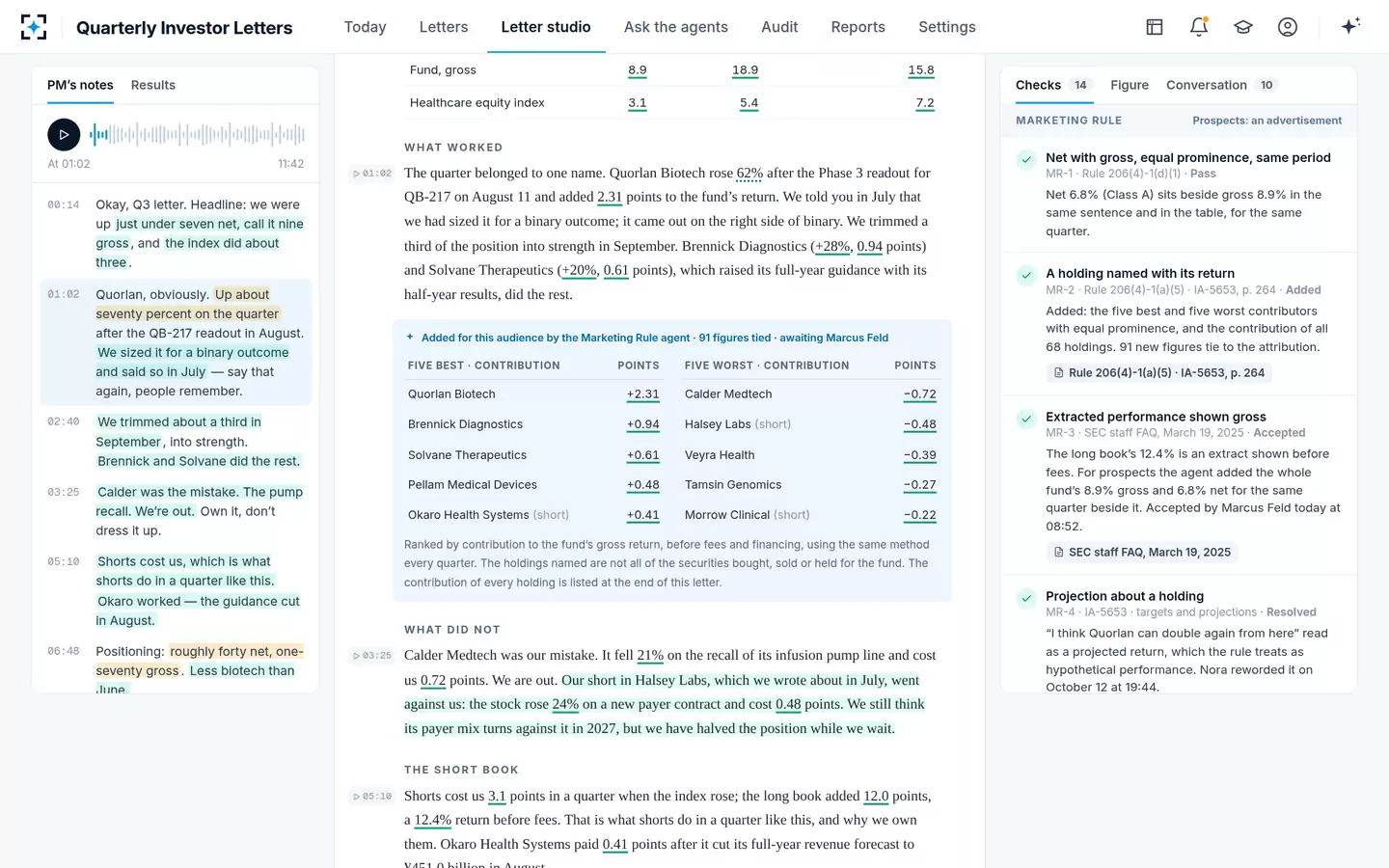
For the prospect version, the sample firm's policy adds a table of the five best and five worst contributors whenever a holding is named with its return, offers every holding's contribution, and puts the fund's total gross and net beside the long book's 12.4% before fees. Those are the firm's settings; the marketing rule itself, and how a compliance team applies it across all its advertisements, is the subject of SEC Marketing Rule Compliance.
The prospect version adds the bottom of the list
"seeking clarification on whether the proposed definition would scope in monthly or quarterly letters to existing investors where such letters discuss account performance and include market commentary"
SEC adopting release for the marketing rule, footnote 91, summarising a comment letter
The Commission answered that question with a general test rather than a rule for letters: communications to current investors are advertisements only when they offer new or additional services. For hedge fund quarterly letters that means the partner letter and the prospect letter are two documents that share most of their sentences. To see one letter built for each audience from a single draft, start from Quarterly Investor Letters.
Questions people ask
Where can I read hedge fund quarterly letters?
Letters to partners are private documents, so most are read by investors, consultants and allocators who receive them. Some managers publish theirs, and readers trade them on forums such as Reddit each quarter. Read them for structure and candour, not as models of compliance: a letter published to the world reaches prospects as well as partners, so it has to meet the stricter audience's standard.
Must a hedge fund letter show net returns?
For prospects, yes whenever it shows gross: the marketing rule bars gross performance in an advertisement unless net is shown with at least equal prominence, for the same period and method. For existing partners the letter is generally not an advertisement, but a gross-only figure can still mislead under the anti-fraud rule, so the safer practice is to show net by class first.
What is the difference between a hedge fund quarterly letter and a quarterly report?
A quarterly report or statement gives an investor's capital account, returns and fees; it is produced by the administrator or the adviser's operations team. The letter is the PM's narrative of the quarter. Both draw on the same final NAV, which is why figures in the letter should match the statement to the firm's tolerance.
How soon after quarter end are hedge fund letters sent?
No US rule sets a date, because no rule requires the letter. Timing follows the administrator: a letter cannot be final before the final NAV. The sample firm sets its release deadline at 22 business days after quarter end, which put its third-quarter 2026 deadline on Friday 30 October.
Can a letter name only the best-performing positions?
To existing partners it can, but the anti-fraud rule still applies if the selection leaves a misleading picture. To prospects the marketing rule requires any reference to specific investment advice to be fair and balanced, and SEC examiners have reported advertisements that showed only the most profitable investments. A losers paragraph of equal weight is the simplest protection for both audiences.