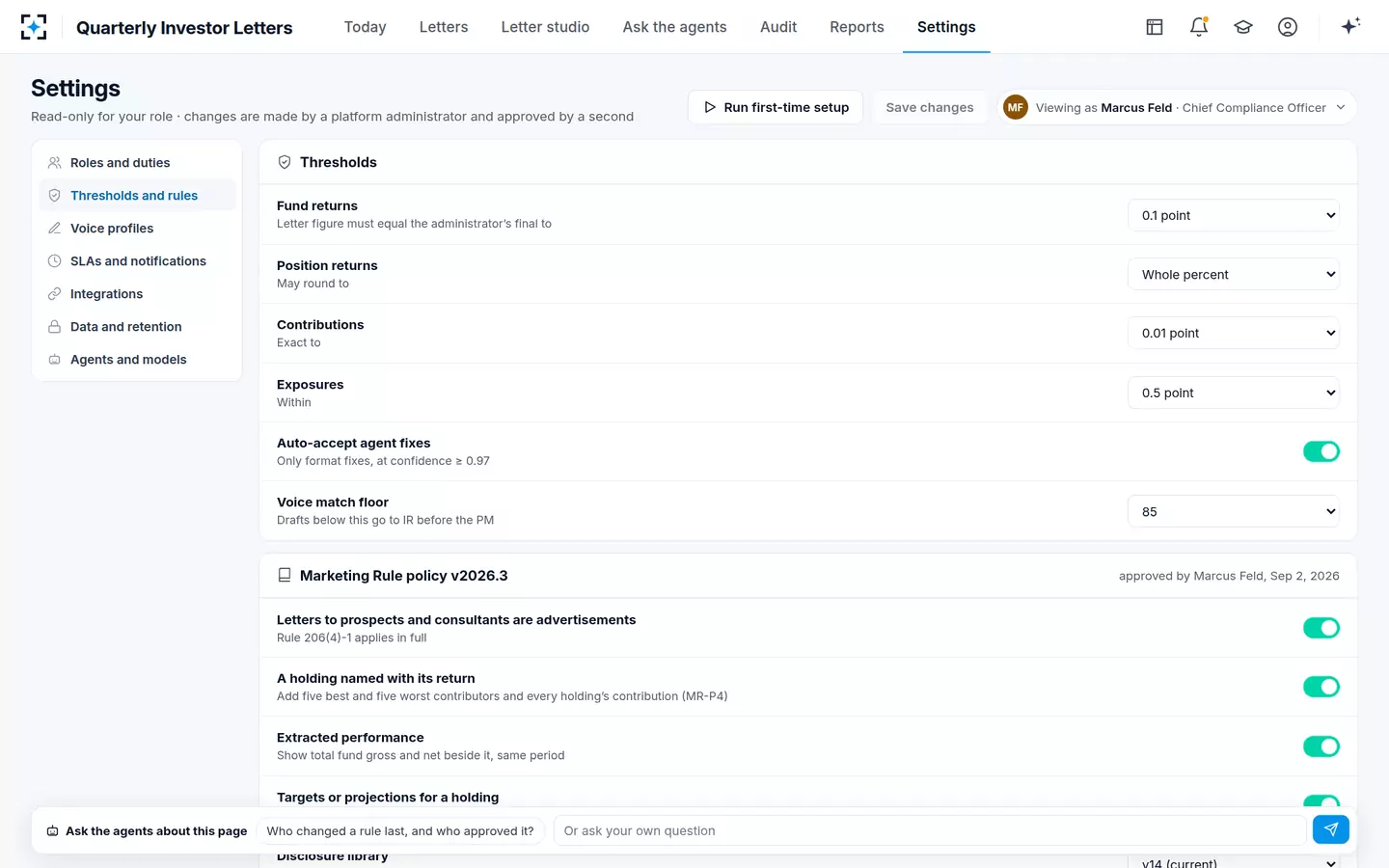
To write a letter to investors that holds up, write the story while the quarter is fresh and the figures last: draft the performance, what worked, what did not, positioning and the outlook from the PM's notes and the administrator's estimate, then replace every number with the final NAV before release. Decide in advance how close each kind of figure must be: fund returns equal to the administrator's final to 0.1 point, position returns rounded to the whole percent, exposures within half a point. The letters that cause trouble are the ones whose figures were typed from an estimate or from memory and never re-tied when the final arrived. Botminds' Quarterly Investor Letters drafts the letter in the PM's voice, holds every figure against its source and its tolerance, and re-ties the letter automatically when the final NAV lands.
The worked example is fictional sample data: the third-quarter 2026 letter of Ardent Healthcare Long/Short, a $1.84 billion fund at a fictional firm, as it runs through the solution. The tolerances shown are the sample firm's own settings, not a regulatory standard; no rule sets them, which is why they need writing down.
Close enough? One firm's tolerance for each kind of figure in a letter
Fund return by class, quarter, year, since inception
ToleranceEqual to the administrator's final to 0.1 point
Source of truthFinal NAV statement, by class and series
Who signsFund CFO certifies
Index or benchmark return
ToleranceSame period, total return, to 0.1 point
Source of truthIndex provider's total return series
Who signsFund CFO certifies
Contribution of a position, in points
ToleranceExact to 0.01 point
Source of truthAttribution from portfolio accounting
Who signsFund CFO certifies
Return of a position, in percent
ToleranceRounded to the whole percent
Source of truthPosition P&L for the quarter
Who signsFund CFO certifies
Net and gross exposure
ToleranceWithin 0.5 point of the quarter-end report
Source of truthRisk system and prime broker
Who signsFund CFO certifies
A view, a thesis, an outlook
ToleranceNo tolerance: a reasonable basis the PM can show
Source of truthThe PM's memo and notes
Who signsPM approves; CCO reviews
How to write a letter to investors: the six parts
A letter to investors in a hedge fund or boutique strategy usually runs in six parts, and each has a different job. Performance gives the result by class against a benchmark for the quarter, the year and since inception. What worked names the positions that drove it, with their contribution. What did not names the detractors with the same precision. The short book or hedges explains what protection cost. Positioning states exposures and the changes made. The close gives the PM's view and thanks partners.
The order is a convention, not a rule; the SEC does not prescribe the content of a private fund letter. What the parts share is a duty: an adviser to a pooled fund may not mislead its investors or prospective investors by what it says or by what it leaves out (17 CFR 275.206(4)-8). Writing each part from its own source is the simplest way to meet it. Each section of one hedge fund letter, annotated by source, shows the six parts on a full example.
Investor letter format: what each part says and where its figures come from
| Part | What it says | Its figures come from | Typical length |
|---|---|---|---|
| Performance | Net return by class for the quarter, year and since inception; gross; the benchmark | The administrator's final NAV; the index provider | One paragraph and a table |
| What worked | Two or three positions, why they were owned, what happened | Position P&L and attribution | One or two paragraphs |
| What did not | The largest detractors, including bets described in earlier letters | Position P&L and attribution | As long as what worked |
| Short book or hedges | What protection cost or earned, and why it is held | Attribution split by book | One paragraph |
| Positioning | Net and gross exposure, concentration, changes made | Risk system, prime broker | One paragraph |
| Outlook and close | The PM's view; thanks | The PM, with a basis she can show | Two or three sentences |
Draft on the estimate, release on the final
The calendar forces the problem. A letter has to be drafted while the quarter is fresh, but the administrator's final NAV, which decides the figures, arrives days or weeks after quarter end, 14 days in the sample, and the estimate before it can differ. The workable sequence is to write against the estimate, mark every figure as provisional, and replace each one with the final before anyone signs.
One sample letter: drafted on the estimate, released on the final
- Quarter closes; PM records memo6 d
- Estimate; draft v12 d
- PM edit; checks4 d
- Wait for final NAV2 d
- Release1 d
The sample shows why the order matters. The PM finished her edit on 12 October, two days before the final arrived. Had the letter gone out then, five of its figures would have been wrong. Because every figure was marked provisional until the final, the change touched one section of the letter rather than the whole of it.
How precise should returns be in an investor letter?
Returns in an investor letter should be stated to one decimal place and equal the administrator's final figure at that precision; contributions in points to two decimals; position returns to the whole percent; exposures to the whole percent within half a point. Those are the sample firm's settings, and they follow a principle rather than a rule: a figure that a partner can check against a statement must match it, and a figure that is an approximation by nature should say so by its rounding.
Three conventions prevent most disputes. Compare unrounded figures before rounding, so a 6.849% does not become 6.9% in one place and 6.8% in another. Round each figure once, from its source, never from another rounded figure. And keep returns and contributions in different units: percent for a return, points for a contribution. The sample PM's letter says Quorlan Biotech "rose 62%" and "added 2.31 points", and never puts the two in one clause.
The books-and-records rule gives the precision a second purpose. The adviser must be able to show how every performance figure in an investment letter was calculated, from the working papers behind it (17 CFR 275.204-2(a)(16)). A stated tolerance is the easiest way to show an examiner that 6.8% in the letter and 6.8% in the statement are the same number.
What if the final NAV differs from the estimate?
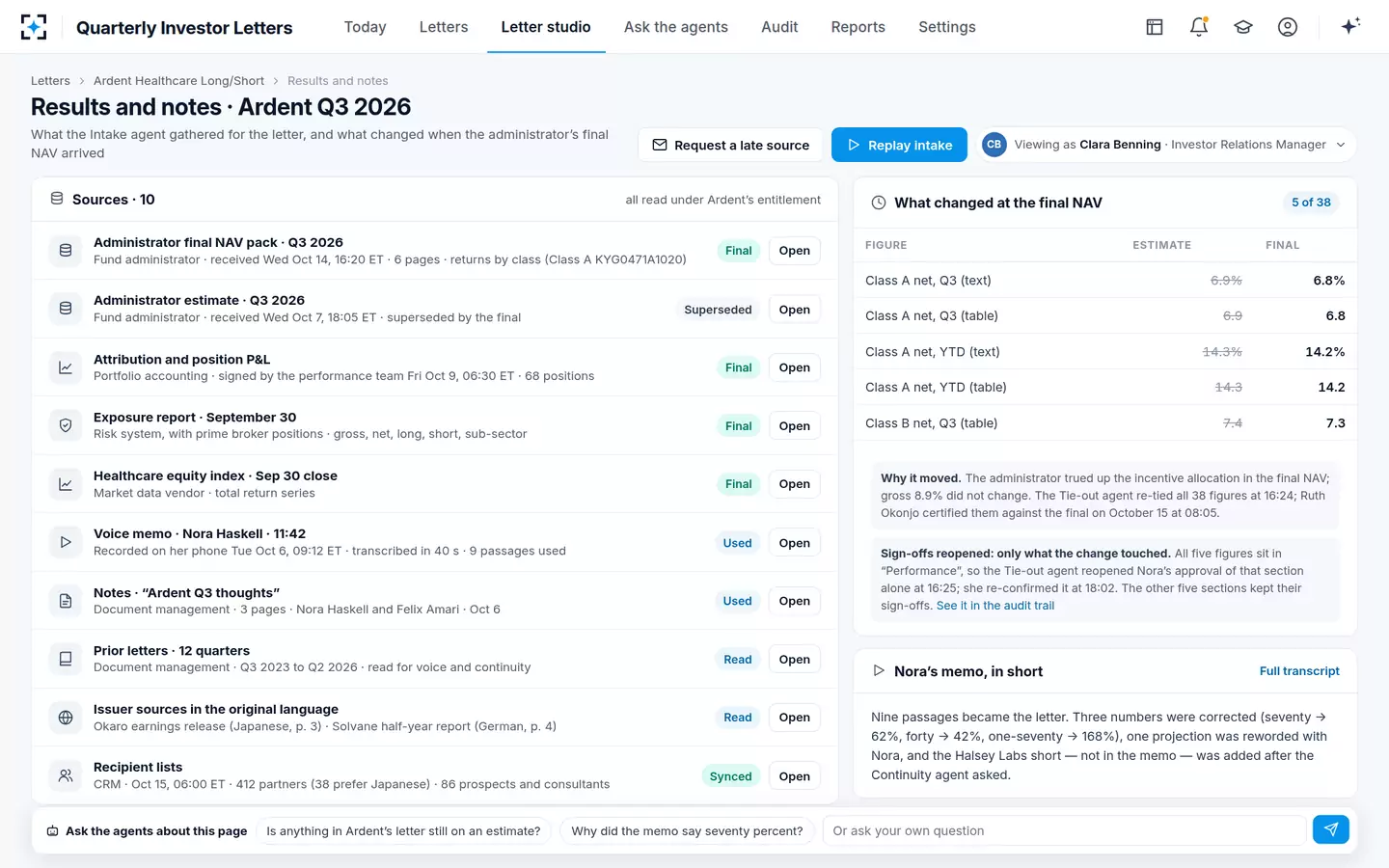
If the final NAV differs from the estimate, every figure derived from it must be re-tied before release, and every sign-off that covered a changed figure must be given again. The sample's final moved five of 38 figures by 0.1 point, because the administrator trued up the incentive allocation. Gross return did not change; the net figures, which sit after the incentive allocation, did.
Five of 38 figures moved at the final NAV, each by 0.1 point
The list holds a lesson about where errors hide. Two of the five changes are the same number in a different place: the Class A return for the quarter is stated in the first sentence and repeated in the table. Retyping by hand is how a letter ends up saying 6.9% in the text and 6.8% in the table. The fix is mechanical: every instance of a figure points to one source value, and changing the value changes every instance.
The sign-offs need the same care. In the sample, all five changed figures sat in the performance section, so only the PM's approval of that section reopened; the other five sections kept their sign-offs. She re-confirmed at 18:02, and the Fund CFO certified all 38 figures against the final the next morning. If a letter has already gone out on the estimate, the honest course is a short correction to the same recipients, with the corrected figures and the reason, kept on file with the original.
What changed when the final NAV arrived, and why
Memo numbers versus book numbers
The second source of wrong figures is the PM's own memory. PMs talk about their book in round numbers, and a letter dictated from a memo inherits them. The sample memo contained three: Quorlan Biotech "up about seventy percent on the quarter", net exposure "roughly forty", gross "one-seventy". The books said 62.4%, 42% and 168%.
None of the three was careless. The seventy was the stock's gain at its September peak, not the position's return over the quarter. Exposures move daily, and the memo was recorded a week after quarter end. Each would have failed the firm's tolerance, which is the point of having one: a whole-percent rule turns 62.4% into 62%, not 70%, and a half-point exposure rule rejects forty against 42.
Every memo number in the sample missed its tolerance
Write the losers with the same precision as the winners
A letter that gives winners to two decimals and losers in adjectives is not balanced, whoever reads it. The sample states Calder Medtech's loss as precisely as Quorlan's gain: it fell 21% and cost 0.72 points. It states a short that went wrong as plainly: Halsey Labs rose 24% and cost 0.48 points, against a thesis the PM had described to partners in July.
For prospects the requirement is explicit: an advertisement that refers to specific advice the adviser gave must present it in a fair and balanced way (17 CFR 275.206(4)-1(a)(5); the seeded-error test plants the missing-detractors version). Writing the partner letter to the same standard costs nothing and means the prospect version needs additions, not a rewrite. What candour does to investors' behaviour is a separate argument for the same habit.
What a letter to investors may say about next quarter
A letter may give the PM's view of markets, of a sector and of the thesis behind a position; it should not promise a number. The marketing rule treats targeted or projected returns for a portfolio as hypothetical performance when they appear in an advertisement, and the Commission was explicit that targets can be useful but must suit their readers: "advisers must consider the intended audience when making such presentations in advertisements" (adopting release, 86 FR 13024).
The sample's draft said "I think Quorlan can double again from here." The firm's policy flags any predicted return for a named holding, and the PM rewrote it: "We believe the market still underestimates QB-217's commercial potential." The second sentence says what she thinks and why without giving partners a figure to hold her to.
Your tolerances, written down and changed only with a second approval
Before release: a checklist for any letter to investors
Nine checks between the last edit and the send
- Every figure comes from the final NAV, not the estimate
The estimate is marked superseded; the letter shows the date of the final it was tied to.
- Every instance of a figure matches
The text and the table quote the same return for the same class and period.
- The class most partners hold leads
A founders' or lowest-fee class shown first overstates what most investors earned.
- Net appears wherever gross appears
Same period, same method, equal prominence; for prospects it is a condition of the rule.
- Position returns come from the books, not the memo
Percent for returns, points for contribution, never mixed in one clause.
- The largest detractors are named
With figures as precise as the winners'.
- Last quarter's bets are accounted for
Every position or promise described in the previous letter is mentioned or deliberately left out with a reason.
- The outlook is a view, not a number
Any target or predicted return goes to the CCO before it goes anywhere else.
- A copy and its working papers are kept
The final statement, the attribution, the memo, each version sent and who approved it.
To see a draft re-tied when a final NAV arrives, with only the affected sign-offs reopened, start from Quarterly Investor Letters. If the question is who does all this in the week before release, the investor relations week follows it day by day.
Questions people ask
Is there an investor letter example I can follow?
The sample on this page follows a common form: a performance paragraph with a returns table, what worked, what did not, the short book, positioning and a two-line close, within 1,100 to 1,500 words. Use any example for structure only, and take every figure from your own final NAV and attribution, never from the example's layout.
How do you write a letter to shareholders of a fund?
The same way, with stricter rules if the fund is registered. Lead with net results by class against the benchmark, explain the main contributors and detractors with figures from the books, state positioning and give a view without a target number. A registered fund's shareholder reports have content requirements of their own that a private fund's letter does not.
When should a quarterly letter to investors go out?
After the administrator's final NAV, and only once every figure has been re-tied to it. In the sample the final arrived 14 days after quarter end and the letter went out the next morning; the firm's own deadline is 22 business days after quarter end. No US rule sets the date for a private fund letter.
What should you do if a figure in a sent letter is wrong?
Send a short correction to the same recipients with the right figure and the reason, and keep it with the original and its working papers. A material figure left wrong is an untrue statement to investors under the pooled-vehicle anti-fraud rule; a corrected one is evidence of a control that worked.
Should an investor letter round returns?
Fund returns should be stated to one decimal and equal the administrator's final at that precision; rounding them further hides differences between classes. Position returns can round to the whole percent because they are illustrations, not account figures. Compare unrounded values before rounding so the same figure never appears two ways.