Hedge fund investor relations is the function that looks after a fund's investors and prospects: it answers their questions, keeps the CRM and recipient lists, runs due diligence requests and meetings, and produces the quarterly letter and reports that go to partners. In letter week, most of that job is coordination. The PM writes the letter, but investor relations chases the fund administrator's final NAV, re-types figures when they move, routes each version to the CFO and the chief compliance officer, and decides who receives which version. The PM's weekend of writing is the visible part of a week of IR work. Botminds' Quarterly Investor Letters gives the mechanical part of that week to agents, so the IR manager spends it on the decisions and the people.
The week described here is fictional sample data: the third-quarter 2026 cycle at Quillfield Alternatives, a fictional firm whose IR manager, Clara Benning, owns 14 of its 40 letters, as it runs through the solution.
Four people around one letter, and what each keeps when agents take the mechanical part
Today
Chases the PM for the draft, the administrator for the final NAV and compliance for approval; re-types figures when the final moves; rebuilds recipient lists by hand; answers partners who quote last quarter's letter back.
With agents
Starts the day with what moved overnight and which letters need her; sees the whole cycle by stage and due date; confirms the versions and lists, and turns the first release key.
Still theirs: The relationship with partners, the recipient lists, the first key.
Today
Writes the letter over a weekend from memory, a voice memo and last quarter's letter, then edits it again when compliance and the CFO come back.
With agents
Records a memo, edits a draft in her own voice, answers the questions she is asked, approves her voice profile.
Still theirs: Every view, every reason, the voice.
Today
Vouches for figures typed from an estimate, and finds out at the final NAV which ones no longer tie.
With agents
Sees, figure by figure, what moved between estimate and final and why, and certifies against the final with one signature.
Still theirs: Certification of every figure.
Today
Reads every draft at the last minute for net with gross, named winners and forecasts, and rebuilds the prospect copy.
With agents
Opens each audience's status and checks with the rule passage behind each, accepts or returns each addition, approves with a reason.
Still theirs: Approval, the second key.
What does hedge fund investor relations do?
Hedge fund investor relations does three kinds of work: it answers investors, it prepares what they receive, and it keeps the list of who they are. Answering means calls, questionnaires and meetings. Preparing means the quarterly letter, monthly performance updates and anything a consultant asks for. Keeping the list means knowing which partner holds which class and feeder, which prospect has been qualified, who prefers another language and whose confidentiality agreement has lapsed.
Letter week puts all three under pressure at once. Partners ask when the letter is coming and quote last quarter's back. The letter cannot be finished before the administrator's final NAV. And the recipient list decides the letter's legal status, because the same text is an advertisement for a prospect and not for a partner, a distinction explained in what an investor letter is, and when it is an advertisement.
Who writes the hedge fund letter?
The portfolio manager or CIO writes the hedge fund letter; investor relations produces it. The voice, the views and the account of what went wrong belong to the PM, and partners can tell when they do not. Everything around those words, from collecting the administrator's figures to building the versions and lists, sits with investor relations, which is why the IR manager is usually the person who knows where a letter stands.
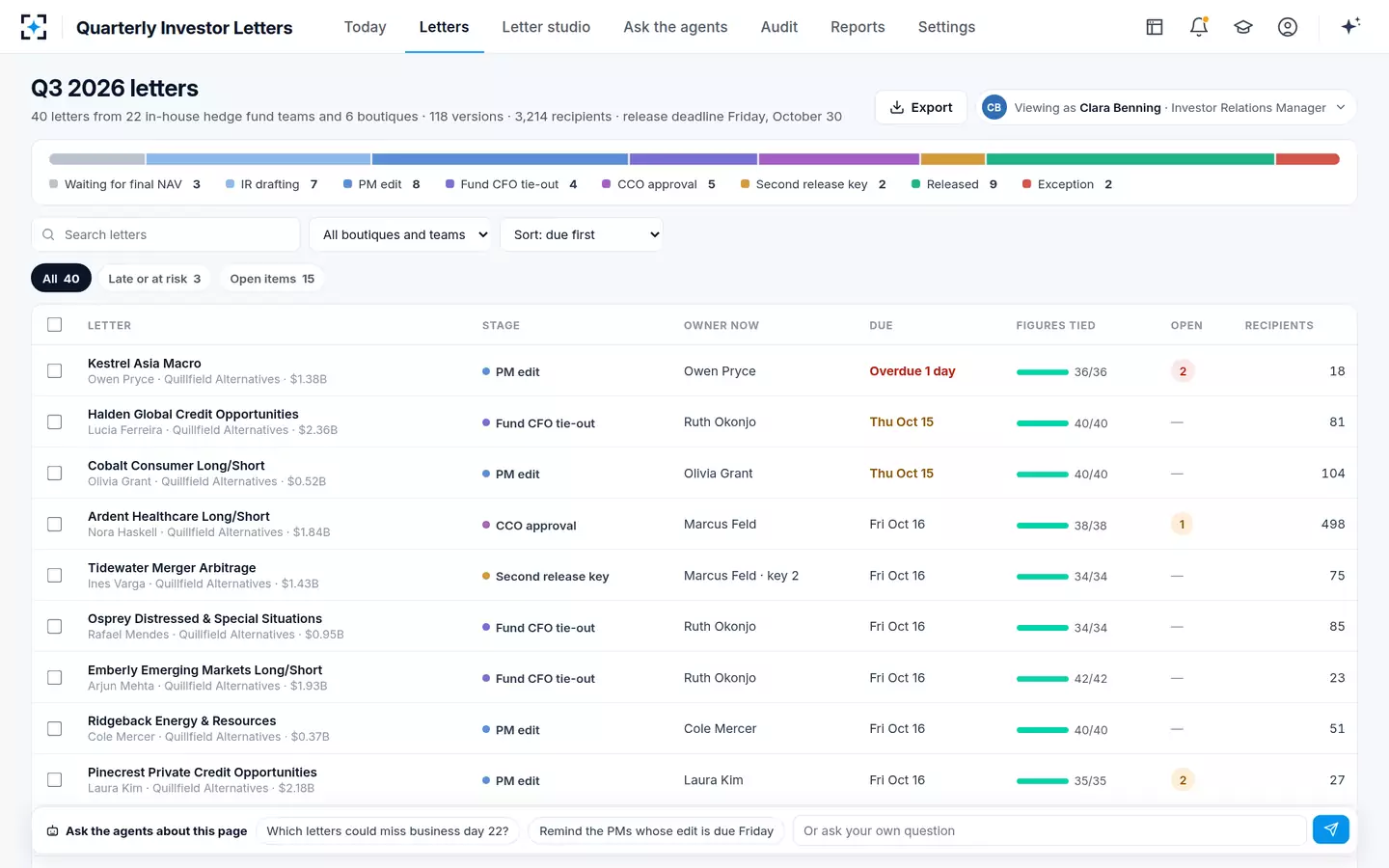
The split matters in practice because the PM's time comes in blocks and IR's in fragments. A PM may write over a weekend. IR's week is a series of small hand-offs, each of which waits on someone else. In the sample cycle of 40 letters from 22 in-house hedge fund teams and six boutiques, the letters were spread across eight stages on the Thursday before release: three waiting for a final NAV, seven with IR, eight with their PMs, four with the Fund CFO, five with the CCO, two waiting for the second release key, nine released and two exceptions.
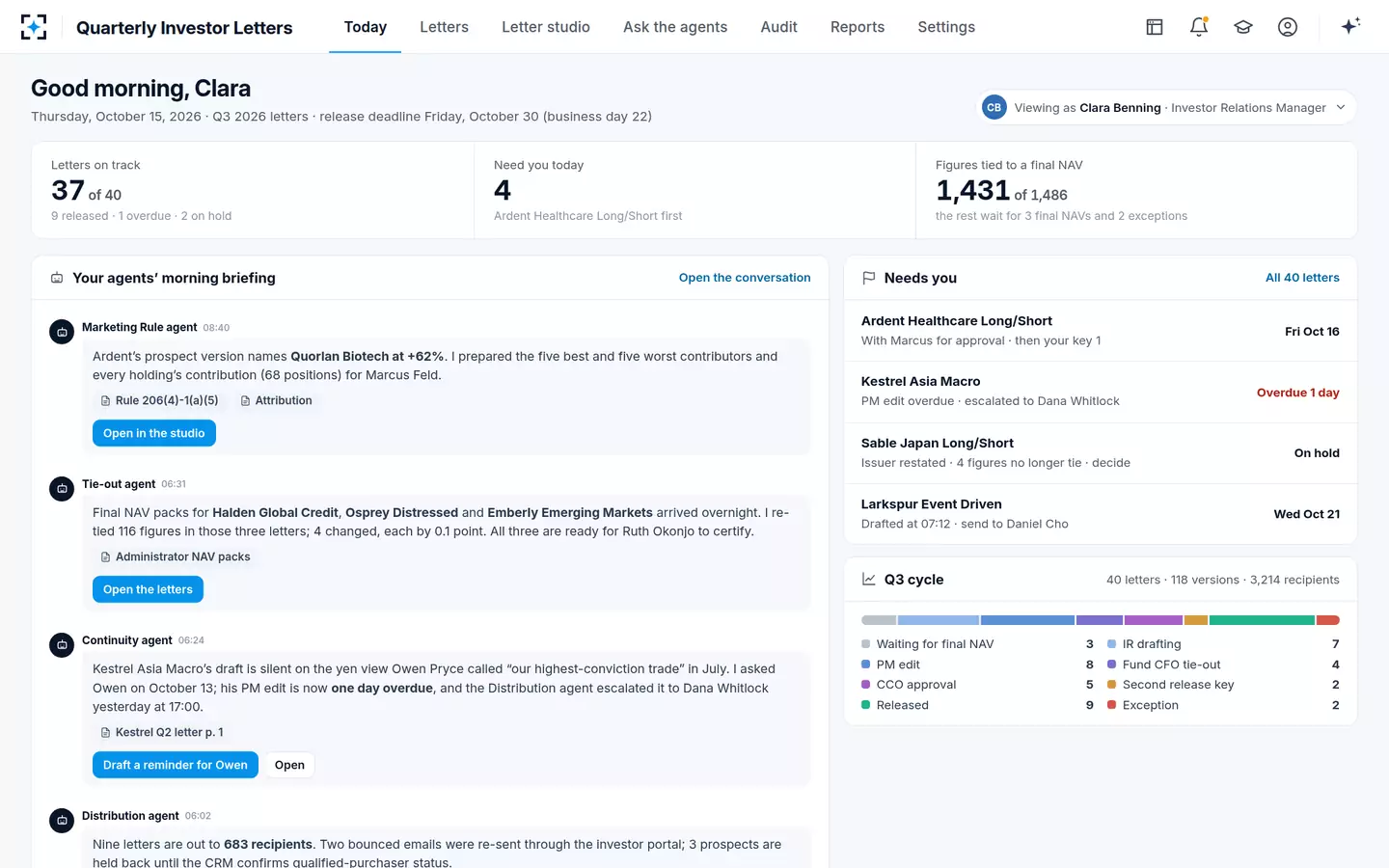
The IR manager's Thursday: what moved overnight, and what needs her
Letter week, day by day
A letter week has a fixed shape because its inputs arrive in a fixed order: the PM's thoughts first, the administrator's estimate next, the attribution after that, the final NAV last. The sample letter for Ardent Healthcare Long/Short shows the order in timestamps. The CIO recorded an 11-minute voice memo on Tuesday 6 October; the estimate arrived on 7 October; a first draft was ready on 8 October; the attribution was signed on 9 October; the PM's edit ran to Monday 12 October; the final NAV arrived on Wednesday 14 October at 16:20; the Fund CFO certified at 08:05 on Thursday; the CCO approved at 09:31; and the two release keys turned at 09:36 and 09:41.
Read the gaps rather than the steps. Between the PM's edit and the final NAV, two days passed in which nobody could finish the letter. Between the final NAV and certification, 16 hours passed, most of them overnight. The work is short; the waiting is long, and each wait is on one person.
Who waits on whom in one letter week
| Who waits | On whom | For what | In the sample |
|---|---|---|---|
| Investor relations | The PM | The memo, then the edit | Memo 6 October; edit finished 12 October |
| Everyone | The fund administrator | The final NAV by class | Estimate 7 October; final 14 October, 16:20 |
| The Fund CFO | Investor relations, then the final | A draft whose figures point to their sources | Certified 15 October, 08:05 |
| The PM | The Fund CFO and the agents | Which figures moved, and which sections to re-confirm | Performance section re-confirmed 14 October, 18:02 |
| The CCO | The PM and the Fund CFO | A final text and certified figures, and the prospect version | Extract sentence accepted 08:52; contributors table 09:24; approved 09:31 |
| Investor relations | The CCO | Approval, then the second key | Key 1 at 09:36; key 2 at 09:41 |
Waiting on the administrator
The administrator's final NAV is the one input investor relations cannot hurry. Until it arrives, every return in the letter is provisional, and on a fund with an incentive allocation the net figures are the ones most likely to move. In the sample, the final moved five of the letter's 38 figures by 0.1 point after the incentive allocation was trued up; gross did not change.
By hand, that is the moment IR re-types. Each changed figure has to be found in the text and the table, corrected, and sent back to the PM and the CFO, and the risk is a letter that quotes two different returns for the same class. With the figures tied to their source, the change is applied once and only the sign-off that covered it reopens. How to write a letter that survives the final NAV sets out the tolerances that decide what counts as a change.
Where one letter's hours go: by hand, and with the agents
- Gather3 h
- PM writes and edits12 h
- Re-type3 h
- Compliance4 h
- Lists, release4 h
- PM edits2 h
- All else2.2 h
Versions and recipient lists
A letter is not one document but a set of versions, and the list decides which reader gets which. The sample cycle's 40 letters went out in 118 versions to 3,214 recipients: an English and sometimes a Japanese version for partners, and a prospect version for prospects and consultants. Each recipient's version follows from what the CRM knows about them.
The books-and-records rule has a long-standing provision for lists. When an adviser sends an advertisement offering its services to more than ten persons, it need not keep every name and address, but where the advertisement goes to "persons named on any list", it must retain with the copy "a memorandum describing the list and the source thereof" (17 CFR 275.204-2(a)(7)(iv)(B)). For the prospect version of a letter, that makes the list itself part of the record.
The list is also where letters are withheld. In the sample, release held back two people on the prospect list: a family office the CRM had not confirmed as a qualified purchaser, and a consultant whose confidentiality agreement had lapsed on 30 September. The letter was right; sending it to those two readers would not have been. Holding them back until the CRM was fixed took a rule, not a judgement made at 9:36 on a Thursday.
Forty letters by stage, owner and due date
Compliance at the end of the queue
The chief compliance officer reads last, and in letter week that means reading many letters at once. The sample CCO approves 40 letters and their prospect versions in a fortnight. By hand, the review he can give each one is limited by when it arrives: a letter that reaches him the day before its deadline gets a read for the obvious problems, net with gross, named winners, forecasts, and not for the quiet ones, such as a position the PM described last quarter and has stopped mentioning.
The remedy is not to read faster but to arrive with the checks done. In the sample, the CCO opened the Ardent letter with each audience's status settled, the prospect version's additions already prepared, and every figure certified. What was left for him was the decision: he accepted the extract sentence at 08:52 and the contributors table at 09:24, and approved at 09:31 with a reason code.
The person who prepares a release never confirms it.
The sample firm's release rule in Quarterly Investor Letters
Hedge fund investor relations roles and salary: what public data shows
No government survey counts hedge fund investor relations staff or reports their pay separately, and salary surveys of the role are run by recruiters and vendors rather than by regulators or researchers. What public data does show is the pay of the occupations around the letter. The Bureau of Labor Statistics puts the median financial analyst at $103,570 a year in May 2025, across 443,100 jobs, and notes that "as financial analysts gain experience, they may advance to become portfolio or fund managers" (BLS, Financial Analysts).
Pay around the letter: three occupations, all industries
$103,570
median financial analyst, May 2025
443,100 jobs
$166,570
median financial manager, the CFO and controller family
879,700 jobs
$80,730
median compliance officer
436,400 jobs
Titles in hedge fund IR run from analyst and associate to manager and head of investor relations, and they do not map to a standard. The useful question for a candidate or a hiring manager is which of the three kinds of work the role owns. An IR analyst may own the letter's production and the recipient lists; a head of IR may own the relationships and never touch a figure. In the sample, the IR manager owns 14 letters end to end and turns the first release key on each.
What changes when agents take the mechanical part
The waits that remain are the ones that should: the administrator's final, the PM's judgement, the CFO's signature and the CCO's decision. What goes are the waits created by the work itself: the PM waiting for IR to assemble last quarter's letter and the attribution; the CFO waiting for IR to re-type figures; the CCO waiting for the prospect version to be built. In the sample, each was done by an agent before the person who needed it arrived, and each agent's step is on the audit trail with the evidence it used.
The roles do not change; the IR manager's day does. Instead of chasing, she reviews a morning summary in which each line names its source and an action: a letter re-tied overnight, a draft silent on last quarter's highest-conviction trade, a PM edit one day overdue and already escalated. Where the line sits between what agents may do and what people must decide is the subject of its own guide. To see the week from the IR manager's screen, start from Quarterly Investor Letters.
Questions people ask
How long does a hedge fund letter take to produce?
No regulator or independent study measures it. Our estimate for one fund's letter by hand is about 26 hours across the PM, IR, the CFO and compliance, of which the PM's writing, one to two days, is the largest part. Measure your own by logging each role's hours for one quarter.
Who approves a hedge fund letter before it is sent?
The PM approves the content, and the firm's own policies decide who else signs. A registered adviser must designate a chief compliance officer "responsible for administering the policies and procedures" it adopts (17 CFR 275.206(4)-7(c)), so the CCO's review is the usual last step. The sample firm adds a Fund CFO certification and a two-key release.
What does an investor relations team need from the fund administrator?
The estimate and the final NAV by class and series, with the date each was produced, and notice of any true-up between them. In the sample, the final arrived 14 days after quarter end and moved five figures by 0.1 point after the incentive allocation was trued up.
How many letters can one IR manager handle in a quarter?
It depends on how much of the production is done by hand. In the sample cycle, one IR manager owns 14 of 40 letters, each with its own versions and recipient lists, because figures, versions and lists are prepared by agents and she reviews and releases them.
What is a hedge fund investor relations analyst?
The title has no standard definition. In a team where the manager owns the relationships, the analyst owns production: the letter's figures and versions, performance updates, questionnaire answers and the CRM. The nearest occupation the BLS measures is the financial analyst, with a median of $103,570 in May 2025 across all industries.