An investor letter template is the fixed frame of a fund's quarterly letter: the sections and their order, the returns table and which classes it shows, the disclosure blocks each audience needs, the length range and the rules for filling it. For a hedge fund the sections are usually performance, what worked, what did not, the short book, positioning, outlook and a close, with a prospect version that adds a contributors table and an advertisement legend. A template plus the PM's last letters and edits is most of what agents need to draft the next one: with access to the administrator's results, portfolio accounting and the CRM, a firm can go from template to a live letter drafted by agents and released by people within one quarter. Botminds' Quarterly Investor Letters is built from exactly those inputs, and this guide sets out the template and the plan.
The plan below is our suggested sequence, not a measured average; the examples come from fictional sample data at a fictional firm, Quillfield Alternatives, as its letters run through the solution.
Live by next quarter: thirteen weeks from template to first live letter
- Templatewk 1
- Voicewk 2
- Sourceswk 3
- Replay a sent letterwk 4–5
- Comparewk 6
- Quarter runs; memos recordedwk 7–10
- Drafted by agentswk 11–12
- Released by peoplewk 13
What should an investor letter template hold?
An investor letter template should hold everything that is the same every quarter and leave room only for what changes. That means the section headings and their order; the returns table's rows (which classes, gross, the benchmark) and columns (quarter, year to date, since inception); the rounding rule for each kind of figure; the disclosure text for each audience; the closing line; and the length range. What it should not hold is boilerplate prose that the PM would not write, because a template full of stock phrases produces letters full of them.
A template is also a control. In adopting the marketing rule, the SEC listed among effective ways to prevent problems "reviewing a sample of advertisements based on risk or pre-approving templates", and said compliance procedures should include "objective and testable means" of preventing violations (adopting release, 86 FR 13024). A template whose prospect version already carries the right legend and table is a pre-approved structure; the letter's text still needs review, but the frame does not.
Hedge fund investor letter template, section by section
A hedge fund investor letter template has seven sections for partners and two additions for prospects. The table sets out the format: what each section contains, which parts are fixed, and where its figures come from.
A hedge fund investor letter template: format, fixed parts and sources
| Section | Fixed in the template | Filled each quarter | Source of the figures |
|---|---|---|---|
| Heading | Fund names (onshore and offshore), "Dear Partners", the quarter | Date | None |
| Performance | Returns table: each class net, fund gross, benchmark; quarter, year to date, since inception | One paragraph on the result | Administrator's final NAV; index provider |
| What worked | Heading; rule: percent for returns, points for contribution | Two or three position stories | Position P&L; attribution |
| What did not | Heading; rule: detractors as precise as contributors | Largest detractors; bets from earlier letters | Position P&L; attribution; prior letters |
| Short book or hedges | Heading | What protection cost or earned | Attribution by book |
| Positioning | Exposure line: net and gross | Changes made and why | Risk system; prime broker |
| Outlook and close | One line of thanks | The PM's view, without a target number | The PM |
| Prospect version: contributors | Five best and five worst by contribution, same method each quarter; every holding's contribution offered | The table | Attribution |
| Prospect version: legend | Advertisement disclosures; net with gross; total fund beside any extract | Period and figures | Final NAV; attribution |
Two choices in the template deserve a written reason. The first is which class leads the performance paragraph; the class most partners hold is the defensible answer. The second is the length range: the sample firm's is 1,100 to 1,500 words, so a strong quarter does not grow the letter and a weak one shrink it. The tolerances behind each figure belong in the template too, as settings rather than as advice.
What do we need to start automating investor letters?
Six things, most of which a firm already has. The template, written down as above. The PM's last eight to twelve letters, with the drafts and edits if they survive, because the edits teach the voice better than the finished letters. The firm's marketing rule policy for letters. Read access to the administrator's estimate and final NAV, portfolio accounting's attribution and position P&L, and the risk system's exposures. The CRM's recipient flags: who is a partner in which class and feeder, who is a prospect or a consultant, who is qualified, who prefers another language. And the names of the people who sign.
Inputs for week one
- Your investor letter template
Sections, returns table, rounding rules, disclosures per audience, length range.
- The last eight to twelve letters, with edits where they survive
The sample PM's voice profile came from 12 letters and 41 of her own edits.
- The marketing rule policy for letters
Which audiences make a letter an advertisement, and the checks for each.
- Read access to the administrator's estimate and final NAV
By class and series, with the date each was produced.
- Attribution, position P&L and exposures
From portfolio accounting, the risk system and the prime broker.
- CRM recipient flags
Audience, class and feeder, qualification, language, confidentiality status.
- The sign-off chain
Who drafts, who approves content, who certifies figures, who approves, who releases.
Weeks 1–3: template, voice, sources and lists
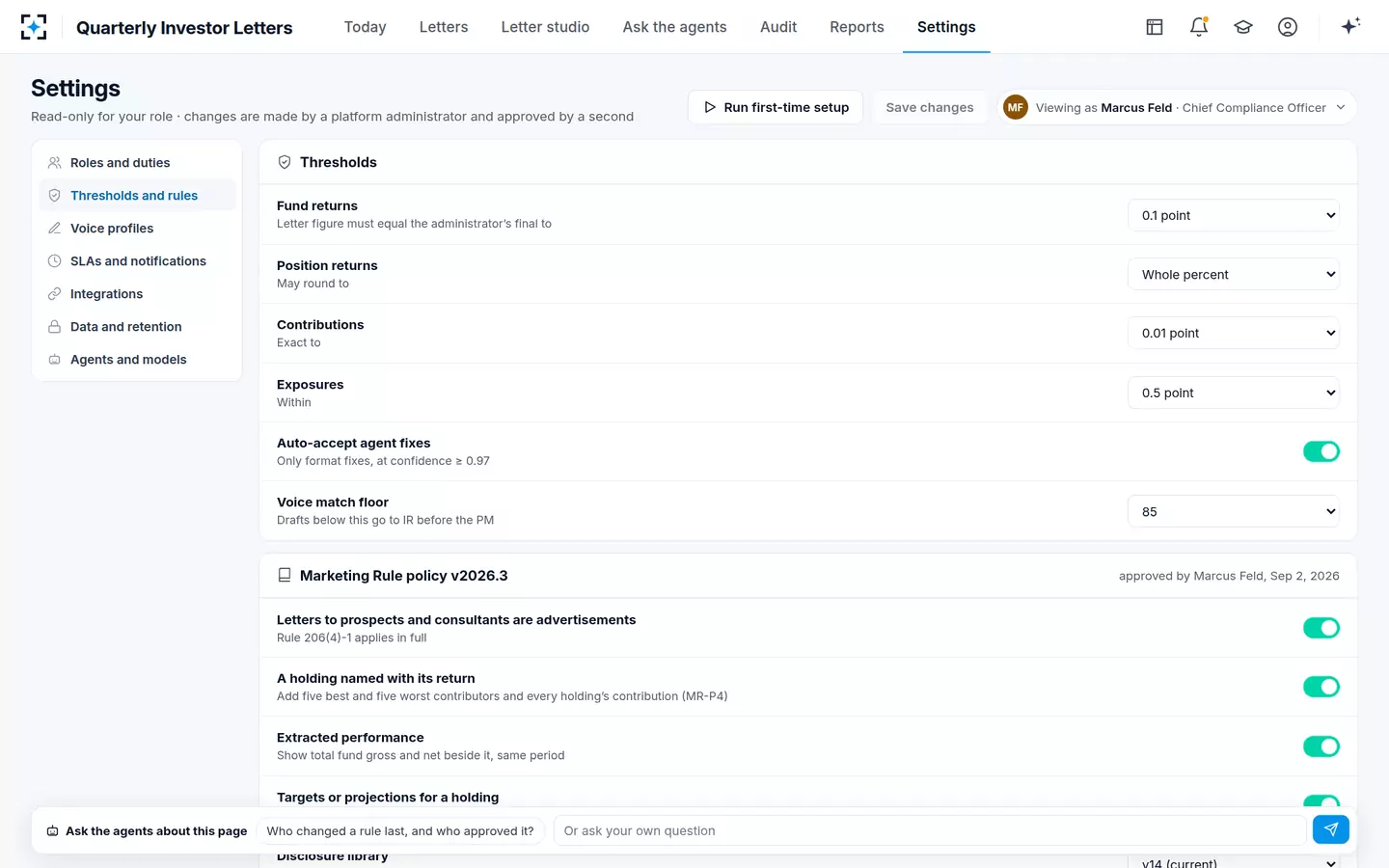
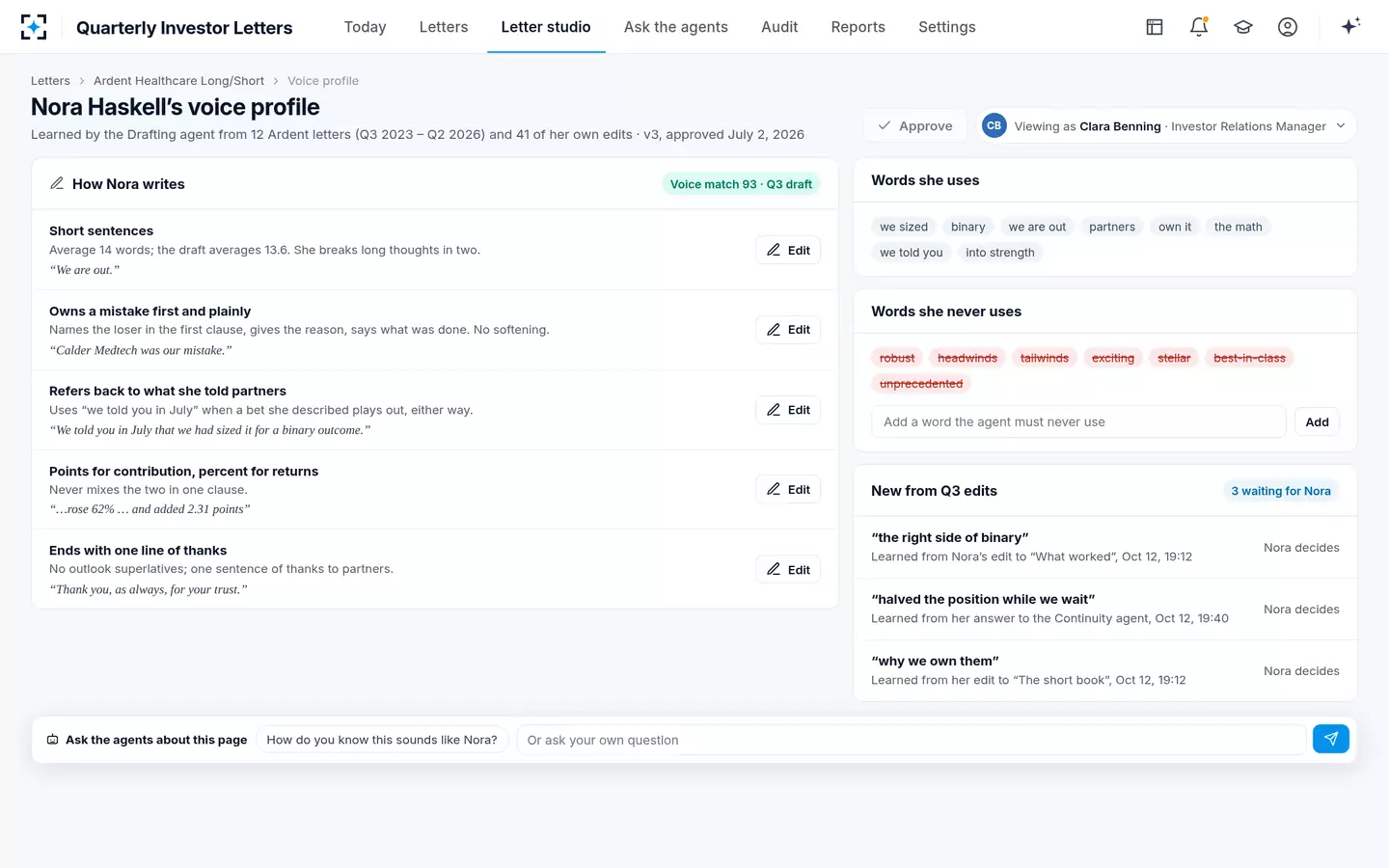
The first three weeks turn documents into settings. The template becomes sections and rules; the tolerances become thresholds that a second administrator must approve to change; the marketing rule policy becomes checks, each tied to the passage it rests on. The PM's past letters become a voice profile that the PM reads and approves: in the sample, short sentences averaging 14 words, a mistake owned first, points for contribution and percent for returns, and seven words she never uses.
Sources and lists take longest, and the delay is rarely technical. The administrator's files have to arrive with a clear mark of estimate or final. The CRM has to say who is qualified, and gaps found here are the same gaps that would have sent a prospect version to the wrong person. Fixing them is part of going live, not a side effect of it.
Thresholds and policy as settings, with a first-time setup
Weeks 4–6: replay last quarter in parallel
The replay is the test. Take the letter the firm sent last quarter and run the same inputs through the agents: the PM's memo or notes if they exist, the estimate and final NAV, the attribution, the prior letters, the recipient list. Because the right answers are known, the comparison is objective. Did every figure tie to the final? Did the agents find the bets the earlier letter described? Did the prospect version match what compliance built by hand, or improve on it? How long did the PM's edit take?
The replay also tests the policy. SEC examiners have found policies that "were updated to reflect the Marketing Rule but were not implemented" (SEC Risk Alert, April 2024). A replay is where a firm finds out whether its written policy produces the letter it thinks it does. ESMA, writing for firms that use AI, calls the checks made after the fact "post-interaction assessments" and says they "are crucial in ensuring ongoing compliance" (ESMA, May 2024); the replay is the first of them.
Pass criteria for the replay: what to compare, and what passing looks like
What to compare: Every figure in the agents' draft against the final NAV, attribution and exposure report.
Passing looks like: Every figure tied to a source and page; none from the estimate.
What to compare: Bets and promises in the previous letter against the replayed draft.
Passing looks like: Every one mentioned or raised with the PM.
What to compare: Each recipient's status and version against what was actually sent.
Passing looks like: Same or better; any difference explained by a CRM flag.
What to compare: The agents' additions against compliance's own version.
Passing looks like: Accepted by the CCO without rework, or the policy changed.
What to compare: The draft's voice score and the PM's edits.
Passing looks like: Above the floor; the PM recognises it as hers.
Weeks 7–13: the first live letter
The first live letter follows the same path as any later one. The PM records a memo after quarter end; the intake agent marks the estimate and, later, the final; the drafting agent writes; the PM edits and answers the continuity agent's questions; the tie-out agent re-ties at the final NAV; the Fund CFO certifies; the CCO approves; two people release. In the sample, that path took from 6 October, when the CIO recorded her memo, to 15 October, when the letter went out the morning after the final NAV.
What changes in the first live quarter is attention, not process. The PM reads every paragraph's source link the first time and fewer later. The CCO opens every rule passage the first time. Translation needs a native-speaker reviewer to sign off each fund's first translated letter. By the second quarter, the work settles into reviewing and deciding.
Who signs off the go-live
Going live is a decision with four owners, and each should sign for the part they will answer for afterwards. The PM approves her voice profile and the template's prose rules, because the letter will go out under her name. The Fund CFO approves the tolerances and the list of sources marked final, because he will certify against them. The chief compliance officer approves the policy: which audiences make a letter an advertisement, which checks run, and what the prospect version adds. And whoever owns the CRM confirms that the recipient flags are complete enough to hold back anyone who cannot be qualified.
Keep the replay's results with those approvals. The compared drafts, the differences found and the settings changed in week six are the evidence that the firm tested its procedure before relying on it, which is the same evidence an examiner would ask for after the fact. In the sample, every settings change is a pending version until a second administrator approves it, so the go-live decisions sit in the same history as every later change.
How long does it take to automate investor letters?
About one quarter for a fund or a small family of funds, on the plan above: three weeks to set up, three to replay, and the next quarter's letter live. The determining factors are not the agents but the inputs: how quickly the administrator's files and the CRM's flags can be read reliably, and how quickly the PM approves a voice profile. A firm with 40 strategies, like the sample, runs the same plan with more letters in the replay, and the cycle view then shows every letter by stage and owner.
The PM approves her own voice profile before it is used
What can go wrong in the first quarter
Four things are most likely to slow the first quarter, and each has a remedy. The CRM cannot say who is qualified: hold those readers back rather than guess, as the sample did with a family office and a consultant. The administrator's files do not say estimate or final: agree a naming convention before week four. The PM does not recognise the voice: feed in more of her edits, not more of her letters. And the written policy turns out not to match practice: change one or the other before going live, not after the first letter.
None of these is solved by better drafting, which is why the replay matters more than the demonstration. What the agents may and may not decide is worth settling before week one, and the cost of one letter before signing anything. To run the replay on a quarter you already sent, start from Quarterly Investor Letters.
Questions people ask
What is the format of an investor letter?
A heading with the fund names and quarter, a performance paragraph and returns table, what worked, what did not, the short book or hedges, positioning, and an outlook with a short close. A prospect version adds a contributors table and the disclosures an advertisement needs.
Is a shareholder letter template the same as an investor letter template?
The structure is similar, but a registered fund's shareholder communications sit under the rules for registered funds, while a hedge fund letter is a private communication to partners. Start from the hedge fund template above if the readers are partners in a private fund.
Can an investor update email template work for a hedge fund?
Investor update emails are usually short company updates from a startup to its backers, with a different purpose and no fund performance. A hedge fund's quarterly letter reports returns by class against a benchmark and must be tied to the final NAV, so it needs the fuller template.
How many past letters do agents need to learn a PM's voice?
The sample profile was learned from 12 letters, three years of quarters, and 41 of the PM's own edits. Edits matter more than letters, because they show what the PM changes when someone else's draft is in front of her.
Should compliance pre-approve the template?
Yes, for the fixed parts: the returns table, the disclosure blocks and the prospect version's additions. The SEC's adopting release names "pre-approving templates" among effective compliance methods. The quarterly text still needs review each time.