Hedge fund reporting requirements fall into two groups. The adviser reports to the SEC: Form ADV at least annually, Form PF if it manages at least $150 million in private fund assets, and Form 13F each quarter if it holds at least $100 million in listed equities. Investors receive what the fund documents promise and, where the adviser relies on the custody rule's audit route, audited financial statements within 120 days of the fund's year end. No US rule requires a quarterly letter to investors; the SEC rule that would have required quarterly statements was vacated in 2024. But a letter, once sent, falls under the books-and-records rule, which requires a copy and the working papers behind every performance figure in it, kept for five years. Botminds' Quarterly Investor Letters builds that file as the letter is written, so the evidence exists before anyone asks for it.
The examples come from fictional sample data: a fictional firm, Quillfield Alternatives, and its third-quarter 2026 letter for Ardent Healthcare Long/Short, as it runs through the solution. The rules are stated as in force in October 2026.
The letter file: what to keep behind one investor letter, and why
Each version as sent: partner, translated, prospect
The rule that reaches it204-2(a)(11)(i): a copy of each advertisement, and of each investment letter sent to ten or more persons
How longFive years after the year it last went out; the first two at the adviser's office
The working papers behind every performance figure
The rule that reaches it204-2(a)(16): the working papers that support or show the calculation of any performance figure in a letter
How longSame period, counted from the year the letter was last sent
Correspondence about the figures and the advice
The rule that reaches it204-2(a)(7): written communications about advice and about performance, sent and received
How longFive years after the year of the last entry
Reasons for any security the letter recommends without stating why
The rule that reaches it204-2(a)(11)(i)(C): a memorandum of the reasons
How longWith the letter
The recipient list for a prospect version
The rule that reaches it204-2(a)(7)(iv)(B): a memorandum describing the list and its source, where an advertisement goes to a list
How longWith the copy
Who approved what, when, and on what evidence
The rule that reaches itYour compliance policies under 206(4)-7; no rule names the log
How longYour policy; the sample firm keeps seven years
Hedge fund reporting requirements at a glance
Most hedge fund reporting is done by the adviser, not the fund, because the fund itself is usually exempt from registration while its adviser is registered. The table sets out the main recurring filings and deliveries for an SEC-registered adviser to hedge funds, with the threshold and the deadline in the rule's own terms.
Hedge fund filing requirements and investor deliveries, by rule
| Requirement | Who | When | Rule |
|---|---|---|---|
| Form ADV, Parts 1 and 2 | Every SEC-registered adviser | At least annually, within 90 days of the end of the fiscal year, and more often if the instructions require | 17 CFR 275.204-1(a) |
| Form PF | Registered advisers to private funds with at least $150 million in private fund assets at the end of the last fiscal year | At least annually, by the date in the form's instructions, and more often if they require | 17 CFR 275.204(b)-1 |
| Form 13F | Managers with discretion over at least $100 million in 13(f) securities on the last trading day of any month | Within 45 days after each calendar quarter | 17 CFR 240.13f-1(a) |
| Audited financial statements to investors | An adviser with custody of a pooled fund that relies on the audit provision | Within 120 days of the fund's fiscal year end | 17 CFR 275.206(4)-2(b)(4) |
| Quarterly letter to investors | No one, by rule | As the fund documents or the firm's practice set | None; anti-fraud and books-and-records rules apply once sent |
Do hedge funds report to the SEC?
Yes, through their adviser. A registered adviser files Form ADV, which is public, and Form PF when "you act as an investment adviser to one or more private funds and, as of the end of your most recently completed fiscal year, you managed private fund assets of at least $150 million" (17 CFR 275.204(b)-1(a)). Form PF is not published fund by fund: the SEC says it "does not intend to make public information reported on Form PF that is identifiable to any particular adviser or private fund" (SEC Private Fund Statistics). Form 13F, which shows long positions in listed equities each quarter, applies to any institutional manager over $100 million, hedge fund or not.
The SEC publishes what those filings add up to. For the third quarter of 2025, its staff reported 9,940 hedge funds advised by 1,834 advisers, from Form PF and Form ADV data. None of those filings contains the quarterly letter. The letter is the one report investors read most closely and the regulator never receives unless it asks, which is why the file behind it matters at an examination rather than at a filing deadline.
Is a hedge fund required to send quarterly letters?
No. No US rule requires a private fund adviser to send investors a quarterly letter or a quarterly statement. The SEC adopted such a requirement in August 2023 as part of its private fund adviser rules, requiring registered advisers "to provide investors with quarterly information about private fund adviser compensation, fund fees and expenses, and performance" (SEC overview chart); on 5 June 2024 the US Court of Appeals for the Fifth Circuit vacated them, and the SEC's technical amendments of November 2024 record that the vacatur "had the legal effect of (i) vacating the new rules and the reservation of rule 206(4)-9 and (ii) vacating the amendments to the existing books and records rule 204-2 and compliance rule 206(4)-7" (89 FR 91252).
The obligation to send a letter therefore comes from the fund's documents, side letters with particular investors, or the firm's practice. The obligations that attach to a letter once it exists come from rules that never mention letters as such: the anti-fraud rule for pooled funds governs what it says, and the books-and-records rule governs what is kept. What makes a letter an advertisement for some readers is a separate question, set out in what an investor letter is, and when it is an advertisement.
What records must a hedge fund keep for investor letters?
A hedge fund adviser must keep a copy of each letter it sends to ten or more persons, a copy of each version that is an advertisement, and the accounts, internal working papers and other records that support or show how each performance figure in it was calculated (17 CFR 275.204-2(a)(11) and (a)(16)). The rule names the letter in both places, as an "investment letter", which leaves little room to argue that a quarterly letter to partners is outside it.
In practice the working papers for one letter are the administrator's final NAV statement by class, the attribution and position P&L behind each position story, the exposure report behind each exposure, and the index series behind each comparison. Correspondence about those figures, such as the administrator's note explaining an incentive allocation true-up, is caught by the rule's provision on written communications relating to performance. Two less obvious items belong in the file too: a memorandum of reasons if the letter recommends buying or selling a specific security without saying why, and, for a prospect version sent to a list, a memorandum describing the list and where it came from.
How long must investor letters be kept?
At least five years from the end of the fiscal year in which the letter was last sent, with the first two years at one of the adviser's offices. The clock for the copy and for the performance working papers runs from the last time the letter was disseminated, not from when it was written, so a letter re-sent to a prospect two years later extends its period (17 CFR 275.204-2(e)(3)(i)). Other correspondence follows the rule's general period of five years from the end of the fiscal year of the last entry.
The records may be electronic, on conditions that matter more than the medium. They must be indexed so that any one can be found and retrieved quickly, protected from loss, alteration and destruction, open only to authorised staff and the SEC, and duplicated: the adviser must "separately store, for the time required for preservation of the original record, a duplicate copy of the record on any medium allowed by this section" (17 CFR 275.204-2(g)). A folder of PDFs on a shared drive meets the first condition with effort and the others rarely. The sample firm writes every version and every action once, so none can be altered, and keeps them seven years.
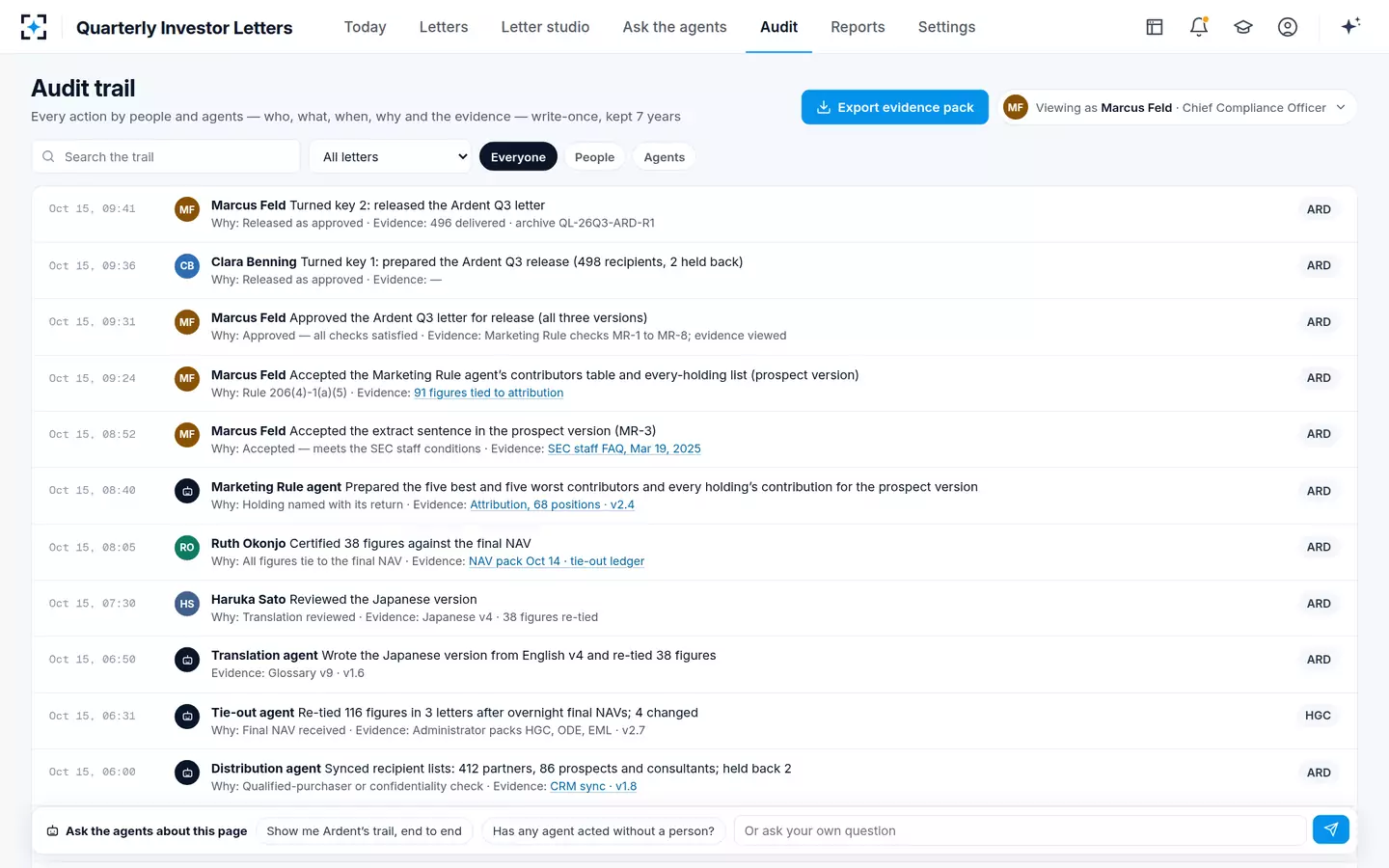
Every action by people and agents, written once
Hedge fund performance reporting: three documents, one set of numbers
A partner sees a hedge fund's performance in three documents: the administrator's statement of their capital account, the quarterly letter, and, once a year, the audited financial statements. They are produced by different people on different timetables, and a careful partner reads them against each other. The statement and the letter should agree to the firm's tolerance on every return they share. Where the custody rule's audit route applies, the audited statements arrive up to 120 days after year end, and they can adjust a valuation that the fourth-quarter letter quoted.
That is why the letter file keeps the final NAV statement the letter was tied to, rather than a note that the figures were checked. If an audit later changes a figure, the file shows which letter quoted it, to whom it went, and what the correction needs to say. In the sample, the Fund CFO's certification names the administrator's final statement of 14 October, so any later change can be traced to the letters that relied on it.
What examiners found when the files were thin
When SEC examiners reviewed firms' compliance with the marketing rule, they found missing support for exactly the figures letters carry: among the books-and-records deficiencies in their April 2024 observations were advisers who had kept no documentation to support the performance claims in their advertisements (SEC Risk Alert, 17 April 2024). The observation is about advertisements, so it reaches a letter's prospect version directly; the underlying duty, to keep the working papers behind performance in any investment letter, reaches the partner version too.
The SEC also looks at returns from the outside. Announcing a set of hedge fund cases in 2011, it described how its asset management unit "uses proprietary risk analytics to evaluate hedge fund returns", flagging "performance that appears inconsistent with a fund's investment strategy or other benchmarks" (SEC press release 2011-252). A file that ties each return in a letter to the statement and attribution behind it is how an adviser answers that kind of question quickly, with the documents rather than a reconstruction.
The letter file, built while the letter is written
The cheapest file is the one assembled as a by-product of writing the letter, not reconstructed for an examination. In the sample, each source arrives marked final or estimate; each figure in the draft points to its source and page; each change at the final NAV is logged with its reason; each approval records what the approver was shown; and each release records who prepared it, who confirmed it and who received which version.
How the file for one letter fills itself in
Agent
IntakeCollects the estimate and final NAV statement, attribution, exposures, the PM's memo and the prior letters; marks each final, estimate or superseded.
Never: treat an estimate as final.
Agent
Tie-outPoints every figure to its source, page and rounding rule; logs every change at the final NAV with the reason.
Never: certify.
A person decides
Fund CFO certifiesSigns the figures against the final; the certification names the statement it rests on.
A person decides
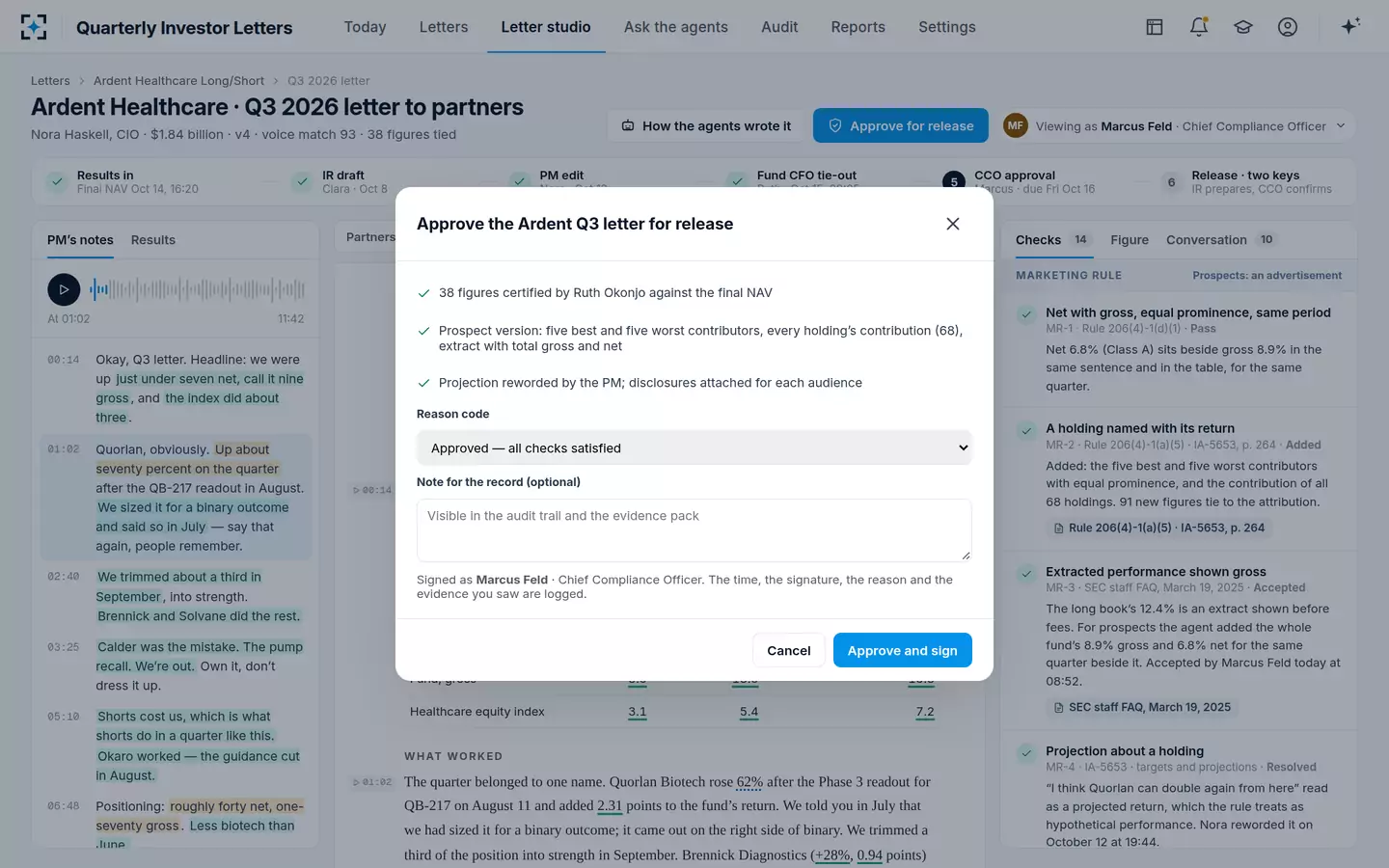
CCO approvesApproves each version with a reason code; the record shows the checks and passages the CCO opened.
A person decides
Two people releaseOne prepares the versions and lists, another confirms; each version is archived as sent, with its recipients.
An approval that records what the approver was signing for
Before an examination: eight things the file for each letter should answer
- Which versions went out, to whom, and when?
Each version as sent, with its recipient list and the date.
- Where did each figure come from?
The final statement, attribution or exposure report, with page.
- Which figures changed between draft and final, and why?
The estimate kept as superseded, with the administrator's reason.
- Who certified the figures?
A name, a time and the statement certified against.
- Which versions were advertisements?
The status for each audience and the passage it rests on.
- Who approved each version, and what were they shown?
Reason code and evidence.
- Who held back whom, and why?
Recipients excluded from a version, with the reason.
- Can every record be produced as kept?
Indexed, duplicated, protected from alteration, for at least five years from the year last sent.
For the errors that the file exists to catch, the seeded-error test shows how to measure a review against them. To see a letter's file assembled as the letter is written, with an export for one letter or a whole cycle, start from Quarterly Investor Letters. Performance standards for composites, such as GIPS, are a separate, voluntary framework covered by GIPS Compliance Reporting.
Questions people ask
Do hedge funds have to file 13F?
A hedge fund manager files Form 13F if it exercises discretion over accounts holding at least $100 million of 13(f) securities, broadly US-listed equities, on the last trading day of any month. It files within 45 days after each calendar quarter, so the holdings it shows can be up to 45 days old when they appear.
What are hedge fund disclosure requirements to investors?
Mostly what the fund's offering documents and side letters promise, plus the anti-fraud rule's ban on misleading statements and omissions. Where an adviser with custody relies on the custody rule's audit provision, investors must receive audited financial statements within 120 days of the fund's fiscal year end.
Does a hedge fund have to report performance to the SEC?
Not as a published figure. Advisers above the $150 million threshold report fund-level information on Form PF, which the SEC publishes only as aggregated statistics. What an adviser says about performance to investors must be supported by the working papers the books-and-records rule requires.
Are hedge fund letters kept by the SEC?
No; they are not filed. The adviser keeps them, and examiners ask for them. That is why the copy, the working papers and the approval history need to be retrievable by letter, by version and by recipient.
Do the books-and-records requirements apply to a letter sent to only a few investors?
The copy requirement for an investment letter applies when it goes to ten or more persons, or whenever the letter is an advertisement. The working-papers requirement for its performance figures applies when the letter goes to any person outside the adviser.