Hedge fund investor letters fail in the same few ways: a figure taken from the administrator's estimate rather than the final NAV, a position return rounded from memory, winners named without the losers, gross returns shown without net, and a claim of recovery with nothing behind it. A sixth error, silence about a bet described to partners last quarter, is the hardest to see because nothing on the page is wrong. The way to know whether your review catches them is to plant them in a real draft and count. Each traces to an SEC examination finding or enforcement case, so the test also shows which rule a miss would break. Botminds' Quarterly Investor Letters checks every draft for all six before the chief compliance officer reads it, and this guide shows where each check sits.
The examples come from a fictional sample letter, the third-quarter 2026 letter of Ardent Healthcare Long/Short at a fictional firm, as it runs through the solution; the exam findings and cases are real and public.
Plant five errors in last quarter's letter, and one silence
- 1 · A figure from the estimate
Change one class return to the administrator's estimate. Rule: the anti-fraud rule for pooled funds; the books-and-records rule for the figure's support.
- 2 · A position return rounded from memory
Replace a position's return with the round number the PM said aloud. Rule: anti-fraud; for prospects, the marketing rule's ban on unsupported statements.
- 3 · Winners without the losers
Delete the paragraph on detractors. Rule: for prospects, specific investment advice must be fair and balanced; for partners, an omission can mislead.
- 4 · Gross without net
Quote the long book or the fund before fees with no net figure beside it. Rule: for prospects, net with at least equal prominence.
- 5 · A rebound with no basis
Add a sentence that the fund is bouncing back, or that a holding will double. Rule: anti-fraud; for prospects, the conditions on projected returns.
- 6 · Silence about last quarter's bet
Remove every mention of a position the previous letter introduced. Rule: the omission clause of the anti-fraud rule.
Why seed errors into hedge fund investor letters?
Because a review that finds nothing is indistinguishable from a review that looked at nothing. A seeded test turns the question "did compliance read the letter?" into a measurement: of the errors we know are there, how many were found, by whom and how late. Planted errors have known locations, so a miss is unambiguous.
The SEC's examiners describe the failure the test is designed to expose. In their 2024 observations on the marketing rule, staff found firms whose written policies were sound but unused: the policies required net-of-fees performance in every performance advertisement, and the same firms' advertisements showed gross performance alone (SEC Risk Alert, 17 April 2024). A policy that says net is required and a review that does not check for it look identical until someone plants a gross-only figure.
Error 1: a figure from the estimate
Plant it by changing one class return to the administrator's estimate. In the sample, the estimate of 7 October had Class A at 6.9% for the quarter and 14.3% for the year; the final of 14 October had 6.8% and 14.2%, after the incentive allocation was trued up. A reviewer reading the letter alone cannot see the difference. Only a reviewer comparing the letter with the final statement can.
The planted figure also tests whether the review checks every instance. The quarter's Class A return appears in the opening sentence and again in the returns table; plant the estimate in one and leave the final in the other. A review that compares the text with the statement but not with itself will pass a letter that quotes two returns for the same class. The tolerances that decide what counts as a match belong in writing before the test, so the score is not a matter of opinion.
Error 2: a position return rounded from memory
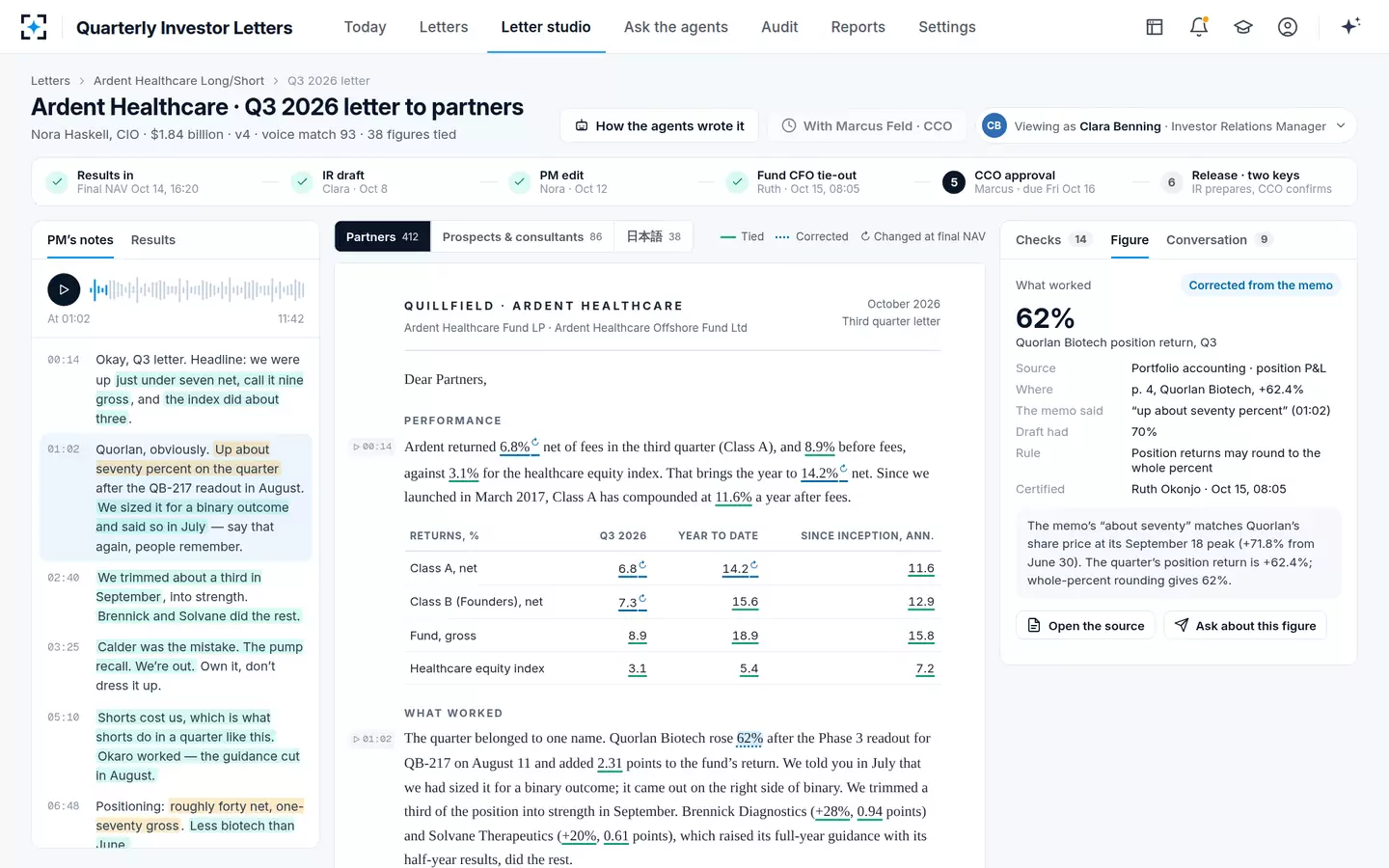
Plant it by replacing a position's return with the number the PM used in conversation. The sample memo gave one ready-made: Quorlan Biotech "up about seventy percent on the quarter", when the position returned 62.4%. The seventy was real, the stock's gain at its 18 September peak, which is what makes the error persuasive. A reviewer who knows the stock had a great quarter will not question it.
For a prospect, the error has a rule of its own: an advertisement may not contain a material statement of fact that the adviser could not substantiate if the SEC asked (17 CFR 275.206(4)-1(a)(2)). Nobody can substantiate seventy from the books when the books say 62.4. The catch requires a reviewer, or a check, that opens the position P&L for every position return in the letter, not only the ones that look large.
The memo's seventy, corrected against the books
Error 3: winners without the losers. Must a letter mention losing positions?
For prospects, a letter that names its winners must treat its losers fairly; for partners, leaving them out can mislead. Plant the error by deleting the detractors paragraph and see whether anyone asks where it went. The marketing rule bars an advertisement from including "a reference to specific investment advice provided by the investment adviser where such investment advice is not presented in a manner that is fair and balanced" (17 CFR 275.206(4)-1(a)(5)).
SEC examiners have seen exactly this. The 2024 risk alert reports advertisements "that included only the most profitable investments or specifically excluded certain investments without providing sufficient information and context to evaluate the rationale, such as investments that were written off as a loss or were lower-performing investments", and firms that "had not established criteria in their policies and procedures" for such references (SEC Risk Alert, 17 April 2024).
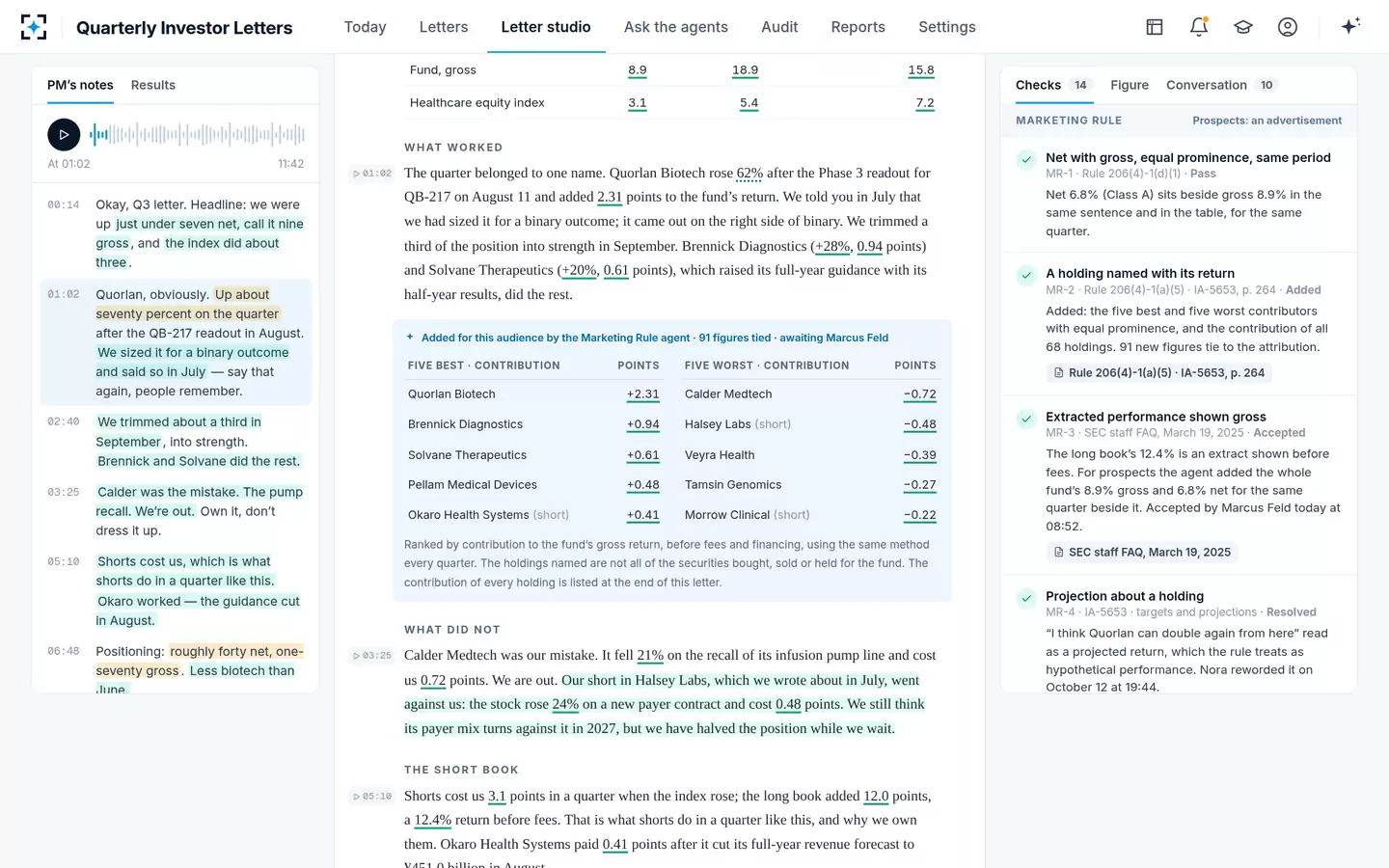
A stated criterion makes the error catchable. The sample firm's policy is that whenever a letter names a holding with its return, the prospect version carries the five best and five worst contributors, ranked by contribution to gross return with the same method every quarter, and offers every holding's contribution. That is the firm's choice, not a number in the rule; what matters for the test is that the reviewer has a rule to apply rather than a judgement to make.
Name a winner, show the losers
Error 4: gross without net. Can a letter show only gross returns?
Not to prospects: an advertisement may not present gross performance "unless the advertisement also presents net performance" with "at least equal prominence" and over the same period and method (17 CFR 275.206(4)-1(d)(1)). To partners, a gross-only figure is not barred by that condition, but it can mislead a reader about what the fund earned after fees. Plant the error with the figure most likely to slip through: an extract.
The sample letter's short-book paragraph says the long book returned 12.4% before fees. That is extracted performance, a subset of the portfolio, and in the prospect version the fund's total 8.9% gross and 6.8% net for the same quarter sit beside it. The SEC staff's marketing FAQ discusses when an extract may be shown gross; how gross and net figures are produced and reconciled is the subject of the SEC marketing rule's gross and net requirement, from the attribution side.
Error 5: a rebound with no basis
The fifth error is a sentence about the future that the facts do not support, and the SEC's clearest case is a hedge fund letter. In 2008 the SEC charged MedCap Management & Research and its principal with "portfolio pumping": heavy end-of-quarter purchases of a thinly traded stock in which the fund was heavily invested, which "inflated MedCap's reported value by $29 million" (SEC press release 2008-251). Then came the letter.
"Immediately after the quarter ended, Toney reported to MedCap's investors that the fund's investments had begun to ‘bounce’ … Toney failed to disclose that this ‘bounce’ was almost entirely the result of his four-day purchasing spree."
SEC press release 2008-251, 16 October 2008
The pumping is a trading violation, but the letter is where investors were told. The release says the purchases ended up "masking what would otherwise have been a 40 percent quarterly loss for MedCap." A review that asks "what is the basis for this sentence?" of every claim about recovery or momentum is the control that would have stopped the letter, whatever happened on the trading desk.
The everyday version is milder. Plant "I think this position can double again from here" in the outlook. The sample firm's policy treats any predicted return for a named holding as a projection that compliance must see; for prospects, the marketing rule puts conditions on "targeted or projected performance returns" for a portfolio. In the sample, the agents flagged the sentence and the PM rewrote it as a view: "We believe the market still underestimates QB-217's commercial potential."
The sixth error: silence about last quarter's bet
Silence is the error almost no review catches, because it requires reading the previous letter. Plant it by deleting every mention of a position the last letter introduced. The pooled-vehicle anti-fraud rule reaches omissions: it is fraud to leave out a material fact that an investor needs for what the adviser did say not to mislead, judged in the light of the circumstances in which it was said (17 CFR 275.206(4)-8(a)(1)). A previous letter that introduced the position is one of those circumstances.
The SEC has charged the extreme form. In its 2011 inquiry into suspicious hedge fund returns, it alleged that the manager of the Solaris Opportunity Fund "made a radical change in the fund's investment strategy, contrary to the fund's offering documents and marketing materials", investing in a single troubled microcap company and hiding it from investors for years, and that he "finally told investors about the Positron investments in a March 2009 newsletter" (SEC press release 2011-252; allegations at the time of the release).
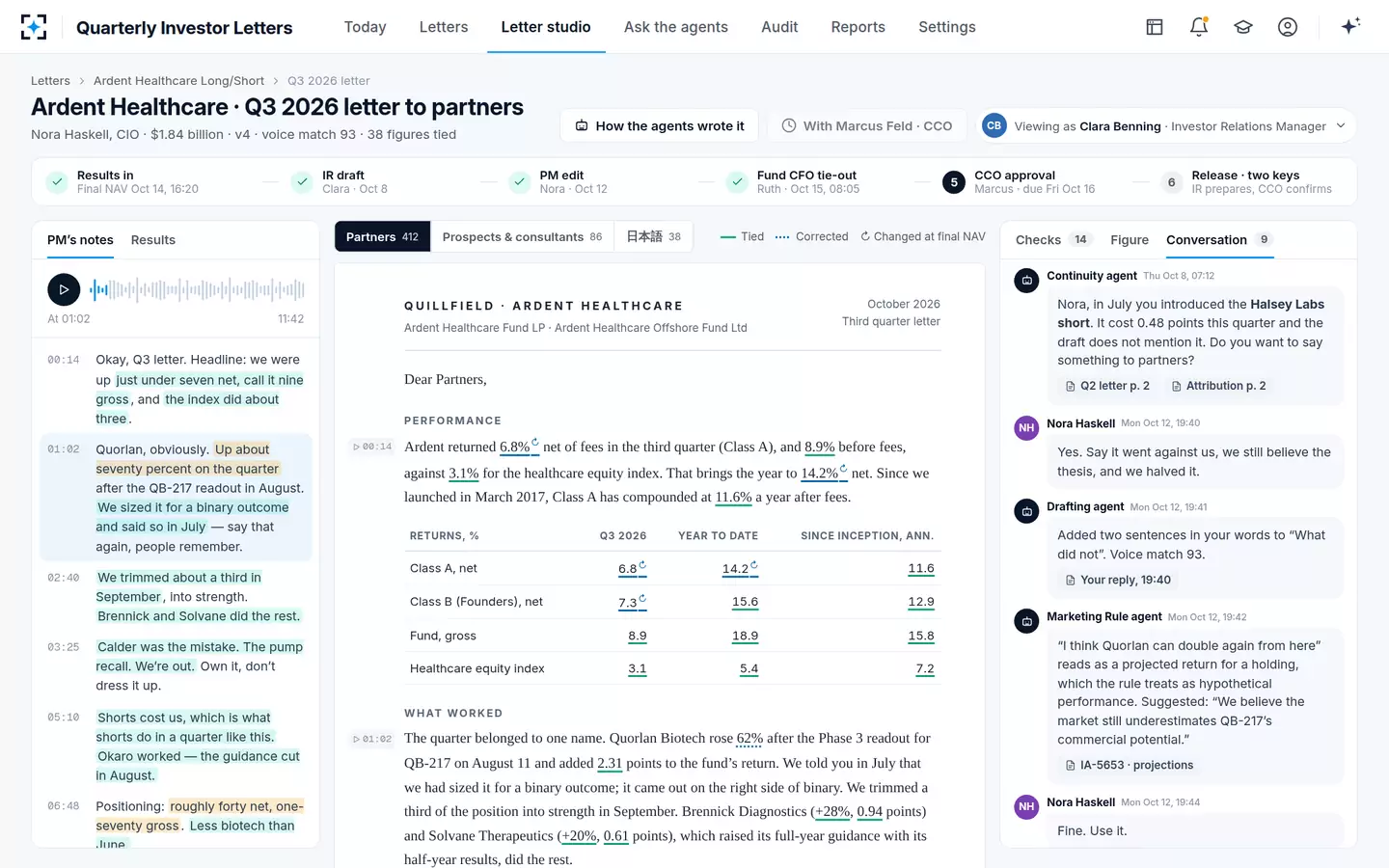
In the sample, the draft was silent on a short in Halsey Labs that the PM had introduced to partners in July and that cost 0.48 points this quarter. The Continuity agent, which reads every prior letter for what the PM told partners, asked her about it on 8 October; she answered in one line, and two sentences in her words went into the letter. That is the shape of the catch: not a reviewer's memory, but a check that compares this letter with the last.
Last quarter's short, remembered and asked about
How to score a review of hedge fund investor letters
Score by error type, not by total. A review that catches every figure error and no omission has a different weakness from one that catches the reverse, and a single percentage hides it. Run the test on last quarter's letter so the facts are known; plant three or four of the six; give the draft to the normal reviewers on their normal deadline; record what each found, when, and whether they found it from the letter alone or by opening a source.
Repeat every quarter with a different mix, and keep the results. A review process that improves on seeded errors is evidence of a working control. One that never sees a test cannot show it has one. Keep the planted draft, the reviewers' notes and the score with the letter's other working papers, so the evidence of the control sits where an examiner will look for it.
A scoring sheet for one seeded test
| Planted error | Caught from the letter alone? | Caught only by opening a source | What a miss tells you |
|---|---|---|---|
| Figure from the estimate | Only if the text and table disagree | The final NAV statement | Figures are reviewed for plausibility, not tied |
| Return rounded from memory | Rarely: the number is plausible | Position P&L | Large positions are trusted because they are well known |
| Winners without losers | Yes, if the reviewer expects a detractors paragraph | Attribution, bottom of the list | No written criterion for naming holdings |
| Gross without net | Yes, if the reviewer checks every figure's basis | The net series for the same period | Extracts and sleeves are read as exceptions |
| A rebound with no basis | Sometimes: the sentence sounds like a view | Trading records, the PM's notes | Outlook sentences are not asked for a basis |
| Silence about last quarter | No | The previous letter | Nobody reads the letters as a series |
What the agents caught in one sample letter before the CCO opened it
To run the six checks on one of your own past letters, start from Quarterly Investor Letters; the records to keep behind every letter covers what a test result should sit beside.
Questions people ask
What are the most common mistakes in hedge fund investor letters?
Figures from the estimate rather than the final NAV, position returns from memory, winners without losers, gross without net, unsupported claims about recovery or future returns, and silence about positions described in earlier letters. SEC examiners have reported several of these in advertisements, including gross-only performance and showing only the most profitable investments.
Can a hedge fund letter say a stock will double?
It is a risky sentence for any audience. To prospects, a predicted return can bring the marketing rule's conditions on projected performance; to anyone, it needs a reasonable basis under the anti-fraud rule. A view about why the market misprices a company says the same thing without a number.
Do the SEC's marketing rule findings apply to letters to existing partners?
Not directly, because a letter to existing partners is generally not an advertisement. The anti-fraud rule for pooled funds applies to every letter, though, and the errors examiners find in advertisements are the same ones that make a partner letter misleading.
How many errors should a seeded test contain?
Three or four per draft is enough to measure and few enough that reviewers cannot guess the list. Rotate the types each quarter and score each type separately.
Who should plant the errors?
Someone outside the review being tested, such as internal audit or a second compliance analyst, using last quarter's letter so the facts are known. Keep the planted version, the reviewer's notes and the score together.