Banks know someone has died only when someone tells them or when their own checks find it: there is no single national feed that informs every bank of every death. For customers who receive federal benefits by direct deposit, the paying agency sends an electronic death notification through the ACH network. For everyone else, the bank usually hears from the family, an executor, a funeral home, a court document, a staff member who knew the customer, or its own review of an account gone quiet. The first of these that is credible matters more than the rest, because it fixes the date the bank “first had actual or constructive knowledge of the death,” which it must certify to Treasury for any federal benefit paid after the death, and which decides how much of that benefit the bank itself may owe. Botminds’ Deceased Account Processing exists to make that date exact; this guide explains where it comes from.
How a bank learns of a customer’s death, and whether each counts as notice
| Source | Who sends it | Counts as notice to the bank? |
|---|---|---|
| Death notification entry | A federal agency (currently SSA, OPM or RRB) over the ACH network | Yes, for federal benefits; the bank is encouraged to flag the account |
| Notice of reclamation (FS Form 133) | Treasury’s Bureau of the Fiscal Service, for the paying agency | Yes |
| Call, letter, branch visit or online form | Family, friends, neighbours | Yes, if credible: “Credible oral or written report of death” |
| Request from the estate | Executor, administrator or other representative | Yes: any contact or request to withdraw |
| Court or funeral home reference | Probate court, funeral home, letters testamentary | Yes |
| Staff awareness | An employee who knows of the death, from an obituary or personally | Yes, if credible |
| The bank’s own screening | Inquiry into a dormant account or other internal checks | Yes, if credible |
How do banks know if someone is deceased?
Through notices that reach them and through their own checks. What a bank has is a set of channels through which news of a death arrives, and a duty to act once it does. The Treasury’s guide lists them, and its list is wider than most bereavement procedures assume: a death notification entry, a notice of reclamation, “Any contact or request to withdraw funds from an Estate, Executor, Administrator, Public Administrator, Personal Representative, Conservator or other representative of such Estate,” “A pertinent reference to or from a Probate Court, a funeral home, or Letters Testamentary,” a “Credible oral or written report of death,” “Credible death information obtained by the RDFI’s inquiry into a dormant account, or through other RDFI internal screening processes,” “Credible personal awareness of the death by the RDFI’s staff,” and a “Credible death notice received in the mail from any source” (Green Book, chapter 5).
The volume these channels carry is large. The United States recorded 3,072,666 deaths in 2024 (CDC, FastStats), and families are told to notify their banks directly: telling the bank or credit union is an item on the CFPB’s checklist for surviving spouses (CFPB).
Does Social Security notify banks of a death?
Yes, for its direct-deposit beneficiaries, through a death notification entry. The Treasury’s guide describes it as the way a federal agency tells a bank that a benefit recipient has died; no one but a federal agency can send one, and today only SSA, OPM and RRB do (Green Book, chapter 4). It moves no money: it is an ACH entry for zero dollars, and its addenda carries the date of death, the deceased’s Social Security number and the amount of the next scheduled payment (see death notification entries, field by field).
Two limits follow. A notification entry reaches the bank only for people the agency pays by direct deposit to that bank; it says nothing about customers who receive no federal benefit, or receive it elsewhere. And it arrives when the agency has processed the death, which may be days after the family has already called the branch. On the sample estate used on this page, the widow’s call came a day before the notification entry. The bank’s knowledge date was the call.
What the bank does with the entry is up to it, within limits. The Green Book encourages it to flag the deceased recipient’s account so that later federal benefits are not accepted. A bank that learns of the death another way can tell the agency by returning the next benefit with reason code R15 or R14, which Treasury’s rule counts as the notice the bank owes the agency (31 CFR 210.10(a)).
Why is the first credible notice the date that matters?
Because federal benefit liability turns on it. A bank owes the government every benefit paid into the account after a recipient’s death unless it qualifies for limited liability, and to qualify it must certify that it had no knowledge of the death when each payment was credited or withdrawn, and the day it first knew, actually or constructively, “regardless of how and where such information was obtained” (31 CFR 210.10 and 210.11). Benefits that arrived before that date can qualify; anything that arrives after it must be returned, and if it is not, the bank answers for it.
The date the certificate arrived is usually not that date. The first credible notice is often a phone call from a relative, and the Green Book treats a payout to an executor as proof on its own: “Any release to an executor or other party clearly acting on behalf of the deceased person or their estate will be deemed by the government to have demonstrated the RDFI’s knowledge of the death” (Green Book, chapter 5). A bank that certifies the certificate’s date when a call came a week earlier has certified the wrong date, and a certification that is late or inaccurate makes the bank answer for any loss it causes, on top of what it already owes (31 CFR 210.11(d); reclamation liability adds it up).
One sample estate’s first two weeks: when the money moved, and when the bank knew
- Death to benefit creditSep 28 → Oct 2
- Credit to joint owner’s ATM withdrawalOct 2 → Oct 4
- Withdrawal to the widow’s call: the bank knowsOct 4 → Oct 6
- Call to federal death notificationOct 6 → Oct 7
Read in order, the sample shows how the certification is built. The credit arrived before the bank knew, so it can qualify for limited liability. The withdrawal also came before the bank knew, but the certification still names the person who made it, because the rule asks for everyone who took money out after the death, not only after the knowledge date. The knowledge date is the call, not the notification entry the next day.
Constructive knowledge: what the bank should have known
Knowledge under the Treasury rule is not only what the bank was told; it includes what the bank would have found out by ordinary diligence. The definition covers information received “by whatever means,” once the bank “has had a reasonable opportunity to act on such information,” and also any case where the bank “would have learned of the death or incapacity if it had followed commercially reasonable business practices” (31 CFR 210.10(b)).
Actual and constructive knowledge of a death, as the Treasury rule uses them
Actual knowledge: The bank received information of the death, by whatever means.
Constructive knowledge: The bank would have learned of the death had it followed commercially reasonable business practices.
Actual knowledge: A call, letter, branch visit, estate request, notification entry or notice of reclamation.
Constructive knowledge: A notice logged in one system but not acted on; staff who knew; a returned statement or dormant-account inquiry that pointed to a death.
Actual knowledge: Once the bank has had a reasonable opportunity to act on the information.
Constructive knowledge: When ordinary practice would have surfaced the death.
Actual knowledge: Later benefit credits must be returned; earlier ones may qualify for limited liability.
Constructive knowledge: The same: the bank is treated as knowing from that date.
Constructive knowledge is where scattered channels hurt. A branch employee who sees an obituary, a contact-center note that the customer has died, a letter returned marked “deceased”: each is information somewhere inside the bank. If none reaches the desk that holds benefits and certifies dates, the bank may later be treated as having known from the first of them. The fix is organisational, not legal: every channel logs a death notice to one place, with the source and the minute.
What should happen in the hour after any credible death notice
Agent
Log the source and the minuteWhichever channel it came through: call, branch, mail, form, federal entry. This is the candidate knowledge date.
Agent
Match the customerName, date of birth, last four of the SSN, date of death; flag same-name and representative-payee notices.
Never: freeze on an unverified notice
Agent
List money moved since the deathEvery credit and debit on every account the customer owned or co-owned, federal benefits marked.
A person decides
Freeze and hold, with two namesThe deceased’s card and sole accounts frozen, federal credits held; a surviving joint owner left untouched.
Agent
Draft the certificationKnowledge date, co-owners, everyone authorized to withdraw, everyone who withdrew after the death.
Never: answer Treasury on its own
A person decides
Confirm the knowledge dateThe specialist confirms the date and its source before anything is certified.
What happens if the bank does not know someone died?
Benefits keep arriving until the agency stops them, and the bank’s position depends on what it did not know. Payments credited before the bank knew are not the bank’s to return on its own initiative: the Green Book says a bank has neither the duty nor the authority to send back post-death benefits it received before it learned of the death (Green Book, chapter 5; see R15 vs R14 return codes). They wait for a notice of reclamation, which the paying agency must start within 120 calendar days of first knowing, actually or constructively, of the death, and which cannot reach back to payments made more than six years before the notice, unless the balance in the account when the notice arrives is larger than everything paid in those six years (31 CFR 210.10(d); the 120-day reclamation rule).
When the notice comes, a bank that qualifies first returns the lesser of two sums: the outstanding total, or the balance in the account once it has had up to one business day to act on the notice, plus any benefits the agency pays in before the bank answers in full. Only if the agency then cannot collect the rest from others does the bank owe more, and only the lesser of the benefits it received in the 45 days after the death and whatever is still outstanding (31 CFR 210.11(a); 31 CFR 210.11 limited liability). Money withdrawn by someone else before the bank knew is pursued by the government from the withdrawer, which is why the certification names them; the Green Book leaves that recovery to the government and does not ask the bank to chase the withdrawer itself.
Outside federal benefits, an unknown death mostly means an account that goes quiet. Statements go unread, the balance sits, and eventually the account becomes dormant under state unclaimed-property law. The Green Book’s list of knowledge sources includes exactly this route: death information “obtained by the RDFI’s inquiry into a dormant account.” A dormancy letter that comes back with a note from a relative is a death notice, and its date counts.
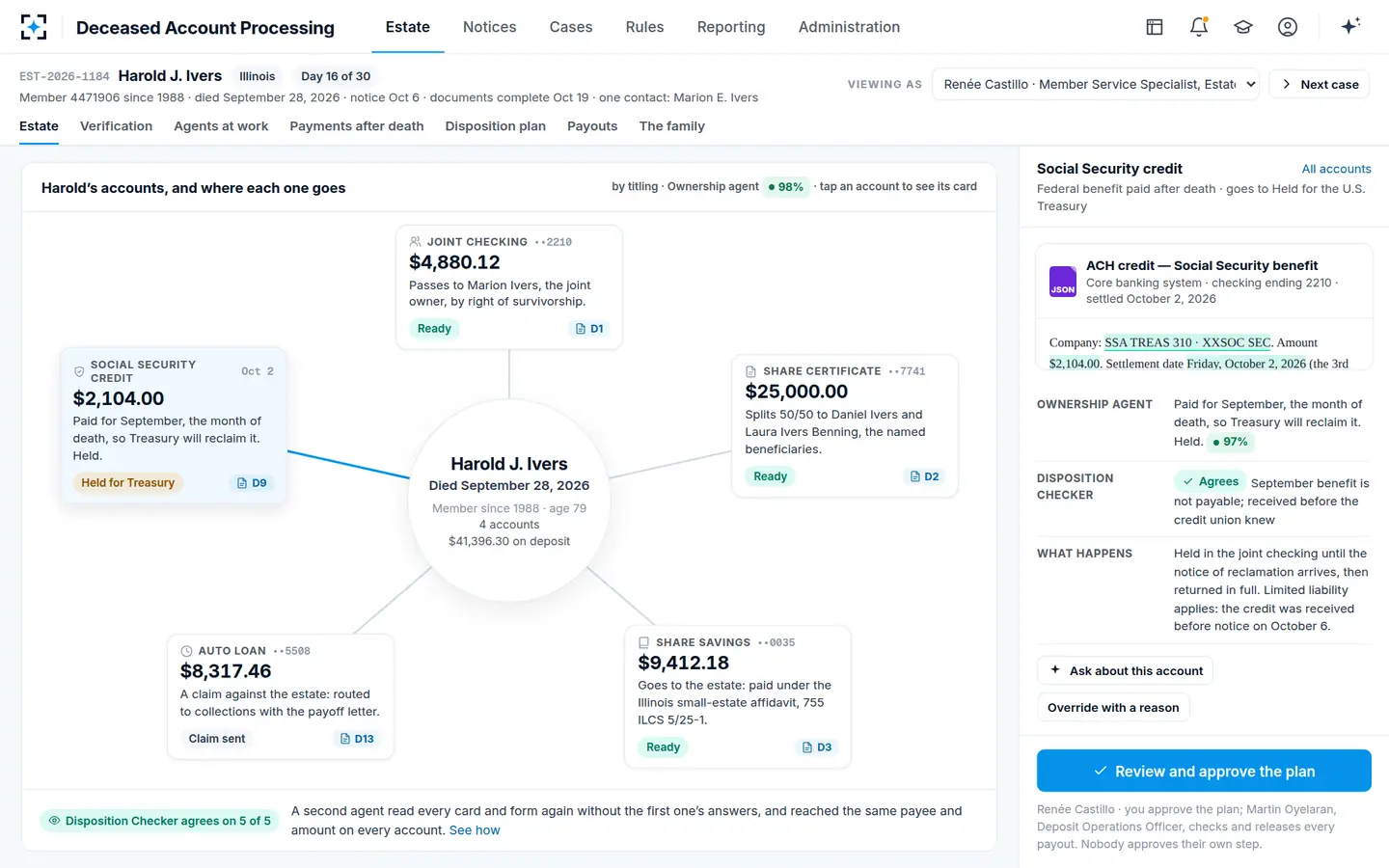
The September credit, held, with its liability, the withdrawer and the answer deadline
Wrong deaths, and the joint-account trap
Notices can be wrong, and a bank that acts on a wrong one can cause the very payment stop it was trying to prevent. The Green Book works through two cases. In the first, an erroneous report of death reaches the agency, a notification entry follows, the bank flags the account, and when the agency resends the payment the bank returns it as a death again; its instruction is “Always remember to remove any “flagging” on an account when a report of death proves to be erroneous” (Green Book, chapter 4). It also warns that a bank’s own wrong report runs the other way: “your incorrect notification of death to a federal authorizing agency (OPM, SSA, RRB) may result in a DNE being sent by the agency.”
The second case is the joint account. One spouse dies, the account is flagged, and the surviving spouse’s own benefit, now arriving in the same account, is returned with reason code R15, and the agency wrongly ends the living spouse’s benefits as though she had died (see ACH return code accuracy). The fix is to flag the account “with another piece of identifying information (i.e., deceased name, SSN),” so the flag follows the person who died. Both cases argue for verifying a notice on several identifiers before acting, and for keeping the knowledge date and the freeze decision separate: the bank can know of a death on day one and still be careful about what it freezes.
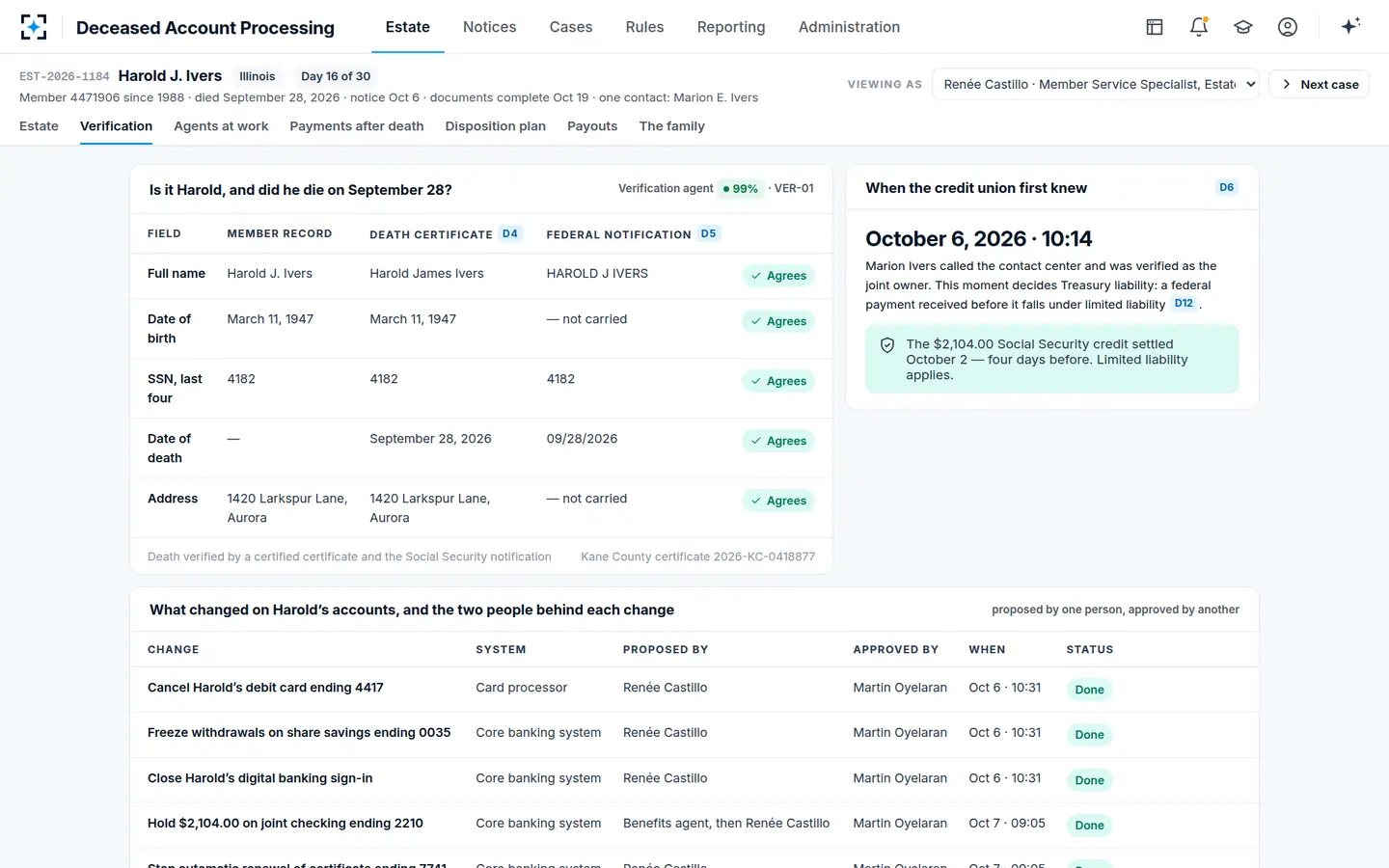
Death verified three ways before anything is frozen, and the minute the credit union first knew
Treasury’s death screening upstream of the bank
Treasury now catches many deaths before a payment is sent, which should mean fewer post-death credits reaching banks, though not none. Congress gave Treasury temporary access to the Social Security Administration’s Full Death Master File, which “contains more than 142 million records, with records going back to 1899,” from December 27, 2023; a five-month pilot “prevented and recovered more than $31 million in fraud and improper payments” (U.S. Treasury, January 15, 2025).
Treasury’s screening of federal payments against death records
885M+
federal payments screened, worth about $2.77 trillion
4,900+
payments to deceased payees found, worth about $99 million
142M+
records in the Full Death Master File, back to 1899
Feb 2026
permanent access enacted
In February 2026 the Ending Improper Payments to Deceased People Act made that access permanent, and by July 2026 Treasury reported screening “over 885 million payments totaling approximately $2.77 trillion,” finding “more than 4,900 payments worth approximately $99 million that were associated with deceased payees,” which “were returned to the originating federal agencies for review before any funds were disbursed” (U.S. Treasury, July 21, 2026). Our reading, not Treasury’s claim: fewer benefits paid after death should reach bank accounts, but a death the government has not yet recorded still produces a credit, and the bank’s own knowledge date still decides who bears it.
The certification that date feeds is built item by item in the deceased account checklist; the first call that so often sets it is the start of the bank bereavement process; and what then happens to each account is in the titling tree. The full sample estate is on the Deceased Account Processing page.
Questions people ask
Do banks get notified automatically when someone dies?
Only partly. A federal agency sends a death notification entry when one of its direct-deposit benefit recipients dies, so a bank paying Social Security, OPM or Railroad Retirement benefits hears electronically. For every other customer, and often sooner even for those, the bank learns from family, an executor, a court document, its staff or its own checks.
How are banks notified when someone dies?
By any credible report. Treasury’s guide lists a federal death notification entry, a notice of reclamation, a call or letter, a request from the estate, a reference from a probate court or funeral home, staff awareness, a death notice in the mail and the bank’s own dormant-account inquiries. Notice of a death from any of these counts for all of that customer’s federal benefit payments.
What do banks do when someone dies?
They verify the death, freeze what the deceased owned alone, hold any federal benefit paid after the death, and then pay out each account under its titling: to a surviving joint owner, to named beneficiaries, or to the estate. A careful bank also logs the date it first knew, because it may have to certify it to Treasury.
Does the funeral home notify the bank?
Not as a rule; that is usually the family’s or the executor’s job. But a reference to or from a funeral home that the bank receives is one of the ways the Treasury’s guide says a bank can learn of a death, so a funeral home’s call or letter counts as notice when it arrives.
What is the knowledge date in deceased account processing?
It is the date the bank first had actual or constructive knowledge of the customer’s death, from any source. Under 31 CFR 210.11 the bank certifies it to Treasury when a federal benefit was paid after the death, and it separates the benefits that may qualify for limited liability from those the bank must return in full.