Death notification entries are zero-dollar ACH entries that the Social Security Administration, the Office of Personnel Management and the Railroad Retirement Board send to a bank to report that a benefit recipient has died; each carries the date of death, the recipient's Social Security number and the amount of the next scheduled payment. For the bank, a DNE does two jobs: it is the signal to flag the account and return any further federal benefit payment with return code R15, and it is evidence of the latest date by which the bank knew of the death. It is not necessarily the earliest. Under 31 CFR Part 210, a bank's liability in a Treasury reclamation turns on the first date it had actual or constructive knowledge from any source, and that is the date Botminds' Treasury Reclamation searches for across the bank's systems before anyone certifies it.
The sample cases here come from a fictional bank, Corvane National Bank, as they run through the solution; every person and account is invented. The rules are quoted from Part 210, Treasury's Green Book and SSA's operating manual, linked where they appear.
One account, three dates the bank could have certified
- Death to the son’s call, payments still arriving132 d
- Call, then DNE, then notice19 d
What is a DNE? The zero-dollar entry, field by field
A DNE is a death notice formatted as an ACH payment of nothing. The Green Book describes it as "a zero-dollar entry with an addenda record", and says the addenda carries "the date of death, the deceased individual's SSN, and the amount of the next scheduled benefit payment" (Green Book, ch. 4). Only a federal agency may originate one.
SSA's manual adds the rest of the entry: the bank's routing number, the depositor account number, all zeros in the amount field, the Social Security number under which the benefits are paid and the name, plus the addenda (SSA POMS GN 02408.605). SSA sends it through the Federal Reserve Bank of Richmond, and it "does not flow through the Department of Treasury (Treasury)", which is why a DNE can reach the bank days before Treasury has done anything at all.
Timing is mechanical. "On the day after a death termination is displayed on a Title II or Title XVI record," SSA passes a DNE to the Federal Reserve Bank of Richmond if the record was in current payment status. A DNE therefore tracks SSA's processing of the death, not the death itself: in the sample, the DNE came 147 days after the date of death.
Who sends death notification entries, and who does not
Three agencies send death notification entries today. "Currently, SSA, OPM, and RRB originate DNEs," the Green Book says, adding that other benefit agencies may do so later. VA benefits, military retirement paid by the Defense Finance and Accounting Service and the other reclaimable payments can therefore reach a reclamation with no DNE in front of them; the bank's first formal notice may be the FS Form 133 itself.
The agencies are also getting better at stopping payments before they go out, which matters to a bank because a payment never sent is one never reclaimed. Treasury says its pre-payment screening against SSA's Full Death Master File has checked over 885 million payments and stopped more than 4,900 associated with deceased payees, worth about $99 million, before any money left, and that Congress made its access to the file permanent in February 2026 (U.S. Treasury, July 21, 2026).
What Treasury's death screening catches before a payment reaches a bank
885M
over 885 million federal payments screened against death data under the new process
4,900
more than 4,900 payments associated with deceased payees, returned to agencies before disbursement
$99M
approximate value of those payments
Feb 2026
Congress gives Treasury permanent access to the Full Death Master File
What happens when a bank receives a DNE?
When a bank receives a DNE it should flag the account so that further federal benefit payments are returned rather than posted, return any that do arrive with R15, or R14 for a representative payee, and open the work that leads to the estate. The Green Book says the bank "is encouraged to 'flag' the deceased recipient's account to prevent accepting further post-death federal benefit payments". SSA's manual says the bank returns any additional government benefit payment for the recipient "within three days", and that for payments already posted it "has the option of waiting for a reclamation before returning the funds".
Flagging is not holding. The Green Book's reclamation chapter is explicit: "Under no circumstances should an RDFI hold benefit payments indefinitely in a suspense account, or by any other means," and doing so "could result in an RDFI's inability to limit its liability" (Green Book, ch. 5). A payment that arrives after the death is known goes back; it does not wait in an account while the family is reached.
A death notification entry inside Treasury Reclamation, from arrival to the R15 return
Agent
Notice agentReads the DNE from the payments system as it arrives and matches the deceased recipient to the account and its owners.
Never: guesses an account or a date of death
Agent
Flag proposedProposes a flag on the deceased recipient, not on the whole account, so a joint owner’s own benefits still post.
Never: holds a benefit payment in suspense
Agent
Recovery agentWatches for the next federal benefit payment for the deceased and proposes returning it with R15, which also notifies the agency.
Never: returns anything without two signatures
A person decides
Reclamation SpecialistApproves the flag and the return as maker, singly or in bulk.
A person decides
Reclamation CheckerSigns every return, including bulk returns; the step cannot be switched off.
Agent
Liability agentWhen a notice arrives, searches seven channels for any mention of the death earlier than the DNE.
Never: decides full liability
The flag has to be precise. The Green Book's own example is a joint account where a flag on the account, rather than on the deceased spouse, sent the survivor's benefits back as R15 and triggered an improper death termination for the living spouse. The return-code errors worth counting covers that case in detail; the fix the Green Book gives is to flag the account with the deceased's name or SSN.
Does a DNE mean the bank must return payments?
A DNE means the bank must return payments it receives after it knows of the death, not the ones already credited before. Part 210 requires a bank to send back every benefit payment that arrives once it is aware of the death, and treats a proper R15 or R14 return as the notice to the agency it must give if it learned of the death another way (31 CFR 210.10(a)). Payments already in the account when the bank learned of the death wait for the Notice of Reclamation.
The Green Book allows a bank to return those earlier payments by ACH without waiting, but does not require it, and warns that Fiscal Service "does not authorize or direct" a bank to take money already credited to a customer's account. The R15 and R14 codes, and when not to use either sets out that line in full.
Is a DNE the date the bank knew of the death?
A DNE fixes the latest date the bank can claim, not the earliest. SSA's manual puts it precisely: "The date of receipt of a DNE is proof that the financial institution (FI) learned of the beneficiary's/recipient's death no later than that date" (SSA POMS GN 02408.605). Any earlier report that reached the bank counts too.
Part 210 defines knowledge broadly. The bank knows of a death once word of it has reached the bank by any route and the bank has had a fair chance to act on it, and it is treated as knowing whenever business practices that are commercially reasonable would have told it (31 CFR 210.10(b)). The date it certifies is the first of those, whichever channel carried the news and wherever in the bank it landed (210.11(b)(2)). How banks learn that someone has died sets out that definition and the channels in full, from the customer's side of the counter.
Eight ways a bank learns of a death, and where each one sits
| The Green Book’s example | Where the evidence usually sits in a bank |
|---|---|
| A Death Notification Entry from SSA, RRB or OPM | The ACH receipt file in the payments system |
| The Notice of Reclamation itself | The FedMail inbox or the post room |
| Contact or a withdrawal request from an estate, executor, administrator or conservator | Branch and deceased-account case notes; the teller journal |
| A probate court, a funeral home or letters testamentary that mention the death | Document imaging at the branch or operations centre |
| Someone credibly telling the bank of the death, by phone, letter or in person | Contact center notes, secure messages, branch logs |
| A dormant-account inquiry or other internal screening that turns up the death | Dormancy and escheat files; screening results |
| A member of staff who credibly knows of the death | Wherever the staff member wrote it down, if anywhere |
| A believable death notice arriving by post, from anyone | Returned mail and correspondence handling |
The list explains why the DNE is so often late in a bank's own history. Families call the bank before the agency has processed the death; executors ask what is in the account; funeral homes send letters. Each of those leaves a trace in a system the reclamation desk does not normally search, and each can be the date the bank first knew.
One date, followed from a phone call to the certification
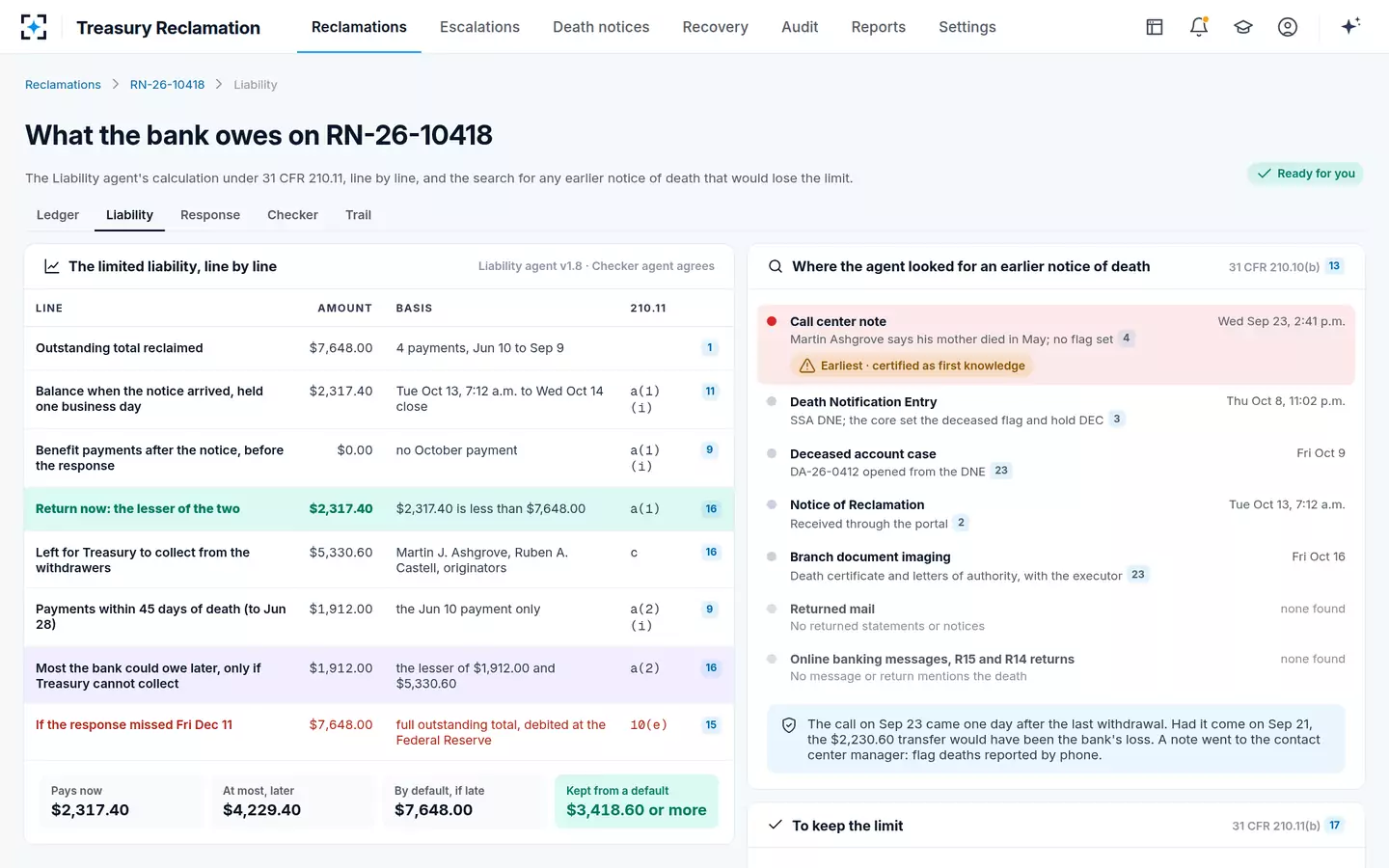
The cost of the wrong date is the difference between a limited and a full liability. In the sample notice, the son of the deceased account holder told the contact center on Wednesday, September 23 at 2:41 p.m. that his mother had died in May; the DNE arrived on Thursday, October 8. Nothing was credited or withdrawn after September 23, so certifying that date keeps the limit, and the bank returns the $2,317.40 balance rather than the $7,648.00 reclaimed. Certifying October 8 instead would have been an inaccurate certification, and Part 210 makes the bank liable for any loss that inaccuracy causes, on top of what it owes.
The same search can find a date that costs the bank money. In another sample case, a death certificate was scanned at a branch on Wednesday, June 3, with no flag and no hold set. Four of the five reclaimed payments, $6,952.00, were credited after that date, so the bank had knowledge when they arrived and cannot limit its liability for them; with a $1,204.55 balance, $5,747.45 would be a loss. The solution does not decide that case: it goes to the deposit operations manager with the options and the evidence.
Treasury Reclamation's search for an earlier notice of death
Why a wrong DNE has to be undone quickly
A DNE is sometimes wrong, and a flag left in place repeats the error. SSA's manual describes the loop: "If the death flag is not removed, the bank rejects and returns future deposits with a reason code of 'death' which posts the death to SSA's records" (SSA POMS GN 02408.605). The Green Book's instruction is just as short: once a death report turns out to be wrong, take the flag off the account.
The same logic applies to a death the bank reports itself. An R15 return tells the agency the recipient has died, and the agency acts on it; a bank that returned a living customer's payment in error should tell the customer to contact the agency at once to restart payments, and watch for a DNE the agency may send as a result. A process that treats R15 as a routine posting exception, rather than as a statement of death to the federal government, will eventually make that mistake.
The DNE also starts a clock on the government's side. SSA usually counts its 120 days to ask for a reclamation from the date the DNE was sent, so the date matters to the bank twice: once as a ceiling on its own knowledge date, once as the starting point for the 120-day rule that binds the agency.
How Treasury Reclamation finds the earliest notice of death
The solution treats the knowledge date as something to be proved, not read. Its agents watch every DNE, branch death certificate and contact-center note as it arrives, propose an R15 return for the next payment once a death is confirmed, and, when a notice comes in, search seven channels for the earliest mention of the death: contact center notes, DNEs, deceased-account cases, the notice, branch document imaging, returned mail, and online banking messages together with R15 and R14 returns.
Death notices and R15 returns in Treasury Reclamation, before any reclamation
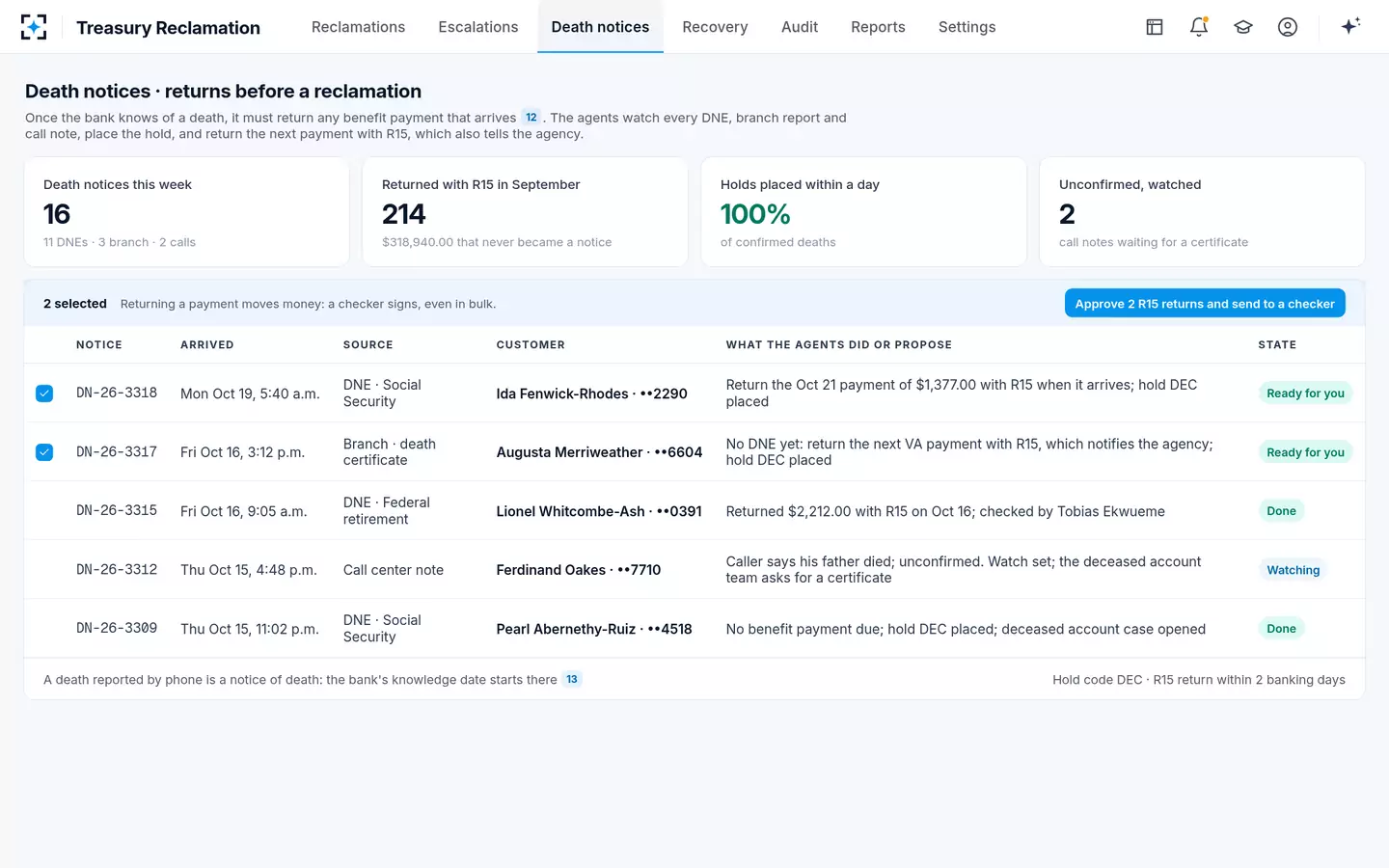
The agents may not decide what the date means. If anything was credited or withdrawn after the earliest date they find, the case goes to the deposit operations manager as a possible full liability, with the evidence attached. A specialist approves the certified date as maker, a second person signs, and the audit trail keeps the reason the date moved, so that the internal auditor's question, how anyone knows it was the first, has an answer. Treasury Reclamation shows the same search on the other sample notices.
Questions people ask
What does DNE mean in ACH?
DNE stands for Death Notification Entry, a zero-dollar ACH entry with an addenda record that a federal benefit agency sends to a receiving bank to report a recipient's death. It is formatted like a payment and travels the same way, but moves no money.
Does every federal agency send a DNE?
No. The Green Book says SSA, OPM and RRB currently originate DNEs. A VA or DFAS reclamation can arrive with no DNE before it, so the bank's first formal notice may be the FS Form 133.
How quickly does SSA send a DNE?
SSA's manual says it passes a DNE to the Federal Reserve Bank of Richmond on the day after a death termination is displayed on the beneficiary's record, if the record was in current payment status. The gap from the death itself depends on when SSA learns of it.
Should a bank return payments already posted when the DNE arrives?
It may, but it does not have to. The Green Book says Fiscal Service will accept such returns if made electronically with R14 or R15, but it neither requires nor directs them; a bank that does so relies on its deposit contract and state law, not on Part 210.
Does a DNE tell the bank about a joint owner?
No. The DNE names the deceased recipient and carries their SSN. The bank has to flag the deceased person rather than the whole account, or a surviving joint owner's own benefits can be returned as R15 by mistake.