The Automated Reclamation Processing System (ARPS) is the Bureau of the Fiscal Service's electronic version of the FS Form 133, Notice of Reclamation, run through Treasury's Pay.gov portal: a bank uses it to answer each notice, certify the date it first knew of the death, list the people who withdrew, and authorize Treasury to debit its Federal Reserve account for what it owes. Since January 1, 2023 it is the required channel for nearly every response. What ARPS does not do is find any of that information: the balance at receipt, the account history from the date of death, the withdrawers' names and the earliest notice of death all sit in the bank's core, card, teller and contact-center systems. Botminds' Treasury Reclamation does that preparation, with agents assembling each answer and two people signing it before it is entered in ARPS.
The figures and screens here come from a fictional sample bank, Corvane National Bank, running the solution; every person and account is invented. The ARPS requirements are quoted from Green Book chapter 5 and 31 CFR Part 210.
Where ARPS sits: the last step of the answer, not the first
Agent
Notice readThe FS Form 133 is read from the email or the post, matched to the account, and its 60 days started from the notice date.
Agent
Account splitHistory from the date of death, the balance at receipt plus one business day, and every withdrawer traced to the card processor, teller journal or ACH originator.
Agent
Knowledge date and limitEvery channel searched for an earlier notice of death; 31 CFR 210.11 computed, and re-added independently.
Never: decides full liability
A person decides
Maker approvesThe specialist reads the answer and the evidence and approves the return and the response.
A person decides
Checker signsA second person checks the evidence and signs; the maker cannot sign her own response.
A person decides
ARPS on Pay.govThe completed FS-133 goes to Treasury with the certifications and, where less than the full amount is returned, a debit authorization.
What is the Automated Reclamation Processing System?
ARPS is a form, a channel and a payment instruction in one. The Green Book describes it as an electronic version of the FS-133 process that "allows financial institutions to submit a response to the Notice of Reclamation (NOR) electronically through the Department of the Treasury's Pay.gov web portal", and adds that responding there lets the bank both limit its liability and make full or partial payment by authorizing a debit (Green Book, ch. 5).
It changes how the answer travels, not what it must say. "This electronic version of the form requires the same information as the paper version," the Green Book says, and the bank is told to keep following the chapter's reclamation procedures when a notice arrives. Part 210's conditions for limited liability, the certifications, the persons and the 60 days, apply in full to an ARPS answer.
ARPS also carries the answers that change a case rather than close it: a 120-day protest, a statement that the customer is alive, a correction to the date of death. Each is a box on the electronic form, and each changes what Treasury does next.
Do banks have to use ARPS? The 2023 rule and its exceptions
Yes, for almost every notice. From January 1, 2023, the Green Book says, "All reclamation responses must be submitted by completing a FS-133 form through the Automated Reclamation Processing System (ARPS) located in Treasury's Pay.gov web portal," and adds: "We will no longer accept remittances related to reclamation responses."
The exceptions are narrow. Reclamations for the Defense Finance and Accounting Service cannot be answered through Pay.gov, and any other exception must be approved case by case by the Bureau of the Fiscal Service. An excepted response still has to meet every other condition for limiting liability, including receipt within 60 days.
Two situations need no ARPS answer at all. If the bank returns the full amount listed on the notice to the disbursing office, it does not need to complete the FS Form 133; and if the reclamation was satisfied by returning the payments through the ACH network, the Green Book says "a response does not need to be submitted in pay.gov". Everything else, including a notice for an account with no money left in it, needs an answer in ARPS.
The dates and limits ARPS answers are held to
2023
from January 1: all reclamation responses through ARPS, with narrow exceptions
60
calendar days from the notice date for a full and accurate response
15
business days to email supporting papers after the ARPS response
3
years, at least, that the bank keeps the form it submitted, or until the case closes
How to respond to a reclamation in Pay.gov, part by part
Responding to a reclamation in Pay.gov means completing the electronic FS-133 in ARPS with four kinds of answer: the money, the certifications, the persons and any exception. If the account holds less than the full amount, the bank returns what is there and "must authorize a debit by using the Automated Reclamation Processing System (ARPS)", the Green Book says. When it returns less than the outstanding total it signs Certification No. 1 and, if it had no knowledge of the death when the payments were received or withdrawn, Certification No. 2.
The persons part is where incomplete answers start. The bank must give the name, address and phone of everyone who withdrew, and for a sole-owner account "MUST complete all applicable fields in ARPS when limiting their liability or returning less than the total amount". Part 210 is wider still: the recipient, every co-owner, everyone authorized to withdraw and everyone who withdrew after the death, each as the bank's records show them, with a certification and a reason wherever a category is empty (31 CFR 210.11(b)(3)).
Each ARPS answer, and where the bank has to find it
| What ARPS asks for | Where it lives in the bank | Why it is hard |
|---|---|---|
| Account balance at receipt of the notice | Core posting journal, as of the notice’s arrival plus up to one business day | Opening the notice late means reconstructing a past balance |
| Amount returned, or debit authorized | The balance and the 31 CFR 210.11 arithmetic | Benefit credits after the notice must be added |
| Knowledge at deposit or withdrawal (Certification No. 2) | Contact center notes, branch imaging, estate requests, DNEs, returned mail | The earliest date may be in a system the desk never searches |
| Date the bank first knew | The same channels, compared | A DNE is evidence of the latest possible date, not the first |
| Persons: owners, authorized signers, withdrawers | Customer file, card processor, teller journal, ACH originators | A card or a teller ID is not a name until another system says whose |
| Notice to account owners sent (Certification No. 1) | Correspondence and mailing proof | It is due on receipt, before the research |
| Exceptions: protest, payee alive, wrong date of death | Agency DNE date, identity documents, death certificate | Evidence must follow by email within 15 business days |
What ARPS does not do: the work behind each answer
ARPS does not tell the bank its balance, its knowledge date or its withdrawers; it records what the bank certifies. Nor does it mail the notice to account owners that Part 210 requires on receipt, debit the customer's account, book the general ledger entry, or keep the evidence behind each figure. Those stay inside the bank, under its own controls.
That division explains where reclamation time goes. Treasury's paperwork notice for the FS Form 133 estimates 8 minutes per respondent (Federal Register, October 1, 2025). Our own estimate for a notice like the sample one, worked by hand from pulling the history to typing the answer, is about 40 minutes, and most of the difference is the research ARPS cannot do: asking the card team who holds a card and the branch who presented a transfer.
The bank also keeps its own copy. The Green Book asks that the bank retain the reclamation form submitted through ARPS "for a minimum of three years or until the associated case is closed", filed under the reclamation ticket number. An examiner who asks why a date was certified will want more than the form: the call note, the scan or the DNE behind it, and who decided.
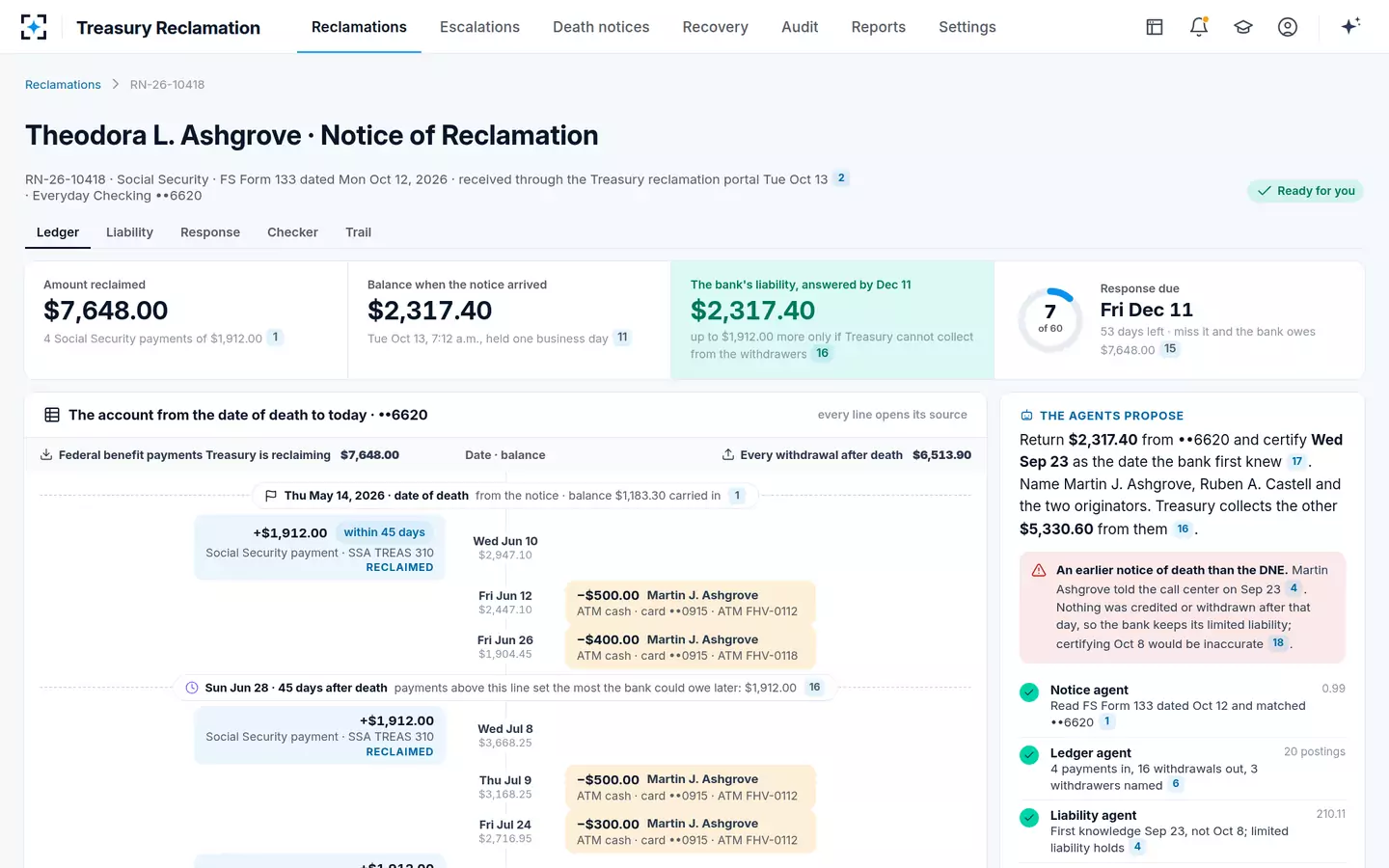
The answer before it reaches ARPS: Treasury Reclamation's split of the account at the date of death
Debit authorizations, the Federal Reserve statement and the ticket number
A debit authorized through ARPS is how most banks pay a reclamation now that remittances are no longer accepted. The Green Book says such a payment appears on the bank's Federal Reserve statement under the IAS transaction code "57180 – Treasury ACH Reclamation FI Auth" with a reclamation tracking number, and that ACH debits are received the same day and posted within one to two business days. Debits Treasury initiates itself, for a missed deadline or a later 45-day amount, carry other transaction codes.
The ticket number ties it together. It sits in the top right box of the FS Form 133 and appears again on the Federal Reserve statement, and the Green Book calls "coordination between the ACH reclamation area and the RDFI accounting department" critical to reconciling the statement. A desk that files cases by account number rather than ticket number will struggle to match a debit that arrives two years after the answer, as a 45-day debit can.
The customer's side is separate. Part 210 does not authorize the debit of a customer's account; whether the bank takes the returned balance from the account, and how, rests on its deposit contract and state law. In the sample bank, the account debit, the general ledger entry and the ARPS submission happen only after the checker signs, and each is kept on the audit trail with the response.
Payee alive, wrong date of death, 120-day protest: the ARPS boxes that change the outcome
Three choices in ARPS change what Treasury does, and each needs evidence the bank must send separately. If the bank accepts proof that the customer is alive, it selects "payee alive" in ARPS and digitally signs both certifications; acceptable proof includes an identity document issued after the date of death on the notice, a notarized statement, or a letter from the agency. If the date of death is wrong, the bank checks the box, gives the correct date and emails a death certificate; supporting papers go to Fiscal Service within 15 business days of the response.
The third is the protest. If the bank believes the agency asked for the reclamation more than 120 days after it first knew of the death, it says so on the electronic form, and Fiscal Service works with the agency to decide. The 120-day rule and the other limits on Treasury explains how that date is established and what the protest wins.
Each of these is a decision, not a data entry. In the sample bank, a customer who may be alive, a notice past the 120-day limit and a withdrawer who cannot be identified are escalations the agents may not settle; the specialist or the manager decides, with the evidence in front of them, before anything is entered.
Can a bank mail a reclamation response?
Not since January 1, 2023, except for DFAS reclamations and exceptions Fiscal Service approves case by case. The Green Book's statement that Treasury "will no longer accept remittances related to reclamation responses" also ends the old practice of sending a check with the form; partial payments are made by debit authorization through ARPS.
The paper notice itself has not disappeared. Notices are still mailed or emailed to banks, and the Green Book asks each bank to keep its Federal Reserve directory address and email contacts current so that notices arrive. What changed is the return path: whatever way the notice came in, the answer goes out through Pay.gov.
What to look for in software that feeds ARPS
Software for reclamations should prepare the ARPS answer and leave entering and signing it to named people; the hard questions are about where its figures come from. Treasury Reclamation lists Treasury's reclamation portal among the systems it works with, and in the sample bank's configuration the response is submitted only after both signatures, with the acknowledgment kept on the case. How a submission physically reaches Pay.gov at a given bank is a question for that bank's information security team and Fiscal Service, and worth asking any vendor directly.
Seven questions for any tool that prepares ARPS answers
- Does every ARPS field trace to a source?
Balance to the posting journal, names to the card processor, teller journal or ACH file, dates to the note or document that set them.
- Is the balance taken at receipt, plus one business day?
And are benefit credits after the notice added before the answer is final?
- Does it fill every persons category, or say why not?
Owners, authorized signers and post-death withdrawers, with a reason wherever a category is empty.
- Who signs, and can the preparer sign?
The certifications are the bank’s statements; the preparer should not be the only reader.
- Does it handle the exception boxes as decisions?
Payee alive, wrong date of death and the 120-day protest should reach a person with the evidence, not be ticked by default.
- Does it keep the form, the ticket number and the evidence together?
At least as long as the Green Book asks, so a later debit can be matched and an examiner answered.
- What does it do with DFAS and approved exceptions?
They do not go through Pay.gov; the tool should route them to a person rather than fail silently.
Where Treasury Reclamation sits beside ARPS
The solution sits upstream of ARPS, in the bank. Its agents read each notice, split the account at the date of death, name each withdrawer from the system that recorded the withdrawal, search seven channels for the earliest notice of death and compute what the bank owes now and at most later; a second agent re-adds the figures without seeing the first result. A specialist approves as maker and a checker signs, and only then are the account debit, the general ledger entry and the ARPS answer released.
Treasury Reclamation's completed response, in the order ARPS asks for it
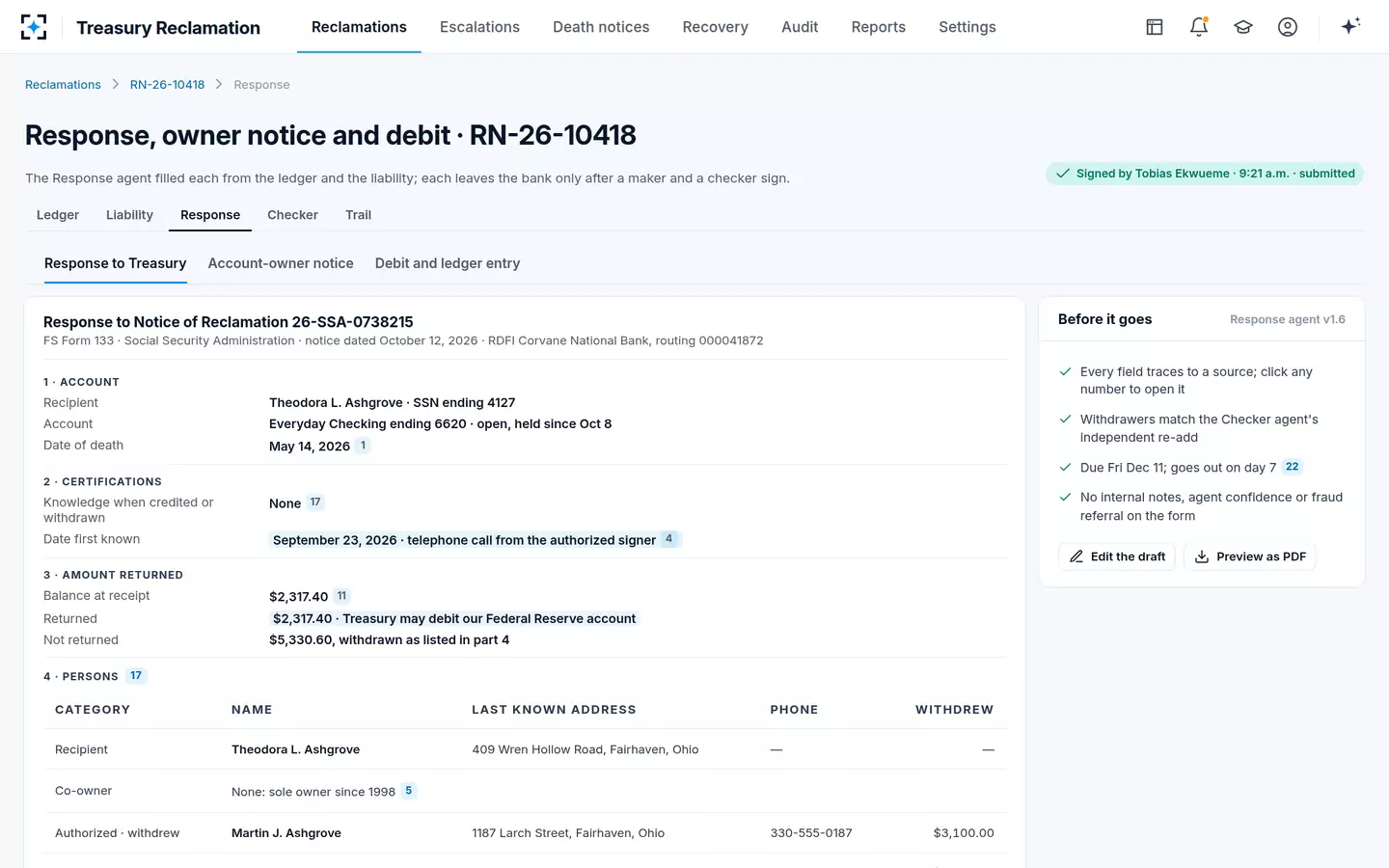
It does not replace ARPS, change what the bank certifies, or decide the cases that cost money; full liability, protests and notices reaching day 45 go to the deposit operations manager. The treasury reclamation process, traced over one notice shows the same steps on the calendar, and the sample notices are on the Treasury Reclamation page.
Questions people ask
What is ARPS in banking?
ARPS is the Automated Reclamation Processing System, the Bureau of the Fiscal Service's electronic FS-133 on Pay.gov. Banks and credit unions use it to answer Notices of Reclamation for federal benefit payments made after a customer's death, certify the facts and authorize Treasury to debit what they owe.
Does ARPS calculate what the bank owes?
No. The bank supplies the balance at receipt, the amount it returns and the facts behind the limit; Treasury then determines the bank's liability. The 31 CFR 210.11 arithmetic, and the evidence behind it, are the bank's to prepare.
Who should have access to ARPS at a bank?
Enough people that a notice never waits on one person's absence, and only people authorized to make the bank's certifications. The Green Book requires each signature to carry the signer's first and last name, title and phone, so the access list is also a list of who speaks for the bank to Treasury.
Who do you call about an ARPS or Pay.gov problem?
The Green Book lists the Pay.gov help desk for technical issues, 800-624-1373 (option 2), and a separate Fiscal Service line for questions about a Notice of Reclamation, (855) 868-0151. Supporting documents go by email to Fiscal Service's reclamations address within 15 business days.
Does a subsequent notice need another ARPS answer?
Yes. The Green Book says a bank that receives a subsequent Notice of Reclamation should respond as it would to an original, and that to keep its limited liability it must answer every notice, even when it has already been debited the 45-day amount on the same case.