31 CFR 210.11 is the section of Treasury's ACH regulation that limits what a bank owes when the government reclaims federal benefit payments made after a customer's death. If the bank did not know of the death when the payments arrived, and it answers the Notice of Reclamation fully and on time, it owes two amounts: first, the lesser of the account balance when the notice arrived (held for up to one business day, plus any later benefit credits) and the outstanding total; then, only if the paying agency cannot collect the rest from the people who withdrew, the lesser of the payments received within 45 days of the death and whatever is still outstanding. Botminds' Treasury Reclamation computes both parts on every notice, shows each line with its source, and has a second agent re-add the figures independently before a specialist and a checker sign.
The worked examples below are the Green Book's own, from chapter 5, and one notice at a fictional sample bank, Corvane National Bank, whose people and accounts are invented.
The 31 CFR 210.11(a) limit, as two terms
Part 1, returned now
the lesser of: balance at receipt of the notice (after up to one business day) + benefit credits before the full response, or the outstanding total
Returned immediately once the bank qualifies, under 210.11(c).
The bank, in its ARPS answer
Part 2, debited later if needed
the lesser of: benefit payments received within 45 days after the death, or the balance of the outstanding total
Only if the agency cannot collect the whole outstanding total from the withdrawers.
Treasury, by debit at the Federal Reserve
31 CFR 210.11(a): the formula in the regulation's own words
The regulation states the limit in one sentence with two branches. If the bank had no actual or constructive knowledge of the death when it received the payments, its liability "shall be limited to: (1) An amount equal to: (i) The amount in the account at the time the RDFI receives the notice of reclamation and has had a reasonable opportunity (not to exceed one business day) to act on the notice, plus any additional benefit payments made to the account by the agency before the RDFI responds in full to the notice of reclamation, or (ii) The outstanding total, whichever is less; plus (2) If the agency is unable to collect the entire outstanding total, an additional amount equal to: (i) The benefit payments received by the RDFI from the agency within 45 days after the death or legal incapacity of the recipient or death of the beneficiary, or (ii) The balance of the outstanding total, whichever is less" (31 CFR 210.11(a)).
Three details in that sentence decide most disputes. The balance is the whole balance, whatever its source, not only the benefit money: a customer's own savings in the account count toward the first part. Later benefit credits are added until the bank "responds in full", so a payment that slips through after the notice raises the figure. And the second part is conditional: it is owed only when collection from the withdrawers fails.
Payment follows the same split. Section 210.11(c) says a qualifying bank "shall immediately return" the first amount, after which the agency tries to collect the rest; if it cannot, Treasury has the Federal Reserve debit the bank for the second.
What is the outstanding total on a notice of reclamation?
The outstanding total is every post-death benefit payment the bank received, less whatever has already gone back to the government. Part 210 defines it as "the sum of all benefit payments received by an RDFI from an agency after the death or legal incapacity of a recipient or the death of a beneficiary, minus any amount returned to, or recovered by, the Federal Government" (31 CFR 210.2(n)).
That definition makes the outstanding total a moving figure. It falls when the bank returns the balance, falls again when the agency collects from a withdrawer, and is the ceiling for both parts of the limit. A payment the bank returned with R15 after it learned of the death never enters it; the Green Book's second example shows exactly that.
What is the 45 day amount?
The 45-day amount is the sum of post-death benefit payments that arrived within 45 calendar days of the death. The Green Book's definition is short: "The ACH 45-day amount is the dollar amount of the post-death benefit payments received within 45 calendar days following the death" (Green Book, ch. 5). The days run from the date of death, not from the notice, and they are calendar days.
Because benefits arrive monthly, the 45-day amount is usually one payment or two, and occasionally none. A recipient who died just after a payment date leaves one payment inside the window, or two if the second arrives before day 45; one who died long before the first post-death payment arrived can leave none. One edge case is ruled out entirely: the Green Book says a bank "is not liable for any benefit payment dated where the effective date is the same as the date of death."
The amount is a cap on later exposure, not a charge. On the Green Book's own arithmetic, a bank whose withdrawers repay everything owes no 45-day amount at all.
How is reclamation limited liability calculated? The Green Book's five scenarios
Limited liability is calculated by subtracting what the bank returns and what the agency collects from the reclamation, then comparing what is left with the 45-day amount. The Green Book's first example uses four $200 payments received after a death, the first within 45 days, so the 45-day amount is $200; the bank had no knowledge when any payment was received or withdrawn.
Green Book Example 1: four $200 payments, a $200 45-day amount
| Scenario | Balance paid with the answer | Collected from withdrawers | Still outstanding | Debited later | Bank pays in all |
|---|---|---|---|---|---|
| 1 | $300 | $250 of $500 | $250 | $200 | $500 |
| 2 | $300 | $500 of $500 | $0 | $0 | $300 |
| 3 | $750 | $0 of $50 | $50 | $50 | $800 |
| 4 | $0 | $0 of $800 | $800 | $200 | $200 |
| 5 | $800 | nothing due | $0 | $0 | $800 |
Read across, the table shows how little the 45-day amount does on its own. In scenario 4 the account is empty and nobody repays, yet the bank pays only $200 of $800. In scenario 3 the bank pays the full $800 because the balance was almost enough on its own. The bank's cost is driven far more by the balance when the notice arrives than by the 45-day cap.
The second example changes one detail: the bank received a DNE before the fourth payment and returned that payment promptly with R15. The fourth payment therefore never appears on the notice, which lists $600, and the first and second payments both arrived within 45 days, so the 45-day amount is $400.
Green Book Example 2: three payments on the notice, a $400 45-day amount
| Scenario | Balance paid with the answer | Collected from withdrawers | Still outstanding | Debited later | Bank pays in all |
|---|---|---|---|---|---|
| 1 | $300 | $50 of $300 | $250 | $250 | $550 |
| 2 | $300 | $300 of $300 | $0 | $0 | $300 |
| 3 | $550 | $0 of $50 | $50 | $50 | $600 |
| 4 | $0 | $0 of $600 | $600 | $400 | $400 |
| 5 | $600 | nothing due | $0 | $0 | $600 |
SSA's operating manual gives a third worked case that reads the same rule from the agency's side: four $200 payments, two within 45 days, a $300 balance returned within 60 days, and a limited liability of "$700 ($300 account balance plus $400 from payments received within 45 days after the death)" (SSA POMS GN 02408.625). That is the most the bank could pay. Of the $500 left outstanding after the return, the bank pays the full $400 only if SSA recovers $100 or less from the withdrawers, and a dollar less for each dollar SSA recovers beyond that.
31 CFR 210.11 on one sample notice
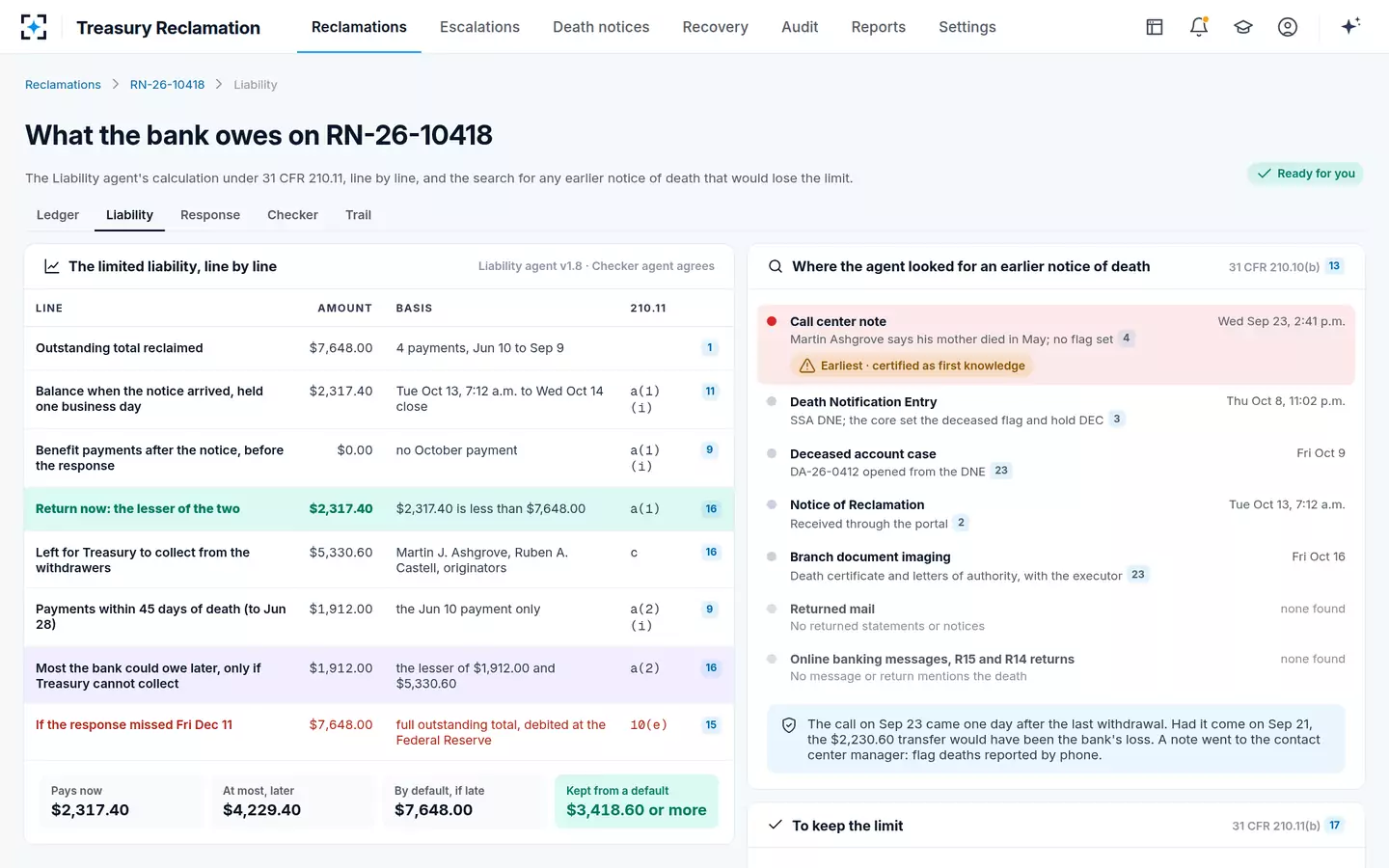
On the sample bank's notice, the formula gives $2,317.40 now and at most $1,912.00 later. Four Social Security payments of $1,912.00 were reclaimed, $7,648.00 in all; the balance when the notice arrived on Tuesday, October 13, held through the close on Wednesday, October 14, was $2,317.40, and no benefit credit followed. Part 1 is the lesser of $2,317.40 and $7,648.00.
That leaves $5,330.60 for SSA to pursue from the three withdrawers the bank named. The death was on Thursday, May 14, so the 45th day was Sunday, June 28, and only the June 10 payment falls inside it. Part 2 is the lesser of $1,912.00 and $5,330.60, owed only if SSA cannot collect. The most the bank can pay in all is $4,229.40; the other $3,418.60 at least is the agency's to recover or lose.
Where the sample notice's $7,648.00 can end up under 31 CFR 210.11
The $7,648.00 reclaimed
- Bank returns now: $2,317.40 · 30%
- Bank pays later only if collection fails: $1,912.00 · 25%
- Agency’s to recover from withdrawers: $3,418.60 · 45%
Treasury Reclamation's 31 CFR 210.11 calculation, with each line's basis
Reasonable opportunity: why the balance is fixed within one business day
The balance in Part 1 is the one in the account after the bank has had a fair chance to act on the notice, and the regulation caps that chance at one business day. The Green Book frames it as the bank's reaction time: on receipt of the notice it has "UP TO ONE BUSINESS DAY" to determine the balance and stop further withdrawals of post-death benefits, where its contract with the account holder allows.
The window works in both directions. A bank that freezes nothing and lets the family withdraw on day 3 still owes the balance as it stood at the end of the window, so the withdrawal is the bank's loss. A bank that opens the notice a week late has to reconstruct the balance from the posting journal as of the notice's arrival, which is possible but slow, and easy to get wrong if a credit posted in between.
Benefit credits after that point are added to Part 1 until the bank answers in full. That is one reason to answer early rather than on day 59: every week the notice sits open is a week in which another payment might post to the account before the flag catches it.
31 CFR 210.10 and 210.11 together: when the formula does not apply
The formula applies only to payments the bank received without knowledge of the death; 31 CFR 210.10 sets the default and the exceptions around it. Section 210.10(a) makes the bank liable for the total of all post-death payments unless it can limit its liability, and requires it to return any payment received after it knew. A payment that arrived after the bank knew sits outside 210.11 altogether and is owed in full.
Section 210.10(d) adds the government's limits: the agency must ask within 120 days of its own knowledge of the death, and cannot reclaim payments made more than six years before the notice unless the balance exceeds what was paid in that period. The 120-day rule and the six-year limit covers both. And 210.11(b) lists what the bank must certify to qualify at all; what a late or wrong answer costs covers what happens when it cannot.
31 CFR Part 210 Subpart B, section by section
Subpart B of 31 CFR Part 210, "Reclamation of Benefit Payments", runs from 210.9 to 210.14, and Green Book chapter 5 is the procedure that implements it.
31 CFR Part 210, Subpart B, in six sections
| Section | What it does |
|---|---|
| 210.9 Parties to the reclamation | Accepting a benefit payment is the bank’s agreement to the subpart and authorizes the debit of its Federal Reserve account; Fiscal Service acts on the paying agency’s direction. |
| 210.10 RDFI liability | Full liability by default; return of payments received after knowledge; R15 or R14 as notice; the knowledge definition; the representative payee exception; the 120-day and six-year limits; the debit. |
| 210.11 Limited liability | The two-part limit; the certifications and persons needed to qualify; when each part is paid; liability for any loss from a late or inaccurate answer. |
| 210.12 RDFI’s rights of recovery | No authority to debit the customer; the bank’s own rights under state law and contract are unaffected, and so is its liability. |
| 210.13 Notice to account owners | The owner copy goes out immediately on receipt; Fiscal Service may ask for proof it was sent. |
| 210.14 Erroneous death information | If the customer is alive or the date is wrong, the bank tells the agency, which returns improperly reclaimed funds. |
Treasury reclamation calculation errors worth checking for
Most calculation errors come from the wrong date or the wrong balance, not from the arithmetic. The ones that recur are easy to state: counting the 45 days from the notice instead of the death; using today's balance instead of the balance at receipt; forgetting a benefit credit that posted after the notice; including a payment for the month before the death, such as the sample account's May 13 credit for April; and treating the 45-day amount as owed now rather than later and only if collection fails.
The sample bank's answer is to compute everything twice. One agent builds the calculation from the account split; a second re-adds it from the raw posting journal and the card settlement file without seeing the first result, and any difference above $0.00 escalates. The checker then reviews the evidence, not the sums, because the date and the names are where a correct sum can still be wrong.
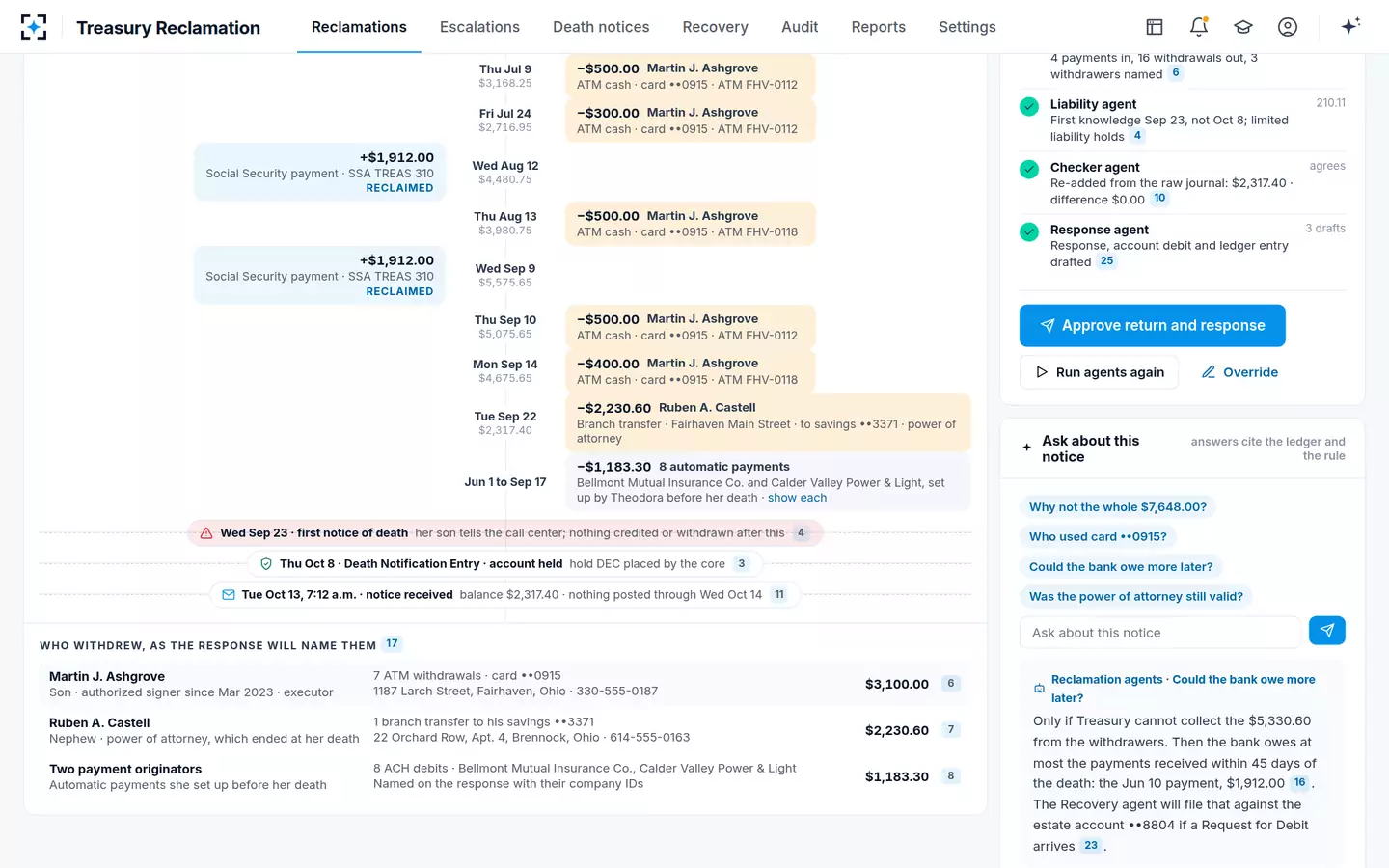
Asking Treasury Reclamation whether the bank could owe more later
Questions people ask
Is the 45-day amount always owed?
No. It is owed only if the agency cannot collect the entire outstanding total from the withdrawers, and never more than what is still outstanding. In the Green Book's second scenario, where the withdrawers repay in full, the bank pays nothing beyond the balance.
What if the balance is larger than the reclamation?
The bank returns the outstanding total, not the balance, because Part 1 is the lesser of the two. That is scenario 5 in both of the Green Book's examples: the account held enough to cover every post-death payment, so nothing is left to collect and no 45-day amount arises.
Are the 45 days calendar days or business days?
Calendar days, counted from the date of death. Only the one-business-day reaction time on receipt of the notice is in business days; the 60-day response period is also in calendar days.
Does 31 CFR 210.11 apply to VA and OPM payments?
Yes. Subpart B covers every federal benefit payment subject to reclamation, including VA benefits, OPM and military annuities and Railroad Retirement, not only Social Security. Federal salary, tax refunds and vendor payments are not benefit payments and are not reclaimed this way.
Who calculates the final figure?
The bank prepares and certifies its answer, but Treasury determines the bank's liability and any later debit, according to SSA's operating manual. A bank that computes the limit itself, and keeps the working, can check every debit against it when it arrives.