The R15 ACH return code means the beneficiary or account holder, other than a representative payee, has died; R14 means the representative payee, the person who receives benefits on someone else's behalf, has died or can no longer act. For federal benefit payments both codes do two jobs at once: they return a payment the bank must not post, and under 31 CFR 210.10(a) the proper use of either "shall be deemed to constitute" the notice of death the bank owes the paying agency. A bank must return with R15 or R14 every federal benefit payment it receives after it knows of the death; it is not required, and the Green Book says not authorized, to return payments credited before it knew, which instead wait for a Notice of Reclamation. Botminds' Treasury Reclamation watches each death notice, proposes the R15 return for the next payment, and has a specialist approve and a second person sign every return, even in bulk.
The rules are quoted from Part 210 and the Green Book's chapters on returns and reclamations. The examples come from a fictional sample bank whose people and accounts are invented.
R15 and R14 for federal benefit payments, side by side
R15: Beneficiary or account holder (other than a representative payee) deceased.
R14: Representative payee deceased or unable to continue in that capacity.
R15: The beneficiary, the person entitled to the benefits, with no representative payee or guardian involved.
R14: The representative payee or guardian who receives payments for an under-aged or incapacitated beneficiary.
R15: A Social Security or VA payment payable to the beneficiary’s own name.
R14: A payment payable to “John Doe, for [another person]”, in the Green Book’s example.
R15: That the recipient has died; it stands as the bank’s notice of death.
R14: That the payee has died or can no longer act; it stands as the bank’s notice.
R15: Return of every later benefit payment for the recipient, from every federal agency.
R14: Full liability for all later post-death payments from all agencies, and for any in the account the bank then lets be withdrawn.
What is an R15 return?
An R15 return is an ACH credit sent back to its originator because the person it was paid to has died. For federal benefits, the Green Book defines it simply: "The beneficiary is the person entitled to the benefits. In this case, there is no representative payee or guardian involved" (Green Book, ch. 5). The return carries the date of death in the addenda, which the Green Book asks banks to give in YYMMDD format.
What makes R15 different from most return codes is what it starts at the other end. It is the bank's statement of death to the federal government, and the agency acts on it by stopping the payments and, for SSA, treating the return as evidence of when it knew of the death. A bank that sends R15 is not only rejecting a credit; it is reporting a death.
The return codes the Green Book lists as most common on federal credits are R02, R03, R04, R06, R14, R15, R16, R17 and R20. Choosing the right ACH return code covers the whole family and the errors worth counting across it; this page is about the two that report a death.
R14 vs R15: the difference is who died
R15 is for the death of the beneficiary; R14 is for the death or incapacity of a representative payee who receives the payments on the beneficiary's behalf. The Green Book's example of an R14 situation is a payment "payable to 'John Doe, for [another person]'". The code tells the agency which person it has lost, and so which record and which relationship it must change.
The R14 case carries the sharper liability. "Any information of the death of a representative payee that is received by the RDFI or any of its employees, from whatever source, establishes the full legal liability for ALL SUBSEQUENT post-death federal benefit payments from all agencies, as well as any post-death benefits in the account, which the RDFI then allows to be withdrawn," the Green Book says. A teller who hears that a payee has died has fixed the bank's knowledge from that point on, and what the account does next is the bank's risk.
The opposite case, a beneficiary who dies while a representative payee is still receiving the payments, is usually handled outside reclamation. The Green Book says the paying agency does not reclaim those payments from the bank and pursues the payee instead, and SSA's manual treats them as overpayments that require due process (SSA POMS GN 02408.610).
When to use R15: after the bank knows, for every benefit payment
Use R15, or R14, for every federal benefit payment that arrives after the bank has actual or constructive knowledge of the death, from whatever source that knowledge came. The Green Book says the bank "must immediately return any post-death benefit payments received after the RDFI becomes aware of the death", and that notice of death from any source "constitutes notification for all federal benefit payments received by that recipient". A customer who drew Social Security and a VA pension needs both returned.
Knowledge does not wait for a Death Notification Entry. A branch that scans a death certificate, a contact center that takes a call from a son, an executor who asks to close the account: each is knowledge, and the next benefit payment after it must go back. The Green Book also forbids the halfway house: a benefit payment may not sit in a suspense account, or be held any other way, while the bank decides.
Survivors sometimes ask the bank not to return a payment because they believe they are owed it. The Green Book's instruction is to return it anyway and send them to the paying agency, which decides whether a final survivor payment is due.
What an R15 return for a federal benefit carries, and what it must match
2
jobs in one return: the payment goes back and the agency is notified of the death
6
digits for the date of death in the addenda, in the YYMMDD format the Green Book asks for
4
fields that must match the original entry exactly, or Treasury dishonors the return
When not to use either: payments credited before the bank knew
A payment credited to the account before the bank knew of the death is not the bank's to return on its own initiative. The Green Book is explicit that the bank "is not obligated or authorized to return post-death benefit payments that the RDFI received before becoming aware of the recipient's death". Those payments wait for the Notice of Reclamation, and the limited-liability formula decides what the bank owes on them.
The reason is ownership. Once a payment is credited, the Green Book explains, "it becomes the property of the account holder", and after a death the property of the joint owner or the estate; the government "cannot legally authorize or direct an RDFI to take funds already credited to an account and return them". A payment that arrives after the bank knows has not been credited, so returning it takes nothing from anyone.
The Green Book leaves one door open. Some banks review the account on learning of a death and return earlier post-death payments voluntarily, and Fiscal Service "will accept pre-NOR returns of post-death payments provided that they are made electronically using an R14 or R15 code". A bank that does so acts on its own deposit contract and state law, since Part 210 gives it no authority over the customer's account, and should be ready to explain each such return to the estate. The 31 CFR 210.11 calculation shows what those payments would otherwise cost under a notice.
Why was my R15 return dishonored?
A federal R15 return is dishonored when it does not match the original payment exactly. Treasury reads four fields, the original trace number, the effective entry date, the amount and the individual ID number, and "if any one of these four fields are not identical to the original payment data, Treasury will dishonor the return" (Green Book, ch. 4). The discretionary data field must also be copied exactly if it held anything.
Treasury's dishonored-return codes, and what each usually means for an R15
| Dishonor code | What it says | Usual cause on a benefit return |
|---|---|---|
| R61 | Misrouted return | Sent to the wrong disbursing office or routing number |
| R67 | Duplicate return | The same payment returned twice, often once by hand and once in bulk |
| R68 | Untimely return | Returned after the allowed time |
| R69 | Field errors, with sub-codes 01 to 07 in the addenda | Account number, trace number, amount, ID number, transaction code, company ID or effective date differs from the original |
| R70 | Permissible return entry not accepted | A return the receiving point would not accept |
A dishonor is not just a rework item. "Financial institutions should carefully track returned benefit payments to ensure that the returns are not dishonored. This could create an additional liability for the financial institution in a reclamation case," the Green Book warns. A payment the bank believes it returned, but which came back dishonored, is a post-knowledge payment still in the account, and it will appear on the next notice.
The Green Book also warns about processors. Banks that receive reformatted data from a processor may be missing what the return needs, and "the original payment information must be used in its exact format to avoid rejections". A correctly coded R15 built from a reformatted file can still fail.
Joint accounts, survivors and other R15 mistakes
The costliest R15 mistake returns a living person's money. On a joint account, a death flag set on the account rather than on the deceased owner can send the survivor's own benefits back as R15, and the agency then records the survivor as dead. The Green Book's fix is to flag the deceased person by name or SSN, or open a new account with a new direct deposit enrollment; the return-code accuracy guide sets out that case and its consequences.
The second mistake is a flag that outlives an error. If a DNE or a report of death proves wrong and the flag stays, the next payment goes back as R15 and re-reports the death. The Green Book says to remove the flag at once, and if the bank itself reported a death in error, to tell the recipient to contact the agency immediately to reactivate payments, which a death return stops.
The third is the return that is right but late in the bank's own process: a payment that should have gone back with R15 is posted, and the family withdraws it. It is then a payment received after knowledge, owed in full, and no formula limits it. Death notification entries and the knowledge date covers how that date is set.
Before an R15 or R14 goes out on a federal benefit payment
- Is the death confirmed for this person?
A DNE, a certificate, or a credible report the bank can point to; an unconfirmed call is watched, not returned on.
- Is it the right code?
R15 for the beneficiary; R14 for a representative payee who has died or can no longer act.
- Is the payment for the deceased, not a joint owner?
Match by name and SSN, not by account number alone.
- Do the four fields match the original exactly?
Trace number, effective entry date, amount and individual ID, from the original entry, not a reformatted file.
- Is the date of death in the addenda, as YYMMDD?
The Green Book asks for it in that format.
- Are other federal payments to the same person covered?
Notice of death from any source covers every federal benefit the person receives.
- Was it checked by a second person?
An R15 is a report of death to the federal government; it deserves the same two signatures as a reclamation answer.
How Treasury Reclamation handles R15 returns before a reclamation
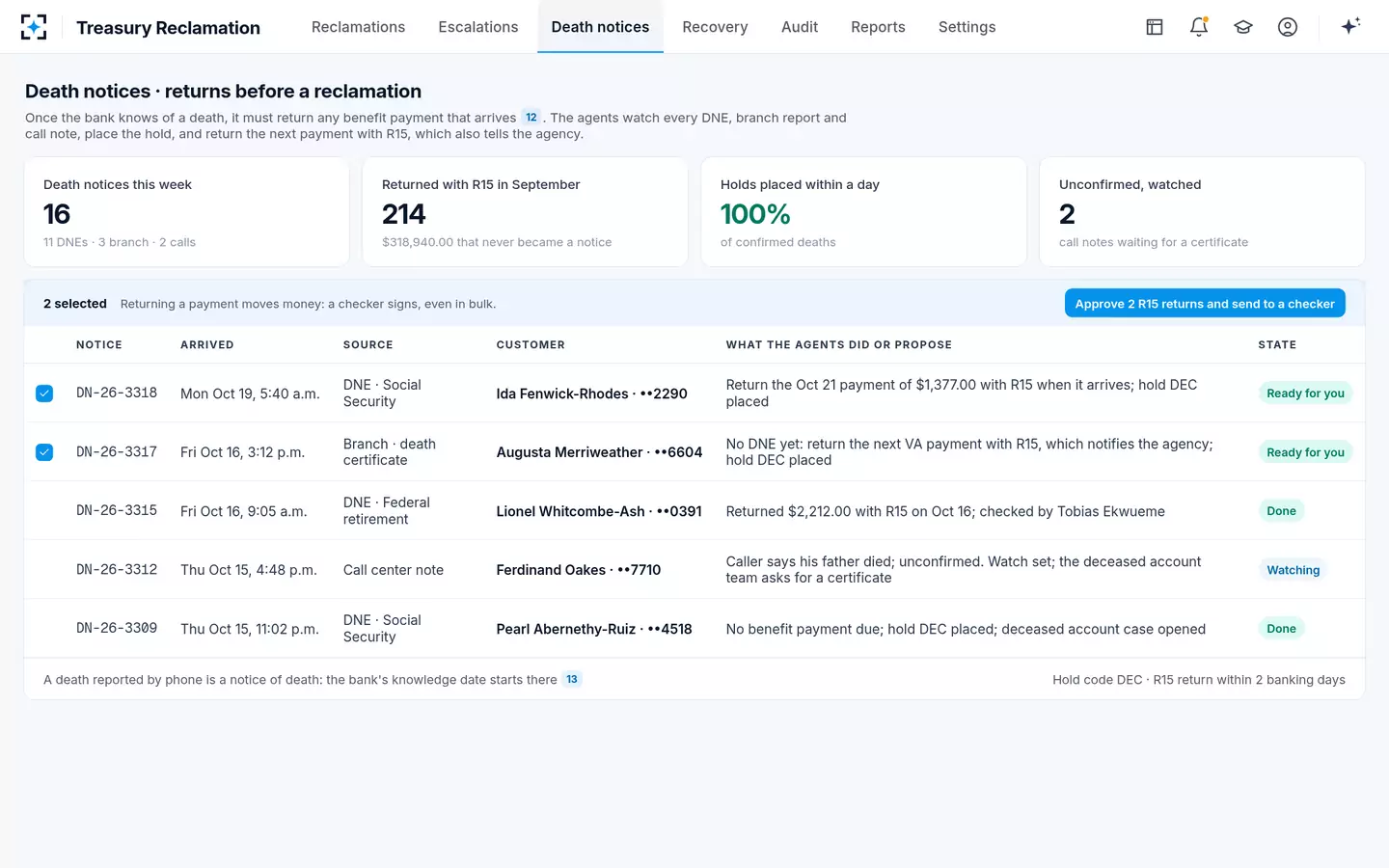
The solution treats each death notice as the start of the return work, not the reclamation. Its agents watch DNEs, branch death certificates and contact-center notes; once a death is confirmed they propose a flag on the deceased and an R15 return for the next federal benefit payment, and a specialist approves the return as maker while a checker signs. Bulk returns still need a checker, as one step, and the setting cannot be switched off.
In the sample bank's week, one Social Security recipient's next payment of $1,377.00 is set to go back with R15 when it arrives after the DNE; a branch death certificate for a VA recipient, with no DNE, leads to an R15 on the next VA payment, which also tells the agency; and a call from a man saying his father has died is watched, not acted on, until a certificate arrives. Each return the bank makes this way is a payment that never becomes a notice.
Death notices and R15 returns in Treasury Reclamation
An R15 return is evidence of knowledge, on both sides
An R15 return is proof that the bank knew of the death by the day it was sent, and for SSA it can also mark when the agency knew. SSA's manual gives it as the example of the agency's own constructive knowledge: "An example of constructive knowledge of death would be a return of a payment for reasons of death by the FI" (SSA POMS GN 02408.610). From that point the agency's 120 days to ask for a reclamation are running.
That cuts both ways for the bank. A return it sent fixes the latest date it can certify as its first knowledge, so a payment posted after its own R15 is owed in full. And the same return can support a protest if the agency's Notice of Reclamation arrives more than 120 days later.
The R15 work also feeds the reclamation. Every R15 and R14 return is one of the seven channels the agents search for the earliest notice of death when a Notice of Reclamation does arrive, because a return the bank sent is proof the bank knew. The returns and the reclamations sit in the same solution for that reason: Treasury Reclamation shows both on the sample notices.
Questions people ask
Does an R15 return count as notifying Social Security of a death?
Yes, for federal benefits. Part 210 says the proper use of R15 or R14 is deemed to be the notice of death the bank must give the agency when it learns of a death from another source, and the Green Book repeats it in both its returns and reclamations chapters.
Should a bank return a benefit payment that was credited before the DNE arrived?
It is not required to, and the Green Book says it is not authorized or directed to. Fiscal Service will accept such a return if made electronically with R14 or R15, but the payment otherwise waits for the Notice of Reclamation and the limited-liability calculation.
Does the bank have to return VA and OPM payments as well as Social Security?
Yes. Notice of a death from any source covers every federal benefit payment the person receives, and the Green Book reminds banks that recipients may get payments from several agencies and that each one subject to reclamation should be returned once the bank knows.
How are wrong R15 codes corrected?
The Green Book tells banks that need to correct errors in their use of return reason codes to contact the agency receiving the return. If the error reported a living person as dead, the recipient should contact the agency at once to restart payments.
Is R15 used for non-federal payments too?
Yes. R15 is a standard ACH return reason, and the Green Book notes the government accepts all approved return codes. The reclamation rules described here, including the notice and liability effects, apply to federal benefit payments under 31 CFR Part 210.