The treasury reclamation process is how the federal government recovers benefit payments deposited by ACH after the recipient died. The paying agency, usually the Social Security Administration, records the death and asks the Bureau of the Fiscal Service to reclaim; Fiscal Service sends the receiving bank a Notice of Reclamation, FS Form 133; the bank mails a copy to the account owners at once, fixes the balance, returns what it owes and answers through the Automated Reclamation Processing System (ARPS) on Pay.gov within 60 calendar days; the agency then pursues the people the bank named. Botminds' Treasury Reclamation does the bank's part of that sequence on each notice: agents read the notice, split the account at the date of death and compute the bank's limit, and a maker and a checker sign before anything is returned or sent.
This guide follows one notice from start to finish: Notice of Reclamation 26-SSA-0738215 at a fictional sample bank, Corvane National Bank, for four Social Security payments of $1,912.00 credited after the death of Theodora L. Ashgrove. The people and accounts are invented; the rules are quoted from 31 CFR Part 210, the Green Book and SSA's operating manual.
Most of the calendar passes before the notice exists
- Death to first post-death payment27 d
- Payments keep arriving; family withdraws105 d
- Call, DNE, notice19 d
- Answered on day 7
- Left on the 60 days53 d
How does treasury reclamation work before the notice reaches the bank?
Treasury reclamation starts at the agency, not the bank. SSA's manual sets out the usual sequence for Social Security and SSI: SSA receives death information and terminates the record; a Death Notification Entry goes to the bank; an electronic stop-payment request, the SF-1184, goes to Treasury "to request a reclamation of EFT (direct deposit) payments made after death that were not due and have not been returned"; and Treasury sends the bank the FS Form 133 (SSA POMS GN 02408.600).
Two things follow from that order. The agency's clock runs first: it must ask for the reclamation within 120 calendar days of its own knowledge of the death (31 CFR 210.10(d)). And by the time the notice arrives, the bank may already hold the DNE, so the notice often describes a death the bank has known of for days. In the sample, the DNE arrived on Thursday, October 8 and the notice was dated the following Monday, October 12, Columbus Day; it reached the bank the next morning, and the 60 days still ran from the date printed on it.
Fiscal Service acts on the paying agency's instruction; Part 210 says it "shall act pursuant to the direction of the agency that certified the benefit payment(s) being reclaimed" (210.9(b)). That is why a VA, OPM or Railroad Retirement Board reclamation arrives on the same form as a Social Security one, and why, when someone presents proof that the recipient is alive and the bank and that person disagree, the Green Book leaves the paying agency to decide.
What is a notice of reclamation? Reading the FS Form 133
A notice of reclamation is the FS Form 133, which tells the bank the date of death, the amount it may owe and the details of each payment in question. The form has six parts; the bank receives Parts 1 to 5, including Part 5, the Notice to Account Owners Copy, and Part 6, the disbursing office's pending copy, never leaves Treasury (Green Book, ch. 5). Notices come by post or, for banks enrolled in FedMail, as a daily PDF with the payee's Social Security number and account number truncated.
What the FS Form 133 tells the bank, and what it leaves the bank to find
| On the notice | What the bank does with it |
|---|---|
| Date of death or legal incapacity | Splits the account there; checks it against the bank’s own evidence, because a wrong date changes which payments are owed |
| Each payment: date, agency and type, trace number, amount | Finds each credit in the posting history and confirms it was not already returned with R15 or R14 |
| Recipient’s name, claim number, account type and number | Matches the account, including joint owners whose own benefits must not be returned |
| Reclamation ticket number, top right of the form | Files the case under it; the same number appears on the Federal Reserve statement if the bank is later debited |
| The amount for which the bank may be liable | Compares it with the balance at receipt, plus one business day, to see whether the limit applies |
| Part 5, Notice to Account Owners Copy | Mails it to the owners’ last known address immediately |
Email delivery changes when the clock starts in practice, not in law. The Federal Reserve's FedMail terms say that "an email message that is transmitted and not returned as undeliverable will be deemed to have been received by the financial institution" (Federal Reserve Financial Services). The Green Book is clearer still about the deadline itself: "The RDFI has up to 60 calendar days from the issue date of the reclamation to provide a full and accurate response." Both point the same way: an unread inbox is not a defence.
Day 1: the owner notice goes out and the balance is fixed
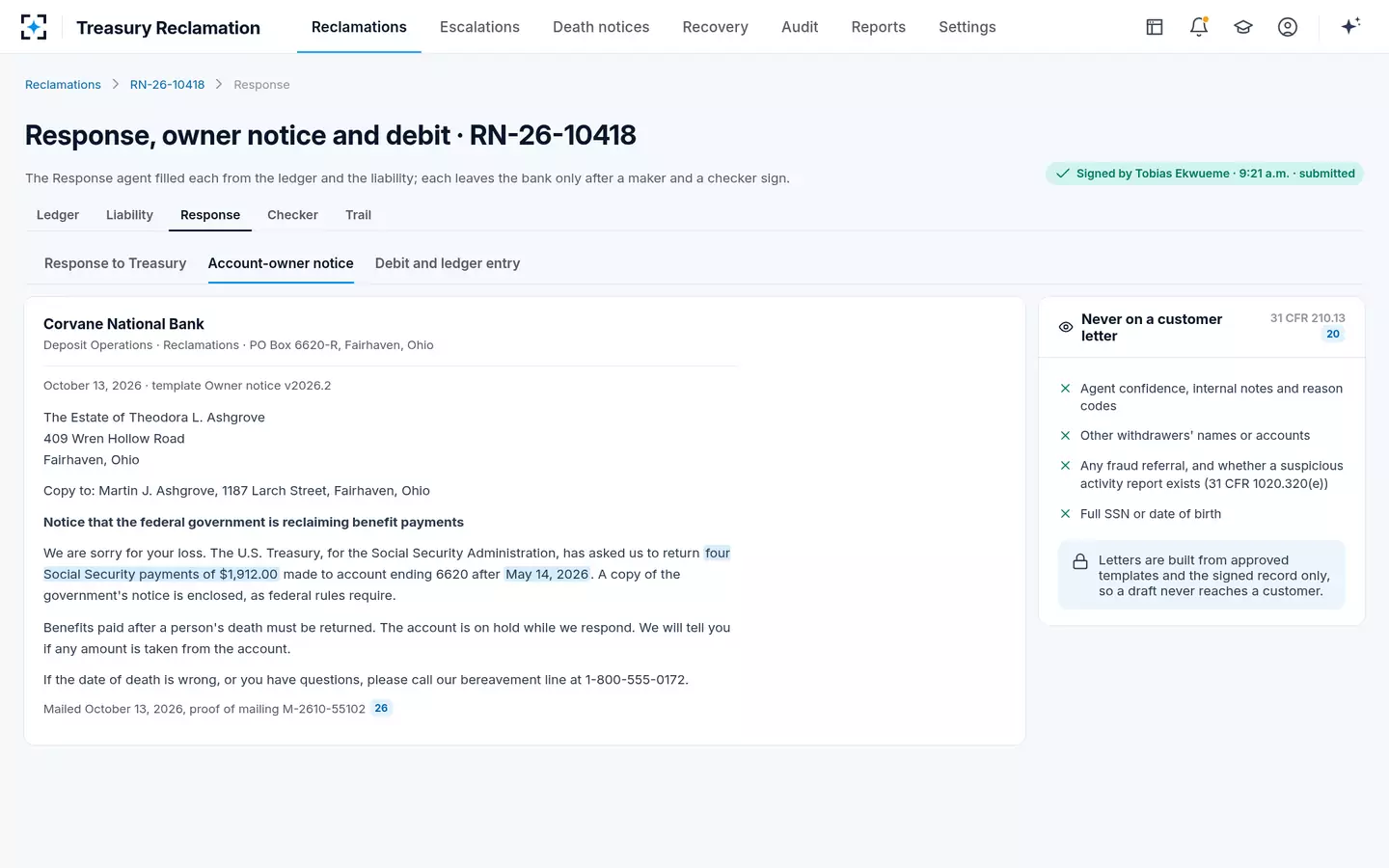
Two things happen on the day the notice arrives, before any research. Part 210 requires that the bank "immediately shall mail to the last known address of the account owner(s) or otherwise provide to the account owner(s) a copy of any notice required by the Service" (31 CFR 210.13), and proof of mailing may be requested. In the sample, the letter to the Estate of Theodora L. Ashgrove was approved by the specialist at 3:58 p.m. and checked at 4:30 p.m. the day the notice arrived.
The second is the balance. The Green Book gives the bank up to one business day to determine the balance and prevent further withdrawals of post-death benefits "if possible, under the terms of the contract with the account holder." The notice came in at 7:12 a.m. on Tuesday, October 13; the balance was taken then and held through the close on Wednesday, October 14, when it stood at $2,317.40, with no further benefit credit.
Treasury Reclamation's account-owner notice, sent on the day of receipt
Days 2 to 6: the account split at the date of death
The core of the response is a two-sided picture of the account from the date of death to the day of the notice: on one side every benefit payment Treasury is reclaiming, on the other every debit and who made it. In the sample, $1,183.30 was in the account when Mrs. Ashgrove died on May 14. Four Social Security payments of $1,912.00 arrived on June 10, July 8, August 12 and September 9; the May 13 credit, for April, came before the death and is not reclaimed. The Green Book draws the boundary on the day itself as well: the bank is not liable for a benefit payment whose effective date is the date of death.
Against those credits, $6,513.90 left the account: seven ATM withdrawals on card ••0915 totalling $3,100.00, one branch transfer of $2,230.60 on September 22 and eight automatic payments of $1,183.30 to two companies. The arithmetic closes: $1,183.30 plus $7,648.00 less $6,513.90 is the $2,317.40 balance. The 45th day after the death fell on Sunday, June 28, so only the June 10 payment counts toward the most the bank could owe later.
Each debit then needs a person attached. The card processor shows who holds card ••0915; the teller journal shows who presented the branch transfer; the ACH file shows the originators. The bank's answer must give the name, last known address and phone of the recipient, every co-owner, everyone authorized to withdraw and everyone who withdrew after the death (210.11(b)(3)). Why the bank names who withdrew explains what the agency does with that list.
The knowledge date, and the two certifications that rest on it
To limit its liability the bank signs two certifications on the response, and both depend on one date: when it first knew of the death. Certification No. 1 states that the owners were sent their notice, were told of any action against the account, and that any error in the date or fact of death was corrected. Certification No. 2 states that the bank "had no actual or constructive knowledge of the death at the time of deposit or withdrawal" of any post-death payment and has returned the account balance (Green Book, Table 3-B).
The DNE is the easy candidate and, in the sample, the wrong one. A note in the contact center system from Wednesday, September 23 at 2:41 p.m. records the son saying his mother had died in May. That is fifteen days before the DNE, so the bank certifies September 23. Nothing was credited or withdrawn after that date, so the limit holds. Had the call come on September 21, the September 22 transfer would have left the account after the bank knew, the bank could not truthfully sign Certification No. 2, and without it Part 210 gives no right to limit liability at all (210.11(b)(1)): the Green Book's full-liability rule would make the bank answerable for all $7,648.00 of post-death payments, not just the $2,230.60 that one transfer moved. How the knowledge date is found walks through every channel that can set it.
Who does what on one notice in Treasury Reclamation
Agent
Notice agentReads each FS Form 133 as it arrives, by email or post, matches the account and starts the 60-day clock from the notice date.
Never: guesses an amount, account or date of death
Agent
Account splitSplits the account at the date of death and names each withdrawer from the card processor, the teller journal and the ACH originators.
Never: names a withdrawer below 0.98 confidence
Agent
Liability agentSearches seven channels for the earliest notice of death and computes what the bank owes now, at most later and by default.
Never: decides full liability
Agent
Checker agentRe-adds the account from the raw posting journal and the card settlement file without seeing the first result.
Never: adjusts the first result
A person decides
Reclamation SpecialistReads the split, asks questions, approves the return and the response as maker.
A person decides
Reclamation CheckerCompares the response with the independent re-add, checks the evidence and signs.
Agent
Response agentPrepares the response, the account debit and the general ledger entry, and submits only after both signatures.
Never: sends anything unsigned
How to respond to a treasury reclamation in ARPS, and what happens next
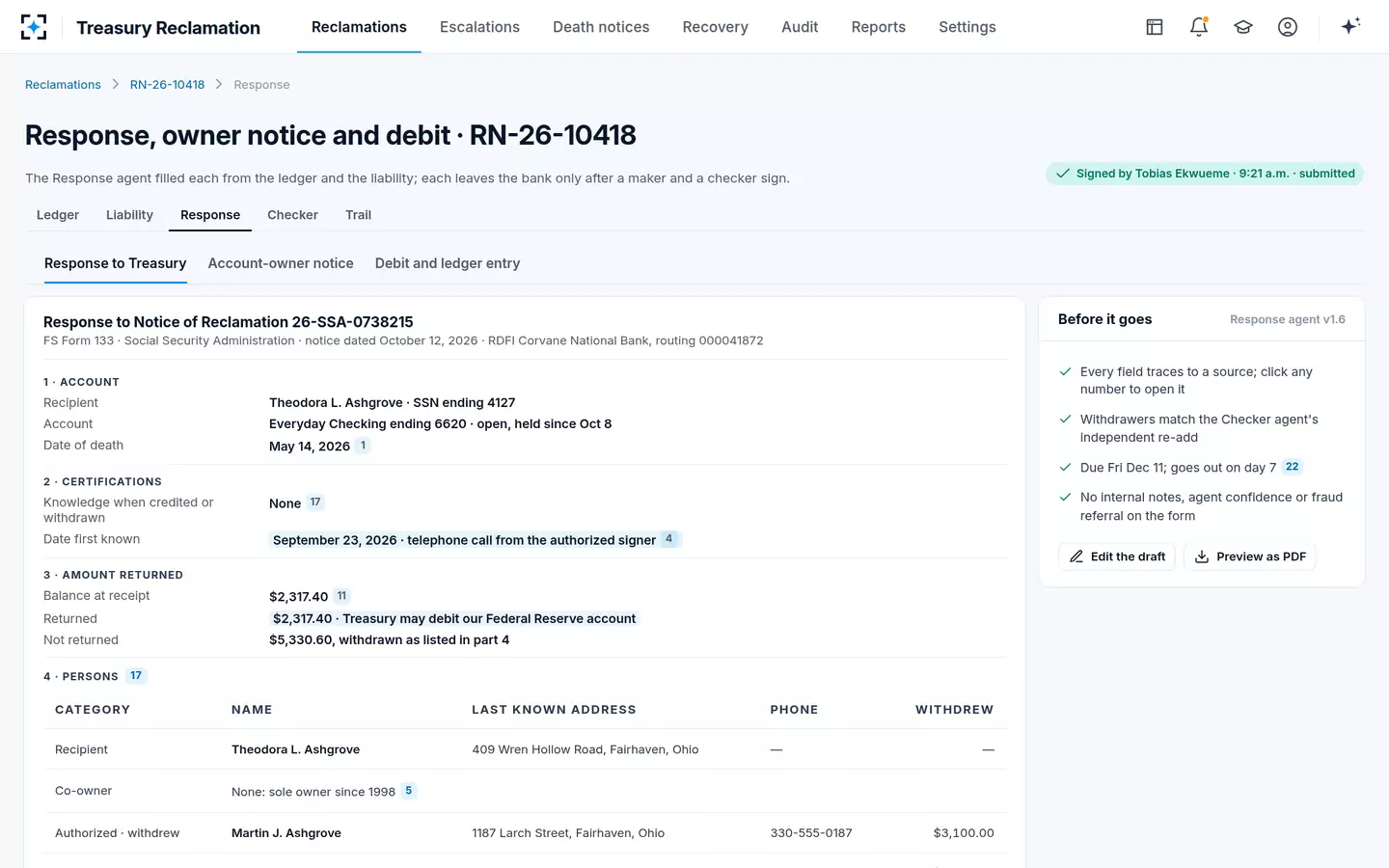
A bank responds to a treasury reclamation by completing the electronic FS-133 in ARPS on Pay.gov: it returns the balance, or authorizes Treasury to debit it, certifies the knowledge date, and lists the persons. Where it returns less than the full amount it must authorize a debit through ARPS and give the name, address and phone of the people who withdrew. A debit authorized this way appears on the bank's Federal Reserve statement under transaction code 57180 and posts within one to two business days.
The completed response in Treasury Reclamation, before the checker signs
What follows depends on the answer. If the bank qualified for limited liability and money was withdrawn before it knew, the Green Book suspends the reclamation while the agency tries to collect from the withdrawers. For Social Security, SSA mails each named withdrawer a repayment notice. If the agency cannot collect, Treasury debits the bank for the 45-day amount, no more than what is still outstanding, using the FS-135 Request for Debit, and agencies have three years from the date of the notice to submit that final debit (SSA POMS GN 02408.626).
The four numbers that set the treasury reclamation process
60
calendar days from the notice’s issue date to a full and accurate response
1
business day, at most, to fix the balance after the notice arrives
45
days after the death: payments in this window set the most the bank can owe later
3
years from the notice date for the agency to submit a final debit
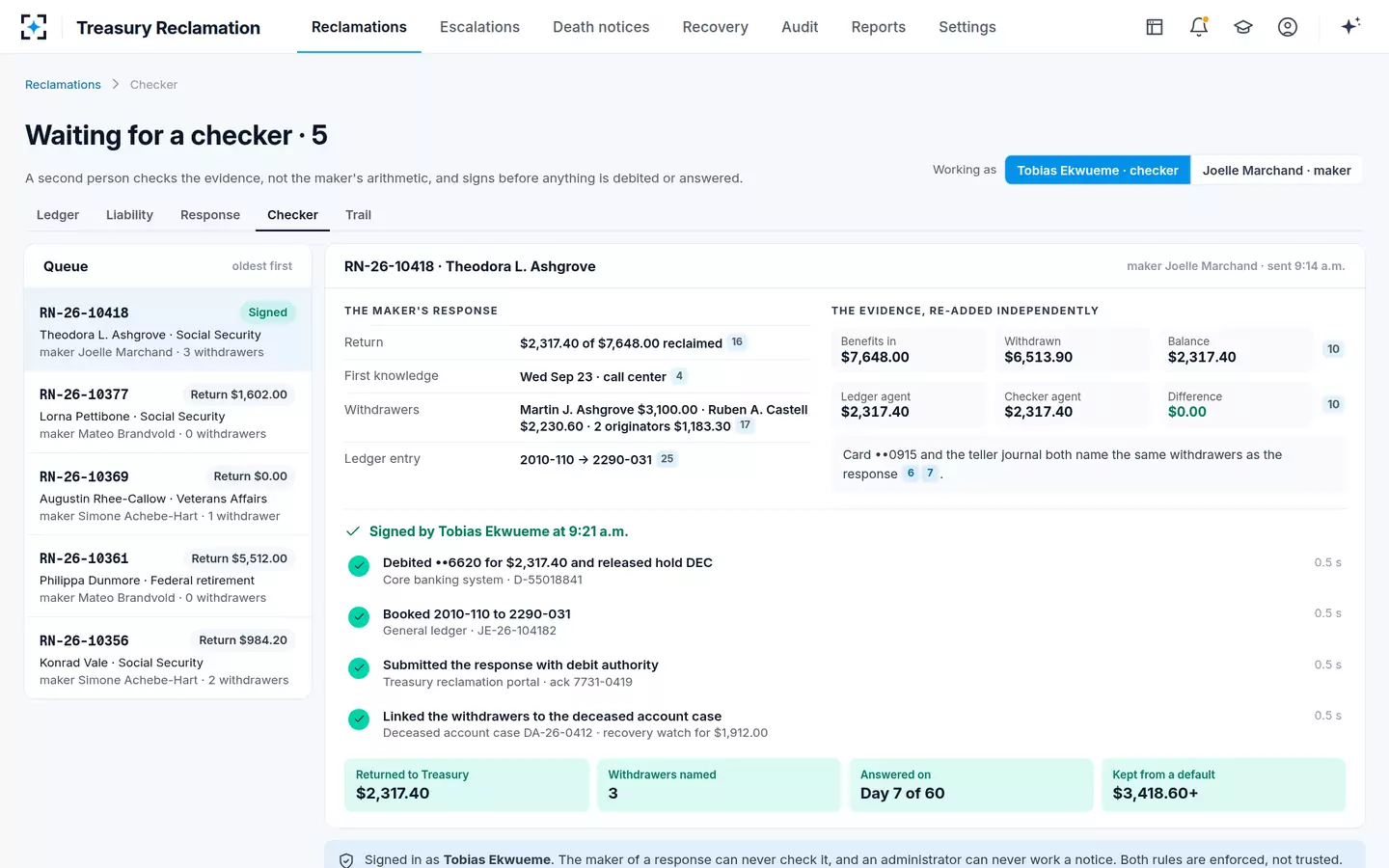
In the sample, the checker compared the maker's response with an independent re-add from the raw journal: $7,648.00 in, $6,513.90 withdrawn, $2,317.40 balance, a difference of $0.00. He signed at 9:21 a.m.; the account was debited, the general ledger entry booked and the response submitted on day 7 of 60. The bank paid $2,317.40 now and can owe at most $1,912.00 more, and only if SSA cannot collect the other $5,330.60. The 31 CFR 210.11 calculation sets out each line.
The checker's screen: the maker's figures beside an independent re-add
Treasury reclamation green book: what chapter 5 adds to the regulation
Chapter 5 of the Green Book is Treasury's procedure for the rules in 31 CFR 210.9 to 210.14, and it binds the bank as firmly as the regulation does: anyone who receives a government entry "agrees to be bound by this part and to comply with all instructions and procedures issued by the Service under this part, including the Treasury Financial Manual and the Green Book" (31 CFR 210.3(c)). The chapter also states that Part 210's reclamation provisions "completely preempt" the Nacha Operating Rules for federal benefit payments.
Chapter 5's reclamations guidance adds what the regulation leaves out. It requires responses through ARPS since January 1, 2023; sets the follow-up notice, FS Form 2942, at 30 days; tabulates, in Table 3-C, when the bank's Federal Reserve account is debited; explains how to read a reclamation debit on the Federal Reserve statement by its ticket number; and covers the cases where the person did not die, where the date of death is wrong, and where a second notice arrives because the first did not list every payment, or because the date of death, account number or routing number changed. A bank that has already been debited the 45-day amount on a case "will not be debited again on a subsequent Reclamation for the same case", but must still answer it.
It also covers what happens before any notice. If a survivor asks the bank not to return a post-death payment, the bank should return it anyway and send the survivor to the paying agency. Payments already credited before the bank knew can be returned early with R15 or R14, though the bank is not required to do so, as the R15 and R14 return codes explain; chapter 4 sets out how those returns must match the original entry to avoid being dishonored (Green Book, ch. 4).
DFAS and VA notices of reclamation: what changes by agency
Very little changes for most agencies, because Fiscal Service sends the same FS Form 133 on each agency's instruction. The Green Book lists VA benefits, OPM annuities, military retirement, Railroad Retirement Board annuities and federal workers' compensation among the payments subject to reclamation, and the bank's liability and its 60 days are the same for each.
The Defense Finance and Accounting Service is the exception the Green Book names: ARPS is required "except for responses by DFAS which cannot be processed through pay.gov and any Treasury-approved exceptions", and those responses must still meet every other condition for limiting liability, including receipt within 60 days. The other difference is upstream. Only SSA, OPM and RRB currently send Death Notification Entries, according to Green Book chapter 4, so a bank may receive a VA or DFAS notice with no DNE before it.
The agency also decides what happens after the bank answers. SSA's manual sets its own steps for writing to withdrawers, referring large cases and requesting the final debit; other agencies follow their own procedures. What does not vary is how far back any of them can reach. No agency may reclaim a payment made more than six years before the notice date, unless the balance when the notice arrives is larger than all the post-death payments of those six years, in which case the bank answers for every post-death payment up to that balance (31 CFR 210.10(d)). A notice that lists older payments is worth checking against that rule before anything is returned.
Questions people ask
Who sends a notice of reclamation?
The Bureau of the Fiscal Service, part of the U.S. Treasury, on the instruction of the paying agency. It is mailed or emailed to the receiving institution at the address and routing number Treasury holds, which is why the Green Book asks banks to keep their Federal Reserve directory details and email addresses current.
Does the bank have to answer if it returns the full amount?
No. The Green Book says that if the full amount listed on the reclamation is returned to the disbursing office, the bank does not need to complete and return the FS Form 133. If it returns less, it must answer in ARPS within the 60 days.
What if the customer is not dead?
The bank must still answer the notice in ARPS. If it accepts the proof, such as an identity document issued after the stated date of death or a letter from the agency, it selects "payee alive", signs both certifications and tells the customer to contact the agency, because a reclamation stops the payments and accepting the proof does not restart them.
What if the date of death on the notice is wrong?
The bank may adjust the outstanding total if it has acceptable proof, by checking the box in ARPS, giving the correct date and emailing a death certificate to Fiscal Service within 15 business days of its response. If it learns of the error only after it has answered and paid what it owed, it must ask the paying agency to make the adjustment.
How long should a bank keep a reclamation file?
The Green Book asks that the form submitted through ARPS be kept for at least three years or until the case is closed, filed under the reclamation ticket number so that any later debit can be matched. A bank may keep it longer under its own policy; the sample bank keeps five years.