Reclamation liability is what a bank owes the federal government for benefit payments it received after a customer's death. By default it is the full amount: Part 210 makes the bank "liable to the Federal Government for the total amount of all benefit payments received after the death" unless it qualifies to limit that liability (31 CFR 210.10(a)). A bank that did not know of the death when the payments were credited or withdrawn, returned everything it received afterwards and answers the Notice of Reclamation fully and accurately within 60 days owes much less: the balance when the notice arrived, and later, only if the agency cannot collect from the people who withdrew, the payments received within 45 days of the death. Botminds' Treasury Reclamation exists to keep a bank on the second side of that line: agents compute every figure and search for every earlier notice of death, and two people sign before Treasury is answered.
The figures on this page come from a fictional sample bank, Corvane National Bank, and an invented customer; the rules are quoted from 31 CFR Part 210, Treasury's Green Book and SSA's operating manual.
One notice, three possible bills: the sample liability calculator
Benefit payments reclaimed (the outstanding total)
Amount$7,648.00
BasisFour Social Security payments of $1,912.00, Jun 10 to Sep 9
Balance when the notice arrived, held one business day
Amount$2,317.40
BasisTue Oct 13, 7:12 a.m. to the close on Wed Oct 14
Benefit credits after the notice, before the full response
Amount$0.00
BasisNo October payment arrived
Returned now: the lesser of balance and outstanding total
Amount$2,317.40
Basis210.11(a)(1)
Left for the agency to collect from the withdrawers
Amount$5,330.60
BasisSon, nephew and two payment originators, named
Benefit payments within 45 days of the death
Amount$1,912.00
BasisOnly the Jun 10 payment falls before Sun Jun 28
Most the bank can owe later, only if the agency cannot collect
Amount$1,912.00
Basis210.11(a)(2): the lesser of $1,912.00 and $5,330.60
If the answer is late, or inaccurate
Amount$7,648.00
BasisThe outstanding total, debited at the Federal Reserve, plus any loss under 210.11(d)
What is bank liability for Social Security after death? Full, unless the bank earns the limit
A bank's liability for Social Security paid after a death starts at the whole amount reclaimed, and the bank has to qualify for anything less. The Green Book states it in capitals: an RDFI "is liable for ALL benefit payments received after the death or legal incapacity of a recipient or death of a beneficiary, unless the RDFI meets the qualifications for limiting its liability" (Green Book, ch. 5). The same rule covers VA, OPM, Railroad Retirement and every other reclaimable benefit.
The reason is the agreement the bank made by accepting the payment. Part 210 says that acceptance "shall constitute its agreement to this subpart" and authorizes the debit of the bank's Federal Reserve account (210.9(a)). The bank does not need to have done anything wrong to owe the money: the payments went to someone no longer entitled to them, and the regulation decides how much of that loss the bank bears.
The gap between the two is the price of an error. On the sample notice, full liability is $7,648.00; the limit is $2,317.40 now and at most $4,229.40 in all. The $3,418.60 or more between them is what a late or wrong answer costs on a single, ordinary notice.
What the sample notice costs the bank, by how it is answered
Limited liability reclamation: three conditions, all of them
A bank qualifies for limited liability only if all three conditions hold. The Green Book lists them: it "certifies it did not have actual or constructive knowledge" of the death when any post-death payment was deposited; it returns every post-death payment it receives after learning of the death; and it "adequately responds" to the FS Form 133 within 60 calendar days through ARPS on Pay.gov. SSA's manual repeats the same three tests and adds that "the Department of the Treasury (Treasury) determines the liability of the FI" (SSA POMS GN 02408.625).
The regulation turns those conditions into certifications. The bank must certify that it had no knowledge when the payments were credited to or withdrawn from the account, certify the date it first did know, give the name, last known address and phone of every co-owner, authorized signer and post-death withdrawer, and "fully and accurately complete all certifications on the notice of reclamation" (210.11(b)). If it cannot identify someone in a category, it must certify that no information is available and say why.
Each condition fails in a different place. Knowledge fails in the contact center or at a branch, where a death was mentioned and nobody told the desk. The return fails in the payments system, where a benefit credit posted after the flag should have caught it. The response fails on the calendar, or in the persons table, where a withdrawer is missing. The limited liability formula, line by line covers the arithmetic once the conditions are met.
What happens if a bank misses a reclamation deadline?
A bank that misses the deadline loses the limit and is debited for the outstanding total. The Green Book's Table 3-C is direct: if the bank "fails to respond within the 60-day time limit" or "fails to respond accurately and completely", its Federal Reserve account, or its correspondent's, "will be debited for the outstanding total". Chapter 5 calls a debit for a missed deadline final.
The rule gives one reminder before that point. If the disbursing office has no response 30 days after the notice, it sends a Follow-Up to the Notice of Reclamation, which warns that a response must arrive "within 30 days of the date of the Follow-Up Notice, or the RDFI will forfeit the right to limit its liability". SSA's manual describes the end of that road: if the bank does not respond 30 days after the follow-up, Treasury debits the bank "for the full reclamation amount, and returns the funds to SSA" (SSA POMS GN 02408.610).
Reclamation liability by what went wrong
| What went wrong | Rule | What the bank pays |
|---|---|---|
| No answer within 60 days, or 30 days after the follow-up | Green Book Table 3-C; 210.10(e) | The outstanding total, debited at the Federal Reserve; final |
| Answer incomplete or inaccurate, such as a missing withdrawer | 210.11(b)(3), 210.11(d) | The outstanding total, plus any loss the error caused |
| Earlier notice of death missed; the wrong date certified | 210.10(b), 210.11(b)(2), 210.11(d) | Full liability for payments credited or withdrawn after the true date, plus any loss |
| A benefit payment received after the death was known, posted not returned | 210.10(a) | That payment in full, whatever the limit on the others |
| Benefit payments held in a suspense account | Green Book ch. 5, No Holding of Payments | Possible loss of the right to limit liability |
| Answered fully, accurately and on time; agency cannot collect | 210.11(a)(2), 210.11(c) | The 45-day amount, capped at what is still outstanding, debited later |
Full liability reclamation: when the bank knew earlier than it thought
Full liability for some or all payments follows whenever the bank had knowledge of the death before a payment was credited or withdrawn. Knowledge includes what the bank would have learned by following commercially reasonable business practices, so a death certificate scanned at a branch or a call to the contact center counts even if nobody at the reclamation desk saw it. Finding the date the bank first knew walks through every place that evidence sits.
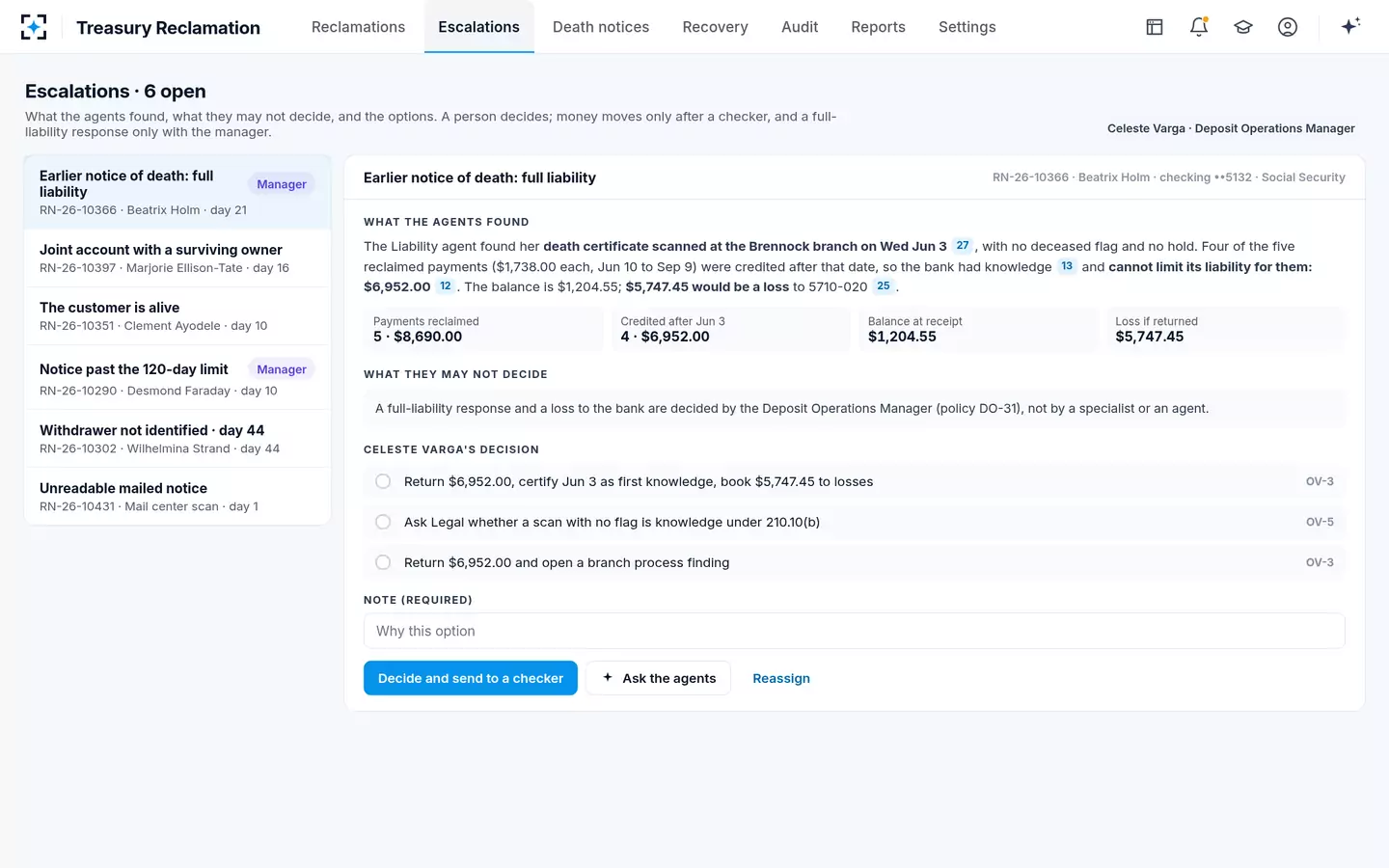
One of the sample bank's escalations shows the cost. A death certificate was scanned at a branch on Wednesday, June 3, with no flag set. Four of the five reclaimed payments, $6,952.00 at $1,738.00 each, were credited after that date, so the bank cannot limit its liability for them; with a balance of $1,204.55, returning them leaves a $5,747.45 loss. The agents found the scan; they may not decide what to do with it.
A full-liability case in Treasury Reclamation goes to the manager, not the agents
Wrong answers cost more than late ones
An inaccurate answer can cost more than no answer, because Part 210 adds the loss it causes to the amount already owed. "An RDFI that fails to comply with any provision of this subpart in a timely and accurate manner, including but not limited to the certification requirements at § 210.11(b) and the notice requirements at § 210.13, shall be liable to the Federal Government for any loss resulting from its act or omission. Any such liability shall be in addition to the amount(s) for which the RDFI is liable" (31 CFR 210.11(d)).
The examples are ordinary. A withdrawer left off the persons table is one the agency cannot pursue, and the amount that person took is the loss. A knowledge date certified from the DNE when the contact center heard of the death two weeks earlier is an inaccurate certification. An owner notice never mailed breaks 210.13. None of these shows up in the arithmetic, which is why reviewing a response by re-adding it catches the least likely error and misses the expensive ones.
The sample bank's response illustrates the alternative. The checker's screen sets the maker's figures beside an independent re-add from the raw posting journal and the card settlement file, but the checker's job is the evidence: whether the card processor and the teller journal name the same withdrawers as the response, and whether anything was credited or withdrawn after the certified date.
Reclamation follow up notice: what FS Form 2942 means
FS Form 2942, the Follow-Up to the Notice of Reclamation, is the last warning before a bank loses the limit. The Green Book says it is sent if the disbursing office has no response within 30 days of the FS Form 133, or if the response it received was incomplete or inaccurate, and that a copy of the original notice is attached. The answer goes through ARPS in the same way as the original.
A follow-up is a symptom worth counting. It means either that a notice was never worked or that an answer went in with something missing, and the second is the more dangerous because the desk believes the case is closed. A bank that tracks follow-ups received per quarter, and why, has an early measure of exactly the errors that turn a limited liability into a full one.
Is the bank liable for Social Security deposited after death? Payment by payment
The bank's liability is decided payment by payment, against the date it first knew. On the sample notice all four Social Security payments were credited before the bank had any knowledge, so all four sit under the limit. Had the call to the contact center come on June 20 instead of September 23, the July, August and September payments would have been received after the bank knew, and the bank would owe them in full whatever the balance.
The 45-day window works the same way, from the date of death. Only payments received within 45 calendar days of the death count toward the most the bank could owe later; on the sample that is the June 10 payment alone, because the 45th day fell on Sunday, June 28. A recipient who dies just after one monthly payment and just before the next can leave a 45-day amount of zero, which is why the most a bank can owe on two similar notices can differ by a full month's benefit.
The bank also has a right the reclamation does not take away. Part 210 gives the bank no authority to debit the customer's account, but leaves intact whatever right the bank has under state law or its deposit contract to recover from it (210.12(a)), and the bank's liability to the government does not change with what it manages to recover.
What to ask of the controls, and of any software, that guard the limit
Guarding the limit is a control problem with four parts: the clock, the knowledge date, the persons table and the decision to accept a loss. Treasury Reclamation's design target is that no notice is ever paid in full by default for a missed deadline; it is a target for a bank running the solution, not a result measured at a bank. Whatever a bank uses, these are the questions to put to it.
Six questions that test whether a process protects reclamation liability
- Which date does the clock run from?
The notice date, with escalation well before day 60 and before the follow-up arrives. The sample bank escalates at day 45.
- Who searches for an earlier notice of death, and where?
Contact center notes, branch imaging, returned mail, estate requests and R15 returns, not only the DNE file.
- Is every withdrawer traced to a source?
Card holder from the processor, presenter from the teller journal, originator from the ACH file, with address and phone.
- Who decides to accept full liability?
A named manager with the loss and the options in front of them, never the preparer and never software.
- Does the checker review evidence or arithmetic?
An independent re-add is useful; the checker’s real task is the date and the names.
- Are follow-up notices counted?
Each FS Form 2942 is either a notice never worked or an answer that was incomplete.
The solution fits where the cost of error is in the gathering: many notices, several withdrawers each, evidence spread over systems the desk does not search. It does not change who carries the liability, and it does not decide the cases that cost the bank money; the manager does. The reclamation specialist on a one-person desk covers the staffing side of the same risk, and the sample notices are on the Treasury Reclamation page.
Questions people ask
Who decides the bank's reclamation liability?
Treasury does. SSA's manual says Treasury determines the financial institution's liability and calculates the amount due; the bank's job is to answer completely and accurately, return what the rule requires and certify the facts the decision rests on.
Can a bank's limited liability be more than the amount reclaimed?
No. The limit is the lesser of the balance at receipt and the outstanding total, and the later 45-day amount is capped at whatever is still outstanding. Only a full liability, or a loss under 210.11(d) for a late or inaccurate answer, can take the bank beyond the limited figure.
Is the bank liable for payments sent to a representative payee?
Generally not through a reclamation. The Green Book says that when a beneficiary with a representative payee dies, the paying agency "will not initiate a reclamation" and pursues the payee instead, and SSA's manual treats such payments as overpayments that need due process.
Can the bank recover what it pays from the family?
Only under its own deposit contract or state law. Part 210 neither authorizes nor directs the bank to debit the customer's account, and the bank's liability to the government is the same whatever it recovers. Any claim against an estate or a withdrawer is the bank's own matter.
What if the agency later finds the reclamation was wrong?
If the bank learns after answering that the customer is alive or the date of death was wrong, it tells the paying agency. If the agency agrees the reclamation was improper, Part 210 says it returns the money, and Treasury may have the Federal Reserve credit the bank's account (210.14).