A reclamation specialist is the person at a bank or credit union who answers the Notices of Reclamation (FS Form 133) that the Bureau of the Fiscal Service sends for Social Security, VA, federal retirement or other federal benefit payments that kept arriving after a customer died: within 60 calendar days the institution must split the account at the date of death, certify when it first knew of the death, name everyone who could or did withdraw, return what it owes and answer Treasury through the Automated Reclamation Processing System (ARPS) on Pay.gov. The specialist assembles all of that, and at a smaller institution she does it alone, beside other deposit operations duties. Botminds' Treasury Reclamation exists because the work is mechanical in its gathering and unforgiving in its signatures: agents assemble each notice from the core, the card processor and the teller journal, and two people sign before anything leaves the bank.
The examples here come from a fictional sample bank, Corvane National Bank, as it runs through the solution; every person and account named is invented. The rules are quoted from 31 CFR Part 210, Treasury's Green Book and the Federal Register, linked where they appear.
Treasury's own estimate of the work behind FS Form 133
223,128
respondents Treasury estimates for the Notice of Reclamation collection
8
minutes: Treasury’s estimated time per respondent
29,750
hours: estimated total annual burden
What is reclamation in banking, and why is it one person's job?
Reclamation in banking is the federal government's procedure for recovering benefit payments sent by ACH to the account of someone who had died or become legally incapacitated before the payment date. The Green Book's chapter on reclamations states the government's right is "established in the United States Code, including at 31 U.S.C. § 3720" and carried out through 31 CFR Part 210, Subpart B (Green Book, ch. 5). Every bank, savings institution and insured credit union that accepts a recurring federal benefit payment has agreed to that subpart by accepting it.
Not every federal deposit can be reclaimed. The Green Book lists the payments that can: Social Security and SSI, Black Lung, military and Coast Guard retirement, civil service annuities, VA benefits, Railroad Retirement Board annuities, federal workers' compensation, DC pensions and "any other federal retirement or annuity". Federal salaries, tax refunds, savings bond payments and vendor payments are not reclaimable; for those, the agency and the survivors settle between themselves.
Where it is one person's job, the reason is usually that the rules are narrow enough for one trained person to carry. The trouble is that the desk then holds three kinds of risk in a single head: the 60-day clock, the date the bank first knew of the death, and the list of everyone who withdrew. When that person is away, the clock does not stop.
Reclamation specialist or reclamation coordinator: one job, several titles
A reclamation coordinator and a reclamation specialist usually do the same job under different titles, because the rules never name a job at all. Part 210 puts every duty on the receiving institution, which it calls the RDFI (31 CFR 210.11), and the Green Book asks for no more about the person than the signer's first and last name, title and phone on the certifications. One bank calls that person a reclamation specialist, another a reclamation coordinator, a third a deposit operations specialist who also does reclamations.
What the title should not hide is the split between preparing an answer and owning the deadline. Where a bank has both a specialist and a coordinator, the useful line is that one assembles the evidence and the other watches every open notice against its 60 days and finds the second signer. On a one-person desk both fall to the same person, and the deadline is the part that slips first when she is out.
Two other trades use the same words, which is worth knowing before reading a job posting. In mining and land management, a reclamation specialist restores land disturbed by surface coal mining, work the federal Office of Surface Mining Reclamation and Enforcement oversees. In bankruptcy, reclamation is a seller's right to take back goods delivered to a buyer shortly before the buyer's bankruptcy (11 U.S.C. 546(c)). The banking role is the one that mentions FS Form 133, ARPS, R15 returns and death notification entries.
Treasury Reclamation's four seats: what each person's week holds
Today
Prints months of account history for each notice, asks the card team who holds the card used at the ATM, asks the branch for the teller’s record of a transfer, adds it up and types the response.
With agents
Opens each notice already split at the date of death, with every withdrawer named and the limit computed; reads, asks questions and approves as maker.
Still theirs: The maker’s approval of every return and response.
Today
Reviews another specialist’s response when there is time, from printed statements; at a small bank this seat may be borrowed from another team.
With agents
Sees the maker’s response beside an independent re-add from the raw posting journal and checks the evidence, not the arithmetic.
Still theirs: The second signature before money moves.
Today
Owns the 60-day clock and learns of a missed notice when Treasury debits the bank’s Federal Reserve account.
With agents
Decides the cases the agents may not: full liability, large returns, protests and notices that reach day 45.
Still theirs: Every decision that costs the bank money.
Today
Asks for the date the bank first knew, and how anyone knows it was the first.
With agents
Reads every action by people and agents with its evidence, and exports a sample for examiners.
Still theirs: Read-only access; never changes a notice.
What does a reclamation specialist do? Seven things for every notice
A full answer to a Notice of Reclamation needs seven things, and only one of them is printed on the notice. The FS Form 133 gives the date of death, the amount that may be owed and, for each payment, the recipient's name, claim number, reclamation ticket number, payment date, the agency, the trace number, the account type and number and the amount (Green Book, Table 3-A). Everything else comes from the bank's own systems.
- The balance when the notice arrived, held for up to one business day, plus any benefit credit that lands before the bank answers in full (31 CFR 210.11(a)).
- The account history from the date of death, so each reclaimed payment sits beside every debit that followed it.
- The name, last known address and phone of the recipient and every co-owner, of everyone authorized to withdraw, and of everyone who withdrew after the death, as the bank's own records show them (210.11(b)(3)).
- The earliest date the bank knew of the death, or should have known, by whatever channel the news arrived (210.11(b)(2)).
- The notice to account owners, Part 5 of the form, mailed on receipt (210.13).
- The return itself, and the debit to the customer's account if the bank's contract allows one.
- The signed certifications in ARPS, with the signer's first and last name, title and phone.
The withdrawer list is the slow part. A card withdrawal names a card, not a person, until the card processor says who holds it; a branch transfer names a teller until the teller journal shows who presented it; an automatic payment names an originator. In the sample bank's notice for Theodora L. Ashgrove, four Social Security payments of $1,912.00 were reclaimed, and the $6,513.90 withdrawn after her death came through seven ATM withdrawals by her son on card ••0915, one branch transfer by her nephew and eight automatic payments to two companies. Each of those names came from a different system.
Where a notice's 40 minutes go when it is worked by hand
One Notice of Reclamation, by hand
- Logging the notice and keying the account · 10%
- Pulling history from the date of death · 20%
- Asking the card team and branch who withdrew · 30%
- Checking for an earlier notice of death · 10%
- Computing balance and limit · 12%
- Typing response and owner notice · 18%
How many reclamations does a bank get? Treasury's own count
No public source gives reclamation counts by bank, so the honest starting point is Treasury's paperwork estimate: 223,128 respondents for the Notice of Reclamation collection, 8 minutes each, 29,750 burden hours a year (Federal Register, October 1, 2025). The abstract describes the form as notice to financial institutions "of an obligation to repay payments erroneously issued to a deceased Federal benefit payment recipient".
The 8-minute figure is worth reading carefully before anyone builds a staffing plan on it. It is Treasury's estimate of the burden of its information collection, and it was unchanged between the 2022 and 2025 notices. The research that the form depends on, from the card processor to the teller journal, is the bank's own cost, and on a notice with several withdrawers it is most of the work.
Volume also arrives unevenly. The Federal Reserve's FedMail service, which delivers reclamation notices by email, sends "a PDF file of up to 10 ACH reclamation notices" each business day by 7:00 a.m. Eastern when there are any (Federal Reserve Financial Services). A desk that sees nothing for a week can see a full file the next morning, and every one of those notices starts its own 60-day clock.
Reclamation processing time: 60 days, a follow-up, then a final debit
A bank has 60 calendar days from the date on the notice to give a full and accurate response, and the date that counts is the notice's, not the day it reached the desk. If Treasury's disbursing office has heard nothing after 30 days, it sends a Follow-Up to the Notice of Reclamation, FS Form 2942, and the bank then has 30 days from the follow-up's date to answer or lose the right to limit its liability. After that, the Green Book is blunt about the debit to the bank's Federal Reserve account: "This debit action will be final" (Green Book, ch. 5).
One notice's 60 days, answered and unanswered
- Answered by day 77 d
- Slack left on the clock53 d
- No response30 d
- After FS Form 2942 follow-up30 d
Two shorter clocks sit inside the long one. The balance is fixed when the notice arrives, allowing the bank no more than one business day to act on it, so a specialist who opens Monday's notice on Wednesday is reconstructing a balance, not reading one. And the notice to account owners must go out "immediately" on receipt. Neither waits for the research.
Who handles Treasury reclamations at a bank when the specialist is out?
Usually nobody, and that is the risk to plan for. The Federal Reserve's own guidance on emailed notices says it is "strongly recommended" that an institution create a single group email address so that authorized users can reach the reclamation forms (FedMail ACH reclamation). A notice sitting in one specialist's inbox through a two-week vacation has used nearly a quarter of its 60 days before anyone opens it.
Coverage needs more than a shared mailbox. The person covering needs the same access to the core's posting journal, the card processor and the teller journal, and the same habit of searching for an earlier notice of death. The third requirement is the one that rarely transfers: knowing that a call to the contact center, a death certificate scanned at a branch or a dormant-account inquiry can each be the date the bank first knew.
The Green Book's definition of that standard is deliberately loose. "The phrase 'commercially reasonable business practices' is a flexible concept since, for example, what is a commercially reasonable practice for a large bank may not be commercially reasonable for a small rural bank, and vice versa." The standard scales with the institution; it does not go away.
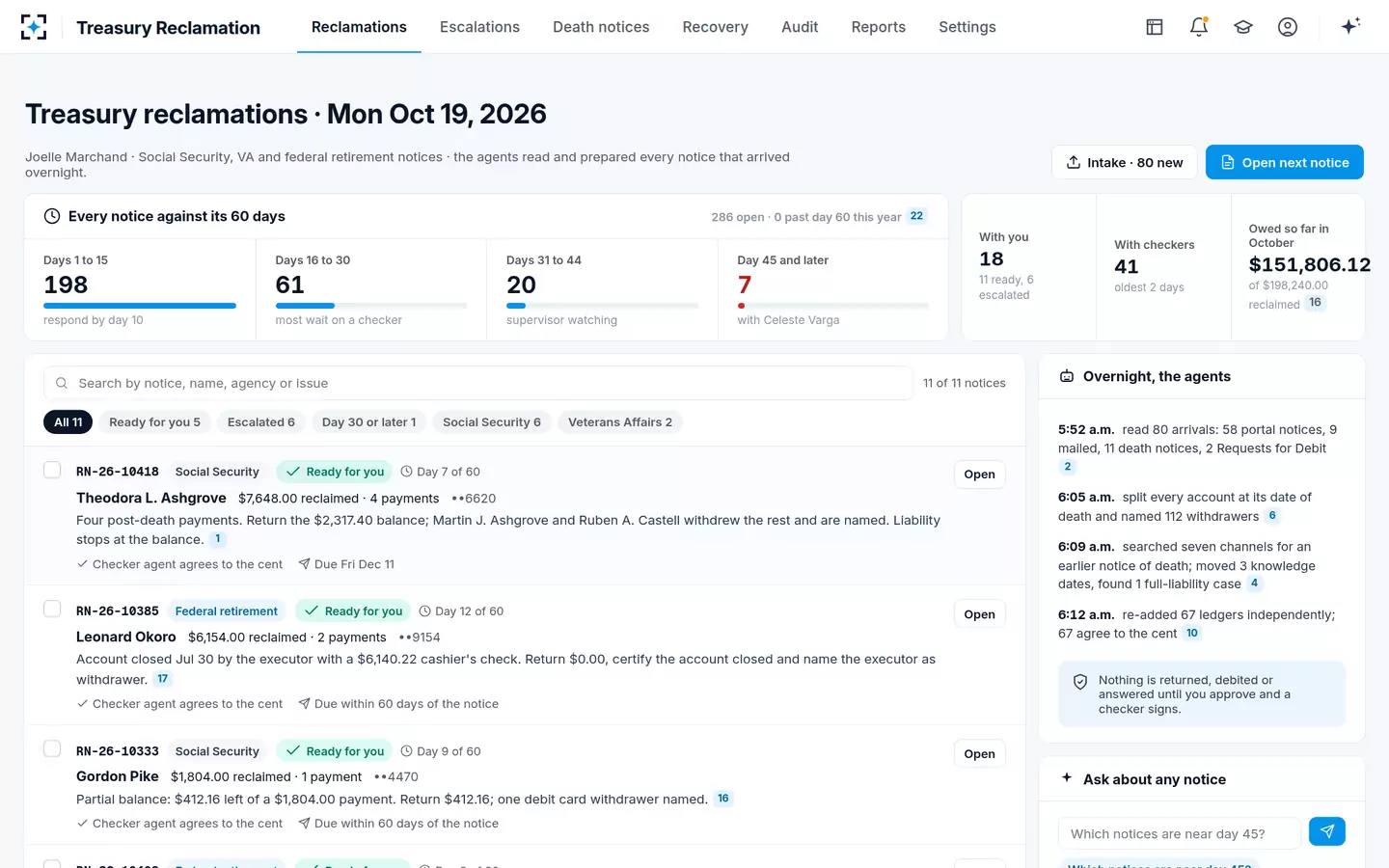
Treasury Reclamation's desk: every open notice against its 60 days
Where a second person is not optional
Two certifications carry the bank's liability, and both are statements of fact the bank cannot take back. To limit its liability the bank must certify that it had no actual or constructive knowledge of the death when the payments were credited or withdrawn, and certify the date it first did know (31 CFR 210.11(b)). A bank that answers late or inaccurately is also liable for any loss its error causes, on top of what it already owes (210.11(d)). What a late or wrong answer costs the bank works that through in dollars.
A second reader matters most at three points. The knowledge date, because the obvious candidate, the Death Notification Entry, is often not the first: in the sample notice a son told the contact center on September 23 that his mother had died in May, two weeks before the DNE arrived on October 8. The withdrawer list, because a missing name is an inaccurate certification. And the decision to accept full liability or to protest a late notice, because both move the bank's money and neither can be undone by the specialist who drafted them.
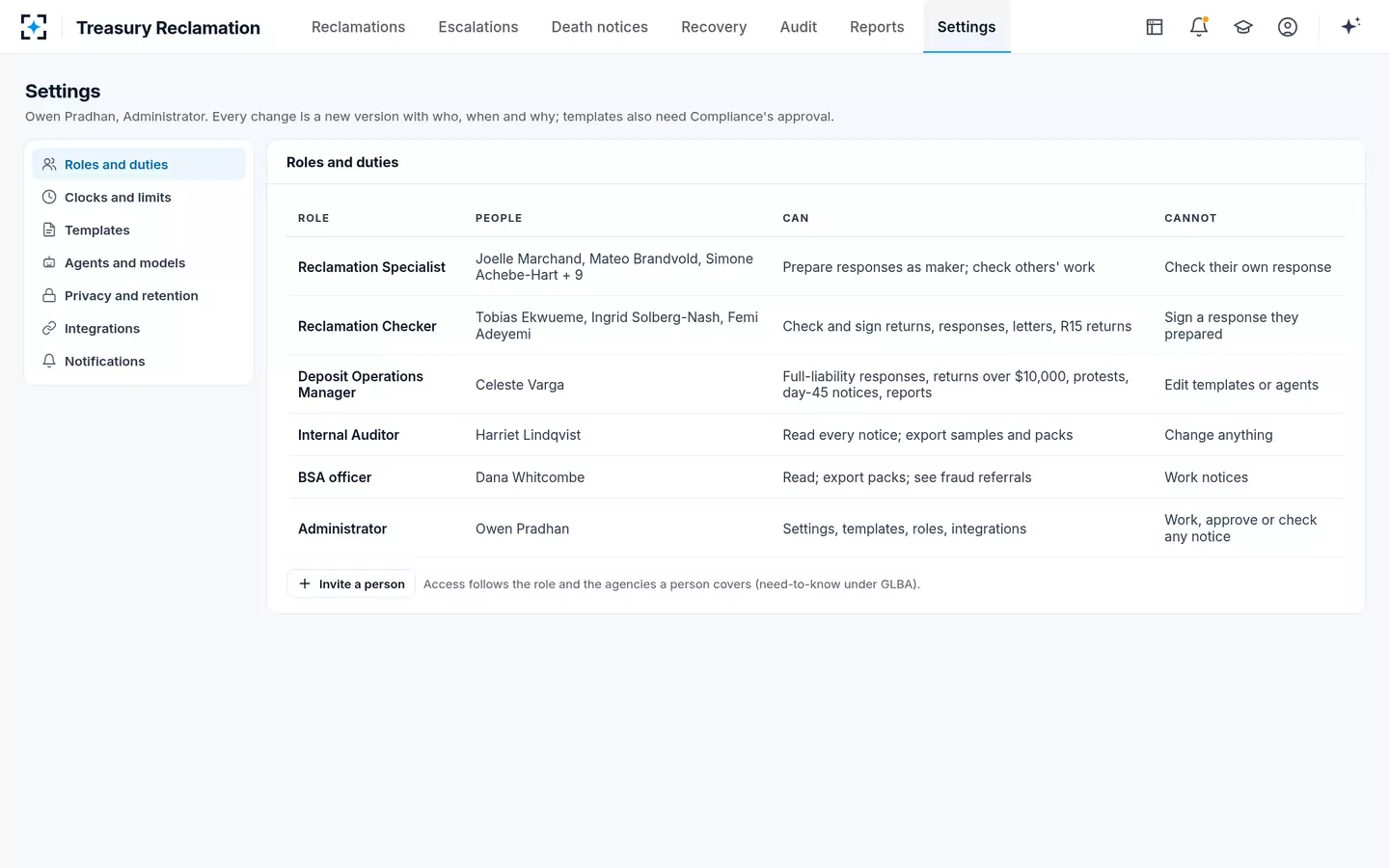
None of this requires a large team. It requires that the person who assembled the answer is not the only person who looked at it, and that the second look is at the evidence rather than at the arithmetic. In the solution, the checker sees the maker's figures beside an independent re-add from the raw posting journal, and the maker cannot sign her own response.
Separation of duties in Treasury Reclamation's settings
What should reclamation processing software do? Eight questions to ask
Good reclamation processing software assembles the evidence and leaves every signature with a person; anything that promises to answer Treasury on its own is promising the part a bank cannot delegate. These are the questions to put to any vendor, including us, with one of last year's notices in front of you.
Eight questions for a reclamation processing demonstration
- Does it start the clock from the date on the notice?
The 60 days run from the notice’s issue date, whether it came by FedMail, by post or was found in a shared inbox.
- Does it fix the balance at receipt plus one business day?
And add any benefit credit that arrives before the full response, as 210.11(a)(1)(i) requires.
- Where do the withdrawers’ names come from?
The card processor, the teller journal and the ACH originators, with address and phone as the bank holds them. A guessed name is an inaccurate certification.
- Which channels does it search for an earlier notice of death?
Contact center notes, branch document imaging, returned mail, online messages, estate requests and R15 or R14 returns, not only the DNE file.
- Does it show both parts of the limit?
What the bank returns now, and the most it could owe later from payments within 45 days of the death if the agency cannot collect.
- Can the person who prepared a response sign it?
The answer should be no, enforced by the system rather than by policy.
- Does it leave ARPS to a person?
The response goes through Pay.gov under a named signer; the software should make that entry a transcription, not a decision.
- What will an examiner see?
Each figure with its source, each decision with who, when and why, and the ARPS form kept at least as long as the Green Book asks.
Where agents fit on a one-person desk, and where they stop
Agents fit the gathering: reading the notice, matching the account, pulling the history from the date of death, finding the card holder and the teller presenter, searching every channel for the earliest mention of the death and doing the 210.11 arithmetic twice, independently. In the sample bank's notice that meant a response ready on day 7 of 60, returning $2,317.40 of the $7,648.00 reclaimed and naming three withdrawers, with a $0.00 difference between the maker's figures and the checker's re-add.
They stop at anything that moves money or makes a statement to Treasury. In Treasury Reclamation the agents never send, debit or return anything, never decide full liability and never certify a withdrawer as unidentified; a specialist approves as maker and a second person signs as checker. Full-liability responses, returns over a threshold the bank sets, protests and any notice that reaches day 45 go to the deposit operations manager.
There are also cases the solution does not take on. Treasury check reclamations follow a separate procedure from the ACH notices covered here. Reclamations for the Defense Finance and Accounting Service are the Green Book's named exception to answering through ARPS, so they need a person who knows that route. And once Treasury has the bank's answer, the Social Security Administration contacts the people the bank named; the bank's job ends at naming them correctly. The full process, traced over one notice's 60 days, shows each hand-off, and what ARPS leaves to the bank covers the Pay.gov side. To see the desk, the account split and the checker's screen on sample notices, start from Treasury Reclamation.
Questions people ask
How long does a bank have to respond to a notice of reclamation?
Sixty calendar days from the issue date on the FS Form 133. If no response arrives within 30 days, Treasury sends a Follow-Up Notice (FS Form 2942), and the bank must answer within 30 days of that follow-up's date or forfeit the right to limit its liability.
What is a treasury reclamation notice?
It is the FS Form 133, Notice of Reclamation, sent by the Bureau of the Fiscal Service on the instruction of the paying agency. It lists each benefit payment made after the date of death that has not been returned, the amount the bank may owe and a reclamation ticket number, and the bank receives Parts 1 to 5, including the copy it must send to the account owners.
Do credit unions receive notices of reclamation too?
Yes. Part 210 defines a financial institution to include insured credit unions alongside banks and savings banks, and any institution that accepts a recurring federal benefit payment agrees to the reclamation subpart by accepting it.
Are all federal payments subject to reclamation?
No. Only benefit payments are: Social Security, SSI, VA, OPM and military retirement, Railroad Retirement and similar annuities. Federal salaries, IRS tax refunds, savings bond and vendor payments are outside it, and the agency settles those with the survivors or the estate.
Can a bank outsource reclamation processing?
It can outsource the preparation, but the certifications are the bank's: Part 210 requires the receiving institution to certify the knowledge date and the withdrawers, and the Green Book asks for the signer's name, title and phone. Whoever prepares the file, a named person at the bank still signs and owns the answer.
What happens after the bank names the withdrawers?
For Social Security, the agency mails a repayment notice to the people the bank named and allows 45 days for a reply before asking Treasury to debit the bank for the limited amount, according to SSA's operating manual (POMS GN 02408.630). If the bank qualified for the limit, its exposure at that point is capped by the 45-day amount it calculated at the start.