A Social Security payment received after the death of a parent usually has to be returned. Social Security's own guidance for families says: "If the deceased was receiving Social Security benefits, you must return the benefits received for the month of death and any later months. If the payment was received by direct deposit, contact the bank or other financial institution. Ask them to return any funds received for the month of death or later" (SSA Publication 05-10008, July 2026). If the bank learns of the death before the next payment arrives, it sends that payment back itself. If payments were already deposited, and perhaps spent, the U.S. Treasury sends the bank a Notice of Reclamation; the bank returns what is left in the account, tells the account owners, and names anyone who withdrew money after the death, and Social Security may then write to those people asking for the rest. Botminds' Treasury Reclamation is software banks use to prepare those answers to Treasury; this guide explains the process from the family's side.
The rules here come from Social Security's publications and manual, the U.S. Treasury's Green Book and 31 CFR Part 210. The example family is fictional sample data used in the software, not a real case.
A payment that arrives after the bank knew, and one that arrived before
Arrives after the bank knows: The bank, at once, with a return code that also tells Social Security of the death.
Arrived before the bank knew: Nobody yet. The bank is not required, or authorized, to take it out of the account on its own.
Arrives after the bank knows: No. It goes back before it is credited, so nothing is taken from anyone.
Arrived before the bank knew: Yes. Once credited it belongs to the account owner, the joint owner or the estate, until Treasury reclaims it.
Arrives after the bank knows: A payment that never appears, or a note that it was returned.
Arrived before the bank knew: Later, a copy of Treasury’s notice from the bank, and possibly a letter from Social Security.
Arrives after the bank knows: No one; the money never left the government.
Arrived before the bank knew: The bank returns what is left; Social Security may ask the people who withdrew for the rest.
What happens if Social Security is paid after death?
If Social Security is paid after death, the payment is not owed and the government takes it back, either because the bank returns it or because Treasury reclaims it from the bank. The deciding question is whether the bank knew of the death when the payment arrived. A bank that knew must return the payment before it reaches the account; a bank that did not will receive a Notice of Reclamation, usually after Social Security has recorded the death.
The bank is told of the death in one of two ways. Social Security sends it a Death Notification Entry, an electronic notice with the date of death, once it has recorded the death; Social Security's leaflet notes that funeral directors "usually report the person's death to us" when they are given the Social Security number. Or the family, an executor or someone else tells the bank directly, and the bank passes the news to Social Security by returning the next payment with return code R15.
Either way, you do not need to send money to anyone the moment a payment arrives. You do need to tell the bank, leave any payment for the month of death or later untouched, and answer the letters that follow.
Social Security payment in the death month: why it goes back
The payment for the month of death goes back even if your parent lived for most of that month. Social Security's manual states the rule for retirement, survivors and disability benefits directly (SSA POMS GN 02408.610), and the leaflet for families repeats it in plain words: the benefits "for the month of death and any later months" must be returned (SSA Publication 05-10008). For Supplemental Security Income, the same section of SSA's manual puts the line one month later: only payments for months after the month of death are not due.
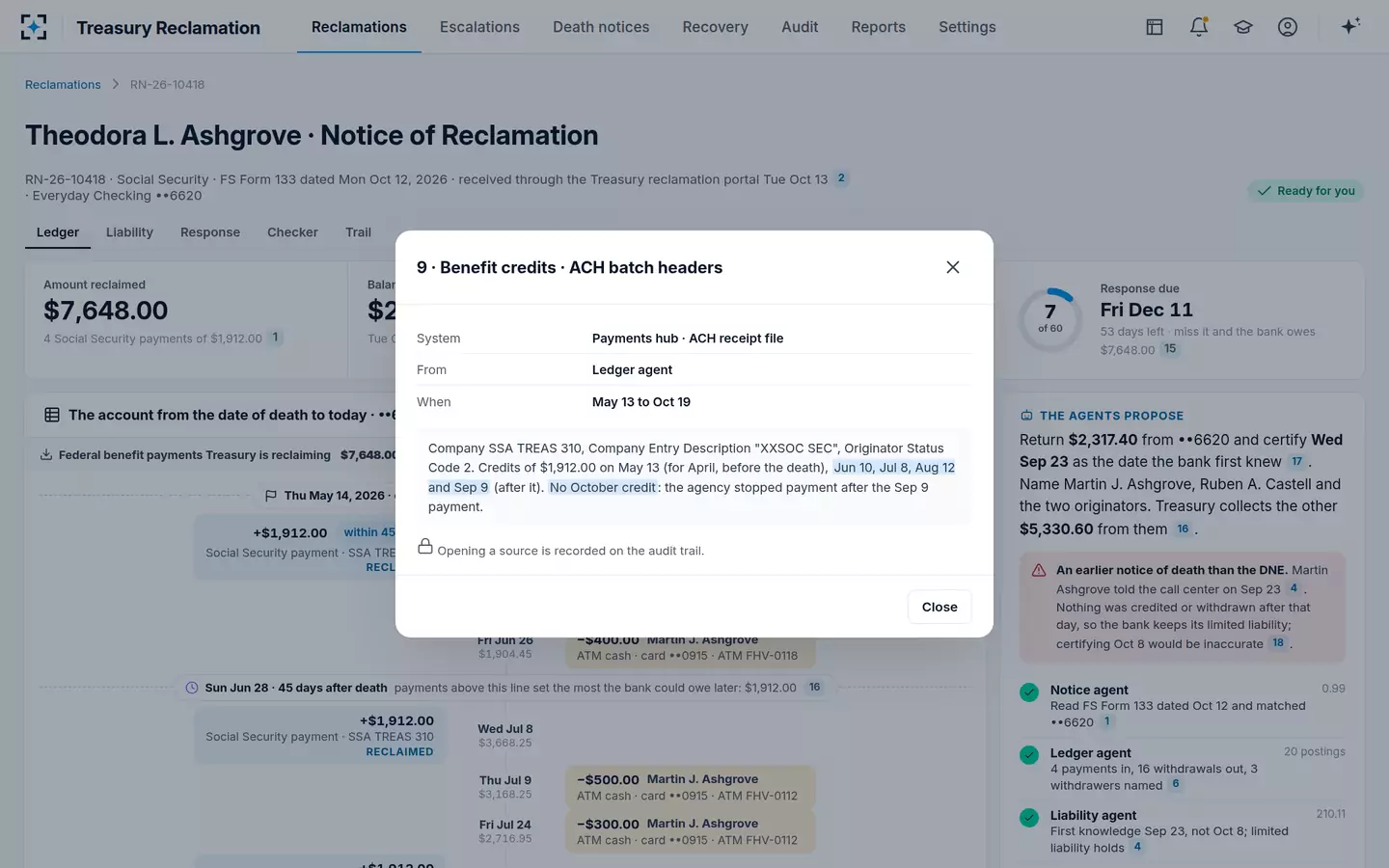
The timing can confuse families, because a payment can arrive in a different month from the one it is for. In the fictional example used in the bank's software, a mother died on May 14. The payment that arrived on May 13 was her April benefit, and it is hers to keep. The payment of June 10 was the May benefit, the month of death, and must go back, as must every payment after it.
Which payments go back, month by month, in the example
- Apr benefit · paid May 13kept
- May benefit · paid Jun 10returned
- Jun benefit · paid Jul 8returned
- Jul benefit · paid Aug 12returned
- Aug benefit · paid Sep 9returned
Families sometimes ask whether they are owed something for the month of death after all. Social Security's leaflet points out that "eligible family members may be able to receive survivors' benefits for the month the beneficiary died", and that a one-time lump-sum death payment of $255 can go to a surviving spouse who lived with the deceased, or, if there is none, to an eligible child. Those are separate benefits you apply for; they are not a reason to keep the parent's payment.
Do I have to return a Social Security payment after death?
You do not have to post a check yourself if the payment came by direct deposit: Social Security's instruction is to ask the bank to return it. If the bank already knows of the death, it will return the next payment without being asked. If you believe part of the money is owed to you, the Treasury's Green Book tells banks what to do: "the RDFI should still return the benefit payment and advise the survivor(s) to contact the appropriate federal benefit agency (see Chapter 7, Contacts) to determine whether a final survivor payment is due" (Green Book, ch. 5).
If you spent money that came in after the death, you may be asked to repay it, but the request comes from Social Security, not the bank, and only after the bank has answered Treasury. The bank is required to name everyone who withdrew from the account after the death, and Social Security writes to those people. Paper checks are different: the leaflet asks families not to cash them and to return them to Social Security.
You can also repay the agency directly. The Green Book says next of kin or the estate can send "a check or money order payable to the authorizing agency (i.e. SSA, VA, OPM, etc.,) directly to them and referencing the ticket number" on the notice. If you do, keep the receipt or a copy of the cashed check: the bank will ask for it, because it is not liable for payments already repaid.
The numbers families meet after a Social Security death
Death month
the first Social Security benefit that must be returned, and every later month
$255
one-time lump-sum death payment to an eligible surviving spouse or child
60
days the bank has to answer Treasury’s notice
45
days Social Security allows a withdrawer to repay before asking Treasury to collect from the bank
Received a Social Security payment after death: what the bank does with it
A bank that received a Social Security payment after a death returns it if it knew of the death when the payment arrived, and otherwise waits for Treasury's notice. The rule is in 31 CFR 210.10: the bank must return any benefit payment received after it becomes aware of the death, however it found out, and the return itself counts as telling Social Security (31 CFR 210.10(a)).
"Aware" covers more than you might expect. The Green Book lists, among the ways a bank learns of a death, a call from a family member, a letter in the mail, a funeral home or probate court, and any request from the estate. It is explicit about executors: once the bank releases money to an executor, or to anyone plainly acting for the person who died or for the estate, the government takes that as proof the bank knew of the death. When an executor closes the account, the bank is treated as knowing from then on; how banks learn that someone has died covers the other routes.
For payments credited before the bank knew, the bank's answer to Treasury decides who pays. It returns the balance in the account when the notice arrived, up to the amount reclaimed, and gives the name, address and phone of everyone who could withdraw and everyone who did. The Social Security reclamation rules explain, from the bank's side, why those names are required.
Social Security payment returned after death: the letter the bank sends
When Treasury reclaims a payment, the bank must send the account owners a copy of Treasury's notice straight away; it is Part 5 of the form, the Notice to Account Owners Copy. Part 210 requires the bank to mail it to the owners' last known address as soon as the notice arrives, and the bank also has to tell the owners of any action it has taken or plans to take against the account.
The letter a family receives, as Treasury Reclamation prepares it
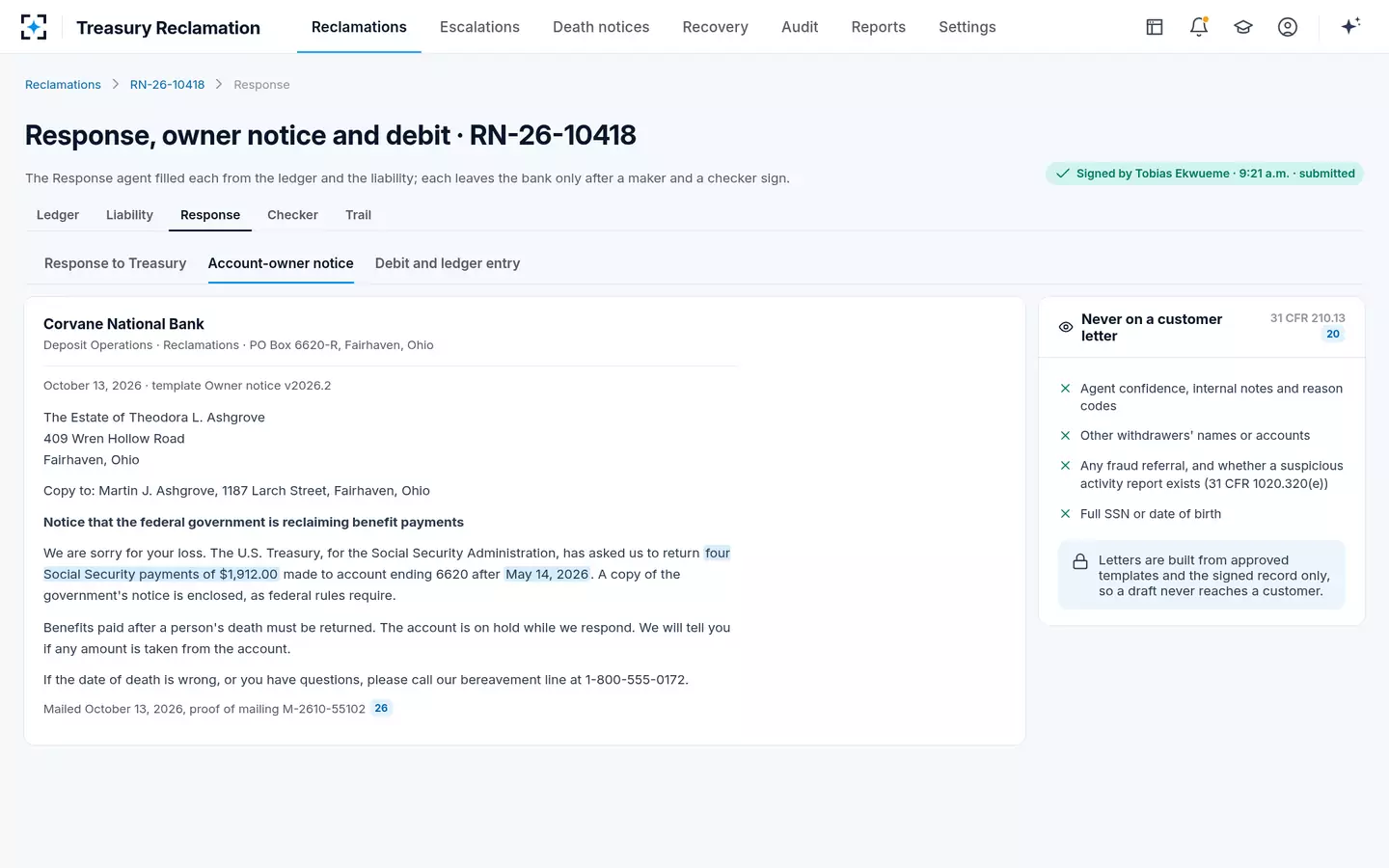
Read the letter for three things: the date of death, which you should check; the payments listed, which should start with the benefit for the month of death; and what the bank says it will do with the account. If the date is wrong, tell the bank at once: the bank can correct the amount with proof of the right date, and only the paying agency can fix it once the case is closed.
The letter is not a bill to you. Whatever the bank recovers from the account, it does so under its account agreement and state law; Part 210 itself gives the bank no right to debit a customer's account (31 CFR 210.12). The Green Book adds that a withdrawer who wants to put money back into the account after seeing the notice may do so, but the government does not require or ask for it.
What happens to the Social Security money when someone dies and the account is joint?
When someone dies and the account is joint, the dead person's Social Security payments for the month of death and later still go back, but the surviving owner's own benefits should keep arriving. The Green Book warns banks against flagging the whole joint account, because a surviving spouse's own benefit can then be returned by mistake as if the survivor had died; the fix it gives is to flag the deceased person by name or Social Security number, or to open a new account with a new direct deposit enrollment (Green Book, ch. 4).
If that mistake happens, the surviving owner should contact Social Security straight away. A payment returned for "death" stops the payments, and the bank's correction alone does not restart them; the person has to ask the agency to.
Joint ownership also means a joint owner who withdrew money after the death will be named to Treasury, like anyone else who withdrew. On the bank's side, co-owners are named even if they never withdrew, because Part 210 asks for all of them.
If the money was already spent: the letter from Social Security
If money paid after the death was spent, Social Security writes to the people the bank named and asks them to repay. Its manual says it mails the withdrawer a notice requesting repayment and allows 45 days for the money to come back; if it is not repaid, it asks Treasury to collect from the bank, which, if it answered Treasury properly, owes no more than the payments that arrived within 45 days of the death (SSA POMS GN 02408.630).
In the fictional example, the mother's son, an authorized signer on her account, took out $3,100.00 at ATMs, and her nephew moved $2,230.60 to his own savings under a power of attorney; two companies also took $1,183.30 in automatic payments she had set up. The bank returned the $2,317.40 left, named all of them, and Social Security's claim for the other $5,330.60 runs to those people first. The bank owes at most $1,912.00 more, and only if Social Security cannot collect.
Each deposit opens its source in Treasury Reclamation, down to the benefit month
What families can do to make it simpler
Most of the friction in a reclamation comes from timing: payments keep arriving because the death has not yet reached Social Security, or reached the bank, and money is spent in the meantime. A few steps make the process shorter and fairer for everyone.
After a parent who received Social Security dies
- Give the funeral director the Social Security number
Social Security says funeral directors usually report the death; that starts its record.
- Tell the bank, and keep a note of when
Once the bank knows, it returns later payments itself, so there is less to reclaim.
- Leave the month-of-death payment alone
It is the first one that must go back; spending it only means a letter later.
- Keep your own benefits separate
If you shared a joint account, make sure the bank flags your parent, not the account.
- Check the date of death on any notice
A wrong date changes which payments are owed; tell the bank with proof.
- Repay the agency directly if you prefer
By check or money order to the agency, quoting the ticket number; keep the receipt for the bank.
- Ask Social Security about survivors’ benefits
You may be due a benefit for the month of death, or the $255 payment, in your own right.
For the bank, the work behind each of those letters is careful and time-bound: 60 days to answer Treasury, every withdrawer named, the right date certified. How banks find the date they first knew of a death covers the bank's side of the timing, and Treasury Reclamation shows how agents prepare the answer and two people at the bank check it before anything is returned.
Questions people ask
Can I keep the Social Security payment for the month my parent died?
No. Social Security says benefits for the month of death and later must be returned. Eligible family members may be able to get survivors' benefits for that month in their own right, which you apply for separately.
Will the bank freeze my parent's account?
When Treasury's notice arrives, the bank has up to one business day to take the balance and, where its account agreement allows, stop further withdrawals of post-death benefits. Beyond that, what happens to the account depends on how it is titled and on state law, which the bank's deceased-account team handles.
How long after a death does the bank get a notice of reclamation?
It varies with how quickly Social Security records the death. In the fictional example, the notice was dated nearly five months after the death, because payments kept arriving until Social Security processed it; the bank then had 60 days to answer.
What if my parent is not actually dead?
Mistakes happen. The person should go to the bank with identification issued after the date of death on the notice, or a letter from Social Security, and contact Social Security to restart payments, because stopping the reclamation does not restart them.
Do the same rules apply to VA or federal pension payments?
Yes. Treasury reclaims VA benefits, federal civil service and military retirement, Railroad Retirement and other federal benefit payments in the same way, through a Notice of Reclamation to the bank. Each agency's own rules decide which payments were not due.