The reclamation 120 day rule says that a federal agency must start a reclamation within 120 calendar days after it first has actual or constructive knowledge of a benefit recipient's death; a Notice of Reclamation sent later can be protested by the bank. It is one of three limits that 31 CFR Part 210 and Treasury's Green Book place on the government rather than on the bank: the 120 days, a six-year limit on how far back payments can be reclaimed, and a three-year limit on when an agency can ask for a final debit of the bank's Federal Reserve account. They matter because a bank answering against its own 60-day clock can overlook that the notice itself was late. Botminds' Treasury Reclamation compares the agency's death record with the notice date on every notice, and puts a late one in front of the deposit operations manager with a protest drafted.
The rules are quoted from Part 210, the Green Book and SSA's operating manual, which describes how SSA answers protests. The sample cases come from a fictional bank whose people and accounts are invented.
Four clocks around one notice, drawn to scale
- Agency’s window to start the reclamation120 d
- Bank’s window to answer in ARPS60 d
- Decision emailed to the bank45 d
- SSA sends proof of when it knew30 d
What is the 120 day rule for reclamation?
The 120 day rule for reclamation is a deadline on the paying agency: "An agency that initiates a request for a reclamation must do so within 120 calendar days after the date that the agency first has actual or constructive knowledge of the death" of the recipient, or of the recipient's legal incapacity (31 CFR 210.10(d)). The bank's own deadline, 60 days to answer, is a separate clock that starts when the notice is issued.
The rule exists because the bank's exposure grows with the agency's delay. Every month an agency keeps paying after it knows of a death is another payment the family can withdraw, and another payment the bank may be asked to cover under the limit. A reclamation started late asks the bank to answer for the agency's slowness.
The same standard of knowledge applies to both sides. Part 210 defines actual or constructive knowledge identically for "an RDFI's or agency's knowledge", so an agency, like a bank, is treated as knowing what it would have learned by following commercially reasonable practices.
When does the agency's 120 days start? Knowledge, and the 2020 presumption
The 120 days start on the date the agency first knew of the death, and since 2020 the regulation presumes that date in a common case. Part 210 says an agency "is presumed to have constructive knowledge of death or incapacity at the time it stops certifying recurring payments to a recipient" if it does not restart the payments and later starts a reclamation for one or more of them (31 CFR 210.10(b)). The provision was added by a Fiscal Service amendment published on March 19, 2020 (85 FR 15721).
The presumption can be rebutted. The Green Book says it does not hold "in cases where an agency can demonstrate that it stopped certifying recurring payments to a recipient for a reason other than death" (Green Book, ch. 5). In practice that gives the bank a fixed point to argue from: the last month the agency paid, rather than whatever date the agency says it learned.
For SSA, the date is also visible in a field the bank already holds. SSA's manual says "The 120-day period is usually counted from the date the death notification entry (DNE) was sent to the FI. However, in some cases the FI protests because it believes we had the death information before that time" (SSA POMS GN 02408.610).
Notice of reclamation 120 day rule: why the DNE date matters to the bank
A bank checking a notice against the 120 day rule should start with the DNE date, because for Social Security it is usually the agency's own starting point. A notice dated more than 120 days after the DNE arrived is a strong candidate for a protest; a notice dated within 120 days of the DNE can still be late if the agency knew earlier, for example because it stopped the payments months before.
The same DNE plays a second role on the bank's side. It is also evidence of the latest date the bank itself knew of the death, which sets its own liability. Death notification entries and the knowledge date covers that side; here the DNE is evidence against the government.
Agencies that do not send DNEs leave the bank with less to go on. The Green Book says only SSA, OPM and RRB currently originate them, so on a VA or military retirement notice the bank's evidence of when the agency knew is usually the date payments stopped arriving.
How to protest a notice of reclamation in ARPS
A bank protests a notice under the 120 day rule by checking the protest box on the electronic FS-133 in ARPS. The Green Book's instruction is one line: "A 120-day protest is filed by checking the appropriate box on the electronic form 133 in Automated Reclamation Processing System (ARPS)." Fiscal Service then works with the agency to decide whether it met the deadline.
A 120-day protest, from the bank's box to Treasury's decision
| Step | Who acts | What happens |
|---|---|---|
| 1 | Bank | Checks the protest box in its ARPS answer to the FS-133, within its own 60 days, with its evidence of when the agency knew. |
| 2 | Fiscal Service | Notifies the paying agency of the protest and asks for proof that it asked in time. |
| 3 | SSA | Responds within 30 days with proof of when it received constructive knowledge and a short narrative; without proof, it is presumed to have known when it stopped certifying payments. |
| 4 | Fiscal Service | Decides, and emails the bank within 45 days: protest valid and the reclamation withdrawn, or denied. |
| 5 | If denied | A bank that qualifies for limited liability is debited only the 45-day amount, the Green Book says. |
The protest does not replace the answer. It is filed as part of the ARPS response, so it must go in within the bank's own 60 days, and the rest of the answer, the balance, the certifications and the persons, has to be complete in case the protest is denied. A denied protest from a bank that did not qualify for the limit leaves the outstanding total.
What a 120-day protest wins, and what it does not
A valid protest ends the reclamation; a denied one leaves the bank where the limit puts it. The Green Book says that if the protest is valid "the RDFI will be notified via email within 45 days and the reclamation action will be withdrawn", and that if it is denied and the bank qualifies for limited liability, "the RDFI will only be debited for the ACH 45-day amount". SSA's manual adds that when a protest succeeds after the bank's Federal Reserve account has already been debited, "the funds due back to the FI will be reversed".
The evidence SSA uses to defend itself is listed in the same manual: a screen print of a development worksheet, the Numident, a report of contact, or archived benefit records showing a suspension, with a short narrative of why SSA had no knowledge of the death before. "If SSA does not provide proof to Treasury, our agency is presumed to have knowledge of death at the time we stop certifying recurring payments."
The bank's side of the argument is usually simpler: the DNE date, the date the payments stopped, or both, set against the notice date. A bank that keeps those dates with each case can protest in minutes; one that has to rebuild them from the payments archive may not bother.
The limits Part 210 and the Green Book put on the government
120
calendar days from the agency’s first knowledge of the death to the reclamation request
6
years back from the notice: the oldest payment that can be reclaimed, unless the balance covers more
3
years from the notice date for the agency to submit a final debit request
45
days for Fiscal Service to email the bank its decision on a protest
Can Treasury reclaim after six years?
Generally no: a post-death payment made more than six years before the date of the notice cannot be reclaimed, with one exception. Part 210 says an agency "may not reclaim any post-death or post-incapacity payment made more than six years prior to the date of the notice of reclamation", unless the balance when the bank receives the notice "exceeds the total amount of post-death or post-incapacity payments made by the agency during such six-year period". In that case the limit falls away, and the bank is liable for all the post-death payments, up to the balance at receipt (31 CFR 210.10(d)).
The exception targets a specific situation: an account where benefits kept arriving for years after a death and nobody spent them. If the money is still there, the government can take it back, however old the payments, but no more than what is in the account. If the money was spent, the six-year limit protects the bank against the older payments.
This is the answer to how far back Social Security can reclaim through the bank. It governs reclamation from the bank; SSA's recovery of overpayments from individuals follows separate rules.
The three-year limit on the final debit
An agency has three years from the date of the Notice of Reclamation to ask for its final debit of the bank. The Green Book says agencies "have up to three years from the date of the FS-133, Notice of Reclamation, to submit final debits requests", and SSA's manual adds that items older than three years "will reject and will not process" (SSA POMS GN 02408.626).
This is the limit on the 45-day amount. When a bank has limited its liability and the agency is still trying to collect from the withdrawers, the debit for the 45-day amount can come months or years later, by an FS-135 Request for Debit. After three years from the notice date it cannot come at all, which is why a bank should keep each case, its ticket number and its 45-day figure at least that long.
There is one more limit, at the other end of the calendar: the bank is not liable for a benefit payment whose effective date is the same as the date of death, according to Green Book chapter 5. A notice that includes one should be answered with that payment excluded.
Reclamation time limits: the bank's and the government's, side by side
Reclamation time limits fall into two groups: the bank's, which cost it the limit if missed, and the government's, which cost the government the claim. Mixing them up is how a bank ends up answering a notice it could have protested, or protesting while letting its own answer lapse.
Every reclamation time limit, and whom it binds
| Time limit | Binds | Runs from | If missed |
|---|---|---|---|
| 120 calendar days | Paying agency | Agency’s first actual or constructive knowledge of the death | Bank may protest; if valid, reclamation withdrawn |
| Six years | Paying agency | Back from the date of the notice | Older payments cannot be reclaimed, unless the balance covers more |
| Three years | Paying agency | Date of the FS-133 | Final debit request rejected |
| One business day | Bank | Receipt of the notice | Balance taken at the end of the window anyway |
| Immediately | Bank | Receipt of the notice | Owner notice late; liability for any resulting loss |
| 30 days | Bank | Date of the FS 2942 follow-up | Right to limit liability forfeited |
| 60 calendar days | Bank | Issue date of the notice | Debit for the outstanding total |
| 15 business days | Bank | The ARPS response | Supporting papers, such as a death certificate, arrive late |
The 60-day and 120-day clocks interact in one way worth planning for. A protest has to be filed inside the bank's own 60 days, so the 120-day check belongs at the start of the work on each notice, not the end. What ARPS asks for, and what it leaves to the bank covers where the protest sits in the answer.
How Treasury Reclamation catches a late notice
The solution checks the government's deadlines as part of reading each notice. Its agents compare the agency's death entry with the notice date and, where the gap passes 120 days, raise an escalation with a protest drafted; in the sample bank, one notice was dated 276 days after the death entry. The agents may not file the protest: the deposit operations manager decides and signs it, and the specialist still prepares the full answer inside the 60 days.
Treasury Reclamation's audit trail, where every date change is kept
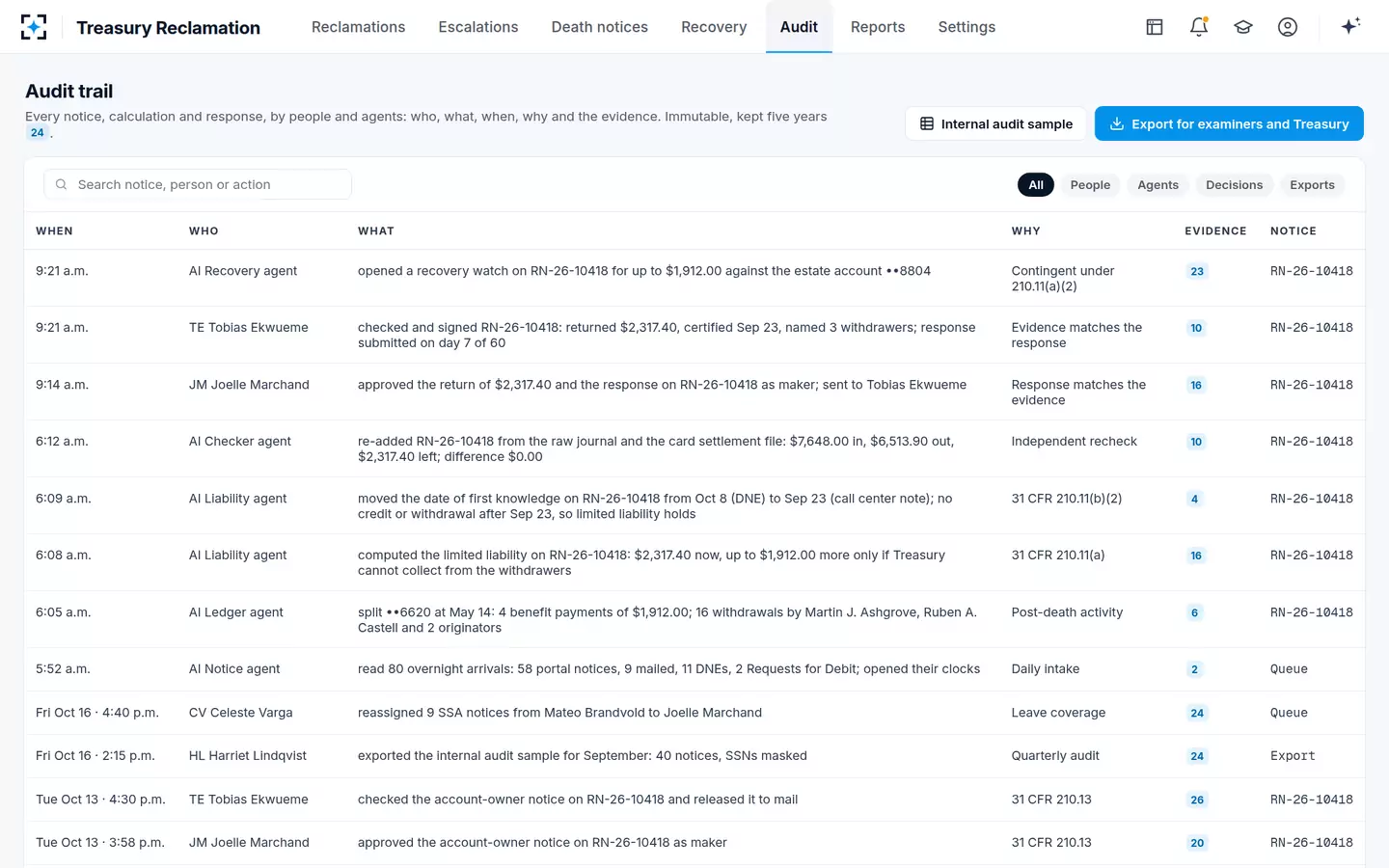
The other limits are worth the same habit: on each notice, check the oldest payment against the six-year line, look for a payment dated on the date of death, and match any later debit to its notice and ticket number before accepting it. Treasury Reclamation shows the late-notice escalation and the others on the sample notices.
Questions people ask
Does the 120 day rule give the bank 120 days to respond?
No. The 120 days bind the agency, which must start the reclamation within 120 days of knowing of the death. The bank has 60 calendar days from the notice date to answer, with a follow-up notice giving 30 more days from its own date before the limit is forfeited.
Who decides whether a protest is valid?
The Bureau of the Fiscal Service, after asking the paying agency for its evidence. SSA's manual gives SSA 30 days to respond with proof of when it learned of the death, and the Green Book says the bank is told the result by email within 45 days.
What if the bank was already debited when the protest succeeds?
SSA's manual says that when Treasury decides the request was too late and the bank's Federal Reserve account has already been debited, the funds due back to the bank are reversed.
Does the 120 day rule apply to VA and OPM reclamations?
Yes. The rule in 31 CFR 210.10(d) applies to any agency that initiates a reclamation of benefit payments. What differs is the evidence: SSA, OPM and RRB send DNEs, while for other agencies the bank usually has only the date payments stopped.
Is the six-year limit the same as the three-year limit?
No. The six-year limit looks back from the notice date and decides which payments can be reclaimed at all; the three-year limit runs forward from the notice date and decides how long the agency has to ask for its final debit of the bank.