The Social Security reclamation rules, set by SSA's operating manual and Treasury's 31 CFR Part 210, fix who repays benefits deposited after a beneficiary's death and in what order: SSA records the death and asks Treasury to reclaim the payments that were not due; Treasury sends the bank a Notice of Reclamation, FS Form 133; the bank returns what is still in the account and names everyone who could or did withdraw after the death; SSA writes to those people for the rest; and only if they do not repay does Treasury debit the bank, for no more than the payments received within 45 days of the death. The names are the hinge. Under 31 CFR 210.11 a bank that leaves out a co-owner, an authorized signer or a withdrawer cannot limit its liability, so an incomplete list turns the family's withdrawals into the bank's loss. Botminds' Treasury Reclamation builds that list from the card processor, the teller journal and the ACH originators, and a second person checks it before it goes to Treasury.
The examples come from a fictional sample bank, Corvane National Bank, and its invented customers. SSA's side of the process is quoted from its Program Operations Manual System (POMS); the bank's from Part 210 and the Green Book.
Where the sample account's money went after the death
$8,831.30: $1,183.30 at death plus $7,648.00 of Social Security
- Son, 7 ATM withdrawals: $3,100.00 · 35%
- Nephew, branch transfer: $2,230.60 · 25%
- Two billers, 8 automatic payments: $1,183.30 · 13%
- Still in the account at the notice: $2,317.40 · 27%
What is SSA reclamation, and how does it work? SSA's sequence, step by step
SSA reclamation is the Social Security Administration's recovery, through Treasury, of benefits paid by direct deposit after a beneficiary died. It is "mainly automated", SSA's manual says, and follows a fixed order from SSA's death record to Treasury's debit of the bank (SSA POMS GN 02408.600). The bank enters at step five and leaves at step six; everything after is between SSA, Treasury and the people the bank named.
SSA's reclamation sequence, and where the bank comes in
| Step | Who acts | What happens |
|---|---|---|
| 1 | SSA | Receives death information, or matches it from states or other agencies, and records it. |
| 2 | SSA | Terminates the record for death. |
| 3 | SSA | Sends a Death Notification Entry to the beneficiary’s bank. |
| 4 | SSA | Sends an electronic stop request (E-stop, SF-1184) asking Treasury to reclaim post-death direct deposits not yet returned. |
| 5 | Treasury | Sends the bank a Notice of Reclamation, FS-133. |
| 6 | Bank | Returns all, part or none of the payments; where part or none, names the withdrawers. If it does not comply, Treasury has the Federal Reserve debit it. |
| 7 | SSA | Writes to the withdrawers the bank named, at the addresses it gave. |
| 8 | SSA | If funds cannot be recovered from them, completes the FS-133 and returns it to Treasury. |
| 9 | Treasury | Debits the bank’s Federal Reserve account for the limited liability amount. |
Two features of that sequence decide the bank's experience. Steps 3 and 4 both follow the death record, so the DNE and the notice can arrive close together; in the sample they were four days apart. And steps 7 to 9 can take a long time, because the agency must try to collect before it asks for the 45-day amount; agencies have three years from the date of the notice to submit that final debit (SSA POMS GN 02408.626).
Social Security reclamation rules: which payments are not due
For Social Security retirement, survivors and disability benefits, the payment for the month of death is not due. SSA's manual is exact: "For Title II, a payment for the month of death or later is not due and must be reclaimed. For Title XVI, a payment for any month later than the month of death is not due and must be reclaimed" (SSA POMS GN 02408.610). Title II is Social Security; Title XVI is Supplemental Security Income.
The rule runs by the month a payment is for, not the day it lands. In the sample, the beneficiary died on May 14; the credit of May 13 was the benefit for April and is not reclaimed, while the June 10 payment, the benefit for May, the month of death, is the first one on the notice. A bank reading a notice should check each payment's month against the date of death.
Payments to a representative payee follow a different rule. SSA treats a payment sent to a payee after the beneficiary's death as an overpayment that needs due process, and says it "will not reclaim funds when the beneficiary had a representative payee, even following the conclusion of due process". Those cases do not reach the bank as reclamations.
Why the bank names every withdrawer
The bank names every withdrawer because the limit on its liability depends on it. To qualify, Part 210 says, the bank must "provide the name, last known address and phone number, as shown on the RDFI's records" of the recipient and any co-owner, of "all other person(s) authorized to withdraw funds from the recipient's account", and of "all person(s) who withdrew funds from the recipient's account after the death" (31 CFR 210.11(b)(3)). If a category is empty, it must certify that no information is available and why.
The list is wider than the people who took money. An authorized signer who never withdrew is still named; so is a co-owner. SSA's manual describes the purpose plainly: "To qualify for limited liability, an FI must report the name, last known address, and phone number of any person who have withdrawn, or had authorization to withdraw funds subject to reclamations" (SSA POMS GN 02408.630). For Title II, if the bank cannot provide them, it "must explain in writing why this information is not available" (SSA POMS GN 02408.625).
The persons on the sample response, and where each name came from
| Category in 210.11(b)(3) | On the sample response | Where the bank found it |
|---|---|---|
| Recipient | Theodora L. Ashgrove | Customer file |
| Co-owner | None: sole owner since 1998 | Account ownership in the core |
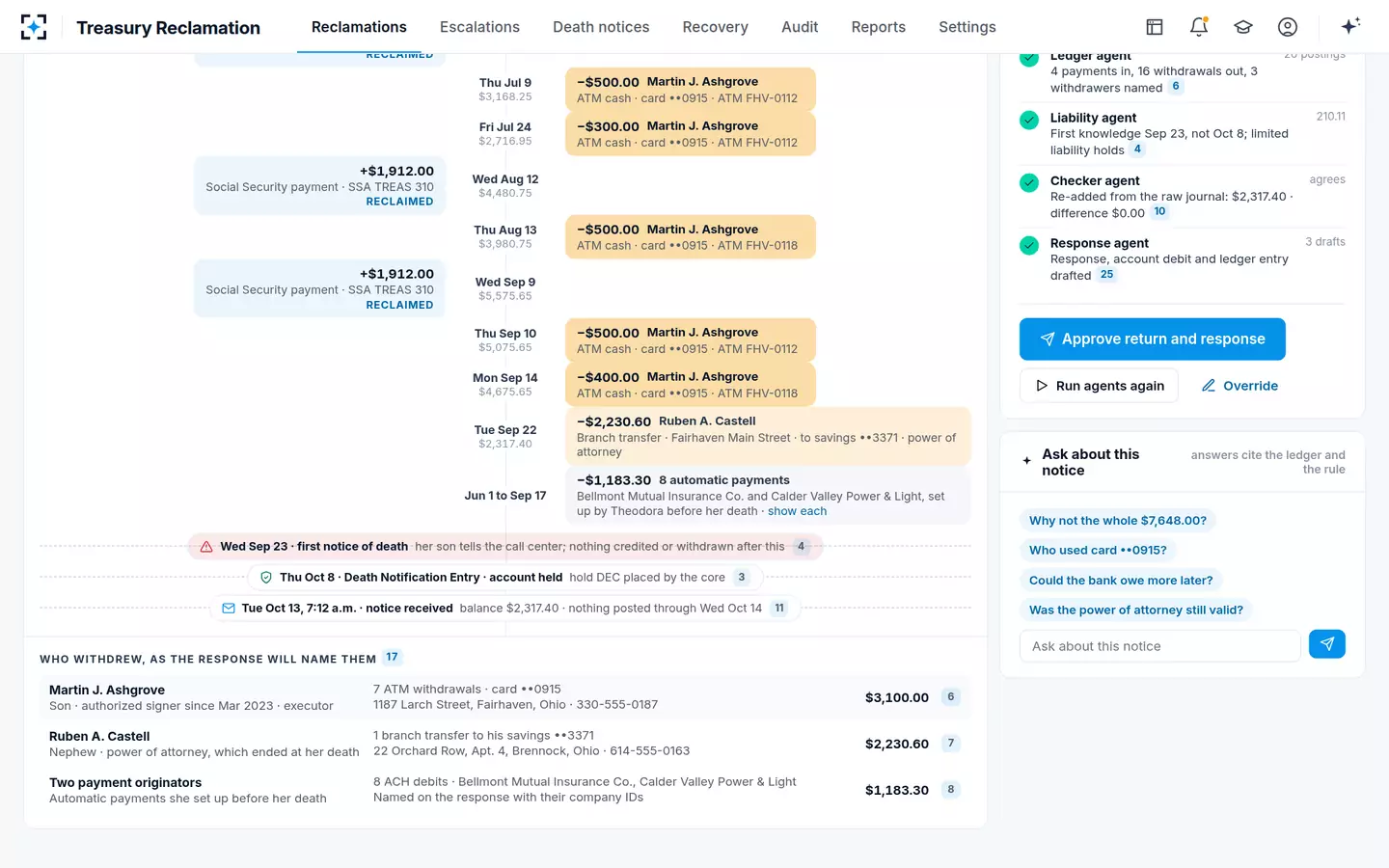
| Authorized to withdraw, and withdrew | Martin J. Ashgrove, son, authorized signer: 7 ATM withdrawals, $3,100.00 | Card processor: card ••0915 issued to him in March 2023 |
| Withdrew after the death | Ruben A. Castell, nephew: branch transfer of $2,230.60 to his own savings, under a power of attorney | Teller journal: the presenter of the Sep 22 transfer |
| Withdrew after the death | Two payment originators: 8 automatic payments, $1,183.30 | ACH debits in the payments system, with company IDs |
Every name in that table came from a different system, which is why the list is slow and error-prone by hand. A card withdrawal identifies a card; a teller transaction identifies a teller; an automatic payment identifies a company. None of them is a person's name and address until another system is asked, and each is a place where a busy desk can stop one step short.
Treasury Reclamation's withdrawer list, as the response will name them
Who is responsible for Social Security payments after death?
The people who withdrew the money are the first ones SSA pursues; the bank is responsible for what was in the account when the notice arrived, and later, only if collection fails, for a capped amount. The Green Book describes the order: if the bank qualifies for limited liability, the reclamation "will be temporarily suspended, and the authorizing federal agency will attempt to collect the outstanding total from the withdrawer(s)" (Green Book, ch. 5).
That allocation is why the bank's answer matters to the family as well. A complete list sends SSA's collection to the people who had the money; an incomplete one leaves the bank with full liability, and the bank then decides, under its own contract and state law, whether to pursue anyone. On the sample notice, the bank returned $2,317.40, and SSA's claim for the other $5,330.60 runs first against the son, the nephew and the two companies.
Executors and estates are covered too. The Green Book counts any release of funds to an executor or other party acting for the estate as evidence that the bank knew of the death, and SSA's letters can go to anyone the bank named, including a representative of the estate who withdrew.
The social security reclamation letter: what SSA sends the people the bank named
The social security reclamation letter is SSA's notice to a withdrawer asking for repayment. For Title II, SSA's processing center reviews the FS-133, records what the bank returned, and "mail[s] a notice (the E3595 or overpayment notice) to the last withdrawer requesting repayment of any outstanding funds withdrawn from the account", then sets a 45-day diary for the money to come back (SSA POMS GN 02408.630). Which letter goes depends on whether the person is a beneficiary and the payment counts as their own overpayment.
What happens next depends on the reply. If the withdrawer repays in part, SSA tells Treasury what it collected, and the rest still due is debited from the bank's Federal Reserve account through the FS-135 Request for Debit. If the withdrawer does not respond within 45 days, SSA asks Treasury to reclaim, and Treasury debits the bank and sends SSA the FS-135. The bank's exposure in that debit is the 45-day amount, capped by what is still outstanding.
Larger cases take a different path. When a reclamation involves at least seven payments and more than $15,000 outstanding, Treasury forwards a copy to the U.S. Secret Service, and SSA receives the FS-133 marked that the agency "should not attempt collection until response received from USSS". Where more than $5,000 remains unavailable after the bank's return, SSA refers the case to its Office of the Inspector General before contacting the last withdrawer (SSA POMS GN 02408.626).
Social Security reclamation after death: the timeline
A Social Security reclamation after death usually runs over months: from the death to SSA's record, to the DNE and the notice, to the bank's 60 days, to SSA's 45-day wait on each withdrawer, and, for the 45-day amount, up to three years from the notice to the final debit. The sample account shows the front of that timeline: death on May 14, four payments credited from June 10 to September 9, the DNE on October 8, the notice dated October 12 (Columbus Day, a federal holiday) and received the next day, and the bank's answer on October 19.
How consistently SSA uses Treasury's reclamation process
95 of 100
sampled deceased beneficiaries for whom SSA used the Treasury reclamation process
5
sampled beneficiaries with no reclamation request: $49,922 paid after their deaths went unrecovered
118,414
deceased beneficiaries SSA paid after death, January 2017 to January 2025, in the review’s data
5,921
beneficiaries the Inspector General estimates SSA did not reclaim for
The Inspector General's June 2026 review gives the only recent public measure of the process from SSA's side. In a random sample of 100 deceased beneficiaries who were paid after death, SSA used Treasury's reclamation process for 95; for three of the other five, staff closed system alerts without submitting the requests, and for two the system raised no alert (SSA OIG, June 26, 2026). From the bank's side, a notice not sent is a payment it is never asked to return; the review is a reminder that the notice it does receive reflects SSA's records, which the bank should check against its own.
What does the bank do when Social Security takes money back?
When Social Security reclaims through Treasury, the bank returns what it owes from its own funds and decides separately whether to recover anything from the customer's account or estate. Part 210 is clear that it gives the bank no such right: "This subpart does not authorize or direct an RDFI to debit or otherwise affect the account of a recipient." Any right the bank has comes from state law or its deposit contract, and its liability to the government is the same whatever it recovers (31 CFR 210.12).
The Green Book applies the same line to withdrawers: if the money has already been withdrawn when the bank learns of the death, the government does not authorize or direct the bank to recover it from the withdrawer, and "if the RDFI does so, it acts under its own authority". The bank must still tell the account owners: the copy of the notice goes to their last known address immediately, and Certification No. 1 confirms they were told of any action against the account.
In the sample, the bank debited the account for the $2,317.40 balance, booked the general ledger entry, and linked the withdrawers to the deceased-account case so that, if a Request for Debit for the $1,912.00 45-day amount arrives later, a claim against the estate can be prepared. Each of those steps waited for the checker's signature. The 31 CFR 210.11 calculation sets out why $1,912.00 is the most that later debit can be.
How Treasury Reclamation builds the withdrawer list
The solution's agents split the account at the date of death, classify each debit by channel, and name each withdrawer from the system that recorded the withdrawal: the card holder from the card processor, the presenter from the teller journal, the originator from the ACH file, each with the address and phone the bank holds. An agent never names a withdrawer below a 0.98 confidence threshold and never certifies a withdrawer as unidentified; that decision, and the written reason Part 210 requires, belong to a person.
A second agent re-reads the card settlement file and the teller journal independently and confirms the same names. The specialist approves the list as maker and the checker signs; a withdrawer the agents cannot identify becomes an escalation, as one sample notice did on day 44. The other withdrawers' names and accounts never appear on the letter to the account owners. Social Security payments after the death of a parent explains the same process for the family, and the sample notices are on the Treasury Reclamation page.
Questions people ask
What is a Social Security notice of reclamation?
It is the FS Form 133 that Treasury's Bureau of the Fiscal Service sends a bank when SSA asks it to recover benefit payments made after a death. It lists each payment, the date of death and the amount the bank may owe, and the bank must answer within 60 calendar days.
Does SSA contact the family before the bank?
Not as part of the reclamation. SSA's sequence sends the DNE and the reclamation request first, and writes to withdrawers only after the bank's response has named them. A family may hear from the bank first, through the copy of the notice the bank must send the account owners.
What if the bank cannot find out who withdrew?
It must certify that no information is available and explain why, under 31 CFR 210.11(b)(3)(ii). A missing name the bank could have found is an inaccurate certification, and the bank is then liable for any loss it causes.
Can SSA take money from the person who withdrew without going through the bank?
SSA writes to the withdrawers directly, at the addresses the bank supplied, and asks them to repay. If they pay SSA in full, the bank's remaining exposure falls away; the Green Book says the bank is not liable for post-death payments already repaid to the agency.
Does the bank tell SSA who withdrew for SSI as well?
Yes. SSA's manual says the bank must give the name and address of the last withdrawer on the FS-133 for both Title II and Title XVI reclamations; for SSI, SSA's field office then contacts the withdrawer.