How long it takes a bank to release funds after a death depends on two things: how each account was titled, and how long the bank itself takes to read and act. A joint account with right of survivorship belongs to the survivor at once and need not be frozen at all. A payable-on-death account can be paid as soon as the bank has proof of death and each beneficiary’s identity, usually within days to a few weeks. A sole account with no beneficiary waits on legal authority: letters from a probate court, or a small-estate affidavit that some states allow only after a waiting period, 60 days in Virginia. Federal benefits paid after the death wait for Treasury. On top of all that sits the bank’s own queue, which by hand is often the longest wait of all. Botminds’ Deceased Account Processing is built to shrink that queue, and this guide prices each part of the calendar.
The figures that follow come from the solution’s design estimate for a fictional credit union, Norrell Federal Credit Union, at 260 death notices a month and about 3.4 accounts each, and from one fictional sample estate. They are an estimate and a design target, not a measured result at any institution; the legal periods are real and linked.
Where a median estate’s 34 days go by hand, and the 11 the solution targets
- Prove the death, freeze5 d
- Pull cards and forms6 d
- Decide each account5 d
- Find federal benefits4 d
- Check affidavit, letters, payees6 d
- Family, payouts, letters8 d
- Prove, pull, decide, find benefits3.5 d
- Check affidavit, letters, payees3 d
- Family, payouts, letters4.5 d
How long does a bank hold money after death?
No federal rule sets a single holding period for a deceased customer’s deposits. Each account waits only as long as its titling requires, and a bank that freezes everything until the slowest document arrives is choosing to hold money the law would let it release. The table puts the usual waits side by side.
What each kind of account legally waits for before the bank can release it
| Account | What it waits for | Typical wait | Legal basis (example) |
|---|---|---|---|
| Joint with right of survivorship | Nothing: the survivor may keep using it; retitling needs proof of death | None to a few days | Va. Code § 6.2-613: payable to any party regardless of another’s death |
| Payable on death, in trust for | Proof of death and proof each beneficiary outlived the owner; beneficiary identity | Days to a few weeks | Va. Code § 6.2-614 |
| Sole, small estate | The state’s affidavit, its dollar limit and any waiting period | 60 days or more in Virginia | Va. Code §§ 64.2-601, 64.2-602 |
| Sole, larger estate | Letters testamentary or of administration from the probate court | As long as the court takes | State probate law |
| Federal benefit paid after death | The paying agency’s notice of reclamation, then the bank’s answer | Until the notice; then up to 60 days to answer | 31 CFR 210; Treasury Green Book, chapter 5 |
| Disputed account | Agreement of the parties or a court order, after written notice not to pay | Open-ended | Va. Code § 6.2-616(D) |
Joint and payable-on-death accounts: days, not months
A survivor’s joint account and a payable-on-death account pass outside the estate, so neither should wait for probate. Virginia’s statute is explicit that transfers by survivorship or beneficiary designation “are effective by reason of the account contracts involved” and “are not to be considered as testamentary” (Va. Code § 6.2-610). What the bank needs is proof, not permission.
For a joint account the proof is light. Virginia lets the bank pay any party to a joint account on request, even if another party has died (Va. Code § 6.2-613), so the survivor’s access need never stop; retitling the account into the survivor’s sole name follows when the certificate arrives. For a payable-on-death account, the bank pays the beneficiary on proof of death showing the beneficiary survived every owner (Va. Code § 6.2-614); Florida’s statute gives the same instruction (Fla. Stat. § 655.82(6)). The work is identifying each beneficiary, which for a beneficiary who is not a customer means identity checks and a call-back. On the sample estate, the $25,000 certificate split between two adult children was paid 16 days after the first call, and the two days before release were spent reaching the son, who lives in another state.
Can a bank release funds without probate?
Yes, in three common cases: survivorship and payable-on-death accounts, which never pass through probate; small estates, under a state’s affidavit or summary procedure; and, in some states, small balances paid without even an affidavit. What a bank cannot do is pay a sole account’s balance to a relative simply because they are next of kin.
The small-estate routes are where the days are set by statute. Virginia requires an affidavit by all known successors stating that the personal probate estate “does not exceed $75,000” and that “at least 60 days have elapsed since the decedent’s death” (Va. Code § 64.2-601). For a single asset of $35,000 or less, a Virginia holder may pay a successor without an affidavit, but still only after the same 60 days and only if no personal representative has been sought (Va. Code § 64.2-602). Florida’s summary administration, by contrast, is a court proceeding, available where the estate subject to administration is not more than $150,000 “or that the decedent has been dead for more than 2 years” (Fla. Stat. § 735.201, as amended in 2026). States amend these figures often, so a bank should apply the limit and waiting period in force on the date of death, not on the date the affidavit arrives.
The clocks the law sets on a deceased customer’s accounts, in days
What the bank’s own queue adds
By hand, most of an estate’s calendar is the bank’s own work, and the slowest part is retrieval. In the design estimate above, pulling signature cards and beneficiary forms from document imaging takes six days of a 34-day median, and finding the federal benefits paid after the death takes four more. Neither is waiting on the family; both are a specialist working through other estates’ files first, one account at a time.
What the 34 days are made of, by hand
Median estate, fictional credit union (design estimate)
- Reading and retrieval: cards, forms, benefits · 29%
- Deciding and checking: titling, affidavit, payees · 32%
- Proving the death and freezing · 15%
- Waiting on the family, payouts and letters · 24%
Retrieval is slow for a structural reason. The documents that decide a deceased customer’s accounts were signed when the accounts were opened, often decades earlier, and have lived through system conversions since. The sample estate’s sole savings card was signed in 1988 and re-indexed in a 2011 conversion; its joint checking card dates from 2004; the certificate’s beneficiary designation is dated 2025. A specialist has to find all of them, confirm none was superseded, and read each one, for every account the customer held, before a single decision can be made.
The design target takes reading and retrieval from ten days to one, because six agents read every card, form and transaction in minutes once the documents arrive. Deciding and checking falls less, from eleven days to four, because the decisions stay with people: the specialist approves the plan and a second officer releases each payout. The part the solution cannot remove is the family’s and the court’s, which is why the last segment shrinks least.
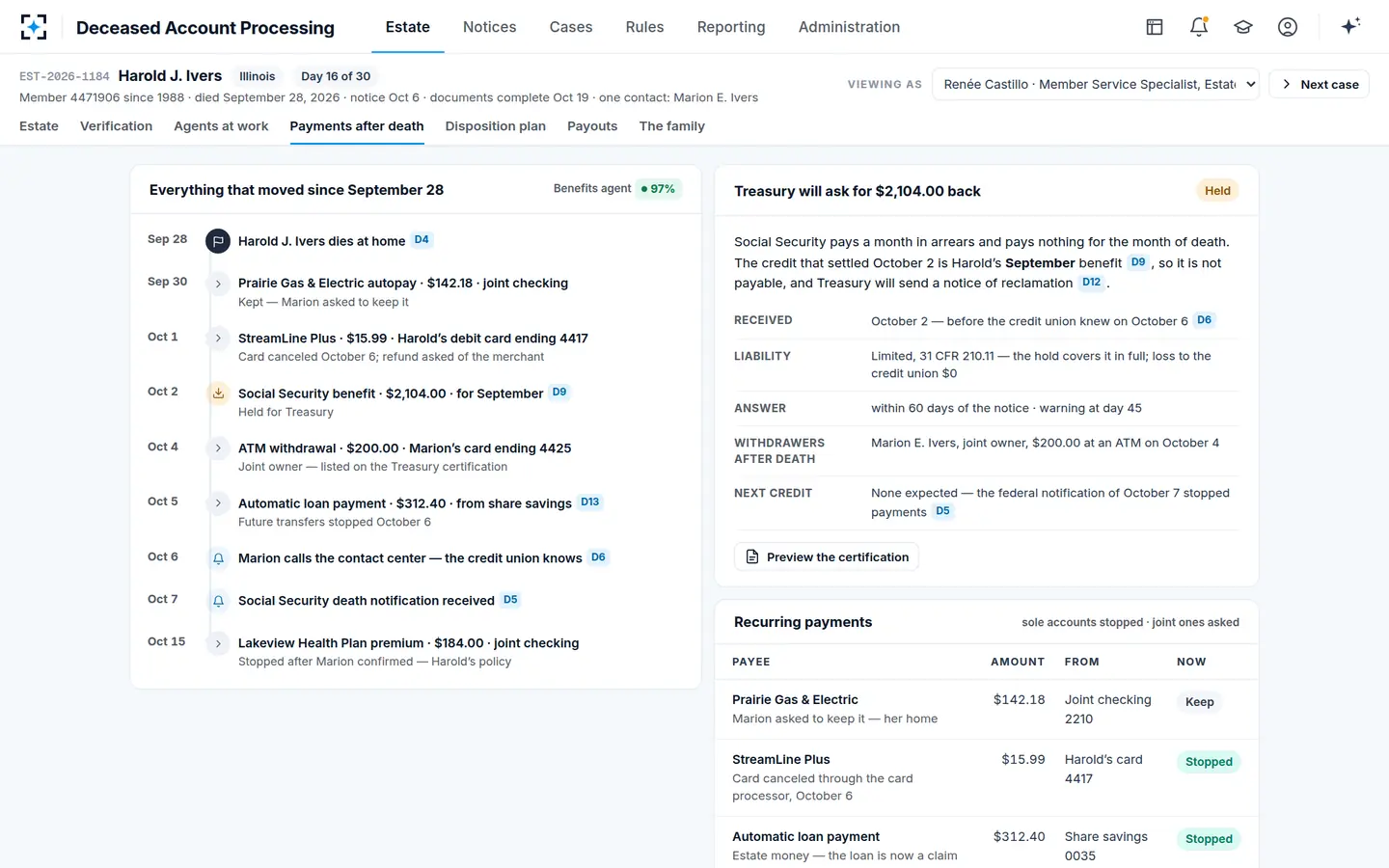
Every payment since the death on one timeline, with the benefit held before Treasury asks
What does each open week cost the bank?
An estate left open costs the bank in three ways: exposure on federal benefits, calls from the family, and money moving that should not. None is a fee; each is risk or time.
The federal exposure is the sharpest. A bank is liable for every benefit payment received after a death unless it qualifies for limited liability, and once it knows of the death it must return any benefit it receives, however it learned of the death (31 CFR 210.10(a)). Even limited liability starts from the account: the bank returns the lesser of the outstanding total and the account’s balance, taken once it has had up to one business day to act on the notice of reclamation and topped up by any benefits paid in before it answers in full; and if the agency cannot collect the remainder, it owes the lesser of the benefits received in the 45 days after the death and what is still outstanding (31 CFR 210.11(a)). An estate that sits open with a benefit credited and not held is an estate where money can leave before the notice, and the bank’s share of the loss grows with it.
The second cost is the family’s calls. The CFPB’s guide for surviving spouses spells out a reason they come: “If your spouse was receiving benefits, SSA does not pay them for the month of their death,” and a payment for that month “will need to be returned to SSA” (CFPB, Help for Surviving Spouses). A survivor who reads that and sees a benefit sitting in a joint account will ring the bank to ask what happens to it. A bank that has already held it, and said so in its first letter, does not get the call.
The third is money moving on its own. Automatic payments keep debiting a sole account until someone stops them, and some of them are the deceased’s obligations while others are household bills the survivor wants kept. Each week open is another cycle of debits to sort out.
Faster everywhere except the federal benefit
Speed is the right goal for every account except one: a federal benefit credited after the death should be held, not released, until the paying agency asks for it. The two goals do not conflict, because they apply to different money.
The reason is the shape of the bank’s liability. Treasury’s rules make a bank liable for post-death benefit payments in full unless it qualifies for limited liability, and the limited amount is measured first against the balance in the account when the notice of reclamation arrives (31 CFR 210.11(a)). A bank that pays the survivor, the beneficiaries and the estate quickly, but holds the benefit, settles the family’s money fast and keeps the government’s money in place. A bank that releases everything quickly, benefit included, has turned a reclamation it could answer from the account into a loss it may have to cover.
The answer to Treasury has its own clock once the notice arrives: the bank has 60 calendar days from the date the reclamation is issued to answer it fully and accurately. If no answer arrives within 30 days, or the answer is incomplete, a follow-up notice goes out, and a bank that has not answered within 30 days of that notice loses its right to limited liability (Green Book, chapter 5; see the Treasury reclamation process and reclamation liability). In the solution, the answer is drafted the day the hold is placed, with the knowledge date and the withdrawers already listed, so the notice can be answered on the day it arrives.
How long can a bank hold funds after death?
As long as the account’s legal claimants have not shown their right to it, and indefinitely if they dispute it. A sole account with no beneficiary is held until someone with authority over the estate appears; the OCC’s banking glossary describes the deceased’s account as frozen until a court orders who now owns the money (OCC, HelpWithMyBank.gov).
Disputes extend the hold by design. Under Virginia’s statute, if any party or personal representative “notifies the financial institution in writing not to permit withdrawals by any party, the financial institution may refuse, without liability, to allow any withdrawal pending the determination of the rights of the parties” (Va. Code § 6.2-616(D)). And if no one claims the account at all, it eventually leaves the bank’s books as unclaimed property: Delaware, for example, presumes a deposit abandoned five years after the owner’s last indication of interest in it, or after a time deposit’s maturity if that comes first (Del. Code tit. 12, § 1133).
The insurance clock runs alongside. The FDIC insures a deceased owner’s deposits as if the owner were alive for six months, unless the account is restructured sooner, and after that insures them according to who actually owns them (12 CFR 330.3(j)); the NCUA’s rule for credit union members is the same six months (12 CFR 745.2(e)). An estate still open at month six has a coverage question as well as a service one; FDIC insurance on payable-on-death accounts works through it.
Where the days go on one sample estate
On the fictional sample estate, the calendar ran like this. Harold Ivers died on September 28. His widow called on October 6, and within seventeen minutes his card was canceled and his sole savings frozen, with the joint checking left open. The Social Security credit of October 2 was held the next morning, when the federal death notification arrived. The family brought the certified certificate and an affidavit to a branch on October 19, the agents read everything that afternoon, the son was called back on October 21, and the plan was approved and four payouts released on October 22: day 16 of a 30-day target. The federal credit stays held until Treasury’s notice comes.
A sole savings account paid under a small-estate affidavit, checked against the rule for the date of death
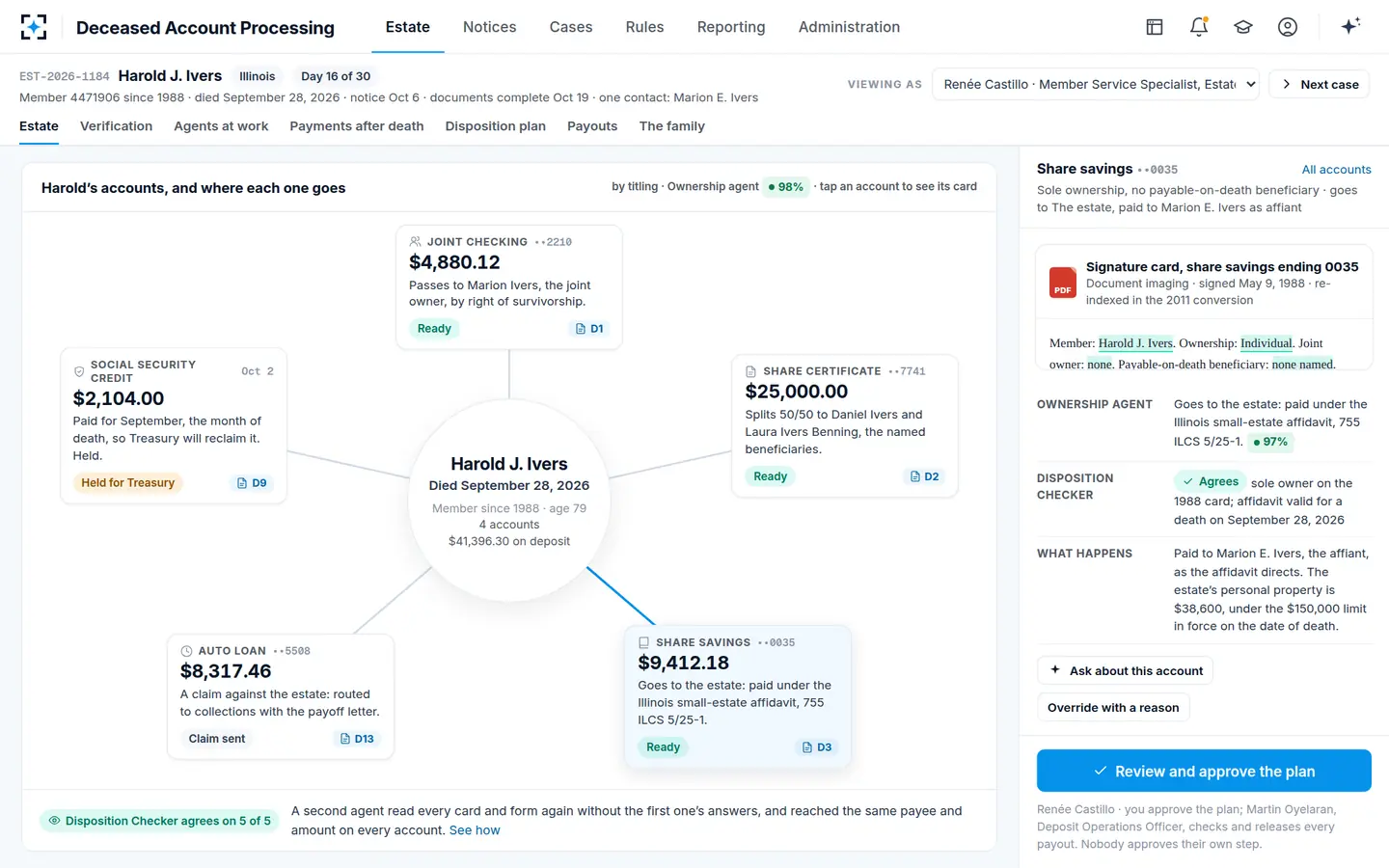
Two things in that calendar are worth copying whatever system a bank uses. The freezes were narrow and fast, so the survivor never lost access to her own account. And every wait after the first day had a named owner, the family, the son, Treasury, so the specialist could tell the family on the first call what would happen and roughly when. The bank bereavement process, seat by seat maps those dependencies, and the titling tree shows which clock applies to which account. The full estate is on the Deceased Account Processing page.
Questions people ask
How long do banks freeze accounts when someone dies?
A sole account stays frozen until someone with legal authority claims it: a beneficiary with proof of death, a small-estate successor after the state’s waiting period, or a personal representative with letters from the court. A joint account with right of survivorship should not be frozen for the survivor at all; only the deceased owner’s card and access are stopped.
How long does a payable-on-death account take to pay out?
Usually days to a few weeks after the bank receives proof of death and each beneficiary’s identity. The statute lets the bank pay once it has proof that the beneficiary survived the owner. Delays come from beneficiaries who are hard to reach or not customers, and from old designations the bank has to find.
How long does a joint account take to transfer after death?
The money does not need to move: a joint account with right of survivorship belongs to the survivor, who can keep using it. Retitling it into the survivor’s sole name and canceling the deceased’s card follow once the bank has proof of death, often in a single visit.
Why is the bank holding a Social Security payment after a death?
Because a federal benefit paid after the death will usually be reclaimed, and once the bank knows of the death it must return such payments under 31 CFR 210. Holding the credit until Treasury’s notice arrives means the bank can return it from the account rather than from its own funds, and nobody in the family is later asked to repay money already spent.
What happens if no one claims a deceased person’s account?
It stays frozen until the account goes dormant under state unclaimed-property law, and the bank then reports and remits the balance to the state, which holds it for the heirs. Delaware, for example, presumes a bank deposit abandoned five years after the owner’s last indication of interest, or a time deposit’s maturity if earlier.