A deceased account checklist is the list of what a bank or credit union must have in hand, and on file, before it pays out any account of a customer who has died. Most checklists are written as a document list: death certificate, letters, affidavit, identification. That is necessary but not enough, because the question an auditor, examiner or Treasury asks is never “did you collect a certificate?” It is “why did this money go to this person, and when did you know?” A defensible file answers three questions for every account: which document decided where it went, the date the bank first knew of the death, and what happened to every federal benefit credited after it. Botminds’ Deceased Account Processing assembles that file as the agents work; this guide uses it to build the checklist.
The example is a fictional sample estate at the fictional Norrell Federal Credit Union: Harold J. Ivers, who died on September 28, 2026, with a joint checking account, a payable-on-death share certificate, a sole savings account, an auto loan and a Social Security credit received after his death. Every person, account and amount is invented.
An annotated deceased-account file: what it holds, and what each part proves
Who died, and how the bank knows
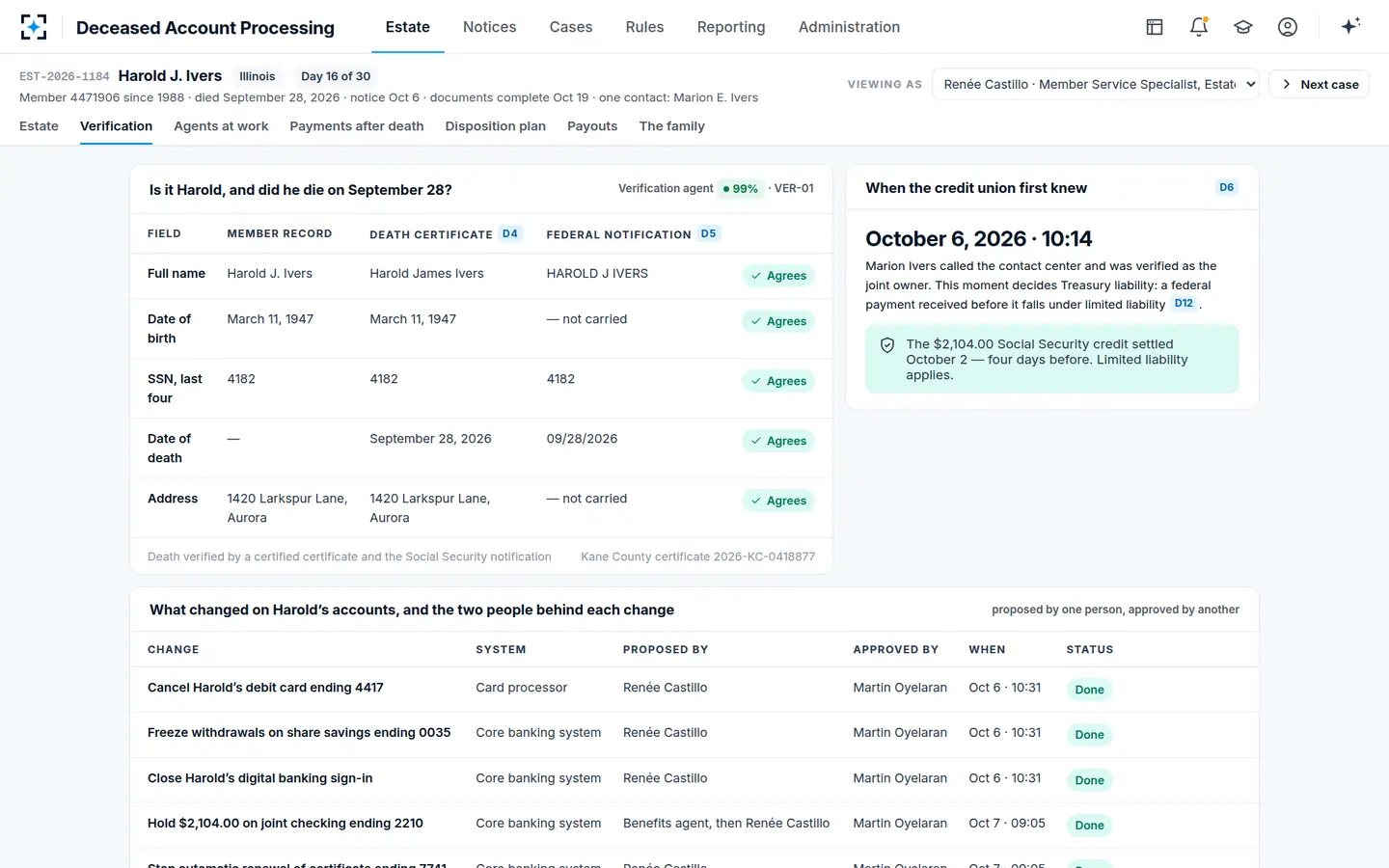
Harold J. Ivers, died September 28, 2026. Name, date of birth, last four of the SSN and date of death agree across the member file, the Kane County certified certificate and the Social Security death notification.
Why it is thereProof of death for every account, and the defence against a same-name or false notice.
The date the bank first knew
October 6, 2026, 10:14: the widow’s call to the contact center, verified as joint owner.
Why it is thereThe date the bank certifies to Treasury. Everything credited before it may qualify for limited liability; nothing after it does.
What was frozen, and by whom
Debit card canceled, sole savings frozen for withdrawals, online access closed at 10:31: proposed by the specialist, approved by the officer. Joint checking not frozen.
Why it is thereShows the bank acted on its knowledge, and that it did not lock out a surviving owner.
Every federal credit after the death
Social Security credit of $2,104.00 on October 2, held October 7 at 09:05. One withdrawal after the death: the joint owner, $200.00 at an ATM on October 4.
Why it is thereThe hold and the withdrawer list are what the Treasury certification asks for.
Each account and the document that decides it
Joint checking: 2004 card, survivorship box. Certificate: payable-on-death designation, two beneficiaries 50/50. Savings: 1988 card, sole owner, no beneficiary. Auto loan: the note.
Why it is thereThe titling decides the payee; the cited passage is what a reviewer checks first.
Authority for the estate’s share
Small-estate affidavit signed under penalty of perjury; will attached naming the widow sole legatee.
Why it is thereWithout letters or a valid affidavit, nobody may receive a sole account’s balance.
Each payee, and how the bank knew it was them
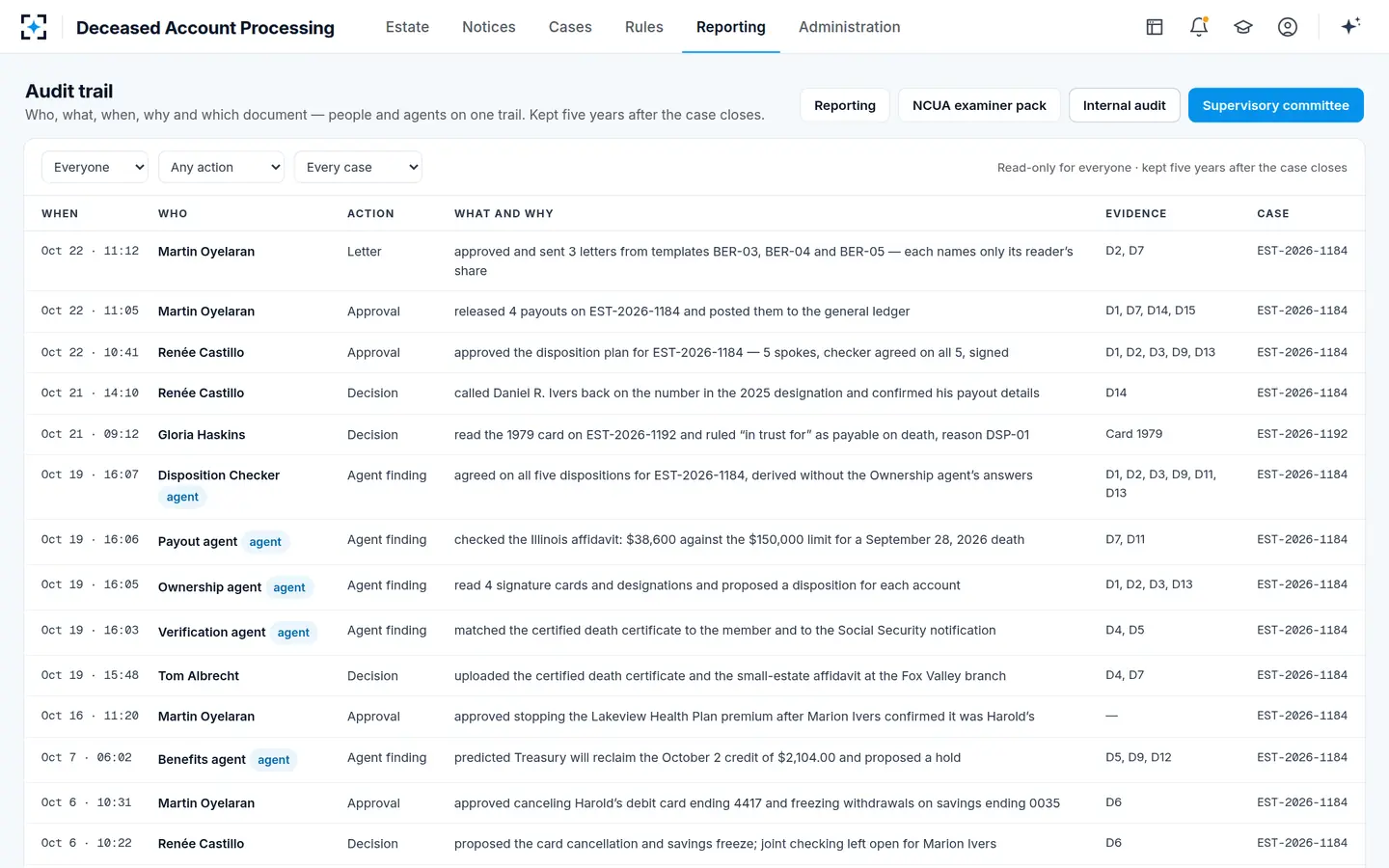
Two members identified in their own accounts; one non-member matched to his 2025 designation, called back on the number on that form, sanctions screen clear.
Why it is thereThe step that stops a payout to an impostor.
Two names on each payout
Plan approved by the specialist October 22 at 10:41; four payouts released by the officer at 11:05.
Why it is thereMaker and checker, provable from the file alone.
What should a deceased account file contain?
It should contain the three proofs for each account, the documents that support them, and the two names on each action. The documents are the evidence; the proofs are the conclusions the evidence has to support. A file with a certified certificate, a signature card and an affidavit, but no note of which passage of the card decided the payee or when the bank first heard of the death, has the evidence and none of the reasoning.
The three proofs come straight from the rules the bank answers to. State multiple-party account statutes make the account’s own terms decide the payee, so the first proof is the deciding document. Treasury’s rules for federal benefits make liability turn on when the bank knew, so the second proof is the knowledge date. And the same rules make the bank answer for benefits paid after the death, so the third proof is what happened to each of them.
Proof one: the document that decides each account
For every account, the file should name the document that decides its destination and the passage in it that does so. A joint account with right of survivorship passes to the survivor; a payable-on-death account to the named beneficiaries who outlived the owner; a sole account with no beneficiary to the estate. The account’s type in the core system is a summary of those documents, often entered years ago, and is not itself proof.
The deposit insurance rules show why the underlying document matters. For informal revocable trusts, such as payable-on-death accounts, the FDIC requires the beneficiaries to appear somewhere in the bank’s deposit account records, and no longer requires a POD or ITF label in the account title (FDIC, Your Insured Deposits); FDIC insurance on payable-on-death accounts explains what that does to coverage. A beneficiary can sit on a separate designation form, with nothing in the title to say so. The file should show the form that was read, its date, and any later form that replaced it.
The legal reason to get this right is the bank’s discharge. Under Virginia’s statute, for example, payment made as the multiple-party account rules provide “discharges the financial institution from all claims for amounts so paid” (Va. Code § 6.2-616). The discharge protects a bank that followed the account’s terms. The file is how it shows that it did.
Proof two: the date the bank first knew of the death
The file should state the date, and ideally the minute, the bank first had credible information that the customer had died, with the source. If a federal benefit was credited after the death, the bank will have to certify the date it first knew, actually or constructively, of the death, whatever the source of that knowledge and however it reached the bank (31 CFR 210.11(b)(2)).
The trap is that the first source is often not the death certificate. The Treasury’s Green Book counts, among other sources, a believable report of the death by phone or letter, a member of staff who credibly knows of it, and any approach from an executor, administrator or other estate representative asking to withdraw the money (Green Book, chapter 5). A branch employee who read the obituary, or a call from a funeral home, sets the date. A file that notes only the date the certificate arrived will certify a later date than the evidence supports. How banks know someone has died goes through each source and the order in which they usually arrive.
Death verified three ways, the date the bank first knew, and two names on every freeze
Proof three: every federal credit after the death, and what happened to it
The file should list every credit and debit on the deceased’s accounts since the date of death, mark each federal benefit among them, and note what the bank did with it: held, returned, or already withdrawn and by whom. That list is the raw material of the certification. To keep its liability limited, a bank must give Treasury the name, last known address and phone number of three groups: the recipient and every co-owner, everyone else with authority to withdraw, and everyone who actually took money out after the death (31 CFR 210.11(b)(3)); the Social Security reclamation rules show how that list is answered.
The last of those categories is why the debits matter as much as the credits. On the sample estate, the widow withdrew $200 at an ATM two days after the benefit settled and two days before she called. She was entitled to use the joint account; she is still named on the certification, because the rule asks who withdrew, not who was in the wrong. Recovering anything from her is a separate matter the rule leaves alone: the Green Book says the government “does not authorize or direct the RDFI to try to recover the funds from the withdrawer” (Green Book, chapter 5).
What documents are needed to close a deceased bank account?
Proof of death for every account, and then one of four sets depending on the titling. The table pairs each titling with the document that decides it and the document that proves the payee’s authority, because a file needs both.
Which documents a deceased-account file needs, by how each account is titled
| Titling | Decides the destination | Proves the payee’s authority | Where it usually goes wrong |
|---|---|---|---|
| Joint with right of survivorship | The signature card or account agreement showing survivorship | The survivor’s identity; usually already on file | A joint card without survivorship, or a tenancy in common, read as survivorship |
| Payable on death, in trust for | The beneficiary designation in force at death, and any later replacement | Each beneficiary’s identity and proof that they outlived the owner | A replaced designation missed; a beneficiary who died first still paid |
| Sole, small estate | The signature card showing sole ownership and no beneficiary | The state’s small-estate affidavit, after any waiting period, within its dollar limit | An affidavit paid before its waiting period or above its limit |
| Sole, larger estate | The signature card | Letters testamentary or of administration; the estate’s tax identification number for the estate account | Payment to a named executor before the court appoints him |
| Loan or line of credit | The note | Nothing from the family; a payoff to the personal representative | A demand sent to relatives who owe nothing |
| Federal benefit after death | The ACH credit and the date of death | None: it goes back to the paying agency | Released to the estate or a survivor before the bank holds it |
The small-estate affidavit deserves a line-by-line check of its own, because the statute, not the bank, writes its contents. Virginia’s, to take one state, must be sworn by every known successor and must say, among other things, that the whole personal probate estate is worth no more than $75,000, that 60 days or more have passed since the death, and that no one has applied to be personal representative (Va. Code § 64.2-601); how long a bank takes to release funds after a death compares the waiting periods. Each statement is a box the file should tick, and the bank should check the limit and waiting period in force on the date of death, since states change them.
How do banks verify a death?
Banks verify a death by matching the notice to the customer on several identifiers and confirming it against an official document, usually a certified death certificate, and, for federal benefit recipients, the federal death notification. Matching on name alone is how a living customer with a common name, or the father of a son with the same name, ends up frozen.
The federal notification is precise about what it carries. A death notification entry moves no money: it is an ACH entry for zero dollars whose addenda carries three facts, the date of death, the deceased’s Social Security number and the amount of the next scheduled payment (Green Book, chapter 4; death notification entries explained). It does not carry a date of birth or an address, so a verification that compares fields should mark those as not carried rather than as disagreeing. It can also be wrong. The Green Book’s own worked example of an erroneous report ends by reminding banks to take the flag off the account once the report turns out to be wrong. The file should show how a notice was verified, and how a mistaken one was undone.
The deceased account checklist, item by item
The checklist below is built from the three proofs and the documents above. Each item is something a reviewer can find in the file without asking anyone.
The deceased account checklist: what the file must show before any payout
- Identity of the deceased matched on several fields
Name, date of birth, last four of the SSN and date of death against an official document; the federal notification where there is one.
- The knowledge date, its source and the person who logged it
The first credible notice, whatever its form: call, letter, staff awareness, estate request, federal notification.
- Freezes and stops, each with two names
What was frozen and what was deliberately left open, such as a joint account, with who proposed and who approved.
- Every movement since the date of death
Credits and debits on every account the deceased owned or co-owned, with federal benefits marked.
- Each federal benefit after death: held, returned or withdrawn
With the withdrawer named, ready for the certification.
- For each account, the deciding document and passage
The card or designation actually read, its date, and whether a later form replaced it.
- Authority for each payee
Survivorship, beneficiary designation, letters or affidavit, checked against the rule in force on the date of death.
- Each payee identified, screened and, where needed, called back
Call-backs to the number on the original designation, not one supplied with the request.
- A second, independent reading of every disposition
And, where the readings differed, the supervisor’s ruling and reason.
- Two names on every payout, retitle and letter
The person who prepared it and a different person who released it.
Two items on the list are the ones files most often lack. The knowledge date, because desks log the certificate’s arrival rather than the first call. And the second reading, because a single experienced reader is trusted until the day a 1979 card is read the wrong way. What each agent may never do explains how the solution keeps the second reading independent of the first.
What does a reviewer sample, and how long should the file be kept?
A reviewer samples settled estates and, for each, asks for the deciding document, the decision and the two names behind it. That is the test the fictional credit union’s internal auditor applies, and it is the test a file built from the checklist passes without anyone having to remember anything. For estates with a federal benefit after death, the reviewer will also look for the Treasury answer and its date: the Green Book gives the bank up to 60 calendar days from the notice to respond in full, and asks it to hold on to the reclamation form for at least three years or until the case is closed (Green Book, chapter 5; how the Treasury’s reclamation system works).
Retention beyond that is the bank’s own policy. The fictional credit union keeps the full case history five years after a case closes, as a setting in the solution, and its examiner, internal audit and supervisory committee reports are exported from that history with personal data redacted by rule.
Who, what, when, why and which document, for people and agents on one trail
The checklist describes the file at the end. What happens to a bank account when someone dies sets out the titling decisions the file captures, and the full sample estate, with every document behind every line, is on the Deceased Account Processing page.
Questions people ask
What are deceased account procedures?
They are a bank’s written steps for a customer’s death: how a notice is taken and verified, what is frozen, how federal benefits after the death are found and held, how each account’s destination is decided, how payees are checked and who approves each payout. Good procedures name the evidence each step leaves, so the file proves the procedure was followed.
Is a decedent account the same as an estate account?
No. A decedent’s account is the account the customer held at death. An estate account is a new account opened by the personal representative in the estate’s name, under the estate’s own tax identification number, to collect and pay out estate assets. The FDIC insures a decedent’s estate account as a single account.
Does a bank need a certified death certificate?
Most banks ask for one, and state statutes accept it as proof of death, but it is not the only form. Virginia’s definition also includes a court’s certificate of qualification on the estate and an authenticated government record that the person is dead. The bank’s procedure, not the statute, sets which forms it accepts.
What proof of death does a bank accept for a federal benefit recipient?
For stopping federal benefits, the federal agency’s own death notification entry is itself notice: Treasury’s guide calls it a notice of the death of a benefit recipient that only a federal agency may send. For paying out the account, the bank still needs its usual proof of death and the documents its titling requires.
How long should a bank keep a deceased account file?
At least as long as the longest rule that applies to it. For a federal benefit reclamation, the Treasury’s Green Book asks for the reclamation form to be kept for at least three years or until the case closes. Many banks keep the whole file longer under their own record retention policy.