When someone dies, what happens to each of their bank accounts depends on how that account was titled: the ownership and beneficiary choices made when it was opened, recorded on the signature card or a beneficiary form. A joint account with right of survivorship passes to the surviving owner automatically. A payable-on-death account passes to the beneficiaries named on it who are still alive. An account in the dead person’s name alone, with no beneficiary, becomes part of their estate and is paid to an executor or administrator appointed by a court, or, for small estates, to the person named in a state small-estate affidavit. A will decides only that last group. Banks and credit unions apply this account by account, which is why one family can see three different answers from the same bank in the same week; Botminds’ Deceased Account Processing has an agent read every card and form so each account’s answer, and the document behind it, is clear from the start.
The tree below covers the common cases. Statutes differ by state in the details, and the ones quoted here, from Virginia and Florida, are examples rather than the rule everywhere. The worked example is a fictional sample estate at a fictional credit union.
The titling tree: ask these questions of each account, in order
- 1
Is it a loan, line of credit or card balance?
If yes: A claim against the estate
The bank sends the payoff to the personal representative or small-estate successor. Relatives who did not sign owe nothing.
If no, go on to question 2
- 2
Is it a federal benefit credited after the death?
If yes: Back to the paying agency
Held when the bank learns of the death, then returned on the notice of reclamation under 31 CFR 210.
If no, go on to question 3
- 3
Is there a surviving co-owner, and does the account carry survivorship?
If yes: The surviving owner
No payout and no freeze for the survivor: the account is retitled once the bank has proof of death.
If no, go on to question 4
- 4
Is a payable-on-death or in-trust-for beneficiary named, and did at least one outlive every owner?
If yes: The surviving beneficiaries
Paid on proof of death and identity, in the shares the designation sets. A will cannot change it.
If no, go on to question 5
- 5
Is the estate within the state’s small-estate limit, and has any waiting period passed?
If yes: The estate, through the affidavit
Paid to the successor the affidavit names, without probate. Virginia: $75,000, after 60 days.
If no, go on to question 6
- 6
Has a court appointed a personal representative?
If yes: The estate, through the executor or administrator
Paid into an estate account under the estate’s own tax identification number.
What happens to a bank account when someone dies: the short answer
The account is not closed on the day of death; it is sorted. The bank first stops what belonged only to the person who died, such as their debit card and online access, and then works out where each account goes under its own terms. Nothing about the death itself moves money. The CFPB puts the joint-account version plainly: “It depends on how you and the joint owner decided to hold the account. The money could pass to you, or it could pass to the other owner’s heirs” (CFPB, Ask CFPB).
The order of the questions matters. Loans and federal benefits are taken out first because they are not the family’s money to divide. Survivorship and beneficiary designations come next because they take an account out of the estate altogether. Only what is left is the estate’s, and only the estate’s share is governed by the will or, without one, by state intestacy law.
What happens to a joint account when someone dies?
If the account carries a right of survivorship, the money belongs to the surviving owner, who can go on using it. That is the common form. In the CFPB’s words, “Most joint bank or credit union accounts are held with ‘rights of survivorship.’ This means that when one account owner dies, the money passes to the surviving owner, or equally to the rest of the owners if there are multiple people on the account.” The alternative is a joint account held as ‘tenants in common,’ where “that person’s share of the account passes to their heirs, either as described in their will or per their state’s laws” (CFPB, Ask CFPB).
Where the card is silent, some states presume survivorship by statute. Florida’s presumes that, unless the contract, agreement or signature card says otherwise, a deposit account in two or more names vests in the survivors on a death, and makes an account between spouses a tenancy by the entirety unless otherwise specified in writing; the presumption can be overcome “only by proof of fraud or undue influence or clear and convincing proof of a contrary intent” (Fla. Stat. § 655.79). Virginia’s is similar: sums on deposit “belong to the surviving party as against the estate of the decedent unless there is clear and convincing evidence of a different intention at the time the account is created” (Va. Code § 6.2-608).
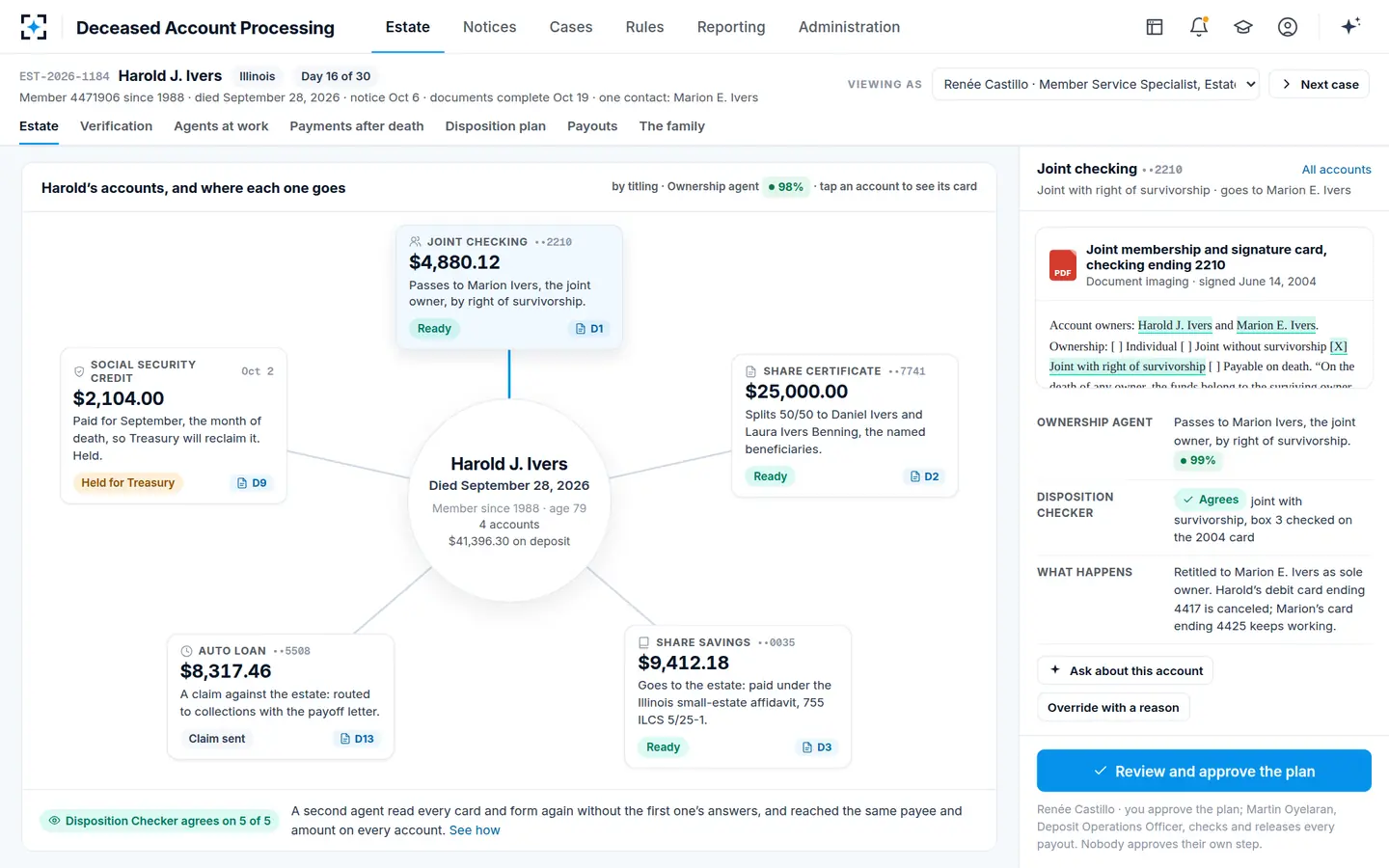
That is the difference between “joint account” and “joint with right of survivorship” in practice. While both owners are alive the two usually look identical: either can deposit and withdraw. Only the survivorship term, stated or presumed, decides who owns the balance after a death, and it is often a single ticked box on a card signed decades earlier. For the bank, reading that box decides whether the survivor keeps using her account the same afternoon or the deceased’s share is frozen for the estate, so it is the first document worth pulling and the one most worth a second reader. Two owners on an account opened as a convenience, a parent adding a child to pay bills, is the classic case where the family’s understanding and the card disagree; the card governs unless the statute’s high bar of contrary evidence is met.
The joint checking’s signature card opened beside the estate, with the deciding words highlighted
Payable-on-death and in-trust-for accounts: POD beneficiary vs will
A payable-on-death account goes to the beneficiaries named on it, and a will cannot redirect it. During the owner’s life the beneficiaries have no claim: Virginia’s statute leaves the money with the owner for as long as the owner lives, whatever the designation says (Va. Code § 6.2-606). At the owner’s death it passes to the named beneficiaries who are still alive, and the statute adds that a payable-on-death designation “cannot be changed by will” (Va. Code § 6.2-608).
So when a will says “everything to my daughter” and the savings account’s designation names a son, the son gets the savings account. The same goes for older in-trust-for or Totten trust accounts, which state law treats in the same way at the trustee’s death. The interesting cases are the ones where a beneficiary died first, or a later form replaced an earlier one; what happens if a POD beneficiary dies takes those one by one. Florida adds one more: a payable-on-death designation on a multiple-party account without survivorship “is ineffective” (Fla. Stat. § 655.82(4)).
Sole accounts: letters testamentary vs a small-estate affidavit
An account in the deceased’s name alone with no beneficiary is paid to the estate, through one of two doors. Letters testamentary, issued by the probate court to the executor a will names, or letters of administration where there is no will, are the court’s appointment of a personal representative; that person opens an estate account, which the OCC defines as “An account held in the name of a decedent that is administered by an executor or administrator of the estate” (OCC, HelpWithMyBank.gov), under a tax identification number the IRS issues to the estate (IRS). Probate is the court process; letters are the document it produces that a bank asks to see.
Small estates can skip probate through a sworn affidavit. Virginia’s works only where the whole personal probate estate is worth $75,000 or less, and only once 60 days have passed since the death (Va. Code § 64.2-601). Florida’s nearest equivalent is a court proceeding, summary administration, open to estates of up to $150,000, or of any size once the death is more than two years past (Fla. Stat. § 735.201). Limits differ by state and change; a bank should apply the one in force on the date of death.
Each titling, who it goes to, and the document the bank needs to pay it
| Titling on the card or form | Goes to | Decided by | The bank pays on |
|---|---|---|---|
| Joint with right of survivorship | The surviving owner or owners | The account terms; survivorship presumed in many states | Proof of death; then retitle |
| Joint as tenants in common | The deceased’s share to the estate | The account terms | Proof of death plus letters or affidavit for the share |
| Payable on death, in trust for | The named beneficiaries who outlived every owner | The designation; a will cannot change it | Proof of death and each beneficiary’s identity |
| Sole, no beneficiary, small estate | The estate, through the affidavit’s successor | The will, or intestacy law | A valid affidavit after any waiting period |
| Sole, no beneficiary, larger estate | The estate | The will, or intestacy law | Letters testamentary or of administration |
| Loan or line of credit | A claim against the estate | The note | Nothing from the family |
| Federal benefit after the death | The paying agency | 31 CFR 210 | The notice of reclamation |
What happens to a bank account when someone dies without a will?
Most of it, nothing different: joint and payable-on-death accounts pass the same way with or without a will, because a will never controlled them. Only sole accounts with no beneficiary are affected. They go to the estate as before, and the estate is distributed under the state’s intestacy law instead of a will. The bank’s job does not change; the person the court appoints, an administrator rather than an executor, presents letters of administration rather than letters testamentary. Intestacy law decides who inherits from the estate; it never decides who owns a survivorship or payable-on-death account, so a bank should not ask the family whether there is a will before it has read the titling.
What happens to a bank account when someone dies and no one claims it?
It stays frozen, and in the end it leaves the bank for the state. The OCC’s glossary defines escheat as the reversion of property to the state when “a person dies without leaving a will and has no heirs,” or when an account “has been inactive for a certain period of time” (OCC, HelpWithMyBank.gov). A deposit no one claims becomes dormant under state unclaimed-property law: Delaware, for example, presumes a bank deposit abandoned five years after the owner’s last indication of interest in it, or after a time deposit’s maturity if that comes first (Del. Code tit. 12, § 1133). The state then holds it for whoever can prove a claim, so an heir who turns up years later claims from the state’s unclaimed-property office, not from the bank.
The quiet years are not idle for the bank. Statements come back, dormancy letters go unanswered, and somewhere in that file a returned envelope or a relative’s note may say that the owner has died. That note is notice of the death, and it matters if a federal benefit is still arriving: the bank’s duty to return post-death benefits runs from when it knew, however it found out. An unclaimed deceased account is therefore a two-sided task: holding the balance for the estate, and catching any benefit that should go back to the agency long before the balance goes to the state.
Can I withdraw money from a deceased person’s account?
Only if you own the account yourself. A surviving joint owner can: Virginia allows payment from a joint account “to any party without regard to whether any other party is incapacitated or deceased” (Va. Code § 6.2-613). Nobody else can. An agent under a power of attorney loses authority at the death; the OCC’s consumer site says the power generally ends when the account holder dies, with state law and the document’s own terms governing the details (OCC, HelpWithMyBank.gov; see the bank bereavement process for what the desk stops that day). A relative who knows the PIN has no more right after the death than before it.
Even a joint owner’s withdrawals after a death can carry a consequence. If a federal benefit was credited after the death, the bank must name everyone who took money out of the account after the death when it answers Treasury, survivors included (31 CFR 210.11(b)). A survivor who spends a benefit paid for a month the deceased did not live may be asked about it. Telling the bank of the death early, so it can hold the benefit, protects the survivor too.
Loans, benefits and the bank’s own claims
A loan does not pass to the family; it becomes a debt of the estate. “When someone dies, their debts are generally paid out of the money or property left in the estate,” the CFPB explains, and survivors are not personally responsible unless they shared the debt, for example as a co-signer or joint account holder (CFPB, Ask CFPB). The bank files its payoff with the personal representative or the affiant like any other creditor.
Two details trip banks up. The first is the federal benefit: anything credited after the death goes back under 31 CFR 210 and should be held from the day the bank knows, not paid out with the account it landed in. The second is what was already in motion. Florida’s statute, for one, makes what survivors and beneficiaries of a payable-on-death account receive subject to payments the deceased asked for before death, such as a check written on a Friday and presented on the Monday; if it goes unpaid, they owe the payee in proportion to what they took (Fla. Stat. § 655.82(5)), and its joint-account presumption takes effect “less all proper setoffs and charges in favor of the institution” (Fla. Stat. § 655.79).
One estate through the tree
Take a fictional sample estate at the fictional Norrell Federal Credit Union. Harold J. Ivers died on September 28, 2026, with $41,396.30 on deposit across four places and an auto loan. Run through the tree, each account lands somewhere different.
Where one sample estate’s $41,396.30 on deposit goes, by titling
Question one takes the auto loan out as a claim against the estate. Question two takes the $2,104.00 Social Security credit of October 2 out for Treasury. Question three sends the joint checking to Harold’s widow, Marion, by survivorship; it is retitled, and her card keeps working. Question four sends the $25,000.00 share certificate to the two children named on its payable-on-death designation, $12,500.00 each. Only the sole savings reaches question five: it goes to the estate under a small-estate affidavit, paid to Marion as the affiant the affidavit names. The will matters for that one account and for nothing else.
The whole relationship on one wheel, each account with where it goes and the document that says so
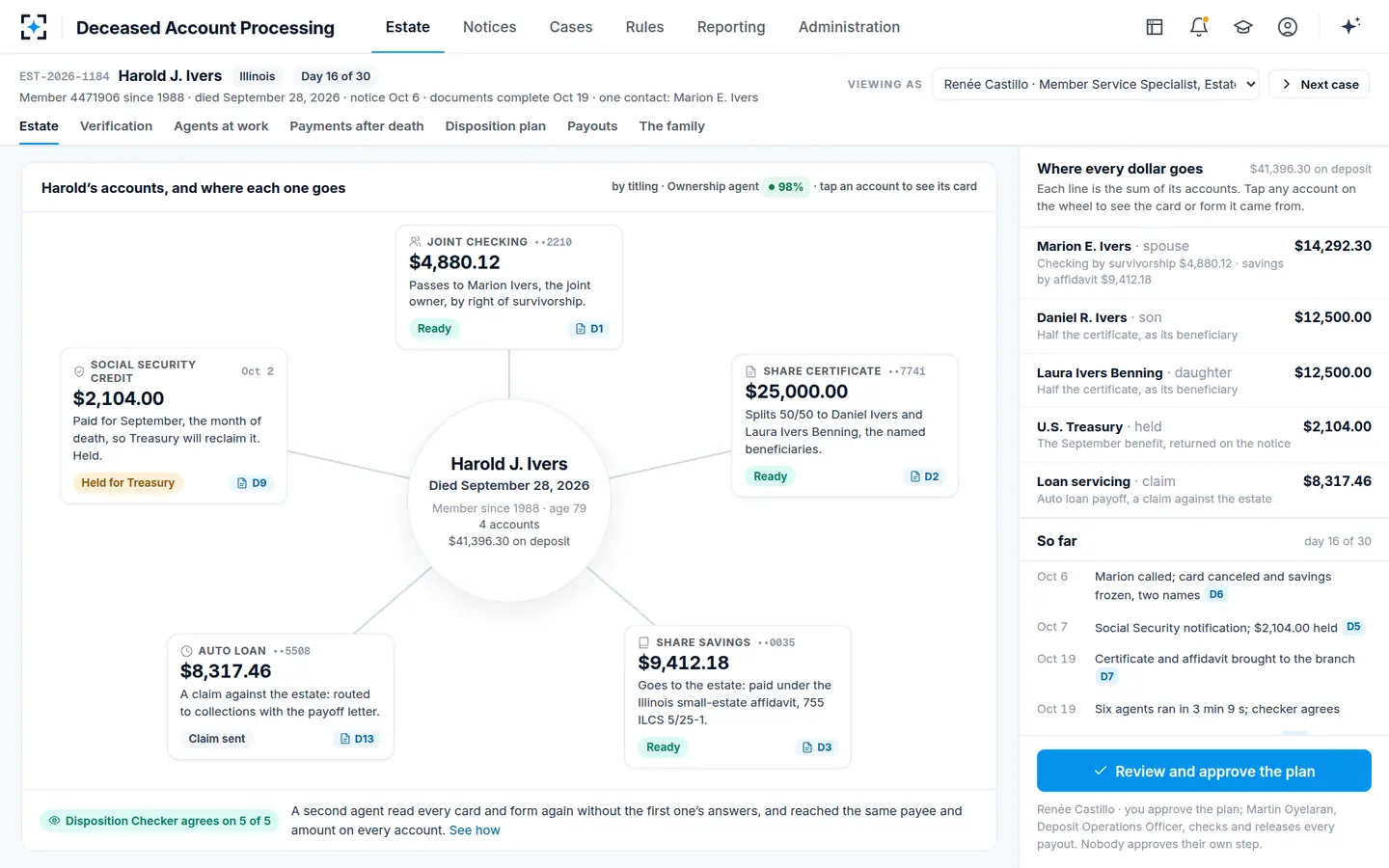
The order of the tree is also the order a bank can act in. The loan and the benefit can be handled on the first day; the joint account the day the certificate arrives; the beneficiaries once each is identified; the estate’s share only when the affidavit’s waiting period or the court allows. How long a bank takes to release funds after a death puts days on each branch, and FDIC insurance on payable-on-death accounts covers what happens to deposit insurance along the way. The full sample estate is on the Deceased Account Processing page.
Questions people ask
Does a will override a joint account or a payable-on-death beneficiary?
No, and the bank should pay as the account says even when a will points elsewhere. Virginia releases a bank from claims over money it pays as the multiple-party account rules direct, even if the person paid is not, as between the family, the rightful owner; that protection does not cover payments made after someone entitled to withdraw has told the bank in writing not to allow withdrawals. A conflict between a will and a designation is then for the family or a court, not the bank.
Is the bank account frozen when someone dies?
Accounts the deceased owned alone are, in the OCC’s glossary words, frozen “pending a court order distributing the funds to the new lawful owners,” or until a small-estate successor appears. A joint account with survivorship should not be frozen for the surviving owner. The exception is a dispute: in Virginia, once any party or personal representative tells the bank in writing not to allow withdrawals, the bank may refuse every withdrawal, even the survivor’s, until the parties’ rights are settled.
What happens to a bank account with no beneficiary?
It becomes part of the estate, and so does an account whose named beneficiaries all died before the owner: Florida’s statute sends a payable-on-death account to the last surviving owner’s estate when no beneficiary is left alive. Either way the bank pays the personal representative or a small-estate successor, never a relative simply as next of kin.
What happens to a joint account if both owners die?
The account belongs to whichever owner died last, so it passes through that owner’s estate, or to payable-on-death beneficiaries who outlived both. The order of deaths decides it: Virginia lets a bank pay the last owner’s personal representative or heirs on a payable-on-death account only on proof of death showing that owner outlived everyone else named on it.
What is the difference between an estate account and a deceased person’s account?
The deceased person’s account still carries their Social Security number and their titling; the estate account is opened afterwards by the executor or administrator under an employer identification number the IRS issues to the estate. For deposit insurance, the FDIC lists a decedent’s estate account among single accounts, insured as the deceased person’s funds, not as the executor’s own.