Deceased account services are the work a bank or credit union does when a customer dies: taking the notice, verifying the death, freezing what must be frozen, holding federal benefits paid after the death, deciding where each account goes under its titling, checking every payee, paying out and writing to the family. A bank can run that work three ways. It can keep an in-house desk that does everything by hand; it can send the work to an outside estate-settlement service; or it can keep the desk and give it software agents that do the reading and drafting while its own staff decide. The choice is usually framed as cost. The better question is who certifies the date the bank first knew of each death and who signs each payout, because federal and state rules put both on the bank in every model. Botminds’ Deceased Account Processing is built for the third model; this guide compares all three on those terms.
What a bank can hand to someone else, and what stays with it in every model
Can be done by a provider or by agents: Taking the notice, matching it to the customer, comparing the certificate with the federal notification.
Stays with the bank, whoever does the work: The date the bank first knew, which it certifies to Treasury whatever the source of that knowledge.
Can be done by a provider or by agents: Pulling signature cards and designations, reading the titling, drafting where each account goes.
Stays with the bank, whoever does the work: The decision to pay, and the risk of paying the wrong person.
Can be done by a provider or by agents: Listing every movement since the death, finding the benefits, drafting the certification and its withdrawer list.
Stays with the bank, whoever does the work: The certification itself, and liability for the loss an answer that is late or wrong causes.
Can be done by a provider or by agents: Drafting letters, scheduling call-backs, chasing documents.
Stays with the bank, whoever does the work: The bank’s name on every letter, and the customer relationship with the survivors.
Can be done by a provider or by agents: Reports, logs, evidence exports.
Stays with the bank, whoever does the work: Responsibility for the activity, exactly as if the bank’s own staff had done it.
What do deceased account services cover?
Everything between the first notice and the last letter, for every account and relationship the customer had: deposits, certificates, retirement accounts with their own designations, cards, loans and lines, and recurring payments. The work has a steady volume. The United States recorded 3,072,666 deaths in 2024 (CDC, FastStats), and a bank of any size settles some every week.
It is skilled clerical work with legal edges. Nobody counts it separately: in the Bureau of Labor Statistics’ May 2023 occupational survey it is folded into broad clerical groups such as New Accounts Clerks (BLS, May 2023), so no federal figure says how many people do it. What makes it more than clerical is that each step applies a rule: the state’s multiple-party account law to each titling, the state’s small-estate statute to each affidavit, 31 CFR 210 to each federal benefit. That is why the operating model matters: it decides who applies the rules, and who checks.
The three operating models, side by side
Each model has a real case. An in-house desk keeps everything close and costs little to change; it is slow where the reading is heavy. An outside service brings capacity and specialists; it adds a handoff, and a provider to oversee. Agents on an in-house desk take the reading off the specialists and keep the decisions in the building; they need integration and a pilot to trust.
Three ways to run deceased account services, compared on the decisions that carry the risk
| In-house desk, by hand | Outsourced estate service | In-house desk with agents | |
|---|---|---|---|
| Who reads the cards and forms | Bank specialists | Provider staff | Agents, with a person reading anything below the confidence threshold |
| Who logs the date the bank first knew | Whichever channel took the call, if it is logged | The provider, for notices sent to it; the bank, for every notice it receives itself | Every channel logs to one case, with the minute |
| Who certifies to Treasury | The bank | The bank, on the provider’s draft | The bank, on the agents’ draft |
| Who signs each payout | A second bank officer, if the procedure requires it | Depends on the contract; the bank’s risk either way | A second bank officer, enforced by the system |
| Who the family deals with | The bank | Often the provider, under the bank’s name | The bank, one named contact |
| Where the evidence sits | Imaging, the core and the specialist’s notes | The provider’s systems, by contract | One case history with every document and both signatures |
| What changes when a state raises a limit | A procedure update and training | A request to the provider | A versioned setting, approved by a named person |
| What the bank must oversee | Its own staff | A third party, under the agencies’ guidance | A software provider, under the same guidance, plus the agents’ settings and versions |
Who handles deceased accounts at a bank?
Usually a small estate services or bereavement team in deposit operations, with branches and the contact center taking notices and a second officer releasing payouts. In the outsourced model the provider’s staff take over the reading and drafting, and sometimes the family contact; in the agent model the bank’s own team stays and the agents take the reading.
The same four seats in an agent-run desk, and what each keeps
Today
Retrieves and reads every card, form and statement line; types letters; answers the family.
With agents
Opens each estate already read, checks the agents’ sentences against the cited documents, approves the plan.
Still theirs: the plan, the knowledge date, the family
Today
Asks for the card and the payee’s proof before every release.
With agents
Sees each payee’s evidence beside the card and releases each payout as a signed entry.
Still theirs: every release, freeze, retitle and letter
Today
Reads every file at risk of missing its clock.
With agents
Sees disagreements between the two readings, missing forms and late cases.
Still theirs: the ruling when readings disagree
Today
Samples settled files and rebuilds each decision from memos.
With agents
Traces each payout to its document and two signatures on one history.
Still theirs: independence: reads everything, changes nothing
What do the rules leave with the bank, whichever model it chooses?
The federal certification, the payout decision and the oversight. Under 31 CFR 210.11, it is the bank, the receiving depository financial institution, that must certify the day it first knew of the death and name every co-owner, everyone authorized to withdraw, and everyone who withdrew after the death; and it is the bank that pays for any loss its own late or inaccurate answer causes, on top of the benefits it owes (31 CFR 210.11; reclamation liability sets out the sums). The Green Book allows 60 calendar days from the date on the notice of reclamation for a complete, accurate answer (Green Book, chapter 5; the Treasury reclamation process). A provider can draft; the bank answers.
The knowledge date is where outsourcing is most delicate. The Green Book counts a believable report of the death, by phone or in writing, and the knowledge of the bank’s own staff as notice, and treats any payment to an executor or anyone else plainly acting for the estate as proof that the bank knew (see how banks know someone has died). If a family calls a branch on Monday and the provider receives the file on Friday, the bank knew on Monday. An outsourced model works only if every channel inside the bank logs death notices, with the time, and passes them on; otherwise the certified date will be later than the facts.
The payout decision stays with the bank because state law protects the bank only when it pays as the account terms and statute provide. Virginia’s, for example, releases a financial institution that pays as the multiple-party account rules direct, even where the person paid is not the money’s beneficial owner (Va. Code § 6.2-616). A payout to the wrong person, made by a provider in the bank’s name, is the bank’s problem.
Should a bank outsource bereavement?
It can, and for some banks it is the right call, but outsourcing moves the work, not the accountability. The banking agencies’ guidance on third parties has said so since 2023, and their September 2026 proposal to replace it repeats the principle: a bank that uses a third party carries the same responsibility for meeting its legal requirements as if it had done the work in-house (proposed guidance, September 15, 2026; the interagency third-party guidance in force today). The proposal’s comments close on November 16, 2026; until a final version is issued, the 2023 guidance applies (2023 guidance).
Outsourcing fits a bank whose volume is too uneven to staff, or that lacks the specialist knowledge for its states, and that is prepared to oversee a provider handling some of its most sensitive customer moments. It fits less well where the bank wants the family to deal with its own people, where documents live in its own imaging and would have to be shipped out, or where its own procedures, such as which documents it accepts and when it calls back a payee, are strict and specific. The same oversight question applies to buying software, including the agents in this guide: the GAO found in 2025 that the federal financial regulators oversee AI chiefly with the laws, guidance and risk-based examinations already in place (GAO-25-107197; AI audit software under that oversight). Neither a provider nor a model changes which rules apply.
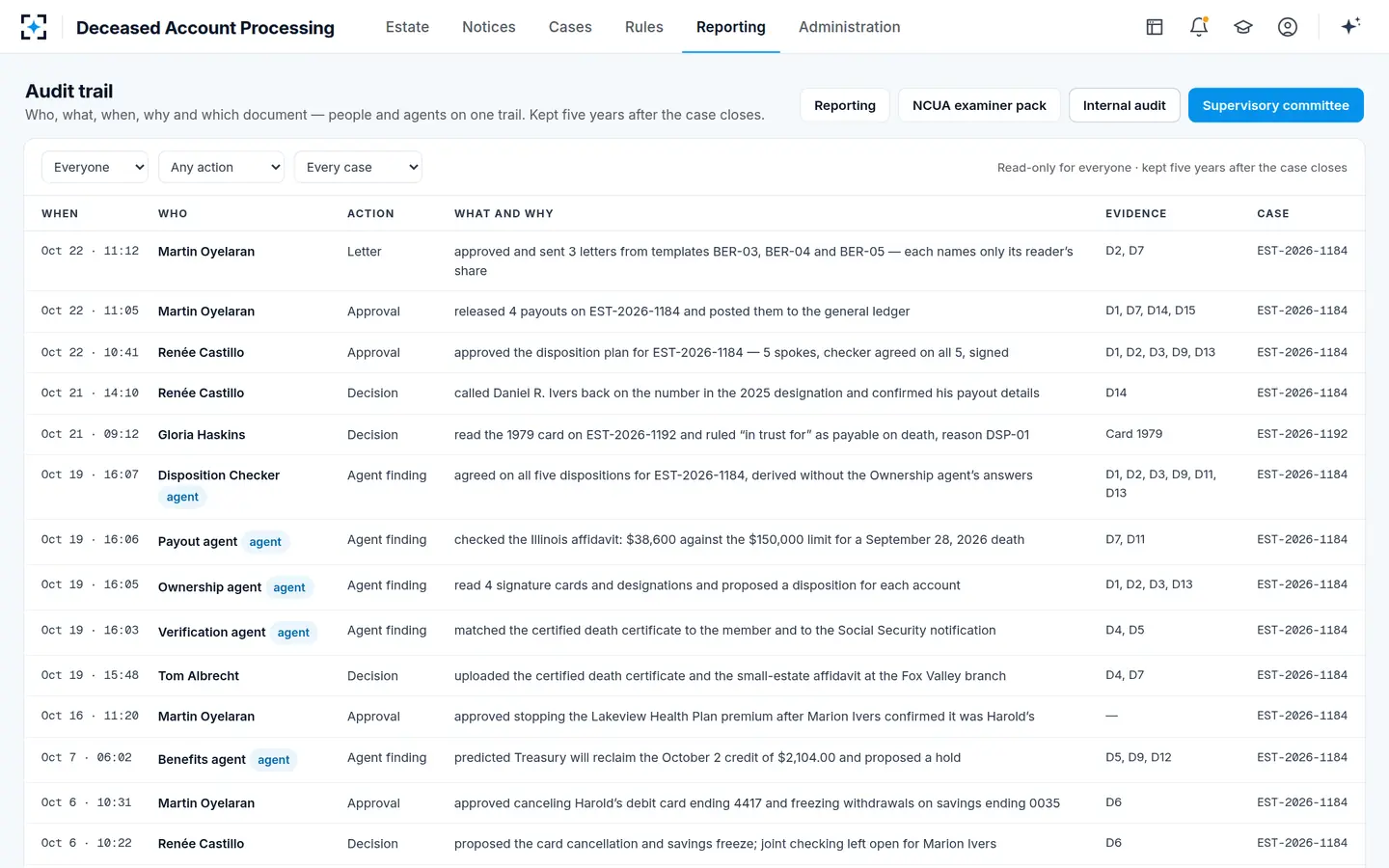
One history for people and agents, exportable for the examiner, internal audit and the supervisory committee
How to price the three models
Price every line the work creates, not only the line on an invoice. A per-estate fee from a provider, or a licence for software, is visible; the specialist hours the bank still spends, the oversight it owes and the cost of errors are not, and they decide which model is cheaper for a given bank. The table lists the lines; the figures are the bank’s own.
The cost lines of deceased account services, and where each falls in each model
| Cost line | In-house desk, by hand | Outsourced estate service | In-house desk with agents |
|---|---|---|---|
| Reading and drafting | Specialist hours on every card, statement and letter | In the provider’s fee | Agents; specialist time on low-confidence documents only |
| Decisions and second signatures | Specialist and officer time | Bank time to review the provider’s output, plus any provider sign-off | Specialist and officer time, on prepared files |
| Family contact | Bank staff | Provider staff, or both | Bank staff, with letters drafted |
| Fees | None | Per estate or per account | Software subscription |
| Oversight | Internal procedures and audit | Due diligence, contract management and monitoring of a third party | The same for a software provider, plus settings and version control |
| Integration | None | Secure transfer of documents and account data | Read access to the core, imaging and the payments hub; writes only after approval |
| Errors the bank pays for | Wrong payees; benefits released after knowledge; late or wrong Treasury answers | The same, made by the provider and carried by the bank | The same, reduced by a second independent reading and enforced release rules |
Two lines usually move the answer. The first is errors: a single payout to the wrong person costs the bank the payout again, and a benefit released after the bank knew of the death is a federal liability, so a model that halves the error rate can carry a higher fee. The second is volume: a bank that settles few estates a month pays for software or a provider across too few files, and a careful desk with a good procedure may be cheapest. The pilot in estate settlement software, piloted on closed estates produces the error side of the comparison from the bank’s own files.
What families notice about deceased customer services
Families notice three things, and none of them is the operating model. They notice whether they are asked for the same document twice, whether one person can tell them what happens to each account, and whether a letter tells them something about another relative’s money. The CFPB advises surviving spouses to order ten to twelve certified copies because so many institutions want one (CFPB, Help for Surviving Spouses); a bank that takes one copy, keeps it on file and never asks again spares the family one of them.
Each model can meet that standard, and each can fail it. An in-house desk fails it when the branch, operations and the loan department each ask separately. An outsourced service fails it when the family talks to the provider and the branch does not know what the provider has. An agent-run desk fails it if the agents draft letters nobody reads before they go. The fix in every case is the same: one named contact, a list of documents already on file that every channel can see, and one letter per person, approved by someone, naming only that reader’s share.
What to ask any provider of deceased account services
Ask the questions that test where the risk sits, not how many estates the provider handles. The list below works for an outside service and for a software vendor alike.
Questions for any deceased account services provider, outside service or software
- How is the knowledge date captured, from every channel?
Including calls to branches and the contact center that never reach the provider directly.
- Who drafts the Treasury certification, and who at the bank signs it?
And how fast the draft exists after a notice of reclamation arrives.
- Can anyone release a payout they prepared?
The answer should be no, enforced by the system, not by a procedure.
- What happens to a document nobody can read with confidence?
It should stop and go to a named person, never be answered anyway.
- Is every disposition derived twice, independently?
And does a disagreement stop the payout until someone rules?
- Where are the documents and the evidence kept, and can the bank export them?
For an examiner, internal audit or a dispute, without asking the provider.
- How are state limits and waiting periods kept current?
By date of death, with the statute cited and a named person who verified it.
- Can we test it on our own settled estates first?
Before any contract, with the disagreements explained.
Where Deceased Account Processing fits
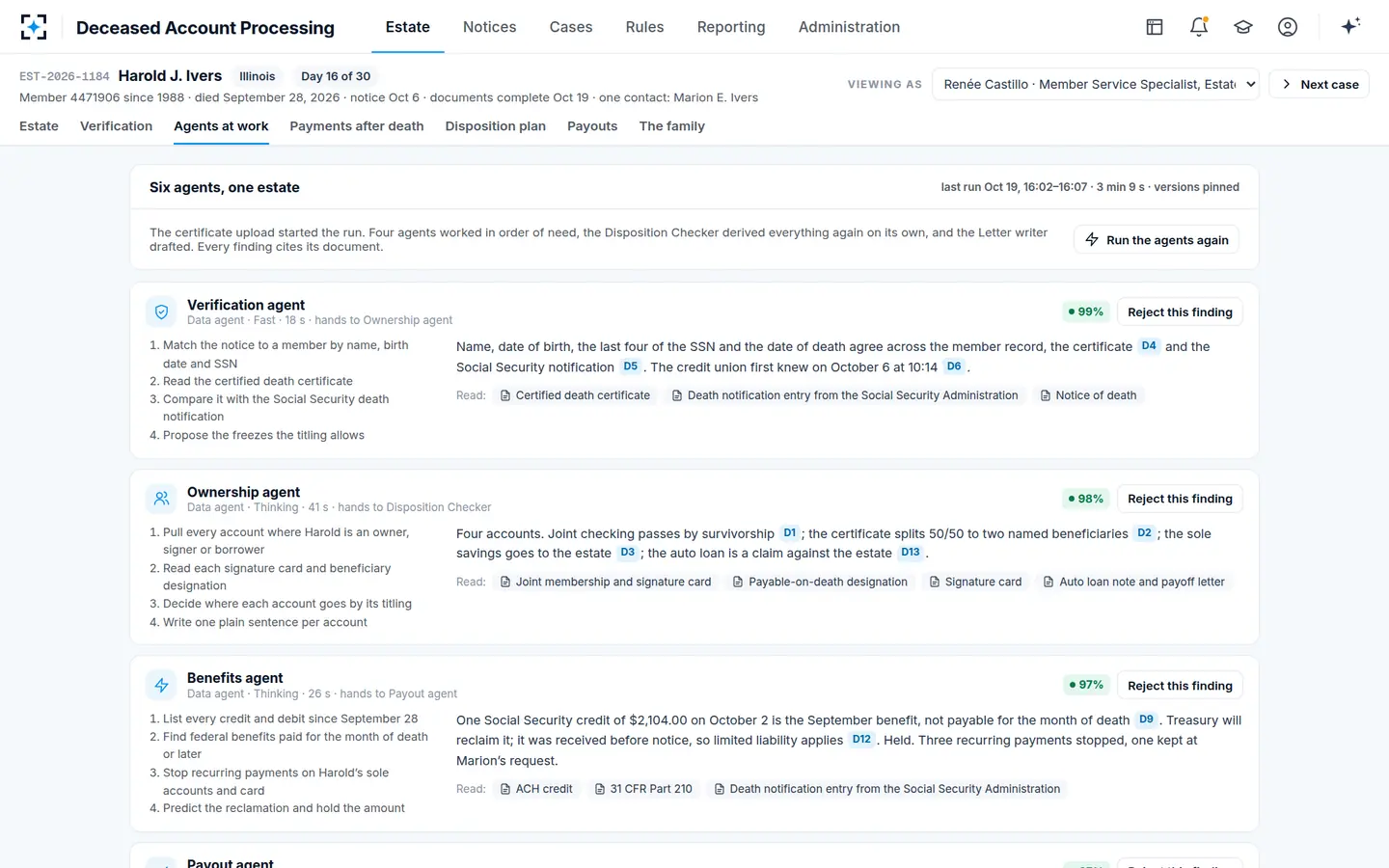
It is the third model: the bank’s own desk, with six agents doing the reading, matching and drafting. The Verification agent matches each notice and logs when the bank first knew; the Ownership agent reads every signature card and beneficiary form; the Benefits agent finds federal benefits after the death and drafts the certification; the Payout agent checks the affidavit or letters and each payee; the Disposition Checker derives every account again without seeing the first answers; the Letter writer drafts one letter per person. The specialist approves the plan, a deposit operations officer releases each payout, and the specialist cannot release her own.
Six agents on one estate: each plan, the documents it read, its confidence and its hand-off
It fits a bank or credit union that wants to keep its estates and its families in-house but whose specialists spend their days retrieving and transcribing. The design estimate for the fictional credit union, at 260 notices a month and about 3.4 accounts each, is a median of about 34 days from notice to settled estate by hand, against a target of 11; those are an estimate and a target, not measured results. It fits less well a bank that settles a handful of estates a month with recent, clean paperwork, where a good written procedure may be enough, or one that has decided to hand the whole function to a provider. It does not replace the people who talk to families, and it is not built to remove the second signature.
For the line between agents and people, see what each agent may never do; for testing any of the three models on real files, the closed-estate pilot above; and for the seats and waits of the desk itself, the bank bereavement process. The full sample estate is on the Deceased Account Processing page.
Questions people ask
What is outsourced estate settlement for banks?
It is an arrangement where an outside firm handles some or all of a bank’s deceased-customer work, such as reading account documents, contacting families and preparing payouts, under the bank’s name. The bank remains responsible for the result, including the Treasury certification for federal benefits paid after a death and every payout decision.
What does a bank estate services team do?
It settles deceased customers’ relationships: verifies each death, freezes and stops what the titling requires, holds federal benefits paid after the death, decides where each account goes, checks the documents and payees, pays out, and writes to the family. Most teams separate the person who prepares a payout from the person who releases it.
Can a provider certify the knowledge date to Treasury for the bank?
The provider can draft it, but the certification is the bank’s. 31 CFR 210.11 requires the receiving bank to certify the day it first knew of the death, actually or constructively, from any source, so notices that reach the bank’s own branches and contact center count even if the provider never saw them.
Is software or outsourcing cheaper for deceased account services?
It depends on volume, the bank’s mix of states and account types, and how much of the work is reading versus talking to families. A fair comparison prices the decisions too: who logs the knowledge date, who signs payouts and who oversees the provider, because those costs stay with the bank in every model.
What is the difference between deceased account services and estate administration?
Deceased account services are the bank’s side: settling the accounts it holds. Estate administration is the executor’s or administrator’s job for the whole estate, from property to taxes, under the probate court. The two meet when the personal representative presents letters to the bank and opens an estate account.