Deceased account processing is the back-office work of taking a deceased customer’s accounts from the first death notice to a settled estate: verifying the death, freezing what must be frozen, holding federal benefits paid after the death, deciding where each account goes under its titling, checking every payee and paying out. Most of that work is reading and comparing documents, which agents now do well. The judgment that moves money is different, because the bank answers for it under federal and state law. Botminds’ Deceased Account Processing runs six agents that verify, read, hold, check and draft, and leaves every freeze, payout, retitle and letter to two named people. This guide shows the line between them, agent by agent, and the rules that put it there.
The examples come from a fictional sample estate at the fictional Norrell Federal Credit Union: Harold J. Ivers, who died on September 28, 2026, with five accounts and credits between them, worth $41,396.30 on deposit plus an $8,317.46 auto loan. Names and figures are invented; the rules are real.
Six agents, what each does, and what each may never do
| Agent | What it does | What it may never do | Who decides instead |
|---|---|---|---|
| Verification agent | Matches the notice to a customer on name, date of birth and the last four digits of the Social Security number; compares the certified certificate with the federal death notification; logs when the bank first knew. | Propose a freeze on an unverified notice; freeze a surviving joint owner’s access. | The specialist proposes each freeze; a second officer approves it. |
| Ownership agent | Reads every signature card and beneficiary designation and writes one sentence per account on where it goes, citing the passage. | Infer a beneficiary not written on a form; decide alone on any card it reads below 90% confidence or any card older than 1990. | A person reads those cards; a missing form goes to the supervisor. |
| Benefits agent | Lists every credit and debit since the death, proposes a hold on federal benefits paid after it, and drafts the Treasury certification. | Return money; stop a payment on a joint account without asking the surviving owner. | The officer approves every hold and return. |
| Payout agent | Checks letters or a small-estate affidavit against the rule in force on the date of death; verifies each payee, screens sanctions, prepares the payout. | Release a payout; pay someone who is not a customer without a call-back; pay before a waiting period ends. | The officer releases each payout as a signed entry. |
| Disposition Checker | Reads the cards, forms, affidavit and rules again from the start and derives each account’s payee and amount on its own. | Read another agent’s answer first; settle a disagreement. | The supervisor decides, with both readings in front of her. |
| Letter writer | Drafts one letter per person from approved templates, naming only that reader’s accounts. | Reveal another person’s balance; mention any referral or investigation; send. | The officer approves every letter before it goes. |
What is deceased account processing, and which parts can agents do?
It is the chain of decisions that settles a deceased customer’s relationship, and agents can do every part of it that is finding, reading, comparing and drafting. They should not do the parts that commit the bank: moving money, changing who owns an account, answering Treasury in the bank’s name, or choosing between two readings of a document.
The split follows the work. A specialist on a bereavement desk spends most of a file’s handling time on retrieval and transcription: pulling decades of signature cards from imaging, reading which box was ticked, looking up the state’s small-estate rule, listing the transactions since the death and typing letters. The fictional credit union’s estimate, at 260 notices a month and about 3.4 accounts each, puts that work at most of a 34-day median by hand. That is the part agents shorten. The decisions at the end of each step take minutes, carry the bank’s liability and stay with people.
Deceased account processing, step by step: what agents prepare and where a person signs
Agent
Verification agentMatches the notice to a customer on four fields, compares certificate and federal notification, logs the minute the bank first knew.
Never: freeze on an unverified notice
A person decides
Specialist and officerApprove the freezes the titling allows: the deceased’s card, sole accounts and online access, each with two names.
Agent
Ownership agentReads each signature card and beneficiary form; one plain sentence per account, citing the deciding passage.
Never: infer a beneficiary
Agent
Benefits agentFinds federal credits after the death, proposes the hold, drafts the certification with the knowledge date and every withdrawer.
Never: return money alone
Agent
Payout agentChecks the affidavit or letters against the state rule on the date of death; identity, sanctions and call-back for each payee.
Never: release a payout
Agent
Disposition CheckerDerives every account again from the documents, blind to the first answers; disagreements go to the supervisor.
Never: settle a disagreement
A person decides
Specialist approves the plan; officer releases each payoutThe specialist cannot release what she prepared. Large payouts can need a third signature.
Why may no agent release money from a deceased customer’s account?
Because every payout is a statement by the bank that this person is entitled to this money under this document, and the law makes the bank answer for that statement, not its software. Two rules show the stakes.
The first is federal. When a federal benefit is paid into an account after the recipient’s death, the bank is liable for it in full unless it qualifies for limited liability, and to qualify it must certify, among other things, the day it first knew of the death and name everyone who took money out of the account afterwards (31 CFR 210.11(b)). A bank that gets those certifications late or wrong also answers for whatever loss its slip caused, over and above the benefits themselves (31 CFR 210.11(d); reclamation liability works through the sums). A hold that slips, or a certification that names the wrong date, is the bank’s loss.
The second is state law. A bank that pays a multiple-party account the way the statute says is protected: in Virginia, a payment made as the statute directs releases the institution from any claim over that money, even if the person paid turns out not to be its beneficial owner (Va. Code § 6.2-616). The protection is for paying according to the account’s terms. A misread card, a replaced beneficiary form overlooked or a small-estate affidavit paid before its waiting period are not that, and the usual remedy is paying the right person as well.
The Treasury’s Green Book adds the rule that makes release the step to guard: once a bank pays out to an executor, or to anyone else plainly acting for the deceased or the estate, the government takes that payment as proof that the bank knew of the death (Green Book, chapter 5; how banks know someone has died lists the other triggers). The moment the bank pays an executor, it is treated as knowing, whatever its systems say. An agent that released money would be creating the bank’s knowledge date by its own action. In the solution, an agent may propose and draft; the release is a signed entry by a named officer, who is not the person who prepared it.
Can AI read a signature card?
Yes, and reading cards is where agents save the most time, but only with a confidence threshold and a rule for the cards that most often mislead. A signature card from 2004 with typed names and a ticked box for joint with right of survivorship is easy. A 1979 card with “in trust for” written beside one name is not, and neither is a sole-ownership card that a later beneficiary form, filed separately, has overridden.
The FDIC’s rules make the card matter more, not less. For payable-on-death accounts, the FDIC no longer needs a POD or ITF label in the account title, but it does need the beneficiaries to be named somewhere in the bank’s deposit account records (FDIC, Your Insured Deposits; FDIC insurance on payable-on-death accounts). A beneficiary may therefore be named on a form that sits nowhere near the account title. An agent that reads only the core system’s ownership code will miss it; one that reads every designation in imaging will not.
The failure to design against is a confident wrong answer. The Treasury’s 2024 report on AI in financial services warns that generative models can invent answers and state them with full assurance (U.S. Treasury, AI in Financial Services, December 2024), the failure AI hallucination in credit policy citations examines in detail. Three controls answer it in the solution: each sentence cites the passage that decides it, so a person can check it in a glance; any card below the confidence threshold, and every card older than 1990, is read by a person; and a second agent derives the answer again without seeing the first.
Each agent’s plan, the documents it read, its confidence and its hand-off
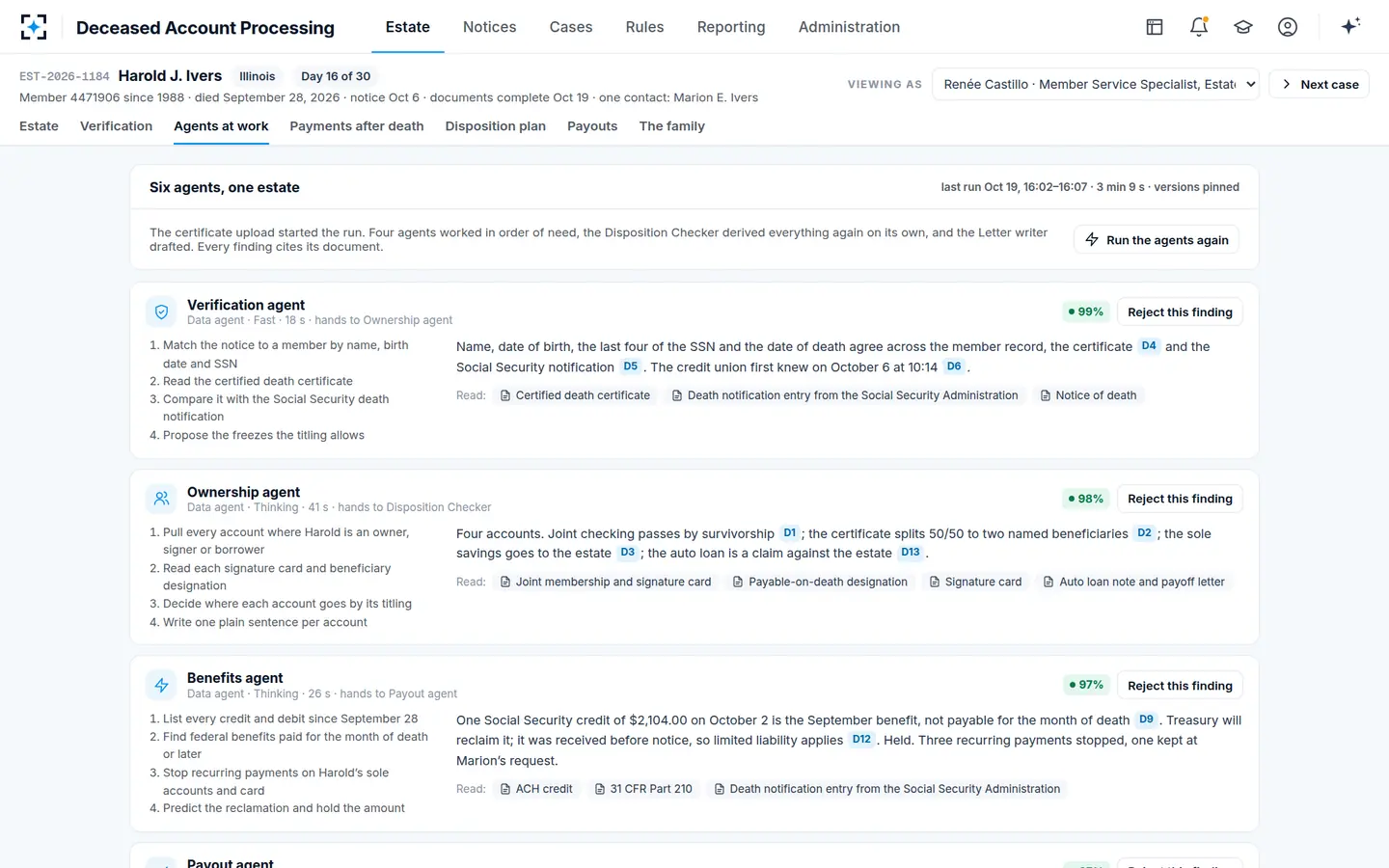
The freeze an agent must never propose: the surviving joint owner
The first decision on any file is what to freeze, and the most damaging error is freezing too much. An agent working from the death notice alone sees a Social Security number and every account it touches; a joint checking account shared with a spouse is one of them. The rule in the solution is that the Verification agent proposes only the freezes the titling allows: the deceased’s own debit card, sole accounts and online access, never a surviving owner’s access to a joint account.
The federal payment system has a version of the same trap, and the Treasury’s guide spells it out. When a federal agency sends a death notification entry, banks are encouraged to flag the account so that later benefit payments are returned. If one spouse on a joint account dies and the whole account is flagged, the survivor’s own benefit is returned with the death reason code, and the paying agency wrongly stops the living spouse’s benefits as though she had died (Green Book, chapter 4; see ACH return code accuracy). Its fix is to tie the flag to something that identifies the person who died, such as the name or Social Security number, as well as the account. The agent applies the same discipline: the flag follows the person who died, not the account number.
On the sample estate this is the difference between Marion Ivers keeping her household account and losing it. Her husband’s card was canceled and his sole savings frozen within seventeen minutes of her call; the joint checking, and the utility bill she asked to keep paying from it, were left alone.
Who approves a payout from a deceased account?
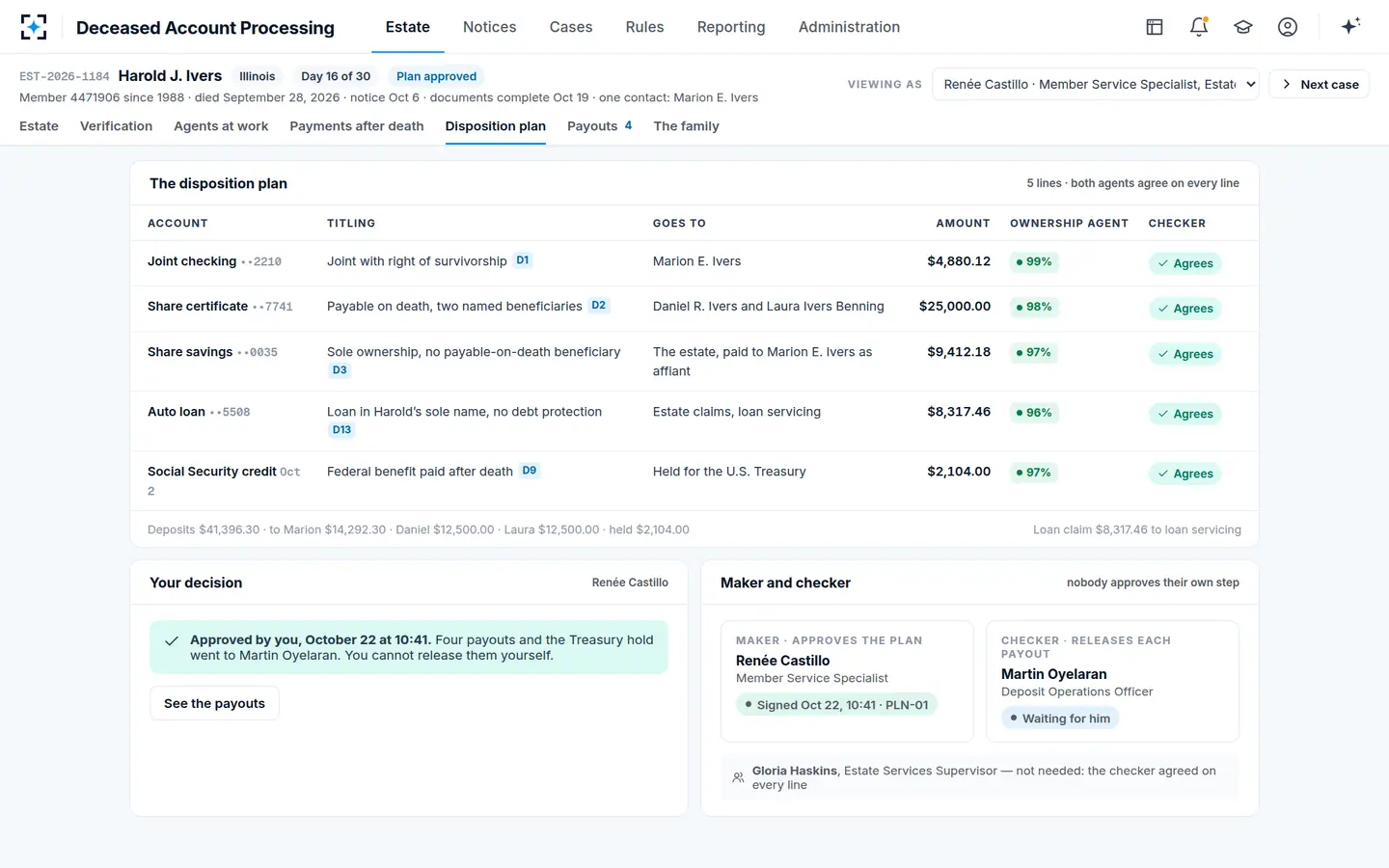
A person who did not prepare it. In the solution the specialist who built the disposition plan approves the plan with a reason code and a signature; a deposit operations officer then checks each payee’s evidence and releases each payout as its own signed entry; the specialist cannot release her own work. Above a set amount, $100,000 in the fictional credit union’s settings, the supervisor signs too.
The officer’s check is not a formality. On the sample estate, one beneficiary of the $25,000 certificate was a member since 2009, paid by internal transfer to her own savings. The other was not a member: his driver’s license was matched to the 2025 designation, the specialist called him back on the number written on that form, the sanctions screen was clear, and only then was he paid by ACH to a validated account. A call-back to a number supplied in the request itself would prove nothing; the number on the original designation is the control.
The plan, approved by the specialist, waiting for the officer
The second reading: why one agent derives everything again, blind
A reviewer who sees the first answer tends to confirm it. The Disposition Checker in the solution therefore reads the cards, forms, affidavit and rules from the start, works out each account’s payee and amount on its own, and only then compares. Where the two agree, the specialist can approve the line; where they disagree, the plan waits and the supervisor decides with both readings and the document in front of her.
The disagreements are the valuable output. In the fictional case list, one estate is escalated because the checker read a 1979 card marked “in trust for” differently from the first agent; the supervisor ruled it payable on death, with a reason code, two days later. Another waits because an IRA beneficiary form is missing from imaging. Both are exactly the files a single reader, human or machine, would have settled confidently and wrongly.
State law explains why the old cards deserve the attention. Virginia’s statute treats a trust account like a payable-on-death account at the trustee’s death, paying the named beneficiaries “if surviving” (Va. Code § 6.2-608), and no will can override the designation. A card read as sole ownership sends the money to the estate and the will; read as a trust account, it goes to the person named on the card. The difference can be the whole balance.
What the rules ask of the bank, and who does it in Deceased Account Processing
What the rule asks: Return any benefit received after the bank becomes aware of the death, however it found out (31 CFR 210.10(a)).
Who does it: The Benefits agent finds the credit and proposes the hold; the officer approves the hold and, on the notice, the return.
What the rule asks: Certify the day the bank first knew of the death, actually or constructively (31 CFR 210.11(b)(2)).
Who does it: The Verification agent logs the minute of the first credible notice; the specialist confirms it; the bank certifies it.
What the rule asks: Name co-owners, everyone authorized to withdraw, and everyone who withdrew after the death (31 CFR 210.11(b)(3)).
Who does it: The Benefits agent drafts the list from the account’s parties and every debit since the death; a person checks it.
What the rule asks: Up to 60 calendar days from the notice to respond in full (Green Book, chapter 5).
Who does it: The answer is drafted on day one of the notice and sits on the case clock; the specialist sends it.
What the rule asks: Virginia: personal probate estate of $75,000 or less, at least 60 days after the death, by sworn affidavit (Va. Code § 64.2-601).
Who does it: The Payout agent checks the limit and the date; the payout cannot be released before the first lawful day.
What do regulators expect of AI in deceased account processing?
No regulator has written an AI rule for deceased accounts; the existing rules apply to whoever, or whatever, does the work. The GAO reported in 2025 that the federal financial regulators supervise AI mainly through the laws, guidance and risk-based examinations they already had, not through rules written for it (GAO-25-107197; what that means for AI audit software). For this desk that means 31 CFR 210, the state multiple-party account and small-estate statutes, the bank’s deposit agreements and its own procedures, examined the way they always were.
Buying the agents from a vendor does not move the obligation either. The banking agencies’ September 2026 proposal to replace their third-party risk guidance keeps the principle that a bank which hands work to a third party stays exactly as responsible for meeting its legal requirements as if it had done the work itself (OCC, Federal Reserve, FDIC and NCUA, proposed guidance, September 15, 2026; the interagency third-party guidance sets out the current version). The proposal is open for comment until November 16, 2026, and the 2023 guidance stays in place until a final version replaces it. Either way, the certification is the bank’s, signed by its people.
That is the practical test for any automation of this desk: after the agents finish, can a named person at the bank see, for each account, the document that decided it, the date the bank knew, the benefits it held, and the two people who approved the result? If yes, the agents have done the work and the bank has kept the decision. The deceased account checklist sets out that file item by item.
What to ask before you automate deceased account processing
Ask what each agent may never do, and ask to see the limit enforced, not described. A vendor should be able to show a freeze that cannot be applied to a surviving joint owner, a payout screen that refuses the person who prepared it, and a disagreement that stops the plan rather than being averaged away. Ask what happens to a card below the confidence threshold, and who sets the threshold. Ask whether the agents’ versions are pinned, so that the reading an auditor checks next year is the reading that was made.
Then ask to run it on your own settled estates rather than the vendor’s example. Piloting estate settlement software on closed estates sets out how, and deceased account services compared weighs this against keeping the desk as it is or sending it out. The full sample estate, from the first call to the last letter, is on the Deceased Account Processing page.
Questions people ask
What is deceased account processing?
It is how a bank or credit union settles a deceased customer’s accounts: verifying the death, freezing and stopping what the titling requires, holding federal benefits paid after the death, deciding where each account goes, checking payees and paying out. Some banks call it decedent account processing or estate services.
Can a bank automate deceased account processing?
It can automate the reading, matching and drafting, which is most of the handling time, and should keep every freeze, payout, retitle and answer to Treasury with named people. The bank certifies the knowledge date and the withdrawers under 31 CFR 210.11, and that certification cannot be delegated to software.
What is deceased account handling?
It is another name for the same work, often used for the customer-facing side: taking the notice, telling the family what each account needs, and keeping them informed. Handling done well means one named contact, documents asked for once, and one letter per person naming only that reader’s share.
How does an agent know a death notice is real?
It matches the notice to the customer on several fields and compares the certified certificate with the federal death notification, where there is one. The fictional credit union requires name, date of birth, the last four digits of the Social Security number and the date of death to agree before any case opens, and flags same-name and representative-payee notices for a person.
What happens when the two agents disagree?
The plan stops and the supervisor decides, with both readings and the document side by side. Nothing is averaged and nothing is paid on the disputed account until she rules, and her ruling carries a reason code on the case history.