If a payable-on-death beneficiary dies before the account owner, that beneficiary’s share does not go to the beneficiary’s own heirs under the statutes quoted here; it goes to the other named beneficiaries who are still alive when the owner dies. If every beneficiary has died first, the account is paid to the owner’s estate, as if no beneficiary had been named. If instead the beneficiary outlives the owner and dies before collecting, the share belongs to the beneficiary and passes through the beneficiary’s own estate. Deposit insurance moves faster than any of this: the FDIC counts only living beneficiaries, so coverage falls the day a beneficiary dies. For banks and credit unions, a beneficiary’s death is therefore a reason to call the owner while the owner is alive, and a trap for the deposit operations team that pays the account later from an out-of-date designation. Botminds’ Deceased Account Processing reads every designation on file before any payout; this guide sets out the rules it applies.
One $500,000 payable-on-death account, before and after one of two beneficiaries dies
Owner alive, both beneficiaries alive
- Insured, $500,000 · 100%
Owner alive, one beneficiary has died
- Insured, $250,000 · 50%
- Uninsured, $250,000 · 50%
What happens if a POD beneficiary dies before the owner?
The surviving beneficiaries take the whole account. A payable-on-death beneficiary has no rights while the owner lives; Virginia’s statute puts it simply: “A P.O.D. account belongs to the original payee during his lifetime and not to any P.O.D. payee” (Va. Code § 6.2-606). A beneficiary who dies first therefore had nothing to pass on. At the owner’s death, the money belongs “to the P.O.D. payee or payees if surviving, or to the survivor of them if one or more die before the original payee” (Va. Code § 6.2-608(B)).
Florida reaches the same result in different words. On the death of the sole owner or the last surviving owner, “sums on deposit belong to the surviving beneficiary or beneficiaries,” and “If two or more beneficiaries survive, sums on deposit belong to them in equal and undivided shares” (Fla. Stat. § 655.82(3)(b)). A beneficiary named alongside two siblings who dies a year before the owner simply drops out; the two siblings take half each.
That result surprises families, who often expect the dead beneficiary’s children to step into the share. Under these statutes they do not; the account is a contract with the bank, and the contract names who takes it. The deposit agreement and the designation form should still be read, because they are the contract, and an owner who wants a different result has to put it on the form while alive.
Two states’ statutes on the beneficiary who dies, side by side
Virginia: “A P.O.D. account belongs to the original payee during his lifetime and not to any P.O.D. payee.”
Florida: “A beneficiary in an account having a pay-on-death designation has no right to sums on deposit during the lifetime of any party.”
Virginia: Sums belong to the payees “if surviving, or to the survivor of them if one or more die before the original payee.”
Florida: Sums belong “to the surviving beneficiary or beneficiaries”; two or more take “in equal and undivided shares.”
Virginia: The bank may pay the owner’s personal representative or heirs on proof that the owner “was the survivor of all other persons named on the account” (§ 6.2-614).
Florida: “If no beneficiary survives, sums on deposit belong to the estate of the last surviving party.”
Virginia: No survivorship between payees afterwards “unless the terms of the account or deposit agreement expressly provide” for it.
Florida: No survivorship afterwards, unless a depository agreement written between December 31, 1994 and July 1, 2001 provides otherwise.
Virginia: No: a payable-on-death designation “cannot be changed by will.”
Florida: Ownership passes under the designation; the statutory form says the account “is not part of the party’s estate.”
Does a POD beneficiary’s share go to their estate?
Only if the beneficiary outlived the owner. Once the owner dies, each surviving beneficiary’s share vests, and a beneficiary who then dies before collecting it leaves that share to their own estate. Virginia says that if two or more payable-on-death payees survive, “there is no right of survivorship in the event of death of a P.O.D. payee thereafter unless the terms of the account or deposit agreement expressly provide for survivorship between them” (Va. Code § 6.2-608(B)). Florida says the same, except for depository agreements written between December 31, 1994 and July 1, 2001 (Fla. Stat. § 655.82(3)(b)).
So the order of deaths decides everything, and the bank needs proof of it. Virginia lets a bank pay a deceased beneficiary’s personal representative or heirs only “upon presentation to the financial institution of proof of death showing that the P.O.D. payee survived all persons named as original payees” (Va. Code § 6.2-614). Two death certificates, compared date against date, are the evidence. A file that notes only that a beneficiary “is deceased” cannot say who gets the share.
Four orders of death, and where the payable-on-death money goes
| What happened | Who takes the account | What the bank needs to see |
|---|---|---|
| One of two beneficiaries died before the owner | The surviving beneficiary, all of it | The owner’s and the predeceased beneficiary’s death certificates; the survivor’s identity |
| Every beneficiary died before the owner | The owner’s estate | All the death certificates; then letters or a small-estate affidavit for the estate |
| A beneficiary outlived the owner, then died before collecting | That beneficiary’s estate takes the share; the other beneficiaries take theirs | Both death certificates showing the order; the beneficiary’s personal representative or small-estate successor |
| Two owners, one dies; beneficiaries named after both | The surviving owner, as on any joint account; beneficiaries wait | The first owner’s death certificate |
What happens to FDIC insurance when a POD beneficiary dies?
Coverage falls at once, because only living beneficiaries count. Only people who are alive, charities and non-profit organizations count as eligible beneficiaries for the FDIC, and it says plainly that a beneficiary’s death brings no grace period: coverage usually shrinks the same day (FDIC, Your Insured Deposits). That is the opposite of the owner’s death, which leaves coverage unchanged for six months.
For most accounts the drop changes nothing in practice: a $25,000 certificate with one beneficiary is still well inside $250,000. It matters for large balances. An owner with $500,000 and two named children, one of whom has died, has $250,000 uninsured at that bank from the day of the death, and probably does not know it. Credit unions move to the same trust rules on December 1, 2026, when the NCUA’s changes bring share insurance into line with the FDIC’s April 2024 rule (NCUA). FDIC insurance on payable-on-death accounts sets out the whole calculation.
Can a will fix a beneficiary designation that is out of date?
No. Virginia’s statute is explicit that “A right of survivorship arising from the express terms of the account or under this section, a beneficiary designation in a trust account, or a P.O.D. payee designation, cannot be changed by will” (Va. Code § 6.2-608(E)). Florida’s statutory form tells the depositor the same thing in plain words: at death, “ownership passes to the designated pay-on-death beneficiaries and is not part of the party’s estate” (Fla. Stat. § 655.82).
The consequence is that the bank’s designation, not the will, is the document that matters, and the bank should be ready for families who expect otherwise. An owner who named three children, lost one, and left a will saying the dead child’s share should go to grandchildren has not changed the account. The two surviving children take it. The only fix is a new designation, filed with the bank while the owner is alive.
How do you update a POD beneficiary?
By filing a new beneficiary designation with the bank or credit union, on its form, while the owner is alive. Nothing else updates it: not a will, not a letter to the family, not a conversation at a branch that never reaches the account’s records. The CFPB’s guide for surviving spouses makes the point for the most common case: “If you named your spouse as your beneficiary, you may need to name a new beneficiary. It’s a good idea to make sure that your beneficiary is still who you want it to be” (CFPB, Help for Surviving Spouses).
For the bank, the work is making sure the new form replaces the old one in the account’s records, and that the replacement is findable years later. A designation replaced at a branch but filed in the wrong place is how a beneficiary who was removed in 2015 gets paid in 2026. The FDIC’s requirement that payable-on-death beneficiaries appear in the bank’s deposit account records cuts the same way: the records are what count.
What should a bank do when it learns a beneficiary has died?
Treat it as maintenance on every account that names the beneficiary, while the owners are alive to act on it. The bank may learn of the death from the owner, from the beneficiary’s family, or from its own work, for instance when it settles the beneficiary’s own accounts as a deceased customer. That last route is easy to miss: the team closing a customer’s accounts may not think to ask whether the same person is named as a beneficiary on someone else’s.
The reason to act early is that both consequences land on the owner, not the bank, and the owner can only fix them while alive. The owner’s coverage may have fallen without warning, and the owner’s estate plan has changed without their choosing: the dead beneficiary’s share has quietly moved to the others. A short letter, naming the account and offering a new designation form, is the whole remedy.
When the bank learns that a payable-on-death beneficiary has died
- Find every account that names the beneficiary
At the bank, the same person may be a beneficiary on several owners’ accounts, and one owner may name them on several.
- Note the date of death on each designation
Proof of the order of deaths is what decides the share later.
- Tell each living owner, in plain words
That the beneficiary has died, that the share now goes to the surviving beneficiaries or the estate, and that insurance coverage may have fallen.
- Offer a new designation form
And file the replacement against the account, with the old one kept and marked superseded.
- If the owner has already died, compare the dates
Beneficiary first: the share goes to the survivors. Owner first: it belongs to the beneficiary’s estate.
- Never pay from the old designation without checking every name on it
Each beneficiary’s identity and survival, before any payout.
Two owners and a beneficiary: the joint account with a payable-on-death designation
Many payable-on-death accounts have two owners, typically spouses, with children named to take after both. When the first owner dies, the beneficiaries get nothing yet: the account goes on as a joint account for the survivor. Virginia says that on the death of one of two or more original payees, “the rights to any sums remaining on deposit are governed by” the joint-account rule (Va. Code § 6.2-608(B)(1)); Florida, that “On the death of one of two or more parties, sums on deposit in the account belong to the surviving party or parties” (Fla. Stat. § 655.82(3)(a)).
The beneficiaries’ turn comes at the second death, and the question of who survived is asked then. A beneficiary who died between the two owners’ deaths has dropped out; one who died after both owners has a share that belongs to their estate. In a long marriage the gap between the two owners’ deaths can be years, which is why the designation should be checked at the first death too, when the survivor may want to name someone new. Florida also warns against one combination: a payable-on-death designation on a multiple-party account without right of survivorship “is ineffective” (Fla. Stat. § 655.82(4)).
What should the bank check before paying a payable-on-death account?
Every name on the designation in force at the owner’s death, and whether each one survived the owner. That sounds obvious; it fails in practice when the designation is old, when a later form exists but sits elsewhere, or when the bank does not know a beneficiary has died. Paying a beneficiary who died first, or ignoring a replaced form, pays the wrong person, and the payment is not the one the statute protects.
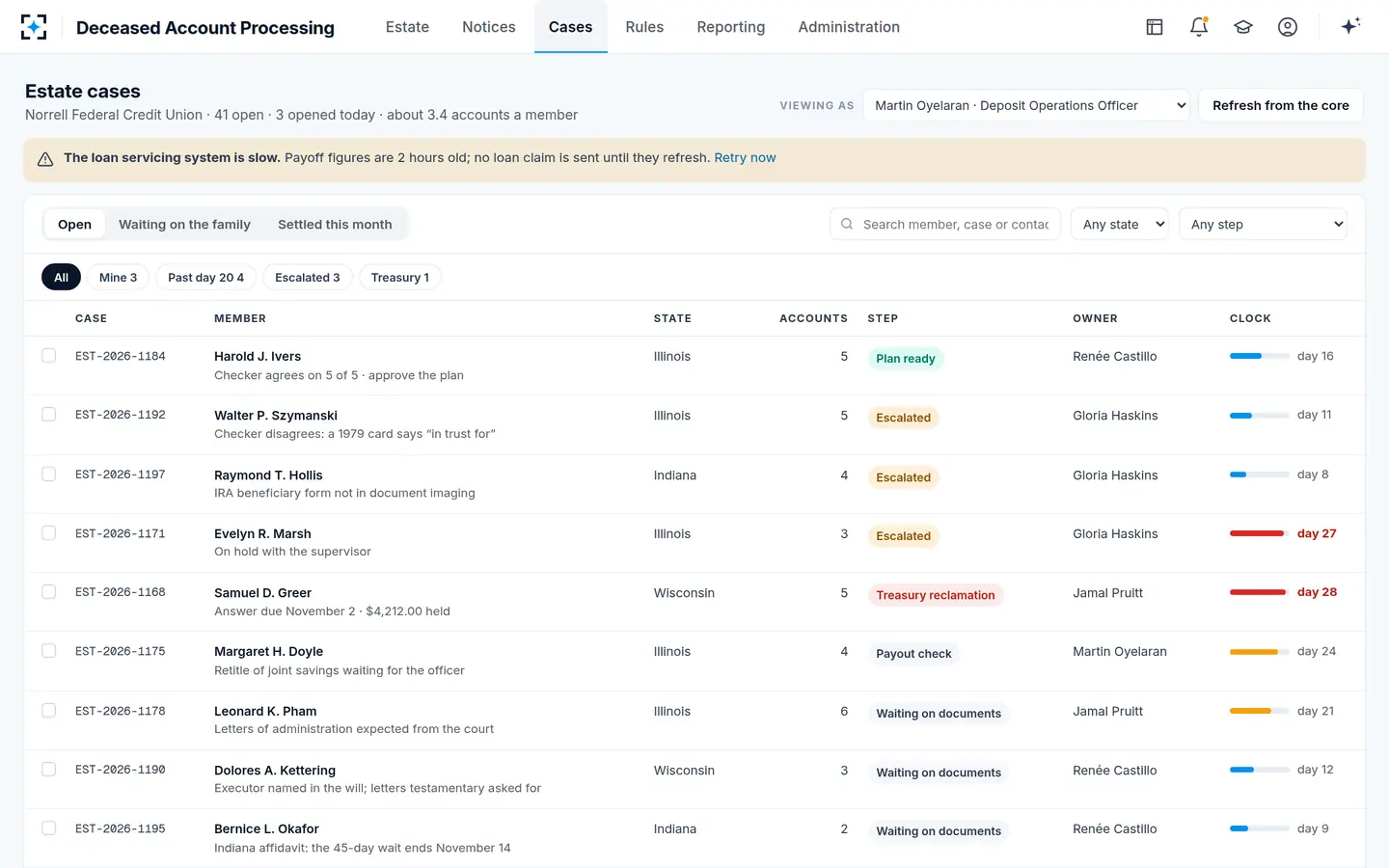
Older forms add a reading problem. A card from the 1970s may say “in trust for” rather than “payable on death,” and state law treats such trust accounts much like payable-on-death accounts at the owner’s death: in Virginia, the money goes to the beneficiaries “if surviving, or to the survivor of them if one or more die before the trustee, unless there is clear evidence of a contrary intent” (Va. Code § 6.2-608(C)). Whether a given card creates such an account, or reads as sole ownership with a note, is a judgment a person should make.
The case list, with the 1979 “in trust for” card escalated because two readings disagreed
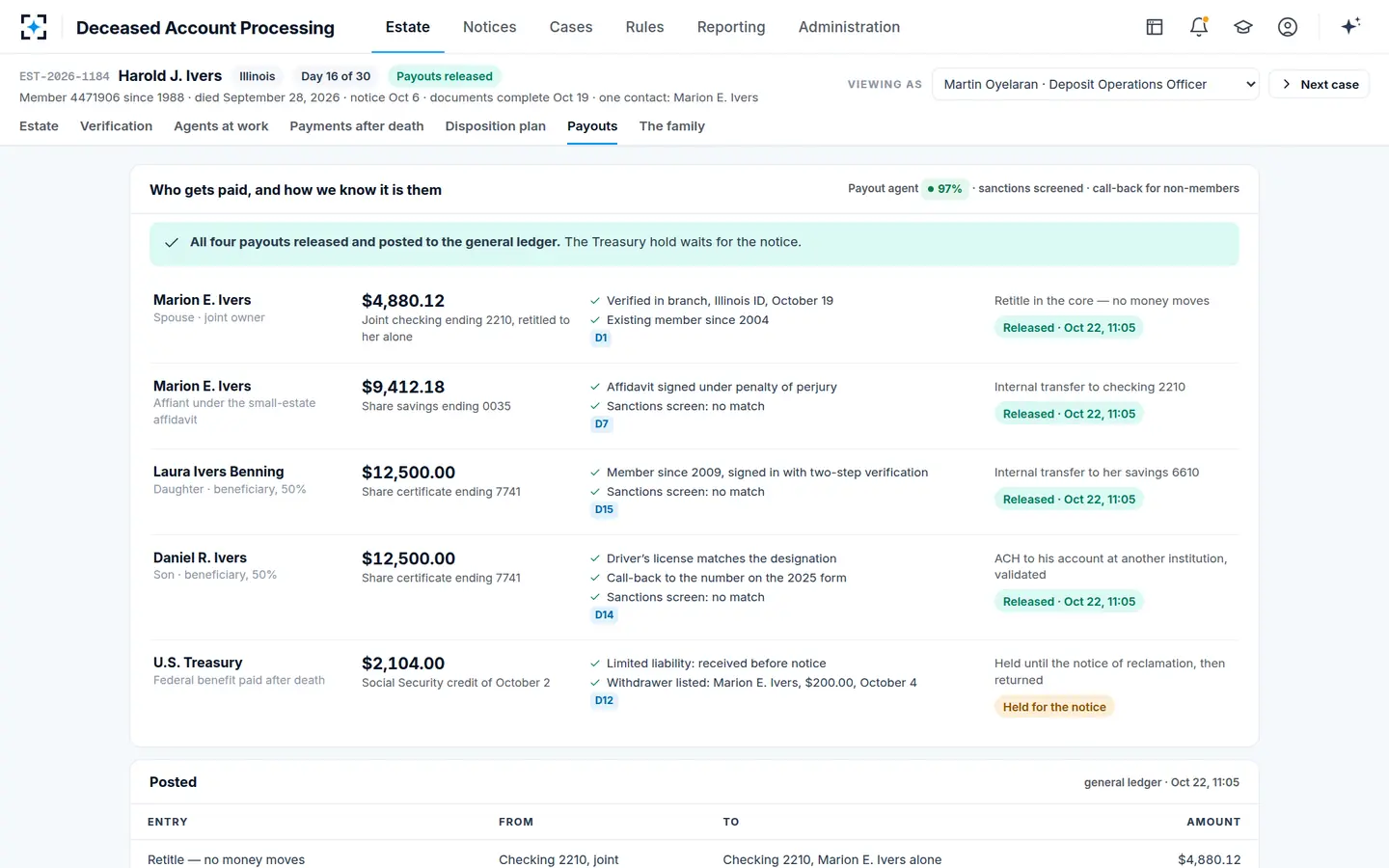
On the fictional sample estate the designation was recent and clear. The $25,000 share certificate named two adult children, 50/50, on a 2025 form; both were alive; one was a member and was paid to her own savings, and the other was identified by his driver’s license against the form and called back on the number written on it before he was paid. Had either died before their father, the other would have taken the whole certificate, and the file would have needed both death certificates to show the order.
Both beneficiaries of the certificate identified before the officer released either share
The rest of the estate is in the companion guides: the titling tree places payable-on-death accounts among the others, and the deceased account checklist lists what the file must show for each beneficiary. The full sample estate is on the Deceased Account Processing page.
Questions people ask
What is a POD beneficiary?
A payable-on-death beneficiary is a person, charity or organisation the account owner names to receive the account at the owner’s death. The beneficiary has no right to the money while the owner is alive, and the account passes to them outside the owner’s will and probate.
What if all POD beneficiaries die before the owner?
The account is paid to the owner’s estate, as if no beneficiary had been named. Florida’s statute says so directly: if no beneficiary survives, the sums on deposit belong to the estate of the last surviving owner. The estate’s personal representative or small-estate successor then collects it.
Do the dead beneficiary’s children inherit the share?
Not under the Virginia and Florida statutes, if the beneficiary died before the owner: the share goes to the surviving beneficiaries. If the beneficiary outlived the owner and then died, the share belongs to that beneficiary’s estate, and the beneficiary’s children may receive it through that estate.
Is there a grace period on deposit insurance when a beneficiary dies?
No. The FDIC counts only living beneficiaries, so coverage is reduced immediately in most cases. The six-month grace period applies only to the death of the account owner.
Can a POD beneficiary be changed after the owner dies?
No. At the owner’s death the money belongs to the beneficiaries on the designation in force who are still alive, and a will cannot redirect it; Virginia’s statute says a payable-on-death designation cannot be changed by will. Only the owner can change the designation, while alive, by filing a new form with the bank.