A bank bereavement process is the procedure a bank or credit union follows from the first notice that a customer has died to the last payout and letter: confirm the death, freeze only what the account titling requires, hold any federal benefit paid after the death, decide where each account goes, check every payee and write to the family. None of those steps is hard on its own. What makes the work slow is that almost every one of them waits on someone outside the bereavement team, and most teams cannot say on day one who that is. Botminds' Deceased Account Processing is software for this desk: agents read the signature cards, beneficiary forms and benefit credits, and a specialist and a second officer make every decision. This guide maps the waits, seat by seat.
The examples follow one fictional sample estate at the fictional Norrell Federal Credit Union. Harold J. Ivers died at home in Aurora, Illinois, on September 28, 2026, leaving a joint checking account with his wife Marion, a $25,000 share certificate payable on death to two adult children, a sole savings account, an auto loan and a Social Security credit that arrived four days after he died. The people, accounts and amounts are invented; the rules quoted are real and linked where they appear.
Five seats touch one estate, and the family should deal with one of them
Today
Pulls every signature card and beneficiary form from imaging, looks up the state rule, types the letters, and answers the family’s calls while the file waits.
With agents
Opens an estate already read, each account with the document behind it and a second reading beside it; approves the plan and stays the family’s one contact.
Still theirs: the plan, the family, and every judgment call
Today
Asks for the card, the form and the payee’s proof before every release, because nothing else shows why the money goes where it goes.
With agents
Sees each payee with identity evidence, call-back and sanctions screen beside the card, and releases each payout as its own signed entry.
Still theirs: the second signature on every freeze, payout, retitle and letter
Today
Watches every open estate against the clock and reads cases that never needed her.
With agents
Sees only disagreements, missing forms and cases past their warning day.
Still theirs: the decision when two readings disagree
Today
Takes the certificate across the counter and is asked by the family what happens next, without the answer.
With agents
Uploads documents and sees what is already on file, never a balance.
Still theirs: the first face the family sees
Today
Samples settled cases and asks for the card, the decision and both names on each.
With agents
Traces each payout to its document and two signatures on one trail.
Still theirs: read-only access, and the sample
What is a bank bereavement process, and who runs it?
It is the bank’s written procedure for a customer’s death, and at most institutions it is run by a small estate services or bereavement team inside deposit operations, with branches and the contact center taking the first notice. The team’s job is to turn one event, a death, into a separate decision for every account, card, loan and recurring payment the customer had, each made under the rule that governs that account.
The volume is steady and large. The United States recorded 3,072,666 deaths in 2024 (CDC, FastStats), and a bank sees its share of them as a stream of phone calls, branch visits, letters, online forms and electronic federal notices. Federal occupational statistics have no separate category for estate services work; it sits inside broader clerical groups such as New Accounts Clerks, which counted 41,180 people at a mean annual wage of $44,670 in May 2023 (BLS, Occupational Employment and Wages, May 2023). In practice the work falls to a handful of specialists; the fictional specialist in the examples carries about twenty open estates.
The process has a fixed shape whatever the institution calls it. A notice arrives; the bank verifies it; it freezes and stops what the titling requires; it finds what was paid in and taken out after the death; it decides each account’s destination; it checks the documents and payees; it pays out, returns, retitles and writes. The rest of this guide is about the gaps between those steps.
How do I notify a bank of a death, and what happens that day?
A family member, executor or friend can notify the bank by phone, in a branch, by mail or through an online form, and the bank should act the same day on what it learns, even before a certified death certificate arrives. The consumer guidance is blunt: the CFPB’s checklist for surviving spouses simply says “Notify your bank or credit union about your spouse’s death” (CFPB, Taking Control of Your Finances: Help for Surviving Spouses).
That first call matters more to the bank than to the family. Under the Treasury rules for federal benefit payments, a bank’s exposure for benefits paid after a death turns on when it first knew, and the Treasury’s Green Book lists a believable report of the death, spoken or written, among the things that give a bank that knowledge (Bureau of the Fiscal Service, Green Book, chapter 5). A desk that logs the call, the caller and the minute is building the date it will later have to certify; how banks know someone has died, and why that date sets liability follows it through.
What the bank does that day should be narrow. In the sample estate, Marion Ivers called the contact center on October 6 at 10:14. By 10:31 Harold’s debit card was canceled, his sole savings frozen for withdrawals and his online banking closed, each change proposed by the specialist and approved by a second officer. The joint checking stayed open, because Marion owns it. The next morning, the Social Security death notification arrived on the ACH network, and the Social Security credit of October 2 was put on hold the same morning.
Does the bank freeze your account when you die?
A bank freezes the accounts the deceased owned alone, and generally should not freeze an account a surviving co-owner still owns. The OCC’s banking glossary describes the classic case as an account that stays frozen until a court orders the money handed to whoever now owns it (OCC, HelpWithMyBank.gov glossary). That fits a sole account; it does not fit a joint one.
State multiple-party account laws say why. Virginia’s, to take one example, lets the bank pay any party to a joint account on request, whether or not another party has died or lost capacity by the time the money is asked for (Va. Code § 6.2-613). A freeze on a joint checking account locks a surviving spouse out of her own money, usually in the week she most needs it. The Treasury’s own guide warns of the electronic version of the same mistake: a joint account flagged on a death notice that then returns the surviving spouse’s own benefit as if she had died too (Green Book, chapter 4).
Two other things stop at death and should be handled the same day. A power of attorney ends: “Generally, the POA automatically expires upon the death of the account holder” (OCC, HelpWithMyBank.gov). And recurring payments on the deceased’s own accounts and cards need a decision, each one, because some are the survivor’s household bills and some are the deceased’s subscriptions.
What documents does a bank need when someone dies?
The bank needs proof of death for every account, and beyond that the documents depend on how each account is titled: a joint account needs little more, a payable-on-death account needs each beneficiary’s identity, and a sole account needs someone with legal authority over the estate. Statutes define proof of death broadly. Virginia’s accepts a death certificate, a court’s certificate that someone has qualified on the estate, or an authenticated copy of a government record or report, from any country, showing that the person is dead (Va. Code § 6.2-604); the deceased account checklist sets out what the file should hold for each account.
What to ask the family for on day one, by how each account is titled
- Every account: proof of death
A certified death certificate is the usual form. The CFPB tells surviving spouses that institutions “may require you to provide a physical copy of the death certificate. Others may accept electronic copies.” Ask once, and say which.
- Joint account with right of survivorship: the survivor’s identity
Usually an existing customer already identified. The account is retitled, not paid out, so no money needs to move.
- Payable on death or in trust for: each beneficiary’s identity and payment details
A beneficiary who is not a customer needs identity checks and, at careful banks, a call-back to the number on the designation before any payout.
- Sole account, small estate: the state’s affidavit, once the waiting period has run
Virginia’s small-asset affidavit covers a personal probate estate of up to $75,000 and requires that at least 60 days have passed since the death.
- Sole account, larger estate: letters testamentary or letters of administration
The court’s appointment of the personal representative, who opens an estate account under the estate’s own tax identification number.
- Loans and lines: nothing from the family at first
A loan becomes a claim against the estate; the bank sends the payoff to the personal representative or the affiant, not a demand to relatives.
The estate account in the last line has its own paperwork. “Before you file an estate income tax return, you need a tax identification number for the estate,” the IRS explains, and that number is an employer identification number (IRS, Deceased taxpayers). A personal representative who arrives without one has to come back.
Small estates have their own waits. Virginia lets a holder pay a small asset of $35,000 or less to a successor without an affidavit, but only once 60 days have passed since the death and only while no one, in any jurisdiction, has applied to be appointed personal representative (Va. Code § 64.2-602). A bank that tells the family on day one that a sole savings account cannot be paid for two months has given them the most useful sentence of the whole process.
Who waits on whom after a death notice?
Once the bank’s own reading takes hours rather than days, nearly all the remaining time on an estate is one party waiting on another, and each wait has a name. On the sample estate, the bank held the file for two of the sixteen days between the first call and the payouts; the family held it for twelve and a beneficiary for two.
Sixteen days on one sample estate, and who held it on each of them
- Bank: verify, freeze, hold the benefit1 d
- Family: certified certificate and small-estate affidavit12 d
- Beneficiary: identity and call-back2 d
- Bank: plan approved, payouts released1 d
The wait list is longer than the sample shows, and each item has its own owner. The family waits on the funeral home or the health department for certified copies; the CFPB tells surviving spouses to order “10-12 certified copies of the death certificate.” A personal representative waits on the court for letters. An affiant waits on the statute’s calendar. A beneficiary who lives in another state waits on the bank’s call-back. The bank waits on its own imaging system for a 1988 signature card, and on Treasury for a notice of reclamation that may come weeks later, with 60 calendar days to answer it once it does (Green Book, chapter 5).
Who waits on whom: the dependencies in a deceased-account file
| Waiting | On | For | What the bank can say on day one |
|---|---|---|---|
| The bank | The family | A certified death certificate | How many copies the bank needs (ideally one) and whether an electronic copy will do |
| The bank | A court | Letters testamentary or of administration, for a sole account above the small-estate limit | That the account will be paid to the estate, and to whom, once letters arrive |
| The family | The statute | The small-estate waiting period | The first lawful day, as a date (60 days after the death in Virginia) |
| The bank | Each beneficiary | Identity, payment details and a call-back | That each beneficiary will hear directly, and only about their own share |
| The bank | Its own archive | Signature cards and beneficiary forms, some decades old | Nothing, if the archive is read on day one |
| The bank | Treasury | A notice of reclamation for a benefit paid after the death | That the benefit is held and will be returned, and that no one in the family is asked to repay what the bank holds |
The fourth column is the argument for mapping the waits. A family told on the first call that the joint checking is untouched, the certificate goes to two named children once each confirms by phone, and the savings will be paid on the affidavit after a stated date, stops calling to ask. A family told “we will be in touch” calls every week, and each call costs the specialist the time she should have spent on the file.
Why should a grieving family hear from one person?
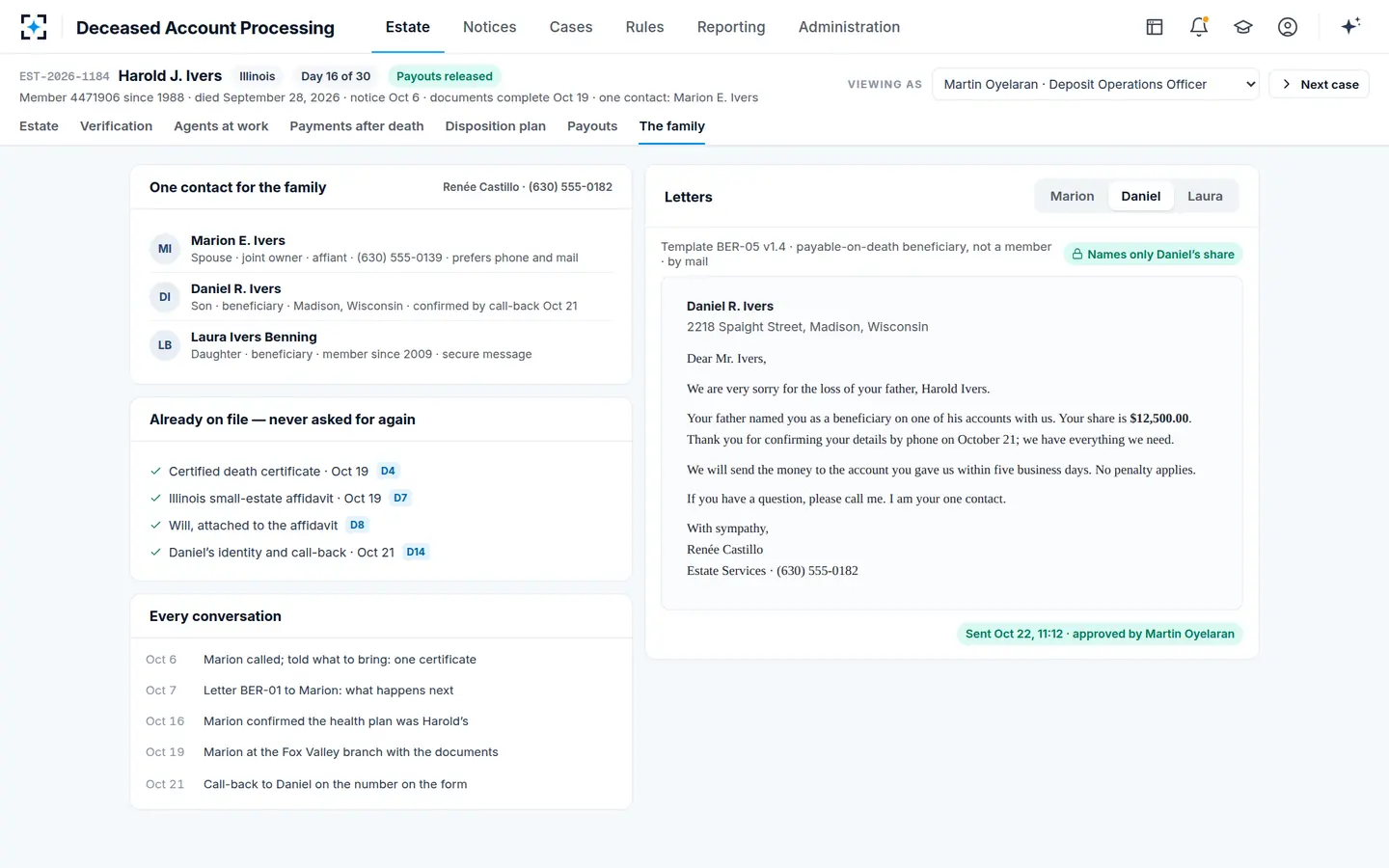
Because every handoff inside the bank risks becoming a new request to the family, and the family is the party least able to bear it: the same certificate asked for by the branch, then by operations, then by the loan department. A single named contact, and a file that shows what is already on hand, removes the repetition.
The same logic applies to letters. A payable-on-death certificate split between two children, one of whom is not a customer, should produce two letters, each naming only that reader’s share. A letter that lists the whole estate tells one heir what another received, which is a privacy failure and often the start of a family dispute the bank is then drawn into.
One contact for the family, what is already on file, and one letter per person
Who holds the pen, and who signs
A bereavement desk is a two-signature operation even when the rules do not say so in words. The specialist prepares: the freeze list, the benefit hold, the destination of each account, the payees, the letters. A second officer checks and releases each one. A supervisor decides only when two readings of a document disagree or a form is missing. An auditor reads everything and changes nothing.
The reason is the cost of the two errors the desk can make. Paying the wrong person, by reading an old in-trust-for card as sole ownership or missing a replaced beneficiary form, can mean paying the right person as well. Letting a federal benefit leave the account after the bank knew of the death leaves the bank liable for it under 31 CFR 210. Both are judgments about documents, and both are the kind of judgment a second person catches. In the fictional team, the specialist sees “You prepared these payouts, so you cannot release them” when she opens the payout screen: the separation is enforced, not just written in the procedure.
How long does it take to close a deceased person’s bank account?
For a joint or payable-on-death account with clean paperwork, days to a few weeks; for a sole account, at least as long as the state’s small-estate waiting period or the court’s letters take, which can be months. The bank’s own handling adds to either. The solution’s design estimate for the fictional credit union, at 260 death notices a month and about 3.4 accounts each, is a median of about 34 days from notice to settled estate by hand, against a target of 11 with the agents doing the reading. Those are an estimate and a design target, not measured results.
Most of the difference is the bank’s own work, not the family’s waits, which is the point of this page: once the reading is fast, the waits are what is left, and they can be named. How long a bank takes to release funds after a death sets out the legal clocks one by one, and what happens to a bank account when someone dies walks the titling tree that decides which of them applies.
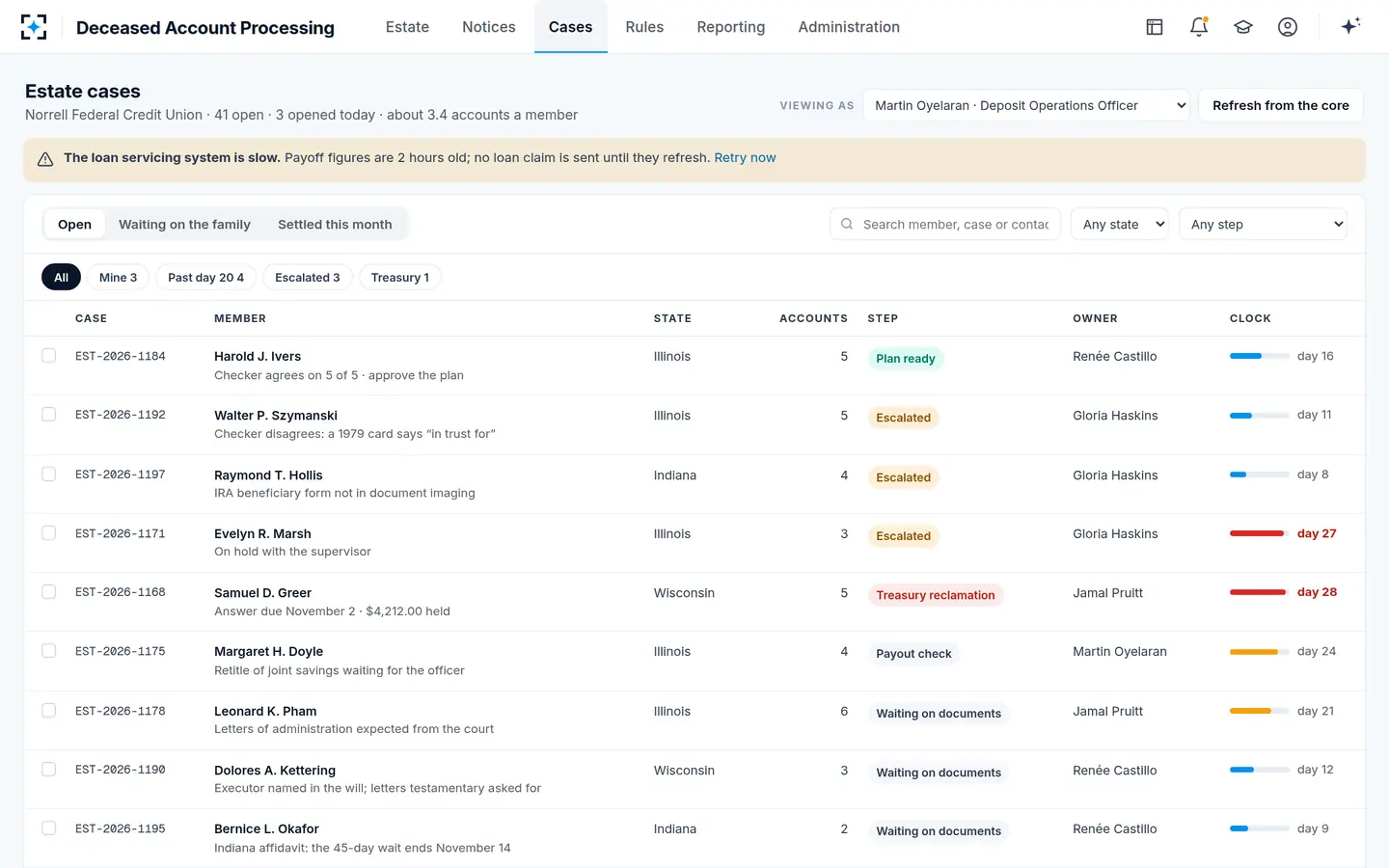
Every open estate on its clock, with the ones waiting on the family in their own tab
Where Deceased Account Processing changes the wait
The solution cannot make a court issue letters faster or shorten a statutory waiting period, and it should not try. What it changes is everything the bank does between the waits. Six agents verify the death against the federal notification, read every signature card and beneficiary form, list every payment since the death and propose a hold on federal benefits, check the affidavit or letters against the state rule in force on the date of death, derive every account’s destination a second time without seeing the first answer, and draft one letter per person. People approve each step: the specialist the plan, the officer each payout.
The effect on the family is the table above, filled in on day one. The effect on the desk is that the specialist spends her time on the cases that need judgment, a 1979 card that reads two ways or a missing IRA designation, rather than on retrieval and typing. To see the full estate, from the first call to the last letter, start from Deceased Account Processing.
Questions people ask
What is a bank bereavement team?
It is the group in deposit operations that settles a deceased customer’s accounts: verifying the death, deciding where each account goes under its titling, holding federal benefits paid after the death and paying out to the right people. Some banks call it estate services or a deceased accounts unit. Its work is usually split between a specialist who prepares and an officer who releases.
How many death certificates will the bank need?
Each institution sets its own rule: in the CFPB’s words, some “may require you to provide a physical copy of the death certificate. Others may accept electronic copies.” The CFPB advises surviving spouses to order 10 to 12 certified copies from the funeral home, because insurers, creditors and other companies may each want one. A bank that keeps its copy on file and never asks again saves the family one of them.
Who can close a deceased person’s bank account?
It depends on the titling. A surviving joint owner keeps the account, and a payable-on-death beneficiary claims it with proof of death and identity. A sole account is closed by the personal representative named in letters from the court, or, where the estate is small enough, by the successor named in the state’s small-estate affidavit after its waiting period.
Does the bank stop automatic payments when someone dies?
Not by itself, and it should ask before stopping any on a joint account. The CFPB tells survivors to ask each company to stop its charges and then give the bank a stop payment order. A careful bereavement desk lists every recurring payment on the deceased’s own accounts and cards and asks the surviving owner about the household bills on joint ones.
Does a power of attorney still work after the account holder dies?
Generally not. The OCC’s consumer site says the power of attorney “automatically expires upon the death of the account holder,” with state law and the document’s terms governing the details. From then on, authority over a sole account passes to the estate’s personal representative or small-estate successor.
What is deceased customer service at a bank?
It is the front end of the bereavement process: the line, branch desk or online form where families report a death and ask what comes next. Done well, it logs when the bank first learned of the death, takes the certificate once and gives the family a single named contact with a list of what each account needs.