Remarketing, in insurance, means taking a policy back to the market at renewal: instead of accepting the incumbent insurer's renewal offer, the broker asks other insurers to quote the account. It can cover the whole program or a single line, such as the property schedule or an umbrella layer, and it usually follows a trigger: a rate rise past a threshold, a cut in limits or capacity, a nonrenewal or conditional-renewal notice, a large change in exposure, or poor loss history. The word has other meanings, in advertising and in auto finance, where it means reselling repossessed or off-lease vehicles; on a broker's renewal desk it means shopping the renewal. Botminds' Renewal & Remarketing Management treats the remarket call as a decision line by line, recommended by an agent with its reasons and recorded by the account executive before the first submission goes out.
Shop it or keep it: five triggers, and what to do when none is met
The incumbent will not renew
Remarket
There is nothing to keep. Start the same week the notice or the underwriter's warning arrives.
A limit, layer or capacity is cut
Remarket the gap, or split
Keep what the incumbent still offers and place the missing layer elsewhere.
Rate is up past your threshold
Remarket, unless peers rose alike
Compare with similar renewals in your book this quarter before you decide the rise is the account's, not the market's.
Exposure changed by 10% or more
Re-underwrite, then decide
A rise that follows the exposure may be fair; a change of class or value band may move the account out of the incumbent's appetite.
Losses above your loss-ratio line
Remarket selectively, with a narrative
Fewer markets, and a written account of what the client changed after the losses.
No trigger met
Renew, or renew and negotiate
A rise just under the threshold is still worth a counter-offer to the incumbent.
What does remarketing mean in insurance?
It means testing the price and terms of an expiring policy against other insurers before it renews. A new account is marketed; a renewal that goes back out is remarketed. The broker builds a submission from the client's refreshed exposures and loss runs, sends it to markets that have appetite for the risk and that the agency can reach, through its own appointment or a wholesaler's, compares the quotes with the incumbent's offer and the expiring program, and recommends one.
Remarketing is not the same as moving the account. Many remarkets end with the incumbent, at a better price or on better terms than its first offer, because a credible alternative changed the negotiation. What remarketing always costs is time: the client's data, the underwriters' attention, and the weeks in the middle of the renewal process that a remarket needs.
When should a broker remarket a renewal?
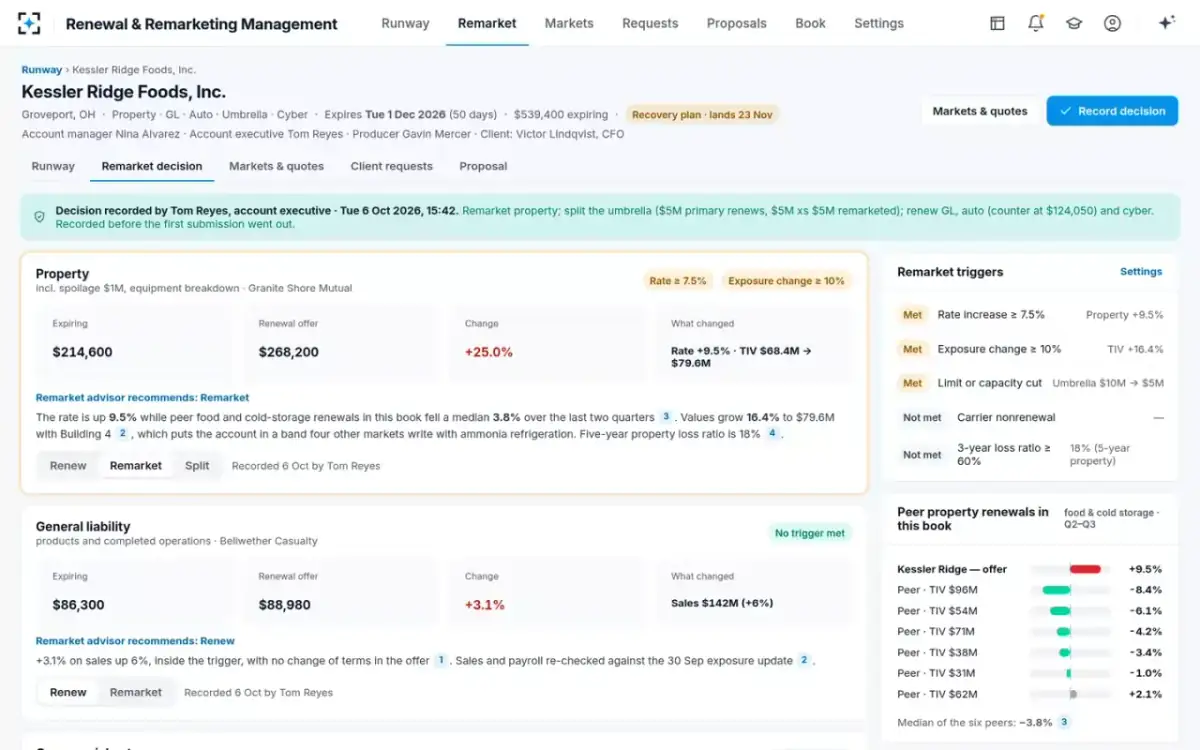
When a written trigger is met, and as early as the trigger is known. The triggers in the figure above fall into three kinds. Some remove the choice: a nonrenewal or a cut in capacity means the cover has to come from somewhere else. Some are about price: a rate rise past the agency's threshold, judged against what similar accounts saw. Some are about the risk itself: a large exposure change or a run of losses can move an account out of the incumbent's appetite, or into a better one elsewhere.
New York's commercial renewal law draws a similar line for insurers. A renewal that cuts limits or cover, raises a deductible, adds an exclusion, or raises premium by more than 10% for reasons other than exposure, experience rating or audit is a conditional renewal, and needs advance written notice to the insured and its broker (Insurance Law § 3426(e)). A broker's own triggers can use the same categories, with thresholds tuned to its book. Without a valid notice the policy carries on at the expiring terms, conditions and rates, which is itself worth knowing when an incumbent's changed offer arrives late.
What is a conditional renewal?
A conditional renewal is an insurer's offer to renew on changed terms: lower limits, narrower cover, a higher deductible, a new exclusion, or a premium increase large enough that the law requires notice. For the broker it is the clearest remarket trigger after a nonrenewal, because the client is being asked to accept less or pay more. What a conditional renewal notice must say, state by state, is set out in the conditional renewal notice sample guide.
Is the market moving in the client's favor?
It depends on the line, and the public price data shows how sharply lines diverged over the last two years. The federal producer price indexes for commercial insurance premiums, which track premiums for comparable cover, show commercial auto and commercial multiple peril rises slowing sharply while liability kept climbing.
Commercial insurance premiums by line: the last two years were not the same market
| Line (BLS premiums index) | 12 months to Sep 2025 | 12 months to Sep 2026 | Five years to Sep 2026 |
|---|---|---|---|
| Non-auto liability | +8.2% | +5.3% | +21.1% |
| Commercial multiple peril | +6.9% | +2.5% | +20.6% |
| Commercial auto | +6.6% | −0.8% | +8.7% |
| Workers' compensation | −3.3% | −0.9% | −7.9% |
The state regulators' own reading of 2025 points the same way. The NAIC's annual industry analysis describes property lines, particularly commercial property, as entering soft-market territory while casualty stays firm, and reports that commercial multiple peril non-liability losses incurred fell 11% while premiums earned rose 9% (NAIC, 2025 annual property and casualty analysis). For a remarket decision the lesson is to read the incumbent's offer against the line's market, not the market as a whole: a 6% rise on liability is close to the line's trend; the same rise on property, in a softening line, is a reason to test it. The wider cycle is set out in hard market vs soft market insurance.
Whole account or one line?
Decide line by line, then check that the pieces still fit together. A commercial account is several policies that depend on each other, and remarketing one can change what the others need. The umbrella is the clearest case: an excess market writes over named underlying policies and limits, so moving the general liability or auto changes what the umbrella insurer is relying on. New York's renewal law recognizes the dependence, letting an excess insurer condition its renewal on requirements for the underlying cover (Insurance Law § 3426(e)).
The sample account shows the pattern. The property line met two triggers and went to market. The umbrella insurer offered only $5 million of an expiring $10 million, so the agency renewed that $5 million and placed a second $5 million layer with another market, quoted to follow the form beneath it. General liability, up 3.1% on sales up 6%, met no trigger and renewed, as did cyber; auto renewed with a counter-offer. Five decisions on one account, each with its reason, and a program that still stacks.
Is it bad to remarket every year?
Not bad, but rarely worth it when no trigger is met. A remarket asks the client for data, takes underwriters' time that markets remember, and spends weeks of the season. Remarketing every account every year teaches markets that the agency's submissions are price checks, and the agency's best accounts get less attention for it. Remarketing on written triggers, and telling the incumbent why, keeps the threat credible.
Personal insurance in the UK shows what happens when renewing customers are treated differently by default. Since 1 January 2022, the Financial Conduct Authority's rule for home and motor insurance sold to consumers has been blunt:
"A firm must not set a renewal price that is higher than the equivalent new business price."
FCA Handbook, ICOBS 6B.2.1R, in force from 1 January 2022
We know of no US rule like it for commercial insurance, where renewal pricing follows filed rates, underwriting judgment and the account's own changes. For a US business owner asking whether to shop insurance every year, the honest answer is that the broker's triggers do the shopping when it is worth doing; a broker that cannot say what its triggers are is the thing to question.
How many markets should a remarket go to?
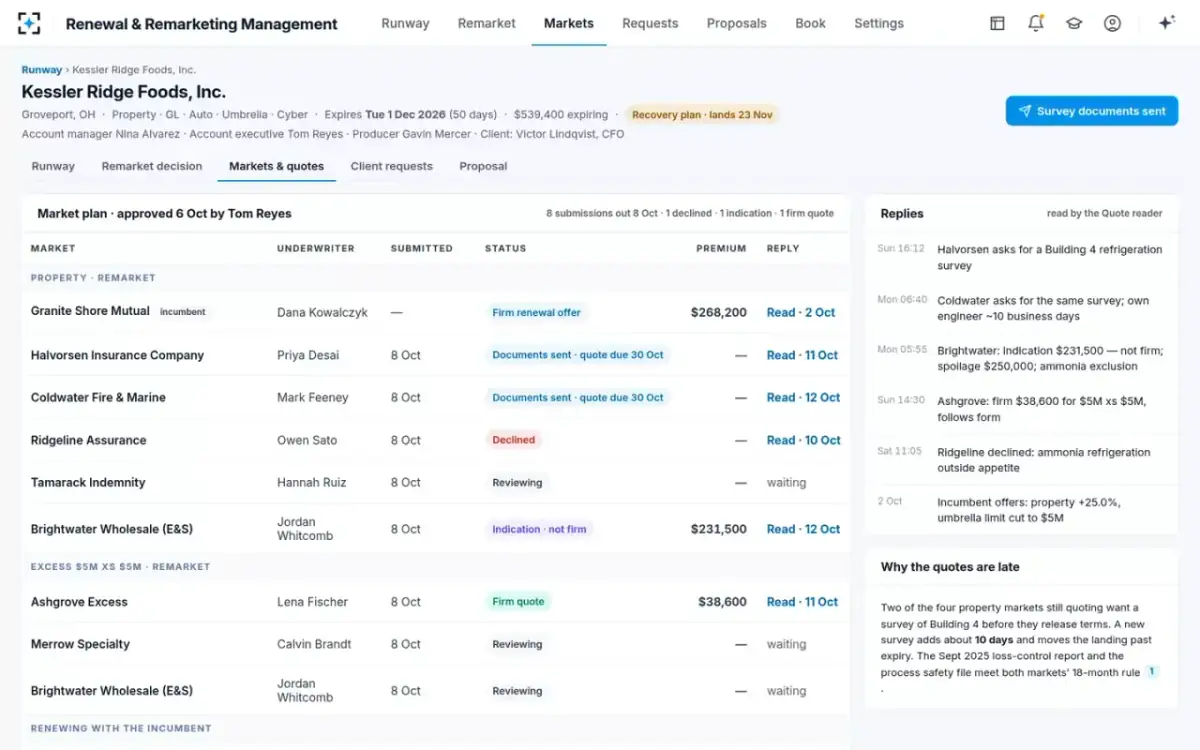
Enough to test the price with markets that would actually write the risk, and no more. There is no published benchmark. The useful filter is appetite and access: a producer may act as an insurer's agent only if appointed by that insurer (NAIC Producer Licensing Model Act, §14), and a market without appetite will decline after costing the client a week. In the sample agency's remarket of a food manufacturer's property, five markets were approached; one declined at once because ammonia refrigeration was outside its appetite, and one sent an indication rather than a firm quote.
One account, three decisions: remarket property, split the umbrella, renew the rest
The remarket in flight: five property markets, one decline, one indication
Does remarketing hurt the incumbent relationship?
Less than a surprise does. Underwriters expect accounts to be tested when they raise rates or cut capacity; what damages a relationship is a remarket the incumbent learns about from a competitor's quote. Tell the incumbent which lines are going out and why, and give it the chance to respond. The sample agency's decision log shows the third path: an auto renewal at +7.2%, just under the 7.5% trigger, renewed and negotiated down to +4.1%.
Three answers to an incumbent's renewal offer, and what each asks of the agency
Remarket the line: A trigger is met: nonrenewal, capacity cut, rate past threshold, exposure or losses that change appetite.
Renew and negotiate: No trigger met, but the offer is close to one, or out of line with peers.
Remarket the line: Fresh exposures, loss runs, sometimes a survey; time to review quotes.
Renew and negotiate: Little beyond the renewal data already collected.
Remarket the line: New submissions to markets with appetite that the agency can reach.
Renew and negotiate: A counter-offer to the incumbent, with evidence.
Remarket the line: Reason and decision before the first submission; market plan approved.
Renew and negotiate: Reason for staying, and the counter and its result.
Remarket the line: Quotes arrive days before expiry; better terms are gone.
Renew and negotiate: The incumbent has no reason to move.
How do you explain a remarket to the client?
With the trigger, the numbers and the plan, in that order, before any submission goes out. "Your property renewal offer rose 9.5% in rate while similar food and cold-storage accounts in our book fell a median 3.8%, and the umbrella insurer has cut your limit from $10 million to $5 million. We are asking five property markets to quote and placing a second $5 million layer; everything else renews." That is a paragraph a CFO can act on, and it is the reason the account executive writes down. How to explain the rise itself is covered in how to explain an insurance rate increase to clients, and what the client sees at the end of the year in the stewardship report.
What a remarket decision should have on file before the first submission
- The trigger met, by line
Which threshold, the figure that crossed it, and where the figure came from.
- The comparison that makes it fair
Similar renewals in the book, and the line's market, so the rise is the account's and not the market's.
- The decision for every line
Renew, remarket, split, or renew and negotiate, including the lines that stay.
- Who decided, and when
The account executive, dated before any submission.
- The approved market plan
Markets with appetite that the agency can reach; nothing goes anywhere else.
- What the client was told
The paragraph above, and the client's reply.
In Renewal & Remarketing Management the Remarket advisor compares each line's renewal offer with the expiring terms, the triggers, peer renewals in the book, the loss history and market capacity, and recommends renew, remarket or split, citing every reason. It recommends only; changing a line's decision later needs a reason too. How the decision feeds the agency's numbers is in renewal retention rate.
Questions people ask
What does remarket insurance policy mean?
It means the broker is asking other insurers to quote a policy that is about to renew, instead of accepting the current insurer's renewal terms. The client may end up with a new insurer, or with the same insurer on better terms after the comparison.
Should I shop for insurance every year?
For business insurance, shop when there is a reason: a significant rise, a cut in cover, a nonrenewal or a big change in the business. Ask your broker what its remarket triggers are and whether one was met this year. Shopping without a reason costs time and underwriters' goodwill.
How early should a remarket start?
As soon as the trigger is known, and in any case before submissions are due, which on a 120-day runway is about 70 days before expiry. In New York an insurer's conditional-renewal notice can arrive as late as 60 days out, so a broker that waits for it can lose the remarket's time.
What is a book roll?
A book roll moves a group of an agency's policies from one insurer to another at renewal, by agreement between the agency and the new insurer. It is remarketing at book level rather than account by account, and each client still needs its renewal terms compared and explained.
Can a broker remarket without telling the client?
A broker can ask for indications, but submitting the client's information and changing its insurer are decisions the client should make. Telling the client the trigger, the plan and the markets before submissions go out avoids a surprise at proposal stage and leaves a written record of what was agreed.