To explain an insurance rate increase to clients, give them the new premium and the change in dollars, then the reasons behind it in dollars with the biggest first, then what can honestly bring it down, and send the same account in writing. The example on this page does that for one homeowners renewal that rose $678. The words are the easy part. The hard part is finding the reasons, because a renewal increase is usually several changes stacked together, the insurer's filed rate revision plus changes specific to the household, and the rating worksheet multiplies factors without saying how many dollars each one added. Botminds' Premium Increase Explanation is software that splits every renewal increase into its reasons, dollar by dollar, and drafts the client letter and the call notes from that split for a person to approve.
The example comes from a fictional sample carrier, Tallowmere Mutual, and its renewal team. Margaret and Owen Lindqvist have insured their Spokane Valley home with it since 2014 through an independent agent, Teresa Ruiz. Their homeowners policy renews on December 11 at $2,520.00, up from $1,842.00. Every name and figure describing them is sample data. The regulatory and complaint figures are real and linked where they appear.
In Texas, most premium complaints end with an explanation, not a correction
1,127
auto and homeowners complaints closed in 2025 that cite premium and rating
72%
of them closed with the regulator noting information furnished
18%
confirmed against the company
98days
median from complaint received to closed
How do you explain an insurance rate increase to a client? Dollars first, then reasons
Start with the number, because it is what the client is holding. “Your premium goes from $1,842.00 to $2,520.00. That is $678.00, 36.8% more.” A client who has to ask “how much?” after a two-minute preamble stops listening to the reasons. Then give the reasons in dollars, largest first, each with the fact from their own policy that caused it. Then say what is not their doing, then what can lower it, then promise the same thing in writing.
The order matters because each step answers the question the client is about to ask. Dollars before percentages, because a client cannot pay a percentage. Reasons before options, because an option offered before the reason sounds like a sales pitch. The written copy last, because the client will repeat the explanation to a spouse, a lender or a regulator, and it should be the same explanation.
What makes this hard in practice is the second step. A rating worksheet shows the expiring and renewal factors line by line and the premium at the end. It does not say that the roof turning 16 added $214 and the rate revision added $158. Those numbers exist only once someone applies each changed line in the order of the rating plan, with every earlier change already applied, and records the dollars each step added. That split is what the rest of this page relies on.
An example: one $678 renewal, explained in six lines
Here is the Lindqvists' increase as the service representative and the agent explain it on the phone. The seven reasons add up to the cent; the three largest, roof age, the rate revision and the dwelling amount, account for $503 of the $678, about three-quarters, so they lead. What a representative may say on such a call without a licence is set out in what an unlicensed insurance CSR can do.
The call script, in the order the client needs it
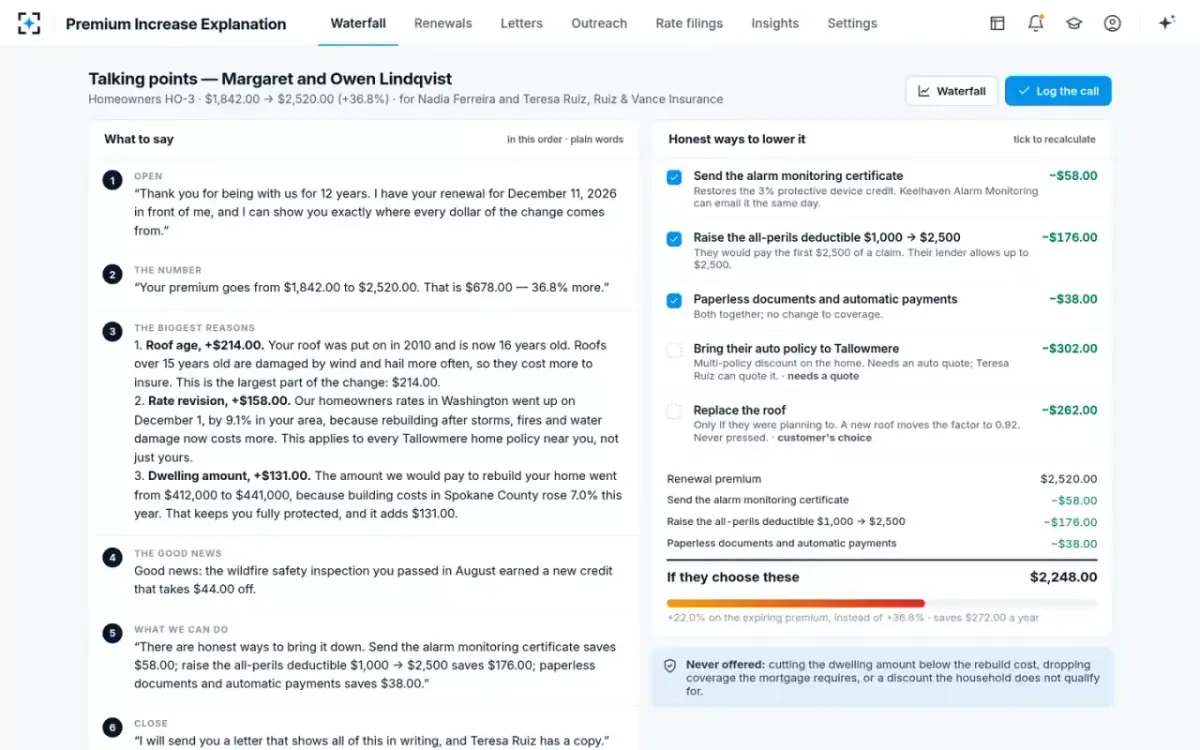
Written out, the six lines are short. Open: thank them for twelve years, and say you can show where every dollar of the change comes from. The number: $1,842.00 to $2,520.00, $678.00 more. The three biggest reasons: the 2010 roof turns 16 and moves into the next age band of the approved rating plan, +$214.00; Washington homeowners rates in their territory rose 9.1% on December 1, +$158.00; the amount needed to rebuild the house went from $412,000 to $441,000, +$131.00. The rest: the February water claim ended the claims-free discount (+$117.00), the alarm credit lapsed with the monitoring certificate (+$58.00), and the water backup cover they added in May costs $44.00. The good news: the wildfire inspection they passed earned a $44.00 credit. What we can do: three options they qualify for, together −$272.00.
Notice what the script does with the rate revision. It says the rate rose for every policy in the territory, not just theirs, which is true and is the one piece of the increase the client could not have changed. It does not lead with it. Here it is $158 of $678, under a quarter of the increase. Leading with “rates went up” would have explained a quarter and implied it explained the whole.
Why “rates are going up everywhere” is the wrong explanation
Because it is rarely the whole reason, and clients can tell. Across the sample carrier's renewal window, 14,212 renewals with an increase added $6,154,200 of premium, and rate revisions were $1,912,400 of it, about a third. The other two-thirds came from changes specific to each household: an exposure change such as a higher dwelling amount, a property factor such as roof age, a claim, a lost discount, a new driver. A script that blames the market for all of it is wrong two times in three.
The cost of the wrong answer shows up as complaints. In Texas, 1,127 complaints about automobile or homeowners coverage that cite premium and rating were closed in 2025, on our count of the regulator's published data. Most were not upheld against the insurer: 18% were confirmed. But 72% were closed with the department noting that information was furnished. In other words, the commonest outcome of a premium complaint is that someone finally explained the premium, months later, through the regulator. The median complaint took 98 days to close.
Two explanations of the same $678 increase
The generic script: “Your renewal is a bit higher this year.”
The explanation from the split: “$1,842.00 to $2,520.00: $678.00, 36.8% more.”
The generic script: “Rates are rising everywhere because of storms and inflation.”
The explanation from the split: Seven reasons with dollars, biggest first; the rate revision named as $158.00 of it.
The generic script: Nothing; the client hears that nothing could be done.
The explanation from the split: The claim, the lapsed alarm credit and the cover they added, each dated.
The generic script: “You could shop around.”
The explanation from the split: Three options they qualify for, −$272.00, and two that need a quote or are their choice.
The generic script: A form letter, if anything.
The explanation from the split: The same seven reasons, in a letter a person approves, with a copy to the agent.
The generic script: Someone rebuilds the explanation from the worksheet.
The explanation from the split: The explanation already exists, tied to the worksheet lines.
Four seats explain the same increase
A renewal increase is explained by at least four people, and the explanation only holds if all four read from the same split. The service representative answers the call and approves the letter. The independent agent hears from the client first and wants to hear from the carrier before the envelope arrives. A retention specialist calls the households most likely to leave. A compliance officer answers for every reason a letter names. If each works from a different source, the client gets four explanations.
Who explains a renewal increase, and what each one signs
Today
Sees the new premium and the worksheet, and spends minutes matching lines before saying anything specific.
With agents
Opens the split, reads the reason behind each bar, and approves and e-signs a letter that already says it.
Still theirs: the call, the judgement on tone, and the signature on every letter
Today
Hears about the increase when the client calls, with nothing in hand.
With agents
Gets the letter in the agent portal and the talking points before the notice lands.
Still theirs: the relationship, and quotes such as a bundle that change the policy
Today
Finds out a long-standing client left after the renewal date.
With agents
Calls households over 30% and $700 first, ranked, with the reasons on screen.
Still theirs: the decision to call and what to offer
Today
Cannot check that each reason in thousands of letters is true for that policy.
With agents
Approves each rate filing’s plain-words wording once; letters reuse it word for word.
Still theirs: the wording, the state rules applied and the right to block a letter
The service representative's line in the sample is the one most renewal teams recognise:
“I can see the number went up. I can’t see why.”
Nadia Ferreira, the sample carrier's policy service representative
The agent's need is timing. An agent who learns of a 36.8% increase from the client starts the conversation defending a number they have not seen. In the sample, the letter and the talking points go to the agent's portal when the representative approves the letter, before the notice mails, and agents of record are told first for their households.
How to explain an auto insurance rate increase to customers
The same way, with different reasons. An auto renewal moves for the household's own changes, a driver added, a vehicle replaced, an accident, a ticket, a new address, and for the insurer's rate revision in the client's territory. Two sample auto renewals show the pattern. Kwame Osei's New York auto rose 16.8%, $284: an at-fault accident added $241, the rate revision $96, and fewer miles took $53 off. Darnell and Gloria Haskins's Washington auto rose 25.7%, $562: a new teen driver added $388, the rate revision $142, and the replacement vehicle $96.
In both, the rate revision is real and the smallest of the main reasons. Leading with the accident or the teen driver feels harder to say, but it is the explanation the client can check against their own year. New York's law names these causes in its list of primary rating factors: claims history, policy changes such as adding or replacing a vehicle or adding a family member or a change in address, expected losses in the rating territory, and higher claim costs (N.Y. Ins. Law §2356(c)).
One reason needs separate handling. When an increase rests partly on a credit-based insurance score, federal law requires its own adverse action notice, and the explanation should point to it rather than paraphrase a score. A client who says nothing changed is often looking at that notice, or at a change they forgot. The page on why car insurance goes up when nothing changed works through those cases.
What you must say in writing, in New York and Washington
In two states the written explanation is now a legal duty, not a courtesy. Since August 24, 2026, a New York insurer renewing a private passenger auto or residential property policy at a total increase of more than 10%, leaving out any increase from insured value added, must send with the premium bill the amount of the increase and a written explanation including the primary rating factors. Below that line, the bill must carry a prominent notice that the policyholder may ask for that explanation in writing, and the answer is due within 20 days (N.Y. Ins. Law §2356). The details, and what counts as specific enough, are on the page on New York premium increase explanations.
Washington runs in phases. Insurers already explain any renewal increase on written request. From November 1, 2026 renewal notices, renewal emails and renewal bills must carry a new, prescribed disclaimer telling the policyholder of that right; from March 1, 2027 the explanation on request must give the top primary factors, up to three; and from 2029 notices go out automatically for renewal increases of 10% or more (WSR 26-15-007). The build that follows from those dates is set out in the Washington premium change notice template.
Everywhere else, the written explanation is still how the call is remembered. State examiners test whether letters from policyholders get a prompt, responsive answer from the right department (NAIC Market Regulation Handbook standards; the measures that follow from it are in policy servicing KPIs and metrics), and a client who complains will be asked what they were told.
Call before the notice lands: which clients hear it from a person first
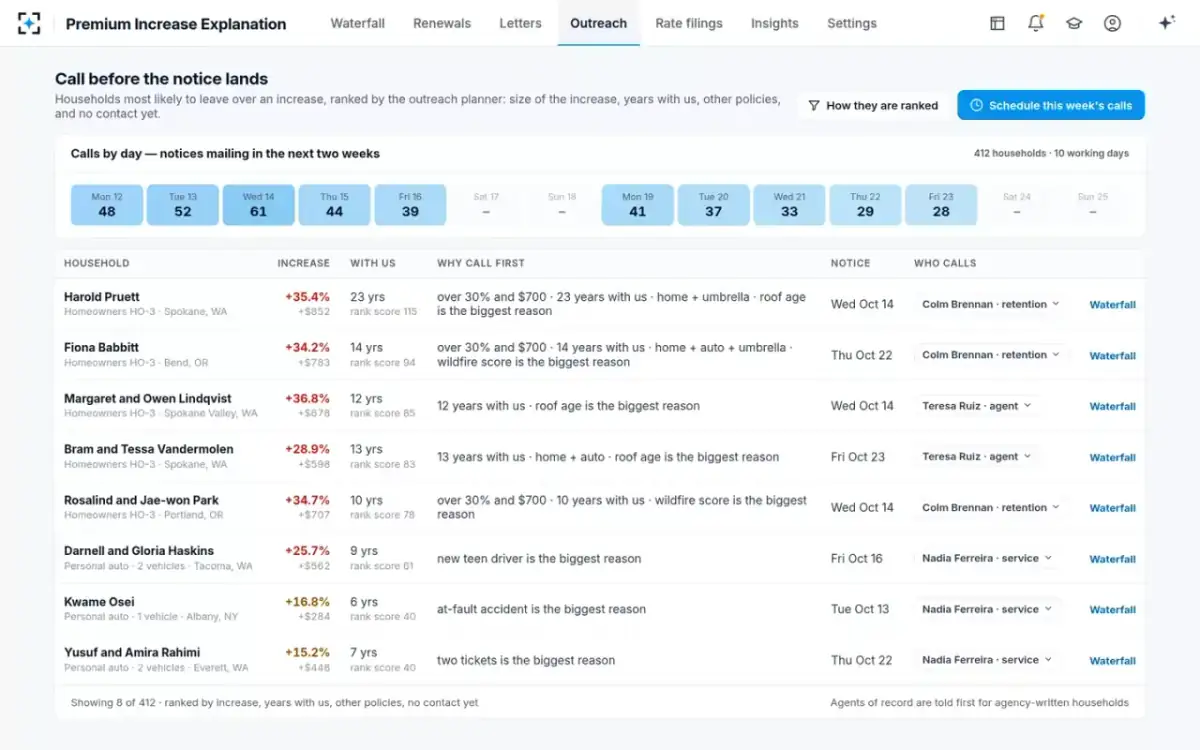
Not every increase needs a call, and calling everyone means calling no one in time. The sample carrier ranks households each night by the size of the increase, years with the company, other policies held and whether anyone has been in touch yet, and proposes who should call: retention, the agent or service. Households over 30% and $700 get a retention call before their letter is approved. The Lindqvists, at 36.8% but $678, fall just under the dollar line, so their agent calls instead.
Who gets a call before the notice, and from whom
From the split to the client: who prepares and who decides
Agent
Change attributorSplits the $678 into seven reasons in rating order, each tied to a worksheet line, adding up to the cent.
Never: forces the bars to add up; more than $1.00 left over holds the letter
Agent
Letter writer and options finderDrafts the letter and the call notes, top three reasons first, and re-rates the options the household qualifies for.
Never: names a reason that is not on the split, or suggests a rebuild amount below cost
Agent
Outreach plannerRanks households for a call before the notice and proposes who calls.
Never: contacts a customer
A person decides
Service representativeReads the checks, edits if needed, approves and e-signs the letter; it mails with the renewal notice.
A person decides
Agent or retention specialistCalls the client with the same reasons and decides what to offer, including any quote.
What not to say when explaining a rate increase
Most of the damage in a renewal conversation comes from four kinds of sentence: a reason that is not true for that policy, internal language the client cannot check, an option that leaves them worse protected, and a promise nobody can keep. The sample carrier blocks credit-score wording, internal factor codes such as “territory relativity” and “base rate offset”, and filler such as “unfortunately” and “as you may know” from every letter, even after a hand edit.
Seven rules for an explanation that holds
- Name only reasons the worksheet shows
A claim is a reason only when the worksheet shows its effect. A storm in the news is not a reason unless the filed rate changed.
- Give every reason in dollars, adding up to the increase
If the reasons add to $640 and the increase is $678, the client will find the gap.
- Lead with the biggest reasons, not the most comfortable
In the example the rate revision is third by dollars; leading with it would mislead.
- Use the approved filing wording for the rate
One plain-words explanation per filing, approved once, reused word for word.
- Point to the credit notice; do not paraphrase a score
A credit-based reason carries its own federal notice and dispute rights.
- Offer only options the household qualifies for
Never a rebuild amount below cost, never dropping cover a lender requires, never a discount they cannot get.
- Say it in writing, the same way
The agent, the letter and the call should give one explanation.
Where Premium Increase Explanation fits, and where it does not
Premium Increase Explanation does the part of explaining a rate increase that people find slowest: reading both declarations and both rating worksheets, matching the lines that changed, finding the approved rate filing and the year's policy changes, and splitting the difference into reasons that add up to the cent. In the sample run, seven agents did that for one renewal in 10.6 seconds, overnight, and for every renewal with an increase in the window. It then drafts the letter and the call notes from the split.
It does not set rates, change a policy or send anything. A representative approves and e-signs every letter; compliance approves each filing's wording and each template before first use; the agent or retention specialist decides what to offer on a call. It needs the carrier's own declarations, rating worksheets, filings and discount rules to work, and the first step is a run on a sample of the carrier's own renewals. To see the screens behind this example, start from Premium Increase Explanation; for the letter itself and how it is checked, see the premium increase explanation letter template.
Questions people ask
How do you explain an insurance rate increase to customers in a letter?
Put the old and new premium and the dollar change at the top, then the reasons with their dollars, biggest first, then what is not the customer's doing, then the honest ways to lower it and who to call. Keep sentences short; the sample carrier targets a reading grade of 8 or below. In New York the letter must include the primary rating factors when the increase is over 10%, excluding insured value added.
What should an insurance renewal letter to a client say when the premium rises?
The renewal date, the new premium, the change in dollars and percent, and each reason with the fact from the client's own policy behind it, such as a roof turning 16 or a claim ending a discount. Add the options the client qualifies for and the agent's contact details. In Washington, from November 1, 2026, the renewal notice itself must also carry the state's prescribed disclaimer about the right to ask why.
Should an agent call a client before a renewal increase arrives?
For the largest increases, yes, because a client who hears it from a person first is not reading the number cold. The sample carrier ranks households each night and sends those over 30% and $700 to a retention call before the letter is approved. Smaller increases go to the agent or the service team, with the letter as the record.
Can a client ask the insurer why the premium went up?
In New York and Washington it is a legal right for personal auto and homeowners renewals: New York gives the insurer 20 days to answer a written request, and Washington 20 calendar days. Elsewhere most insurers will explain on request, and a client can complain to the state insurance department if they do not.
How do you explain a rate increase when the client says nothing changed?
Check the reasons that do not feel like changes: the insurer's rate revision in the territory, a discount or credit that ended, a claim or ticket from earlier in the year, a credit-based insurance score, and an automatic rise in the dwelling amount. If the split shows a reason, name it with its date. If it shows only a rate revision, say so plainly.
How long does it take to explain one renewal increase by hand?
Our estimate, from a carrier's baseline, is about 11 minutes per “why did my premium go up” call, most of it spent finding both declarations and worksheets, matching lines and checking the filing. With the split on screen we estimate about 4 minutes, nearly all of it talking to the client. Measure your own before relying on either figure.