New York's premium increase explanations rule, Insurance Law §2356, applies to renewal premium bills mailed or delivered on or after August 24, 2026. When a private passenger auto or residential property renewal rises by more than 10% in total, leaving out any increase due to insured value added, the bill must come with the amount of the increase and a written explanation including the primary rating factors. Every other bill for a policy covering a motor vehicle or residential real property must carry a prominent notice that the policyholder may ask for that explanation in writing, and a written request must be answered within 20 days (N.Y. Ins. Law §2356). The hard part is not the notice; it is knowing, for each renewal, which factors caused how much of the increase. Botminds' Premium Increase Explanation is software that splits every renewal increase into its reasons, dollar by dollar, before the bill goes out, and drafts the explanation from that split for a person to approve.
The rules below are quoted from the statute and from the Department of Financial Services' published answers. The worked example uses a fictional sample policyholder, Kwame Osei of Albany, and a fictional sample carrier; their figures are sample data.
New York’s premium change explanation rule in four numbers
Aug 242026
renewal premium bills mailed or delivered from this date
>10%
total increase, excluding insured value added, that requires a written explanation with the bill
20days
to answer a policyholder’s written request for an explanation
4
examples of primary rating factors the statute lists
What New York's premium increase explanation law requires
Three things, depending on the policy and the size of the increase. Subsection (a) requires “a notice accompanying the premium bill that includes the amount of the premium increase from the prior policy period and a written explanation for the premium increase, including the primary rating factors causing the increase”, for covered auto and home policies where the total increase is over 10%. Subsection (b)(1) requires, on every other bill for a motor vehicle or residential property policy, a prominent notice in words the statute prescribes:
“Policyholders receiving an increase to their premiums at renewal may request a written explanation, including the primary rating factors causing the increase, by contacting their insurers in writing.”
N.Y. Ins. Law §2356(b)(1); the insurer's contact information must go with it
And subsection (b)(2) requires a written explanation, with the primary rating factors, “within twenty days from receipt of the policyholder's written request.” DFS adds that the notices take effect for “any renewal premium bills they mail or deliver on and after August 24, 2026” (NY DFS). A fourth subsection, (d), is unrelated to increases: a private passenger auto insurer that cuts rates because of the reforms in the state's 2026–2027 budget must tell policyholders that the reduction was due to those reforms.
Which notice each New York renewal bill needs
1Does the policy cover a motor vehicle, or real property used mainly as a home?
NoSection 2356 does not apply: general liability and renter’s policies are out, and so are excess line insurers.
YesGo on.
2Is it private passenger auto, or a home of up to four dwelling units?
NoOnly the notice of the right to ask applies: commercial vehicles, umbrellas, condo master, businessowners and commercial multi-peril policies.
YesGo on.
3Leaving out any increase due to insured value added, is the total premium increase more than 10%?
NoSend the prominent notice of the right to ask, with the bill and the insurer’s contact details.
YesSend the amount of the increase and a written explanation with the primary rating factors, with the bill.
4Did the policyholder ask in writing at renewal?
NoNothing more is owed under Section 2356.
YesA written explanation with the primary rating factors, within 20 days of receiving the request.
New York's 10 percent premium increase test, and what it leaves out
The 10% test compares the total policy premium with the prior policy period and asks whether the increase is “in excess of ten percent, exclusive of any premium increase due to insured value added.” Exactly 10% does not trigger it; 10.1% does. And the part of an increase that comes from more insurance, a higher limit or coverage added, is taken out before the test is run.
DFS's answer on increases in coverage settles the common case. Because an increase due to insured value added is not counted, an insurer “is not required to send the notice required by Section 2356(a) when there is an increase in coverage because an increase in coverage is due to insured value added.” But if the increase is over 10% for another reason, “(e.g., due to a motor vehicle accident)”, and coverage also went up, the insurer must send the notice and “should list both reasons as the primary factors” (NY DFS). The test needs the increase split into insured value added and everything else; a renewal system that knows only the two totals cannot run it. How a higher dwelling limit is treated is covered in why dwelling coverage increases.
Which policies does Section 2356 cover?
More policies get the notice of the right to ask than get the automatic explanation. DFS's answer lists them: subsection (a) applies to private passenger auto, including motorcycles and motorhomes, and to residential property of no more than four dwelling units, other than hotels and motels; subsection (b) reaches further, into commercial vehicles and commercial property used mainly for homes.
Section 2356, policy type by policy type
| Policy | Explanation with the bill, over 10% | Notice of the right to ask; answer in 20 days |
|---|---|---|
| Private passenger auto, motorcycles, motorhomes | Yes | Yes, when (a) does not apply |
| Home of up to four dwelling units | Yes | Yes, when (a) does not apply |
| Commercial motor vehicles; nonowned, hired and garagekeepers | No | Yes |
| Umbrella covering a motor vehicle | No | Yes |
| Condo master, businessowners, commercial multi-peril on residential property | No | Yes |
| General liability; renter’s | No | No |
| Excess line insurers | No | No |
Two edge cases from DFS's answers catch multi-state carriers. A commercial policy covering vehicles principally garaged in New York owes the (b)(1) notice “even if the policyholder's principal business address is outside New York and the policy is neither issued nor delivered in New York.” And a free trade zone licence does not help: it “only exempts an insurer from rate and form filing requirements.”
Must an insurance company explain premium increases to customers in New York?
Yes, for auto and home renewals: automatically with the bill when the increase is over 10% after removing insured value added, and on written request for any increase on a policy covering a motor vehicle or residential property. The answer to a request is due within 20 days. Below the line, the duty is to tell the policyholder, prominently and in the statute's words, that they can ask.
The explanation with the bill against the notice of the right to ask
§2356(a): explanation with the bill: Total increase over 10%, excluding insured value added.
§2356(b): notice, then answer on request: Any bill on a covered motor vehicle or residential property policy where (a) does not apply.
§2356(a): explanation with the bill: The amount of the increase and a written explanation with the primary rating factors.
§2356(b): notice, then answer on request: A prominent notice in the statute’s words, with the insurer’s contact information.
§2356(a): explanation with the bill: Nothing.
§2356(b): notice, then answer on request: Ask in writing at renewal.
§2356(a): explanation with the bill: With the premium bill.
§2356(b): notice, then answer on request: Within 20 days of receiving the written request.
§2356(a): explanation with the bill: With the renewal bill.
§2356(b): notice, then answer on request: DFS: with the initial renewal premium bill, not each installment bill.
§2356(a): explanation with the bill: Paper, or electronic with consent under §3458.
§2356(b): notice, then answer on request: Paper, or electronic with consent under §3458.
How specific must the primary rating factors be?
Specific enough that the policyholder can tell what caused the increase, and complete when there are several causes. The statute gives four examples of primary rating factors: individual claims history; changes made to the policy, “including the policyholder adding or replacing a vehicle, family members being added to the policy, or a change in address”; anticipated losses in the rating territory; and increased claim costs, including vehicle repairs, claims processing or medical costs (§2356(c)). DFS's answer on specificity sets the standard:
“The primary rating factors for the premium increase must be specific enough so that the insured understands what factor(s) are causing the rate increase. If there are two or more factors, the insurer should include all those factors.”
NY Department of Financial Services, answer on Insurance Law §2356
“Increased claim costs” on its own will rarely meet that test for a policy that also had an accident and a new vehicle, because it explains the part of the increase the policyholder shares with everyone and hides the part that is theirs. And “all those factors” means the explanation cannot stop at the biggest one. A New York explanation should list every factor on the split, with the largest first; Washington's rule pulls the other way, as the page on the premium increase explanation letter template explains.
A New York auto insurance rate increase, worked: +16.8%
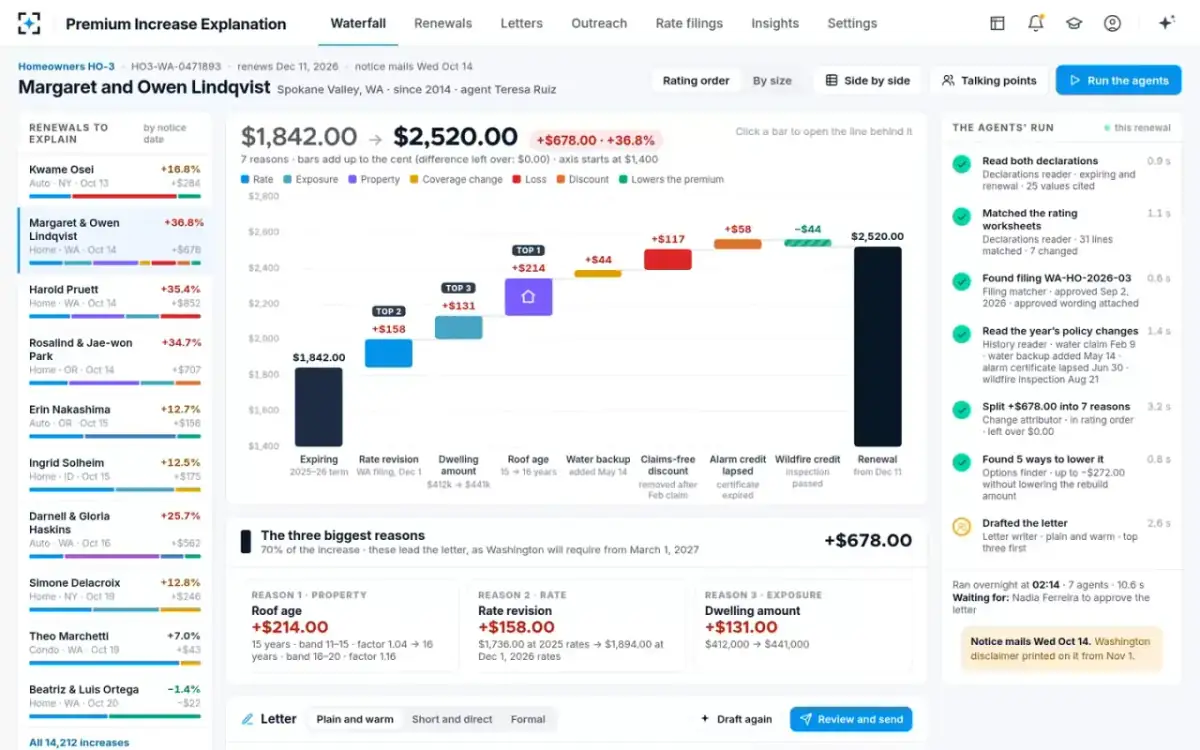
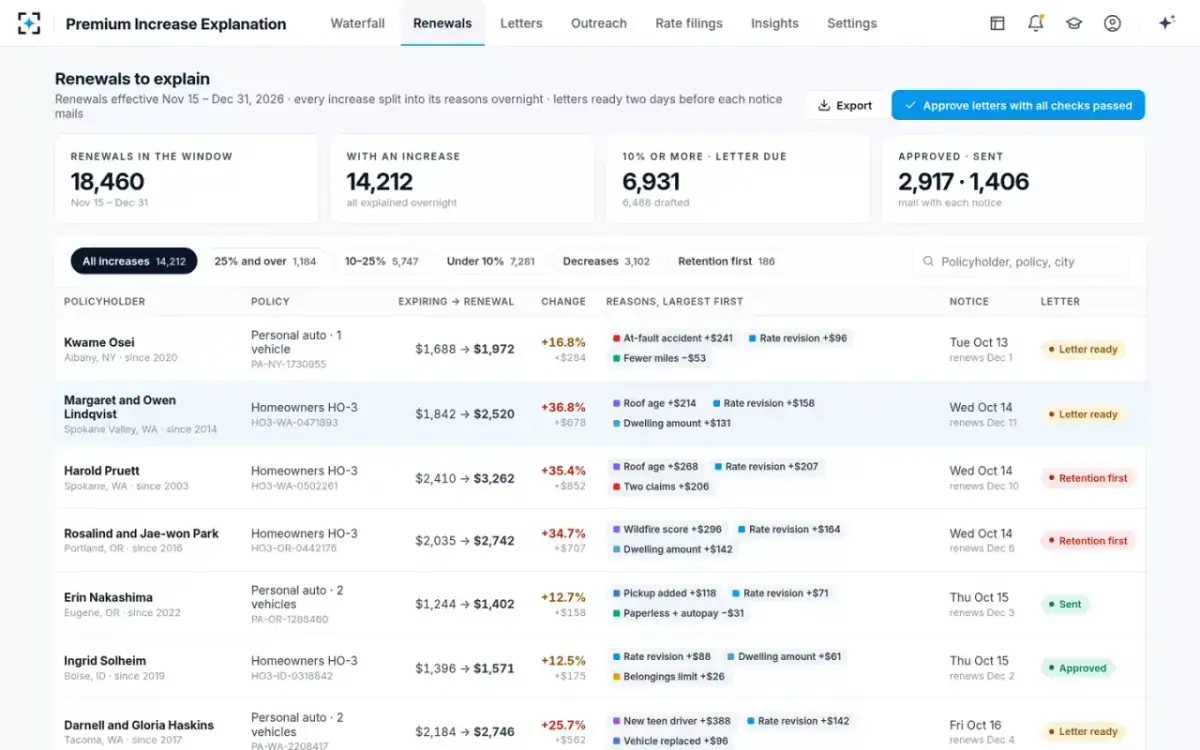
Kwame Osei's personal auto policy, one vehicle, renews on December 1 at $1,972 against $1,688, an increase of $284, or 16.8%. His renewal notice is due to mail on October 13. Split into its reasons, the increase is three changes: an at-fault accident added $241, the New York auto rate revision added $96, and fewer miles driven took $53 off. None of the three is insured value added, so the whole $284 counts toward the test, 16.8% is over 10%, and the bill must carry the amount of the increase and an explanation with the primary factors.
One New York auto renewal through the Section 2356 test
| Reason | Dollars | Insured value added? | Primary factor to name |
|---|---|---|---|
| At-fault accident | +$241 | No | Individual claims history: the accident and its date |
| Rate revision, NY-PA-2026-01 | +$96 | No | The filed rate change in his territory, in the filing’s approved words |
| Fewer miles driven | −$53 | No | A reduction; listed so the reasons add up |
| Total | +$284 (16.8%) | None to remove | Over 10%: explanation with the bill |
Note what the explanation would look like if it led with the rate. “New York auto rates rose” describes $96 of $284, about a third, and would fail DFS's test because the insured would not understand that the accident caused most of the increase. Leading with the accident is harder to write and is the explanation the law asks for. A renewal like this one also shows why the split must be by dollars: an explanation that names three factors without saying which mattered most leaves the policyholder to guess.
New York and Washington renewals to explain, by notice date
Conditional renewal notices and Section 2356: both, not either
A commercial renewal in New York may owe two notices, and DFS says one does not replace the other: an insurer may not send the conditional renewal notice required by §3426(e) in lieu of the §2356(b)(1) notice, and “must mail or deliver both notices as applicable.” The conditional renewal rule has its own 10% line, for “increased premiums in excess of ten percent”, which excludes increases from increased exposure units and from experience rating, loss rating, retrospective rating or audit, and its own lead time of 60 to 120 days before expiration for covered policies (N.Y. Ins. Law §3426(e)).
Getting those notices wrong has a price. In a consent order published in July 2023 with a $360,000 fine, DFS found among other things that Tokio Marine America Insurance Company “failed to include the amount of premium increase or percentage range of premium increase in the conditional renewal notice” and failed to state specific reasons on nonrenewal and conditional renewal notices (NY DFS disciplinary actions, July 20, 2023). That order predates §2356, but it shows how an examiner reads a renewal notice: as a list of facts that must each be present and specific. A conditional renewal notice that meets §3426(e) is annotated in the conditional renewal notice sample.
Getting New York renewal bills ready
Most of the work sits upstream of the bill. A carrier has to know, for each renewal, the total change, how much of it was insured value added, and the factors behind the rest, early enough to print the right notice with the bill. The service desk then needs a way to log written requests and answer within 20 days.
A readiness checklist for Section 2356
- Classify every policy form
(a) and (b), (b) only, or neither, using DFS’s list; include umbrellas and commercial vehicles garaged in New York.
- Split every renewal’s change into insured value added and the rest
The 10% test runs on the rest. A coverage increase alone never triggers (a).
- Print the (b)(1) notice word for word
Prominent, with the bill, with the insurer’s contact information; on the initial renewal bill for installment payers.
- For increases over 10%, print the amount and the explanation
Every primary factor when there are several, each specific to the policy.
- Log written requests and answer within 20 days
Track the date received; the answer includes the primary rating factors.
- Keep commercial conditional renewal notices separate
Send both where both apply; the §3426(e) notice states the amount of the premium increase.
- Check electronic delivery consent
Notices may go electronically only with consent and in line with §3458.
Every renewal in the window, with its largest reasons and letter status
Where Premium Increase Explanation fits New York, and where it does not
Premium Increase Explanation produces what Section 2356 needs and a renewal system usually lacks: every renewal's change split into reasons in dollars, each tied to a worksheet line, with coverage increases identified so the 10% test can be run on the right number. Its letters list the reasons largest first, use each filing's approved wording for the rate, and are checked before a person approves and e-signs them. The same split answers a written request in minutes rather than days.
It does not decide which forms the law covers or how DFS's answers apply to an unusual policy; compliance sets those as rules. It does not print the bill or the statutory notice, which belong to the carrier's billing system. And it sends nothing on its own. For how the split behind each letter is calculated, see rate increase vs premium increase; to see the screens, start from Premium Increase Explanation.
Questions people ask
When did New York's premium increase explanation rule take effect?
DFS says the notice requirements take effect on August 24, 2026, and apply to renewal premium bills mailed or delivered on or after that date. The NY Senate's site shows the section's most recent revision dated August 28, 2026.
Was there a New York premium increase explanation rule in 2024?
Not under Section 2356, whose notices apply to bills from August 24, 2026. Before then, New York renewals were governed by the nonrenewal and conditional renewal notice rules in Insurance Law §3425 for personal lines and §3426 for commercial lines, which require stated reasons for a conditional renewal but not an explanation of every increase.
Does Section 2356 apply to renters or umbrella policies?
Not to renters: DFS says a renter's policy does not cover loss of or damage to real property. An umbrella policy gets the notice of the right to ask, because it covers a motor vehicle, but not the automatic explanation over 10%.
Do installment payers get the notice on every bill?
No. DFS says the (b)(1) notice goes with the initial renewal premium bill and not with each later installment bill.
Can the notices be sent electronically?
Yes, if the insured has consented to electronic delivery and the insurer otherwise complies with Insurance Law §3458 on electronic notices and documents, according to DFS.
Does New York's rule apply to excess line insurers?
No. DFS says Article 23, which contains Section 2356, applies to authorized insurers, and the section makes no reference to excess line insurers.