Homeowners insurance usually goes up a lot when several things happen at once: the insurer's filed rate rose in your area, the amount needed to rebuild your home rose and your dwelling limit with it, your home crossed a rating band such as roof age, a claim or a lapsed certificate ended a discount, or you added cover. Each one is small enough to miss; together they make a renewal 30% higher. All of them can be found by comparing your expiring and renewal declarations pages, and your insurer can tell you how many dollars each one added. Botminds' Premium Increase Explanation is software insurers use to split every renewal increase into those reasons, dollar by dollar, and to send a plain-words explanation before the renewal arrives; this page uses one of its sample renewals to show what such a split looks like.
The renewal belongs to fictional sample policyholders, Margaret and Owen Lindqvist, with a fictional insurer, Tallowmere Mutual; their figures are sample data. The market figures are from U.S. regulators and researchers, linked where they appear.
Why homeowners premiums have risen: the cost of the claims
$18,206
average homeowners claim, 2018–2022, nationally
$26,845
average claim in the Southwest region, about 50% above the national figure
82%
more premium per policy in the fifth of ZIP codes with the highest climate-related losses
$1,818
average homeowners premium per policy in the Southeast zone, 2024
Why did my homeowners insurance go up so much? Usually several reasons at once
Because a renewal premium is calculated from many factors, and several can move in the same year. The insurer's rate for your area may have risen in a filing approved by the state. The dwelling limit, the amount to rebuild your home, may have been raised to keep up with building costs, and you pay for the higher limit. Your home may have moved into a different rating band, most often for the age of the roof. A claim may have ended a claims-free discount, or a certificate for an alarm or a mitigation measure may have lapsed. And any cover you added during the year, such as water backup, is now priced for a full year.
The first of these is the one people hear about, and it is rarely the largest. In the sample renewal on this page, the rate revision in the household's territory was 9.1%, but the premium rose 36.8%. The difference came from the house and the policy, not the market.
Why did my homeowners insurance go up 30 percent? One renewal, split
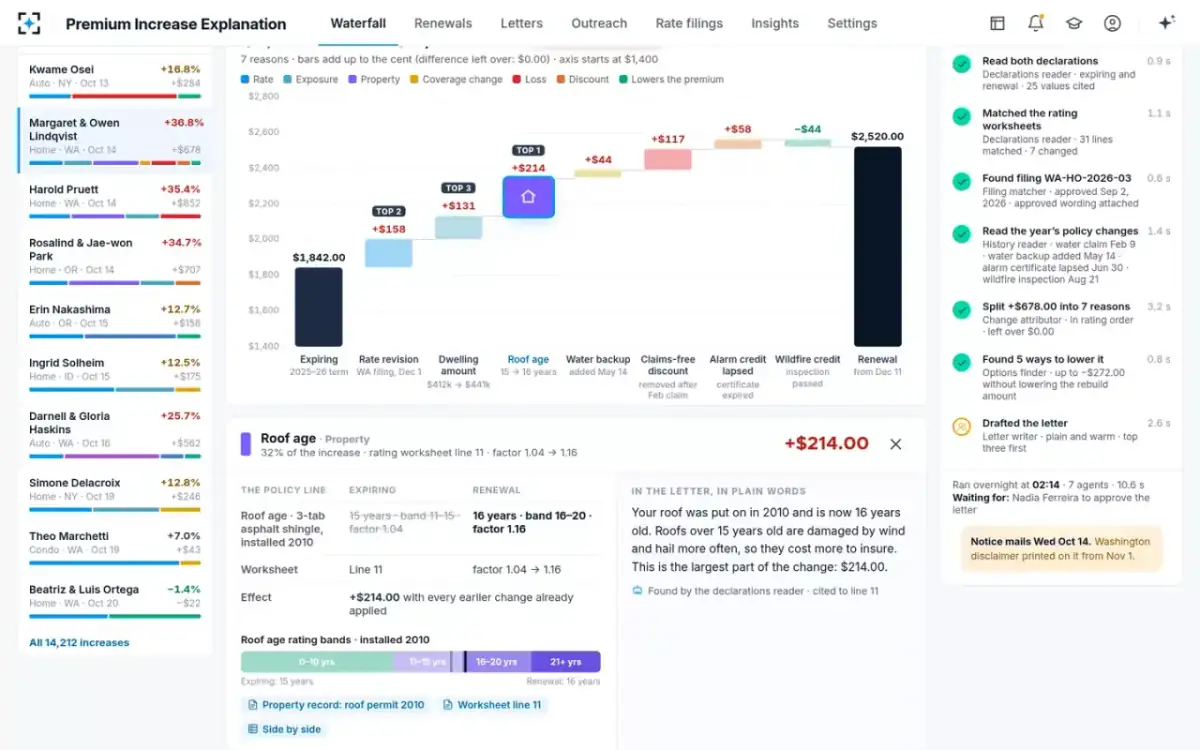
Here is the sample renewal. The Lindqvists' Spokane Valley homeowners policy renews on December 11 at $2,520.00, up $678.00 from $1,842.00, or 36.8%. Split into its reasons, the increase is six changes that raised the premium and one that lowered it:
What raised one homeowners renewal by 36.8%
The $722 of increases, before a $44 credit
- Roof turned 16, into the next age band · $214 · 30%
- Rate revision in the territory · $158 · 22%
- Rebuild amount $412,000 → $441,000 · $131 · 18%
- Claims-free discount ended after a claim · $117 · 16%
- Alarm credit lapsed · $58 · 8%
- Water backup cover added · $44 · 6%
Read the list again from the household's side. The largest reason, $214, is that a roof put on in 2010 turned 16 and moved from the 11–15 year band of the insurer's approved rating plan into the 16–20 year band; the roof did not get worse overnight, but the band changed. The rate revision, $158, is the only reason every neighbour shares. The rebuild amount, $131, means more cover, not a higher price for the same cover. The claim in February ended a 6% claims-free discount, $117. An alarm credit lapsed because the monitoring certificate expired on June 30, $58. And water backup cover they chose to add in May costs $44 a year. A good explanation gives all seven, with dates.
The biggest reason, opened: the roof’s age band
Why did my home insurance go up with no claims?
Because most of the reasons above have nothing to do with claims. The rate in your area reflects the insurer's expected losses for every home like yours there, including other people's claims and storms that missed you. Rebuilding costs rise whether or not you claim. A roof, a wiring system or a house crosses age bands on the calendar. And a credit can lapse for paperwork, as the Lindqvists' alarm credit did.
Where you live matters most to the rate. The Treasury's Federal Insurance Office found that homeowners in the fifth of ZIP codes with the highest expected annual losses from climate-related perils paid inflation-adjusted premiums averaging $2,321 a policy from 2018 to 2022, 82% more than in the lowest fifth (FIO). The cost of a claim varies just as much: the national average was $18,206, but in the Southwest region, where wildfire is common, it was over $26,845. A household with no claims still pays for the claims expected in its area.
Why are home insurance premiums going up everywhere?
Because claims, rebuilding and the insurers' own insurance have all become more expensive at once. The NAIC's analysis of state regulators' market conduct data finds that claim frequency, claim severity, nonrenewals and cancellations for nonpayment “have generally increased over time”, and that:
“Premiums and company-initiated nonrenewals have also risen more sharply in recent years, particularly from 2023 to 2024.”
NAIC Center for Insurance Policy and Research, Examining Homeowner Property Insurance Market Dynamics, July 31, 2026
Two other forces sit behind the rates. Insurers buy reinsurance against catastrophes, and research using 74 million premiums inferred from mortgage escrow payments finds that the link between disaster risk and premiums strengthened, “accelerated by a repricing of catastrophic risk in global capital markets” (Keys and Mulder, NBER working paper 32579). And rebuilding costs rose sharply: the FIO notes that inflation and the rise in replacement and reconstruction costs “were significant” over 2018 to 2022. Averages still differ widely by region:
Average homeowners premium per policy by NAIC zone, 2024
Higher premiums have come with fewer renewals offered in some places; the Personal Lines page on why insurance companies are non-renewing homeowners policies covers that side.
Is it normal for home insurance to go up every year?
Increases have been usual in recent years, but not automatic, and not every reason recurs. Some reasons come back every year: the dwelling limit usually rises with building costs, because many insurers adjust it at renewal, by an inflation factor or a new estimate, to keep the house insured to its rebuild cost. Others are one-offs: a roof crosses a band once in five years, a lost claims-free discount returns after the claim ages off, and a lapsed credit returns when the certificate is sent. Rate revisions depend on the insurer's filings and the state's review.
Premiums can also go down. In the sample insurer's renewal window, about one renewal in six fell. Over 2018 to 2022, the FIO found that in the fifth of ZIP codes with the smallest changes, premiums per policy fell by at least 1.4% relative to inflation. A large increase in one year is a reason to ask why, not proof that the next renewal will be the same.
How to read your renewal: expiring and renewal side by side
Lay the two declarations pages side by side and compare them line by line. The lines that moved are the candidates; each one that moved in the direction of a higher premium is a possible reason. You will usually not see the dollars each change added, because the premium is calculated on a rating worksheet you do not receive, but you will see what changed.
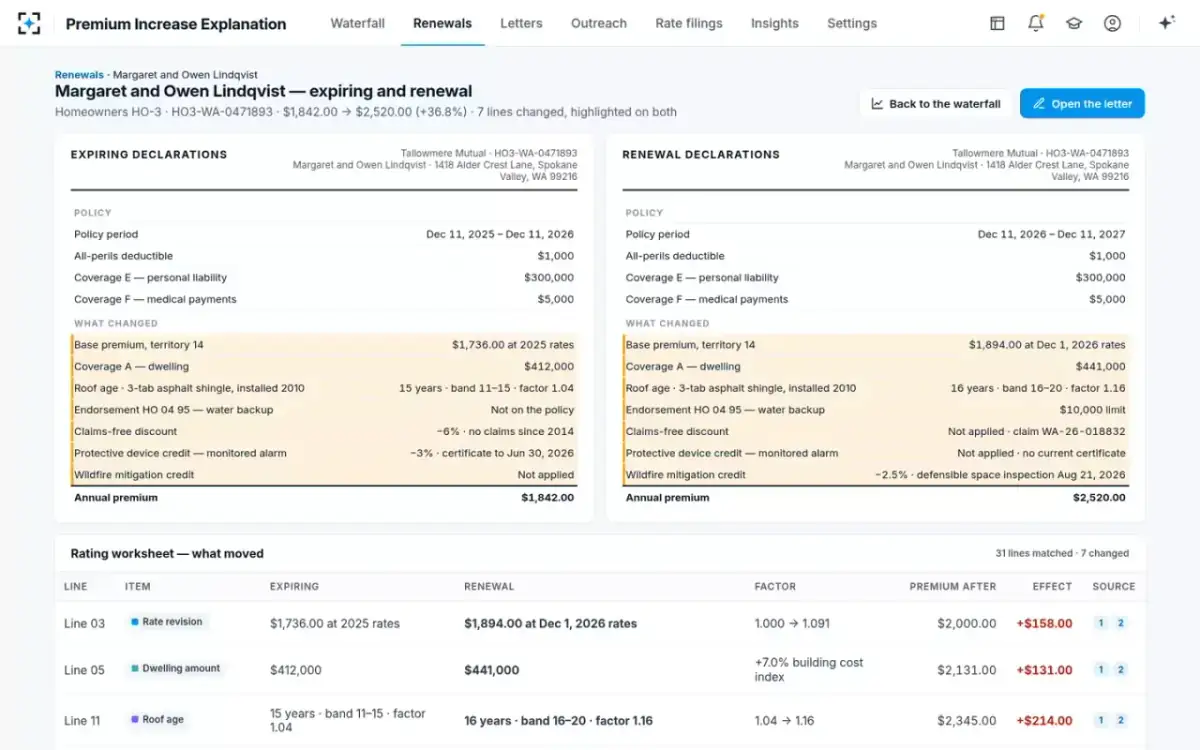
The Lindqvists’ declarations, expiring against renewal
Expiring, 2025–26: $412,000
Renewal, 2026–27: $441,000: a higher limit, paid for
Expiring, 2025–26: 15 years, band 11–15
Renewal, 2026–27: 16 years, band 16–20
Expiring, 2025–26: Not on the policy
Renewal, 2026–27: $10,000 limit, added in May
Expiring, 2025–26: −6%, no claims since 2014
Renewal, 2026–27: Not applied after the February claim
Expiring, 2025–26: −3%, certificate to June 30
Renewal, 2026–27: Not applied, no current certificate
Expiring, 2025–26: Not applied
Renewal, 2026–27: −2.5% after the August inspection
Expiring, 2025–26: $1,000; $300,000; $5,000
Renewal, 2026–27: Unchanged
Both declarations, the changed lines highlighted, and the dollars each added
You can ask why, in writing
In some states you have a legal right to an explanation. In New York, since August 24, 2026, a homeowners renewal that rises by more than 10%, not counting increases from insured value added such as a higher dwelling limit, must come with the amount of the increase and a written explanation of the primary rating factors; for any increase, you can ask in writing and the insurer must answer within 20 days (N.Y. Ins. Law §2356). Washington gives the same right to ask, with an answer due within 20 calendar days, and from November 1, 2026 every renewal notice must say so (WSR 26-15-007).
Elsewhere, ask your agent or the insurer anyway, and ask for the reasons in dollars. A good answer names each reason with its date and what it added. If the answer is only “rates went up”, ask how much of your increase the rate revision accounts for. The New York rule is set out in full in New York premium increase explanations, and the Washington phases in the Washington premium change notice guide.
What you can do about it, honestly
Some of the increase is usually recoverable and some is not. A lapsed credit can often be restored by sending the certificate. A higher deductible lowers the premium if your lender allows it and you can afford the larger share of a claim. Bundling home and auto may earn a discount. Mitigation work, such as the defensible-space inspection that earned the Lindqvists a credit, can help where the insurer offers one. What does not help is cutting the dwelling limit below the cost to rebuild: it lowers the premium by leaving you under-insured, which is covered in why dwelling coverage increases.
Eight things to check on a homeowners renewal that went up
- The dwelling limit
Did it rise, and by how much? Ask what rebuild cost estimate it rests on.
- Any age band
Roof age is the commonest; ask which band you moved into and when you move again.
- Discounts and credits
Claims-free, alarm, new-roof, mitigation: which ended, and what would bring them back.
- Claims in the past year
A paid claim may end a discount or add a surcharge; ask which, and for how long.
- Cover you added or changed
Endorsements such as water backup are priced for the full year.
- The rate revision
Ask how much of your increase it accounts for, in dollars.
- The deductible
A higher one lowers the premium; check what your lender allows.
- The explanation itself
Do the reasons add up to the increase? If not, one is missing.
How insurers can explain it better: where Premium Increase Explanation fits
Most homeowners never see the split above, because producing it by hand takes a service representative many minutes per call. Premium Increase Explanation produces it for every renewal with an increase before the notice mails: it reads both declarations and both worksheets, finds the approved rate filing and the year's claims, inspections and certificates, and splits the difference into reasons that add up to the cent. A person at the insurer then approves and signs a letter that gives each reason in plain words, with the honest ways to lower the premium. It never suggests a dwelling limit below the rebuild cost or dropping cover a lender requires. To see the insurer's side of this renewal, start from Premium Increase Explanation.
Questions people ask
Why did my homeowners insurance go up this year?
Usually a combination: a rate revision in your area, a higher dwelling limit tracking rebuilding costs, a rating band your home crossed, a discount that ended, or cover you added. Regulators' data shows homeowners premium increases were largest in 2023 and 2024. Ask your insurer for the reasons in dollars; in New York and Washington it must explain on written request.
Why does homeowners insurance go up each year?
The commonest recurring reason is the dwelling limit, which many insurers raise at renewal to keep pace with building costs, so you buy a little more cover each year. Rate revisions follow claim and rebuilding costs in your area. Other reasons, such as a roof crossing an age band, happen only occasionally.
Can a claim make my homeowners premium go up?
Yes, usually by ending a claims-free discount or adding a surcharge for a period set in the insurer's rating plan. In the sample renewal, a February water claim ended a 6% claims-free discount for three years, adding $117. Ask how long the effect lasts.
Does the age of my roof affect my home insurance premium?
In many rating plans, yes, in age bands. In the sample renewal, a 2010 roof turning 16 moved from the 11–15 year band to the 16–20 year band and added $214, the largest single reason. A new roof can lower the factor, but it is a large expense and the choice is yours.
Should I lower my dwelling coverage to save money?
Not below the cost to rebuild your home. A lower limit cuts the premium by leaving you under-insured for a total loss, and your lender may require cover to the rebuild cost. Ask instead how the limit was estimated, and correct it if the estimate is wrong.