A premium increase explanation letter template has eight blocks: the renewal date and the new premium, the change in dollars, the three biggest reasons with their dollars, the smaller reasons, the rate revision in the filing's own approved words, any reductions, the honest ways to lower the premium, and who to ask. The template is the easy part. What makes a letter right or wrong is the content poured into it for each policy: which reasons, how many dollars each, and whether each is true for that household. That is why a letter writer, human or software, needs a checker that did not write the letter. Botminds' Premium Increase Explanation drafts each letter from a dollar-by-dollar split of the renewal increase, runs six checks on it, and leaves the approval and e-signature to a service representative.
The sample letter below is from a fictional sample carrier, Tallowmere Mutual, to fictional policyholders, Margaret and Owen Lindqvist, whose Washington homeowners premium rises from $1,842.00 to $2,520.00 at renewal. The rules quoted are real and linked.
The template, block by block, and where each block’s content comes from
| Block | What it says | Where the content comes from | The rule or reason behind it |
|---|---|---|---|
| 1. The renewal | Address, renewal date, new premium, change in dollars and percent | Expiring and renewal declarations | New York requires the amount of the increase with any explanation it owes |
| 2. The three biggest reasons | Each with the fact from this policy and its dollars, largest first | The split of the increase, worksheet line by line | Washington limits on-request explanations to the top three primary factors from March 2027 |
| 3. The other reasons | Smaller changes, each with dollars | The same split | New York’s regulator expects every factor when there are several |
| 4. The rate revision | One sentence on the filed rate change | The approved filing’s plain-words wording | Rates charged must match filed rates; the wording should too |
| 5. Reductions | Credits gained, discounts added | The split | Without them the reasons do not add up |
| 6. Ways to lower it | Options the household qualifies for, with dollars | Options re-rated on the renewal | Only honest options; nothing that leaves the home under-insured |
| 7. Who to ask | Agent and service desk by name and number | Agent of record; service desk | The policyholder can ask for more, in writing |
| 8. State notices | Where the state prescribes them | State rules, by effective date | New York’s and Washington’s notices have their own place and wording |
What a premium increase explanation letter template must contain
It must contain the number, the reasons in dollars and a way to ask for more; everything else is presentation. The number comes first because it is the one fact the policyholder already has. New York's law, for a renewal over the 10% line, requires a notice with the premium bill that states the amount of the increase over the prior policy period, along with the explanation (N.Y. Ins. Law §2356(a)). California's homeowners renewal offer goes further on coverage: any reduction of limits or elimination of coverage must be stated and the specific limits or coverage identified (Cal. Ins. Code §678). A template that leaves out the dollars, or hides a coverage change in the reasons, fails the reader before any rule does.
The reasons are the hard block. A good template does not contain reasons; it contains slots for them, filled from the split of the increase for that one policy. A template with a fixed paragraph about “rising costs of claims and reinsurance” is a rate increase notice, not an explanation. Washington's rule describes what an explanation has to achieve, and it is a useful test for any letter:
“Reasonable explanation is a communication standard that requires insurers to provide sufficient information, in terms and plain language that are understandable to an average policyholder, which enable the policyholder to figure out the basic nature of any premium increase.”
Washington Insurance Commissioner, WAC 284-30A-070(1), as amended by WSR 26-15-007
“Figure out the basic nature” sets a floor, not a ceiling. A policyholder who reads that the roof turned 16 and moved into the next age band can figure out the basic nature of $214 of the increase, and can check the roof's age against their own records. One who reads “property characteristics” cannot.
A premium increase explanation letter sample, line by line
Here is the sample letter for the Lindqvists, in the carrier's “Plain and warm” voice, with each line set beside where its content came from and what a checker should test. Ellipses mark words cut for space; the full letter is in the screen further down.
An explanation letter, annotated: each line, its source and its check
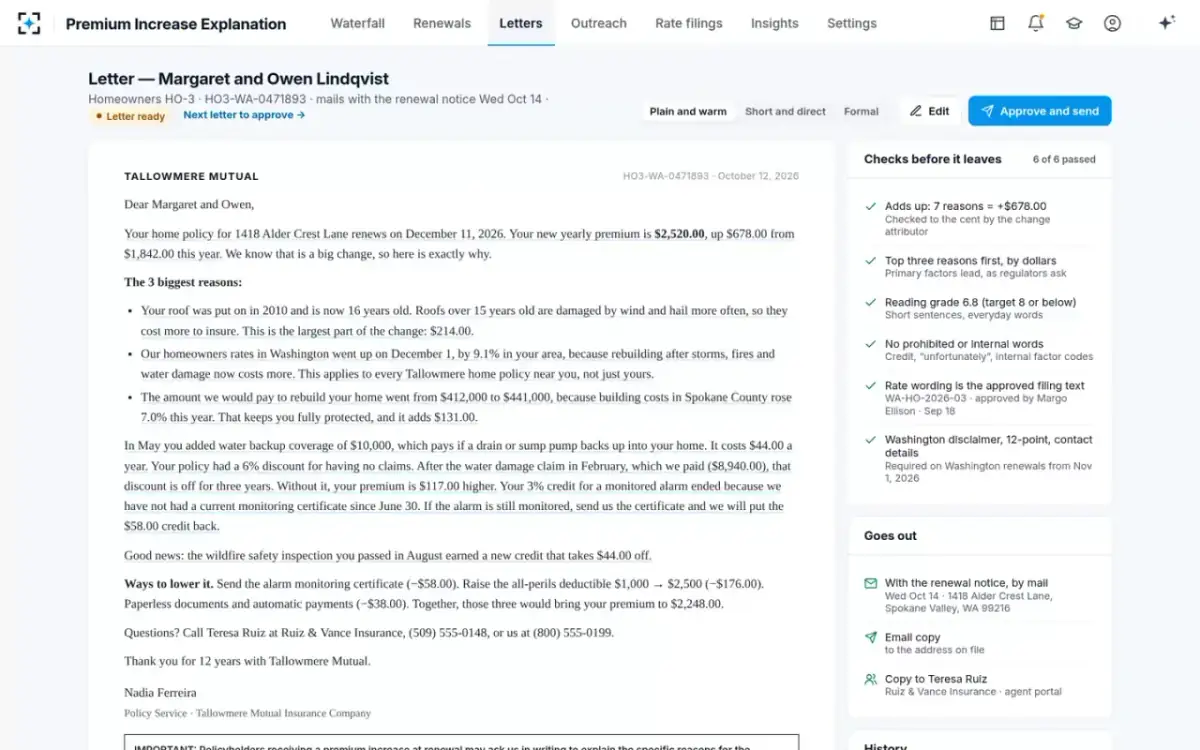
Your home policy for 1418 Alder Crest Lane renews on December 11, 2026. Your new yearly premium is $2,520.00, up $678.00 from $1,842.00 this year.
FromBoth declarations
CheckThe number first, in dollars. The difference must equal the sum of the reasons below.
Your roof was put on in 2010 and is now 16 years old. Roofs over 15 years old are damaged by wind and hail more often, so they cost more to insure. This is the largest part of the change: $214.00.
FromWorksheet line 11; county re-roof permit
CheckA reason the worksheet shows, with its date and dollars. Biggest first.
Our homeowners rates in Washington went up on December 1, by 9.1% in your area … This applies to every Tallowmere home policy near you, not just yours.
FromApproved filing WA-HO-2026-03 and its approved wording
CheckRate wording only from the approved filing explanation, word for word.
The amount we would pay to rebuild your home went from $412,000 to $441,000, because building costs in Spokane County rose 7.0% this year … it adds $131.00.
FromWorksheet line 05; Coverage A on both declarations
CheckAn exposure change named as such, not as a price rise.
Your policy had a 6% discount for having no claims. After the water damage claim in February … that discount is off for three years. Without it, your premium is $117.00 higher.
FromClaim file; discount rules
CheckA claim is a reason only because the worksheet shows the discount removed.
Good news: the wildfire safety inspection you passed in August earned a new credit that takes $44.00 off.
FromInspection of August 21; worksheet
CheckReductions belong in the sum too, or the reasons will not add up.
Ways to lower it. Send the alarm monitoring certificate (−$58.00). Raise the all-perils deductible $1,000 → $2,500 (−$176.00). Paperless documents and automatic payments (−$38.00).
FromRe-rated options the household qualifies for
CheckNever a rebuild amount below cost or dropping cover a lender requires.
Questions? Call Teresa Ruiz at Ruiz & Vance Insurance, (509) 555-0148, or us at (800) 555-0199.
FromAgent of record; service desk
CheckWho to ask, by name. State notices about the right to an explanation go where the rule puts them.
Three choices in the sample are worth copying. The rate sentence says the increase applies to every policy near the household, which separates the one reason the policyholder could not have changed from the ones they might. The claim is explained through its effect, a lost 6% discount worth $117, rather than as a penalty for claiming. And the reductions are in the letter, because a list of increases that adds to more than the change looks like an error.
Why a fixed template fails: the reasons change with every household
Because no two renewals rise for the same reasons. Across the sample carrier's window of 14,212 renewals with an increase, rate revisions supplied about a third of the $6,154,200 of added premium; the rest came from exposure, property, loss, driver and discount changes particular to each policy. A template that explains the rate revision well still says nothing true about two-thirds of the money.
A mail-merge template against a letter drafted from the split
Mail-merge template: One paragraph on market conditions for everyone.
Letter drafted from the split: The reasons on this policy’s split, each with dollars.
Mail-merge template: No dollars, so nothing to add up.
Letter drafted from the split: Reasons sum to the increase, to the cent, or the letter is held.
Mail-merge template: Written by marketing, unchanged for years.
Letter drafted from the split: The approved filing’s own explanation, per state and line.
Mail-merge template: “Contact your agent to review your coverage.”
Letter drafted from the split: Options the household qualifies for, re-rated in dollars.
Mail-merge template: Wrong for every policy in the same way.
Letter drafted from the split: Wrong only if the split is wrong, and the split cites its lines.
The price of a letter drafted per policy is that every letter can be wrong in its own way. A paragraph of boilerplate has one error or none; seven thousand individual letters can have seven thousand different ones. In the sample window, 6,931 renewals rose 10% or more and were due a letter. That is the case for a checker.
The writer and the checker: why the letter needs a second reader
A writer that names reasons must be checked by something that did not write them, because the writer cannot see its own omissions. The same principle runs through every examination standard that touches renewals: the rates charged must follow the filed rates or the company's own rating plan (NAIC Market Regulation Handbook standards; see rate increase vs premium increase), and a letter that misstates why the rate changed is evidence about both. In the solution, the drafting and the checking are separate steps, and the decision is a third.
Writer, checker, person: who drafts, who tests, who signs
Agent
Change attributorSplits the increase in rating order, each reason tied to a worksheet line, and measures what is left over.
Never: forces the reasons to add up; more than $1.00 left over holds the letter
Agent
Filing matcherFinds the approved filing for the state, line, territory and date, and attaches its approved wording.
Never: writes its own explanation of a filing, or uses one still under review
Agent
Letter writerDrafts from the split in the chosen voice, three biggest reasons first, each sentence linked to its reason.
Never: names a reason that is not on the split, uses a blocked word, or sends
Agent
ChecksTest the sum, the order, the reading grade, blocked words, the rate wording and the state notice; any failure stops the letter.
Never: pass a hand-edited sentence that names a reason without a second look
A person decides
Service representativeReads the letter and the checks, edits if needed, approves and e-signs. Increases over 30% and $700 go to retention first.
A person decides
Compliance officerApproves each filing’s wording and each template once, before first use.
The checks are deliberately dull. They do not judge whether the letter is persuasive; they test facts a machine can test exactly. Did the reasons sum to the increase? Are the three largest first? Is the rate sentence the approved text, character for character? Is there a word on the blocked list? Judgement about tone, and the decision to send, stay with the person whose name is on the letter.
Six checks before the letter leaves, and where it goes
What the checker tests before a letter leaves
A checker earns its place by testing what people skim. In the sample, six checks run on every letter, and they map onto the failures that make an explanation untrue or unreadable. A carrier's compliance team will add its own, and the useful ones share a property: each has a yes-or-no answer.
Checks every explanation letter should pass
- The reasons add up to the increase
To the cent. A gap of more than $1.00 means a reason is missing or wrong, so the letter is held, not rounded.
- The largest reasons come first
By dollars, not by comfort. A rate revision that is a quarter of the increase does not lead.
- Every reason sits on the split
No reason in the letter that the worksheet does not show, and no reason on the split left out of a New York letter.
- The rate sentence is the approved filing text
Word for word, from a filing that is approved, for this state, line, territory and date.
- No credit or internal language
No “insurance score”, factor codes or “relativity”. Texas holds that a generalized term such as “poor credit history” is not sufficient notice of a credit-based adverse effect.
- Reading grade at or under target
The sample carrier targets 8 or below; its Formal voice reads at 9.4 and is flagged.
- State notices present where required
The prescribed wording, in the place and type size the state sets, with the insurer’s contact details.
Plain words: reading grade and voice
Plain words are a requirement in Washington and a courtesy everywhere else, and a reading-grade check turns them into something testable. The sample letter reads at grade 6.8 in its “Plain and warm” voice and 5.9 in “Short and direct”; the carrier's target is 8 or below. Switching voice rewrites the sentences without changing a number, which is the property that matters: the policyholder who calls back should hear the same dollars the letter gave.
The same letter in a shorter voice, with every reason still in dollars
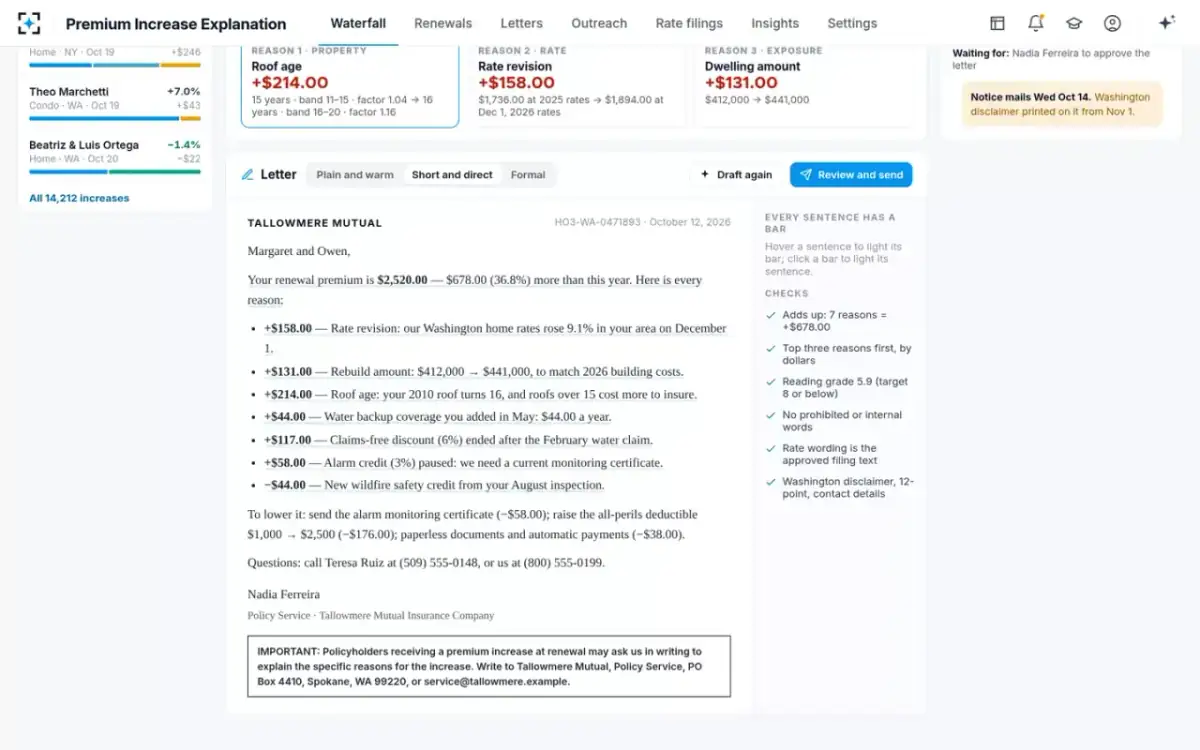
Voice is a choice for the representative, within limits. A letter going to a household that has been with the carrier for twelve years can open with thanks; a letter about a teen driver can be shorter. What the voice must never change is the order of reasons or the dollars, and in the sample every voice is checked against the same reading-grade target before it can be approved.
One template, two states: all the factors or the top three
New York and Washington pull a multi-state template in different directions on how many reasons to list. New York's regulator, answering whether the primary factors must be specific and what happens when there are several, says the insurer should include all of them (NY DFS, premium change explanations). Washington, from March 1, 2027, limits the explanation given on request to the top primary factors, at most three, and says those factors need not carry a dollar or percentage figure until the automatic notices of 2029 (WSR 26-15-007).
A template can satisfy both if it separates the two blocks: the top three reasons as the explanation, and the remaining reasons as supporting detail where the state expects them. Whether Washington's limit reaches a letter the insurer sends unprompted, which lists the smaller reasons too, is a question for the carrier's counsel; the rule also says it does not stop insurers explaining more increases than it requires. The safest build makes the number of reasons listed a setting per state, and keeps the dollars for all of them on file either way. The New York explanation rules and the Washington premium change notice template each have their own page.
What to look for in letter software, and where Premium Increase Explanation fits
Judge any letter software, including ours, by whether it can show you where each sentence came from. The writing is the cheap part; the split behind it, the approved wording and the checks are what an examiner or an unhappy policyholder will ask about.
Questions to put to any premium increase letter software
| Question | Why it matters | What Premium Increase Explanation does |
|---|---|---|
| Does it split the increase itself, from the worksheets? | A letter is only as true as the dollars behind it. | Applies each changed worksheet line in rating order; reasons must add up to the cent. |
| Can every sentence be traced to a line? | An examiner or a complaint will ask why a reason was named. | Each sentence links to its reason, and each reason to its worksheet line and document. |
| Where does the rate wording come from? | A paraphrase of a filing can misstate it. | Only from compliance-approved wording for an approved filing. |
| What can it send on its own? | An unreviewed letter is the carrier’s statement anyway. | Nothing. A representative approves and e-signs every letter. |
| Are state rules settings, with versions? | Washington’s dates move; New York’s notices differ by policy type. | Thresholds, timing, approvers and blocked words are settings; each change is a new version. |
| What does it not cover? | Fit matters more than features. | Homeowners, condominium and personal auto renewals; it does not price, re-rate the book or send. |
Where it does not fit is as important. It needs a rating worksheet it can read line by line for both terms; a carrier whose renewal premium is produced by judgement rather than a rating plan will not get a split that adds up. It does not decide prices, and it does not replace the notice-of-premium machinery a state requires on the bill itself. The usual first step is to run it on a sample of the carrier's own renewals and compare its letters with the ones that went out. To see the screens, start from Premium Increase Explanation; for how the split itself is calculated, see the premium increase percentage calculator.
Questions people ask
What is a premium increase explanation letter?
A letter, for one policy, that states the renewal premium, the change in dollars and the reasons behind it, each with its dollars. It differs from a rate increase notice, which announces a filed rate change to everyone it affects. In New York, since August 24, 2026, one is required with the bill when a personal auto or homeowners renewal rises more than 10%, excluding insured value added.
Is there a premium increase letter template a regulator provides?
Washington publishes a model premium change notice in WAC 284-30A-080, which insurers must use as the basis for their notices, and it prescribes the wording of the renewal disclaimer. New York prescribes the wording of the notice of the right to ask, but not the explanation letter itself. Other states leave the letter to the insurer.
How many reasons should an explanation letter list?
Lead with the three that account for most of the dollars; in the sample, three reasons are $503 of a $678 increase. New York's regulator expects all the factors when there are several. Washington, from March 2027, limits on-request explanations to the top three primary factors, so a multi-state template should make the number listed a setting by state.
Can a letter mention a credit-based insurance score?
The reason belongs in the adverse action notice federal law requires, which names the reporting agency and explains the right to a free report and to dispute it. Texas requires up to four primary factors in that notice and says a generalized term such as “poor credit history” is not sufficient. Many carriers, including the sample one, keep credit language out of the explanation letter and point to the notice.
Who should sign a premium increase explanation letter?
A named person at the insurer, usually a service representative, after reading the checks. In the sample, the representative approves and e-signs; increases over 30% and $700 go to a retention specialist first; and compliance approves each filing's wording and template once before first use.
What reading level should an insurance renewal letter be written at?
No state sets a grade, but Washington requires plain language understandable to an average policyholder. The sample carrier targets grade 8 or below and checks every letter; its “Formal” voice, at 9.4, is flagged before approval.