Your dwelling coverage usually increases because the estimated cost to rebuild your home went up, and your insurer raised the limit to keep the house insured to that cost, either by applying an inflation factor at renewal or by updating a replacement cost estimate. It is not your home's market value, which includes the land. A higher dwelling limit is more insurance, so it raises the premium even when the rate has not changed; the two are different reasons and should be explained separately. New York's law draws the same line: its 10% test for a written explanation leaves out increases that come from insured value added. Botminds' Premium Increase Explanation splits every renewal increase into its reasons, with the dwelling amount as its own line, so a letter can say how much of an increase is more cover and how much is a higher price.
The example renewal belongs to fictional sample policyholders, Margaret and Owen Lindqvist, with a fictional insurer; its figures are sample data. The rules quoted are from New York, California and Washington, linked where they appear.
One dwelling limit, one renewal
$441,000
renewal dwelling limit, up from $412,000
+7.0%
building cost index applied to the limit
+$131
premium added by the higher limit, with no change in rate
19%
of the $678 increase came from the dwelling amount
Why did my dwelling coverage increase? Rebuilding costs, not your home's market value
Because the dwelling limit, Coverage A on most homeowners policies, is meant to pay to rebuild the house, and rebuilding costs have risen. Labour, materials and the time it takes to rebuild all move the number. The Treasury's Federal Insurance Office, analysing homeowners markets from 2018 to 2022, warned that its inflation adjustments “may not adequately reflect the total costs homeowners may have faced when repairing and rebuilding their homes, such as the extended time required to rebuild when many homeowners are rebuilding at the same time” (FIO). A limit set five years ago may no longer rebuild the same house.
Market value is a different number. It includes the land, which does not burn, and it moves with the local housing market, which can rise while building costs fall or the reverse. A dwelling limit that tracked market value would over-insure some homes and badly under-insure others. That is why a renewal can show a higher dwelling limit in a year when the house would sell for less.
Why does my dwelling coverage increase every year? Inflation factors and estimates
Because many insurers adjust the limit at each renewal, either by an index of building costs or by re-estimating the rebuild cost. California's Department of Insurance described both routes when the governor signed Assembly Bill 1797 in 2018: insurers would “provide a policyholder with a full replacement cost estimate every other year” or “apply an inflation factor to the dwelling limit at each renewal”, and an insurer taking the second route must “clearly offer the consumer the option to obtain a full replacement cost estimate” (California Department of Insurance, August 28, 2018).
Before the bill, “state law does not mandate that insurers produce or regularly update a replacement cost calculation.”
California Department of Insurance, on signing AB 1797, August 28, 2018
Two ways a dwelling limit is kept up to date
An inflation factor at each renewal: The limit is multiplied by an index of local building costs.
A new replacement cost estimate: The rebuild cost is re-estimated from the home’s features.
An inflation factor at each renewal: Every renewal.
A new replacement cost estimate: Periodically; every other year under the California law as the department described it.
An inflation factor at each renewal: A kitchen, an extension or a new roof added since the last estimate.
A new replacement cost estimate: Cost movements between estimates.
An inflation factor at each renewal: A limit a few percent higher, often without comment.
A new replacement cost estimate: A new figure that can jump, with the estimate behind it.
An inflation factor at each renewal: +7.0% building cost index: $412,000 to $441,000.
A new replacement cost estimate: Not used this year.
What is an inflation guard on a homeowners policy?
It is the common name for the inflation factor described above: a provision, or an endorsement added to the policy, that raises the dwelling limit automatically by a percentage or an index, usually at renewal. The point is to stop a limit set when the policy was bought from falling behind the cost to rebuild. The cost is that the policyholder buys a little more insurance each year without deciding to, and the premium rises with it.
An inflation factor is only as good as the starting limit. If the original estimate missed an extension or a higher-grade finish, inflating it each year carries the error forward. That is the reason the California route by inflation factor comes with an offer of a full estimate: the factor keeps the number current, the estimate keeps it right.
Increased dwelling coverage meaning: more insurance, priced at the current rate
Increased dwelling coverage means a higher Coverage A limit: the insurer will pay more to rebuild after a covered loss, and charges premium for the larger amount at whatever rate applies. On a rating worksheet it is a change in exposure, the amount insured, not a change in the rate per unit of it. In the sample renewal, the line reads “Dwelling amount, $412,000 to $441,000, +7.0% building cost index”, and the premium after that line rose by $131.
The dwelling amount as its own line, beside the rate revision
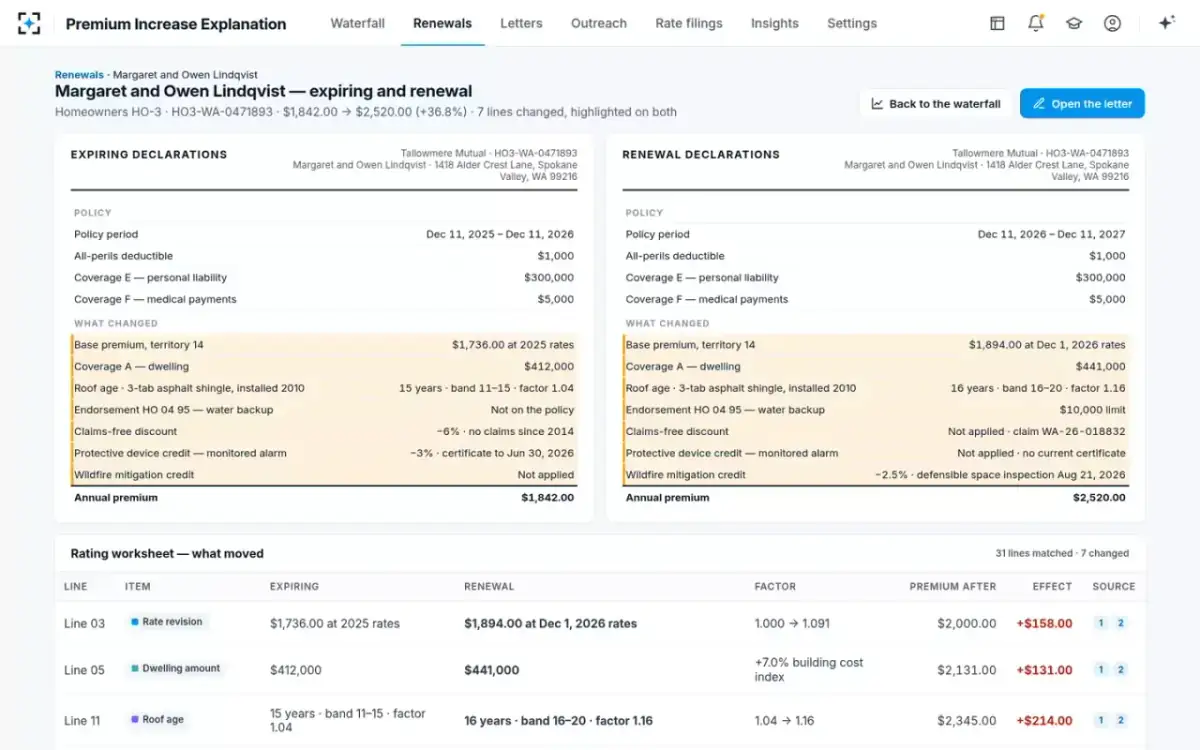
Washington lists value among the reasons an explanation may have to cover: its primary factors include “property related factors (age, location, and value)” (WAC 284-30A-070(2)). So in Washington a higher dwelling amount is a reason to name; in New York it is a reason that does not count toward the threshold.
Is a higher dwelling limit a rate increase? New York says it is insured value added
No. New York's Insurance Law §2356 requires a written explanation with the bill when the total increase is over 10%, not counting any part of the increase that is due to insured value added (§2356(a)). DFS's published answer applies that to increases in coverage: an insurer need not send the automatic explanation when a more-than-10% increase is due to an increase in coverage, but if another reason, such as an accident, pushes the rest over 10%, it must send it and list both reasons (NY DFS). New York's commercial conditional-renewal rule has the same instinct, excluding increases from more exposure units from its own 10% trigger (§3426(e)).
DFS's answer speaks of increases in coverage; a higher dwelling limit is the plainest one. A carrier should still have compliance confirm how an automatic inflation adjustment is treated in its New York forms. The rest of New York's rule is set out in New York premium increase explanations.
Value against price: splitting one $678 renewal
Split the Lindqvists' increase into more insurance and a higher price for the same insurance, and the picture changes. Two reasons add insured value: the higher dwelling limit, $131, and the water backup cover they added in May, $44. The other five are price: the rate revision, the roof's age band, the lost claims-free discount, the lapsed alarm credit and a new wildfire credit.
More insurance, or a higher price for the same insurance?
The same renewal under New York’s 10% test, if the house were in New York
| Measure | Dollars | Percent of $1,842 | Explanation with the bill? |
|---|---|---|---|
| Total increase on the bill | $678 | 36.8% | — |
| Less insured value added (dwelling $131, water backup $44) | −$175 | −9.5% | Not counted |
| Increase tested | $503 | 27.3% | Yes: over 10%, list every factor |
| If only the dwelling limit had changed | $131 | 7.1% | No: insured value added; the notice of the right to ask still goes with the bill |
The last row is the common case the rule was written for. A renewal whose only change is an inflation adjustment to the dwelling limit can rise several percent without a written explanation in New York, because nothing about the price changed. The policyholder still deserves a sentence saying so: the limit went from one figure to another, because building costs rose, and that kept the house fully insured.
Why is my dwelling coverage so high?
Usually because rebuilding costs more than people expect, not because the insurer inflated it. A rebuild prices the whole structure at today's labour and material costs, plus work such as clearing the damaged site, and after a large disaster those costs can rise further as many homes are rebuilt at once, the effect the FIO describes. Claims show the scale: the FIO found an average homeowners claim of $18,206 nationally over 2018 to 2022, and over $26,845 in the Southwest region.
If the figure looks wrong, ask what it rests on. An estimate built on the wrong square footage, number of storeys or construction type can be corrected, and California's law, as the department described it, requires insurers using inflation factors to offer a full estimate. What you should not do is lower it simply to cut the premium.
Should you lower your dwelling coverage to cut the premium?
Not below the cost to rebuild. A lower limit reduces the premium by reducing what the insurer will pay after a total loss, and the difference is paid by the homeowner. The California department's aim with AB 1797, in the Commissioner's words, was to help “homeowners avoid being underinsured in the future.” A mortgage lender may also set a minimum.
California also makes the insurer say so when it is the one lowering cover. A homeowners renewal offer must list any lower limit or dropped coverage, naming each one (Cal. Ins. Code §678; how such a notice is written is shown in the conditional renewal notice sample). The sample insurer's options finder applies the same caution in the other direction: it will suggest a higher deductible, a restored credit or a bundle, and never a dwelling amount below the rebuild cost.
Honest ways to lower a renewal, and the ones never offered
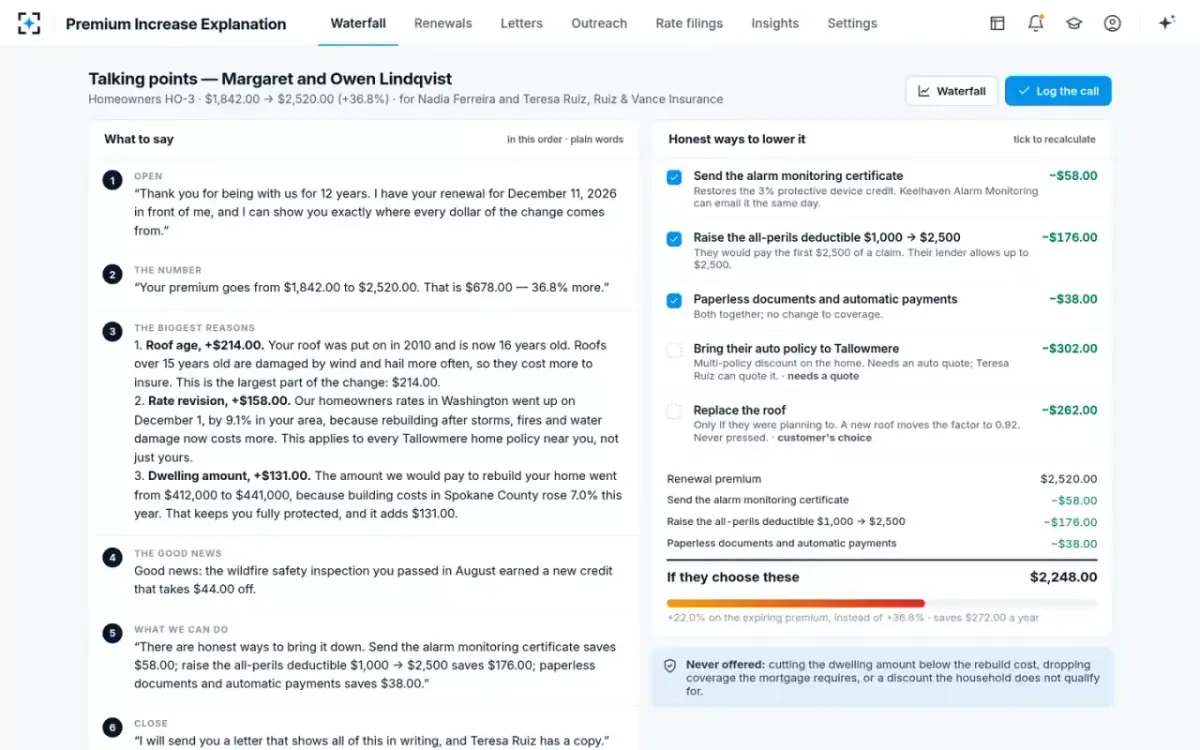
What the renewal letter should say about the limit, and where Premium Increase Explanation fits
A good letter treats the dwelling amount as its own reason, in its own words: the old limit, the new one, why it changed, and what it added. It does not fold it into “rates went up”, and it does not apologise for it, because it is protection the policyholder is paying for. In the sample letter the sentence reads: the amount the insurer would pay to rebuild went from $412,000 to $441,000, because building costs in Spokane County rose 7.0% this year; that keeps the home fully insured, and it adds $131.
Checks on any explanation that involves the dwelling limit
- Give the old and new limit
In dollars, not just the premium effect.
- Say why it changed
An inflation factor, a new estimate, or a change the policyholder asked for.
- Price it separately from the rate
More insurance and a higher rate are different reasons.
- Run New York’s test on the rest
Leave out insured value added before comparing with 10%.
- Offer the estimate, not a cut
If the policyholder doubts the figure, offer to re-estimate; never suggest a limit below the rebuild cost.
Premium Increase Explanation produces that sentence from the worksheet. Its change attributor gives the dwelling amount its own reason, tied to the worksheet line and the declarations; its options finder will not propose a lower limit; and the split separates insured value added from price, which is what New York's test and a clear letter both need. A person approves every letter. For the calculation behind each reason's dollars, see the premium increase percentage calculator; for the homeowner's view of the whole renewal, why homeowners insurance goes up so much. To see the screens, start from Premium Increase Explanation.
Questions people ask
Does my dwelling coverage have to match my home's market value?
No. It should match the cost to rebuild the house, which excludes the land and can be higher or lower than the sale price. A limit set to market value can leave a home under-insured where building costs are high relative to house prices.
Can I refuse an automatic increase in my dwelling coverage?
Ask the insurer to review the limit against a replacement cost estimate; if the estimate supports a lower figure, the limit can be corrected. A lender may require cover to the rebuild cost, and lowering it below that cost shifts the shortfall of a total loss to you.
Does a higher dwelling limit count toward New York's 10% notice?
No. Section 2356's 10% test excludes any premium increase due to insured value added, and DFS treats an increase in coverage as insured value added. If other reasons push the increase over 10%, the explanation must list them and the coverage increase.
How often should a replacement cost estimate be updated?
There is no national rule. California's AB 1797, as the Department of Insurance described it in 2018, required a full estimate every other year or an inflation factor at each renewal with a clear offer of a full estimate. A new estimate is worth asking for after any renovation or extension.
Why did my premium go up more than my dwelling coverage?
Because the dwelling limit is only one reason. In the sample renewal the limit rose 7.0% and the premium 36.8%: the higher limit added $131, while the rate revision, the roof's age band and lost credits added the rest. Ask for each reason in dollars.