The premium increase percentage is the renewal premium minus the expiring premium, divided by the expiring premium, times 100: a renewal of $2,520 against $1,842 is an increase of $678, or 36.8%. Any calculator does that. The question a renewal letter has to answer is harder: how much of the 36.8% came from each factor? Because rating factors multiply, each factor's dollars depend on which changes were applied before it, so a factor-by-factor split needs a fixed order, and the pieces must add up to the increase to the cent. Botminds' Premium Increase Explanation is software that applies each changed rating worksheet line in the rating plan's order, measures the dollars each one adds with every earlier change already applied, and holds the explanation if the pieces do not add up.
The worked examples use either a simple illustration of our own, labelled as such, or a fictional sample renewal from the solution, Margaret and Owen Lindqvist's Washington homeowners policy. Their figures are sample data; the rules and the textbook quoted are real and linked.
The formulas behind a premium increase calculator
Increase in dollars
Renewal premium − expiring premium
$2,520.00 − $1,842.00 = $678.00
From both declarations
Increase in percent
(Renewal − expiring) ÷ expiring × 100
$678.00 ÷ $1,842.00 = 36.8%
The number on the letter
One factor’s dollars
Premium after this line − premium before it, earlier changes applied
Roof age: $2,345.00 − $2,131.00 = $214.00
From the rating worksheet
What is left over
Increase − sum of every factor’s dollars
Should be $0.00; more than $1.00 holds the letter
The check
How to calculate a premium increase percentage
Subtract the expiring premium from the renewal premium, divide by the expiring premium, and multiply by 100. Use the same basis for both: the full-term premium for the same policy, including the same fees, before any installment charges. A six-month auto policy compared with an annual figure, or a premium including a one-off fee compared with one without, gives a percentage that means nothing.
The percentage that matters for notices can differ from the one on the bill. New York's rule tests the total policy premium increase against 10% after leaving out any increase due to insured value added, such as a higher dwelling limit (N.Y. Ins. Law §2356(a)). On the Lindqvists' renewal, the bill shows 36.8%, but taking out the higher dwelling limit ($131) and the water backup cover they added ($44) leaves $503, which is 27.3% of $1,842. A calculator built for New York needs both numbers.
How to calculate a premium increase in dollars, factor by factor
Apply the changed factors one at a time, in a fixed order, and record the premium after each. Each factor's dollars are the premium after its line minus the premium before it. That is what a rating worksheet's “premium after” column makes possible, and it is how the dollars for each reason in a renewal letter are produced.
The catch is that factors multiply. Take a simple illustration of our own: a premium of $1,000.00 with three changes at renewal, a 10% rate revision (factor 1.10), a higher limit (1.05) and a claims surcharge (1.20). The renewal premium is $1,000.00 × 1.10 × 1.05 × 1.20 = $1,386.00, an increase of $386.00, or 38.6%, not the 35% you get by adding 10, 5 and 20. The extra 3.6 points are interaction: the surcharge applies to a premium the rate revision has already raised. Whichever factor comes later gets the interaction.
The same three factors, two orders, two different splits
Rate first, then limit, then surcharge
- Rate +$100.00 · 26%
- Limit +$55.00 · 14%
- Surcharge +$231.00 · 60%
Surcharge first, then limit, then rate
- Surcharge +$200.00 · 52%
- Limit +$60.00 · 15%
- Rate +$126.00 · 33%
Splitting the increase factor by factor: why order changes the answer
Because a factor applied later is multiplied against a premium that earlier factors have already changed. In the illustration, the rate revision is worth $100.00 when it comes first and $126.00 when it comes last; the surcharge is worth $231.00 last and $200.00 first. The total is the same, and both splits add up. Neither is wrong; they answer different questions. “What did the rate add to last year's policy?” is the first; “what did the rate add after everything else changed?” is the second.
For a renewal letter that difference is material. A letter that says the rate revision added $126 to an increase in which it would have added $100 to last year's policy has made the rate look bigger, and a regulator reading “specific enough” or a policyholder checking the filing may ask why. The solution therefore fixes the order and records it, so the same renewal always gives the same split.
Three ways to share out the interaction, compared
There are three common conventions, and each gives a split that adds to the cent. Sequential attribution in a fixed order gives the interaction to whichever factors come later. Averaging over every possible order, a method from cooperative game theory, gives each factor its average contribution. A log share gives each factor a share of the increase proportional to the logarithm of its factor. The last two agree closely and do not depend on an order, but neither matches a line on the rating worksheet.
One $386.00 increase, three conventions
| Method | Rate (1.10) | Limit (1.05) | Surcharge (1.20) | Ties to a worksheet line? |
|---|---|---|---|---|
| In order: rate, limit, surcharge | $100.00 | $55.00 | $231.00 | Yes, if this is the rating order |
| In order: surcharge, limit, rate | $126.00 | $60.00 | $200.00 | Only if this is the rating order |
| Average over all six orders | $112.83 | $57.84 | $215.33 | No |
| Share of the log of each factor | $112.70 | $57.70 | $215.60 | No |
Which order is right? The rating plan's
Use the rating plan's own order, the order the rating algorithm applies the factors in, because it is the only one the rest of the paperwork agrees with. The Casualty Actuarial Society's ratemaking text describes how a premium is built: a base rate, adjusted for each risk characteristic by the multipliers, additions or formula the rating algorithm defines (Werner and Modlin, Basic Ratemaking; one dollar is traced through such an algorithm in rate increase vs premium increase). The algorithm is filed with the rates, the worksheet follows it, and its “premium after” column is the order a service representative, an examiner and a complaint reviewer will read.
Where the algorithm is purely multiplicative, any order reproduces the premium and the choice is a convention; the rating order is the defensible one. Where the algorithm mixes multipliers with additions, minimums or caps, order stops being a convention: applying a flat charge before a multiplier gives a different premium from applying it after, and only the algorithm's order reproduces the renewal premium. A calculator that ignores the rating order can fail to add up at all.
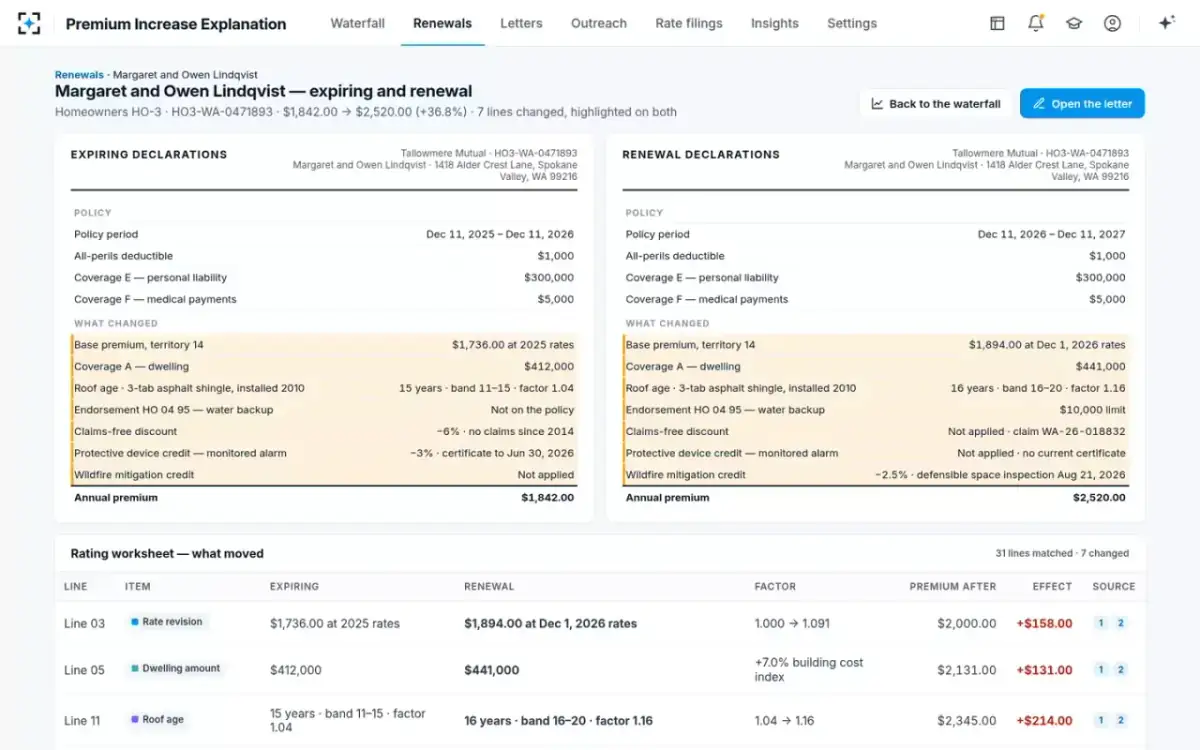
A worked attribution to the cent: the Lindqvists' $678
Here is the sample renewal split in the rating order, as the solution's change attributor does it. Each line is applied with every earlier change already in place; the premium after the last line is the renewal premium; each line's dollars, divided by the expiring premium, give its percentage points of the 36.8%.
One renewal, line by line in rating order, to the cent
| Line, in rating order | Change | Premium after | Dollars | Points of the 36.8% |
|---|---|---|---|---|
| Expiring premium | Starting point | $1,842.00 | — | — |
| Rate revision (line 03) | Factor 1.000 → 1.091 | $2,000.00 | +$158.00 | 8.6 |
| Dwelling amount (line 05) | $412,000 → $441,000 | $2,131.00 | +$131.00 | 7.1 |
| Roof age (line 11) | Band 11–15 → 16–20 | $2,345.00 | +$214.00 | 11.6 |
| Water backup endorsement | Added, $10,000 limit | $2,389.00 | +$44.00 | 2.4 |
| Claims-free discount | −6% → not applied | $2,506.00 | +$117.00 | 6.4 |
| Alarm credit | −3% → not applied | $2,564.00 | +$58.00 | 3.1 |
| Wildfire mitigation credit | Not applied → −2.5% | $2,520.00 | −$44.00 | −2.4 |
| Total, and left over | Seven lines | $2,520.00 | +$678.00 · $0.00 left | 36.8 |
Two details are easy to get wrong. The percentage points are each line's dollars over the expiring premium, not the change in each factor: the roof factor moved from 1.04 to 1.16, but the roof line is worth $214, or 11.6 points, because a factor's dollars depend on the premium it applies to in the rating algorithm, which the worksheet shows and the factor alone does not. And the credits must be in the calculation. Leave out the −$44 wildfire credit and the reasons add to $722, $44 more than the increase, which is exactly the kind of error a policyholder finds.
The worksheet’s “premium after” column is the calculator
Flat charges, minimums and rounding: where calculators drift
Three things make a factor-by-factor split fail to add up. Flat charges, such as a policy fee, do not move with a rate change; the CAS text gives the example of a flat premium that is 10% of the average and does not change, in which case “the base rate has to increase by 5.56% in order to achieve the 5.0% overall change” (Basic Ratemaking). A calculator that applies a rate change to the whole premium overstates it. Minimum premiums and caps clip the result, so a factor's effect can be zero even though the factor moved. And rounding at each line of a worksheet leaves pennies over.
The fix is to treat the leftover as a test, not a plug. The solution's change attributor never forces the reasons to add up; it reports the difference, and more than $1.00 left over holds the letter for a person to look at. A few cents of rounding is normal; a few dollars means a line is missing, a credit was left out, or the order is wrong.
Do regulators require dollars for each factor?
Not yet in Washington, and not explicitly in New York. Washington's rule, from March 1, 2027, requires the top primary factors on written request but says: “There is no requirement for these primary factors to be associated with a dollar amount or percentage of increase.” From January 2029, its model notice will have to show the change in the policyholder's renewal premium in dollars or as a percentage (WSR 26-15-007; the notice is built line by line in the Washington premium change notice template). New York requires the amount of the total increase and primary factors specific enough to understand, without prescribing dollars per factor.
Washington also anticipates calculators that are not exact. Its rule allows estimates on one condition:
“Insurers may include the use of estimated dollars in premium change transparency, if a reasonable explanation is provided by the insurers to the policyholders on the degree of accuracy estimated dollars achieve, as specifically applied to that policy and premium increase.”
WAC 284-30A-070(4), as amended by WSR 26-15-007
A split computed line by line from the worksheet, adding to the cent, is not an estimate and needs no such caveat. An estimate built from average factor effects, or a rule of thumb, does. The same rule says that an insurer that uses composite rating variables in its explanation “shall explain the premium increase attributed to the composite rating variables”, which means knowing how much of the increase they caused. Ranking the top three factors, which Washington needs from 2027, requires dollars even where showing them does not.
Renewal premium increase calculators: what to look for, and where Premium Increase Explanation fits
A renewal premium increase calculator for an insurer is worth having only if its split is reproducible, ties to the worksheet and adds up. Spreadsheet calculators can do the percentage; few can apply a carrier's rating algorithm in order to thousands of renewals a night and prove the result.
What to ask of any renewal premium increase calculator
- Does it use the rating plan’s order?
And record it, so the same renewal always gives the same split.
- Does every factor tie to a worksheet line?
Premium before, premium after, and the document behind the change.
- Does it add up, and what happens when it does not?
A leftover should hold the explanation, not be spread across the factors.
- Does it handle flat charges, minimums and caps?
A rate change applied to a flat fee overstates the rate’s share.
- Does it separate insured value added?
New York tests 10% without it; a letter should say which dollars are more cover.
- Can it rank the top three by dollars?
Washington asks for the top primary factors from March 2027.
- Is the result checked by a person before it goes out?
A calculation is a draft until someone answerable signs it.
The split as a waterfall: seven bars that add up to the cent
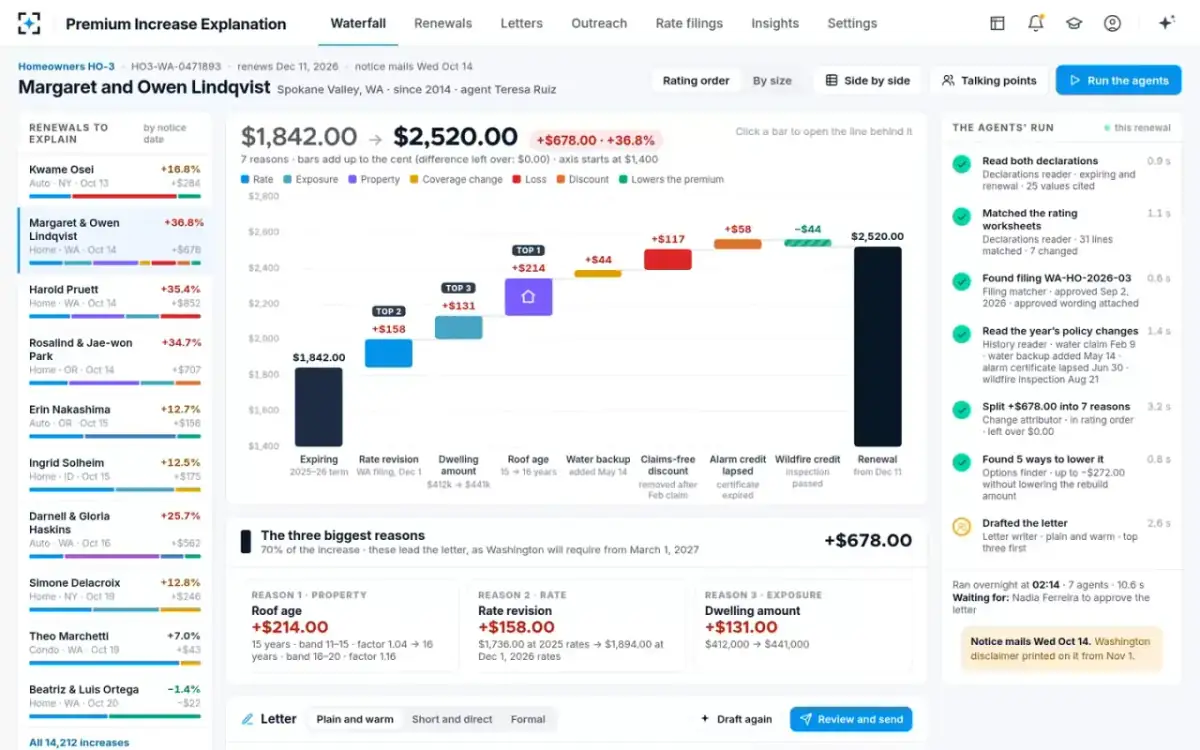
Premium Increase Explanation is that calculator built into the renewal process. It reads both rating worksheets, applies each changed line in the rating order with every earlier change applied, ties every reason to its line and its source document, separates added coverage from price, ranks the reasons by dollars, and holds any renewal whose reasons leave more than $1.00 over. It then drafts the letter from the split for a person to approve. It does not replace the rating engine; it reads the engine's output. To see how the split becomes a letter, read the premium increase explanation letter template; for why the rate's share matters, rate increase vs premium increase; and for the Washington dates, the Washington premium change notice template. To see the screens, start from Premium Increase Explanation.
Questions people ask
What is the formula for a premium increase percentage?
(Renewal premium − expiring premium) ÷ expiring premium × 100. A renewal of $2,520 against $1,842 is $678, or 36.8%. Use the same full-term basis for both premiums.
Why don't the factor percentages add up to the total increase?
Because factors multiply. A 10% rate rise, a 5% limit increase and a 20% surcharge produce a 38.6% increase, not 35%, because each applies to a premium the others have already changed. Splitting the increase in dollars, in a fixed order, makes the pieces add up exactly.
How do I calculate how much of my increase came from the rate change?
Rate the renewal policy at last year's rates and compare it with the renewal premium at this year's rates; the difference is the rate's effect on the policy as it now stands. Alternatively, apply the rate change first to last year's policy, which gives a slightly different figure. Ask the insurer which convention its explanation uses.
What is the premium calculation formula in insurance?
In general, a base rate for the base risk, multiplied or adjusted by a factor for each rating variable, with discounts, credits, flat charges and any minimum premium applied as the rating algorithm specifies. The algorithm is filed with the state alongside the rates, and the rating worksheet shows it applied to one policy.
Can I work out my own renewal increase factor by factor?
Only with the rating worksheet, which most policyholders do not receive. The declarations show what changed but not the dollars per change. In New York and Washington you can ask the insurer for a written explanation; ask for the reasons in dollars.
Is a premium increase calculator's estimate acceptable in a notice?
Washington allows estimated dollars if the insurer explains to the policyholder how accurate they are for that policy and increase. An exact split from the worksheet avoids the need for that explanation.